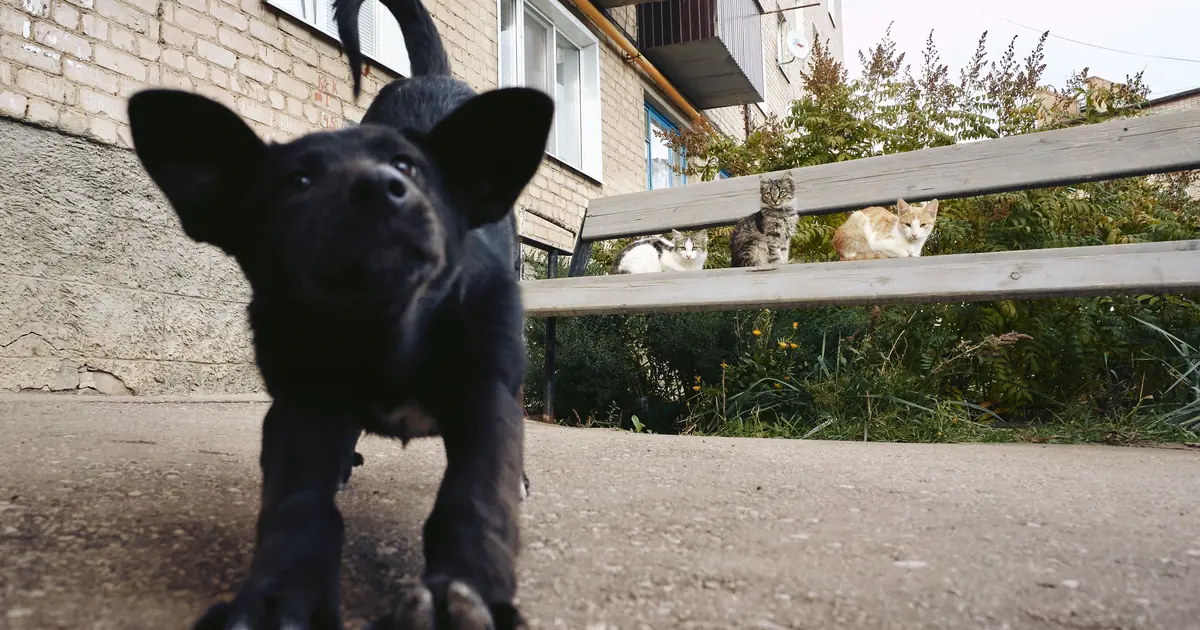
If you’ve ever watched your dog bound up to a new cat, tail going a mile a minute, only to get hissed at and swatted, you’ve seen the language barrier in action. The dog thought it was being friendly. The cat heard something closer to a threat.
Here’s the thing: cats and dogs aren’t speaking the same dialect of body language. But they’re not hopeless at understanding each other either. Given time, patience, and the right introduction, most cats and dogs figure out how to read one another, and plenty end up genuinely attached. Let’s talk about how that actually works.
- Cats and dogs can learn to communicate across species, but they don’t start out speaking the same body language.
- A wagging tail signals happiness in a dog and irritation or agitation in a cat.
- Cats and dogs raised together from a young age typically learn each other’s signals and can form lasting bonds.
- Slow, supervised introductions with scent swapping give cats and dogs the best chance of learning to read each other correctly.
- Warning signs of a mismatch include hissing, stiff bodies, chasing, and a cat with no way to retreat.
Can Cats and Dogs Really Communicate With Each Other?
Yes, cats and dogs can communicate, just not fluently at first. Each species evolved its own signaling system long before either one moved into our living rooms. A cat’s tail, ears, and posture mean something different than a dog’s do, so the two aren’t born understanding each other. What they can do, especially with exposure and time, is learn to associate certain signals with certain outcomes: a low growl means back off, a relaxed stretch means all clear.
Think of it less like two people speaking the same language and more like two people slowly picking up each other’s language through daily life together. It’s not instant, and it’s not perfect. But it’s real, and researchers who study interspecies behavior generally agree that cats and dogs living in the same home can and do develop working communication systems with one another.
Why Do Cats and Dogs Seem to Speak Different Languages?
Cats and dogs seem to speak different languages because the same body signal often means opposite things in each species. A wagging tail is the clearest example: in a dog, it usually means excitement or friendliness. In a cat, a wagging or thrashing tail usually means annoyance, overstimulation, or “I am about to swat you.”
A few more signals that flip meaning between the two:
- Rolling onto the back: A dog rolling over is often asking for a belly rub. A cat rolling over is more often a defensive posture, or just a stretch, not an invitation to touch its stomach (most cats do not actually enjoy belly rubs the way dogs do).
- Direct eye contact: Dogs often read a steady stare as a challenge or a request for guidance. Cats read a hard, unblinking stare as confrontational too, but a slow blink from a cat is actually a friendly signal, closer to a small kiss.
- Approaching quickly, head-on: A dog trotting straight at another animal is usually just being social. A cat sees a fast, direct approach as rude at best and threatening at worst. Cats prefer a slower, sideways approach.
None of this means the two species can’t get along. It just means a dog’s friendliest moves can look like an attack to a cat, and a cat’s protective moves can look like rejection to a dog, until they learn otherwise.
How Do Cats and Dogs Learn to Read Each Other?
Cats and dogs learn to read each other mainly through repeated, low-stress exposure over time. This is why pets introduced as kittens and puppies, or given a slow and careful introduction as adults, tend to communicate far more smoothly than two adult animals thrown together with no warning.
Over weeks and months of sharing a home, cats and dogs start picking up on patterns specific to their own housemate. A dog learns that this particular cat’s tail flick means “I’m done,” not “let’s play.” A cat learns that this particular dog’s play-bow means “want to chase me?” not “I’m hunting you.” They’re not learning a universal cat-to-dog dictionary. They’re learning each other, individually, the way any two housemates pick up on each other’s moods.
Shared routines help too. Eating near each other without conflict, sleeping in the same room, and being handled calmly by the same person all build a kind of mutual trust that makes the body language easier to read correctly.
What Are the Signs a Cat and Dog Are Getting Along?
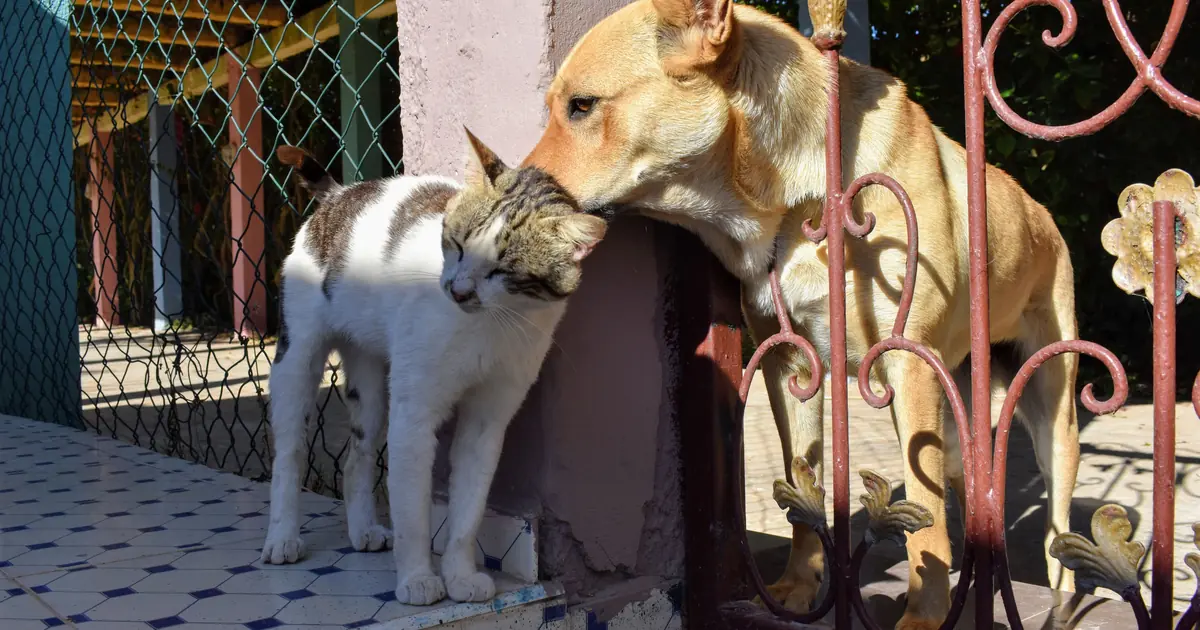
A cat and dog that are getting along show loose, relaxed body language around each other and choose to share space voluntarily. You’ll see a cat walk past a resting dog without a second glance, or a dog lie down calmly while the cat grooms nearby. That kind of casual indifference is actually a great sign. It means neither animal sees the other as a threat.
Signs of a good relationship usually include:
- Sleeping in the same room, or even touching each other, without tension
- Mutual grooming, or a cat rubbing against the dog
- Play that includes pauses, with both animals free to walk away
- A cat’s tail held loose and low, a dog’s body soft and wiggly rather than stiff
- Eating near each other calmly
On the flip side, conflict usually looks like hissing, a stiff and puffed-up cat, a dog fixated and staring hard at the cat, growling, chasing, or a cat that’s constantly hiding and avoiding the shared space. If you’re seeing those signs regularly, it’s worth slowing things back down and giving both animals separate space again before trying a calmer reintroduction. The ASPCA’s guide to introducing cats and dogs has good, practical steps for resetting a rocky start.
Do Cats and Dogs Form Real Friendships?
Yes, cats and dogs can form genuine, lasting bonds. It’s not just a cute internet trope. Pets raised together, or introduced well as adults, often end up grooming each other, sleeping curled up together, and clearly seeking each other out, not just tolerating each other’s presence. That’s meaningfully different from two animals that have simply learned to avoid conflict.
Not every cat and dog pair will get there, and that’s okay. Personality matters as much as species here. A laid-back senior cat and a calm, well-trained dog are far more likely to become close than a high-energy terrier and a nervous, easily startled cat. If your pets settle for peaceful coexistence rather than cuddle-buddy status, that’s still a win.
How Do You Introduce a Cat and Dog So They Communicate Well?
You introduce a cat and dog well by going slow, keeping early interactions controlled, and always giving the cat a way to escape. Rushing the process is the single biggest reason introductions go badly, since neither animal has had time to learn the other’s signals yet.
- Keep them separated at first. Give each animal its own space, with its own food, water, litter box, and bed, for at least several days.
- Swap scents before a face-to-face meeting. Let each animal sniff a blanket or towel that smells like the other. This helps them get used to a new presence without the pressure of a live meeting.
- Set up high, safe spaces for the cat. Cat trees, shelves, or the top of a couch give your cat an escape route and a way to observe the dog from a distance it controls.
- Keep the dog on a leash for the first meetings. This lets you interrupt any lunging or overexcited behavior before it scares the cat.
- Watch both animals’ body language closely. Stop the session at the first sign of stiffness, hissing, or hard staring, and try again later at a shorter, calmer distance.
- Keep sessions short and positive. A few calm minutes that end well beat a long session that ends in a chase.
- Never force interaction. Let the cat approach the dog on its own terms, not the other way around.
Cornell Feline Health Center’s guidance on introducing cats to other pets notes that a gradual, supervised introduction is consistently the biggest predictor of whether a cat and dog end up compatible housemates. There’s no shortcut that reliably beats patience here.
What Body Language Cues Should You Watch For?
The cues that matter most are tail position, ear position, body posture, and vocalizations, and you have to read them for each species separately since the same signal often means opposite things. A relaxed dog has a loose, wiggly body and soft eyes. A relaxed cat has a tail held low or gently curled, ears forward, and slow blinking eyes. Learning your own cat’s specific body language signals will make it much easier to catch early signs of stress around a new dog, before things escalate to hissing or swatting.
Here’s a quick side-by-side of signals that flip meaning between the two species:
| Signal | What It Means in a Dog | What It Means in a Cat |
|---|---|---|
| Wagging tail | Happy, excited, friendly | Agitated, overstimulated, or annoyed |
| Rolling onto back | Wants a belly rub, submissive | Defensive posture or a stretch, usually not an invitation to touch |
| Direct, hard stare | A challenge or a request for direction | A threat or confrontation |
| Purring or panting | Panting: normal cooling or excitement | Purring: usually contentment, but sometimes self-soothing during stress |
This is educational information, not a substitute for hands-on advice from a vet or a certified animal behaviorist. If your cat and dog show ongoing aggression, or your cat is hiding constantly and losing weight from stress, a vet or a qualified behavior consultant can help you build a safer reintroduction plan. Always introduce cats and dogs slowly, supervise early meetings, give the cat high escape routes, and never force an interaction between them.
Frequently Asked Questions
Q: Can cats and dogs actually understand each other?
Yes, to a real degree. Cats and dogs don’t start out understanding each other’s body language, since a wagging tail and other signals mean different things in each species. But with time and exposure, most cats and dogs learn to read their specific housemate’s cues correctly.
Q: Why does my dog’s tail wag confuse my cat?
A wagging tail means happy and excited in dogs, but in cats a wagging or thrashing tail usually signals irritation. Your cat may read your dog’s friendly tail wag as a warning sign, at least until they’ve spent enough time together to learn otherwise.
Q: Do cats and dogs get jealous of each other?
Cats and dogs can act possessive over food, toys, resting spots, or a shared owner’s attention, which can look like jealousy. This is more about resource guarding than true jealousy, and it usually improves once each pet has its own dedicated food, water, and resting areas.
Q: How long does it take for a cat and dog to get along?
Most cats and dogs need anywhere from a few weeks to a few months to become comfortable housemates, depending on their individual personalities and how gradual the introduction was. Kittens and puppies introduced young often adjust within days to a couple of weeks.
Q: What are signs my cat and dog will never get along?
Persistent stalking or chasing, a dog that won’t stop fixating on the cat even when corrected, or a cat that never stops hiding after weeks of gradual introduction are signs the pairing may need permanent management, like separate living areas, rather than full integration.
Q: Should I let my cat and dog sniff each other right away?
No, it’s better to swap scents using a blanket or towel before any face-to-face meeting. A cold introduction where they sniff each other directly on day one skips the step that helps both animals feel less threatened by a new presence.
Q: Can a cat’s purring calm down an anxious dog, or the other way around?
There’s no solid evidence that a cat’s purr calms a dog directly, since dogs don’t process purring as a soothing cue the way cats do. What does help an anxious pairing is a calm household routine and a slow introduction, which lowers stress for both animals over time.
Q: Do certain dog breeds communicate better with cats?
Breeds with lower prey drive and a calmer temperament, like Cavalier King Charles Spaniels or many retriever mixes, tend to have an easier time reading a cat’s signals correctly. Still, individual temperament and training matter more than breed alone, so a well-socialized dog of almost any breed can learn to communicate well with a cat.

Hello and welcome to The Ideal Cat!
We are some passionate cat owners from different professions. We love our cats and have a lot of experience in how to care for our pets. We are incredibly excited to share our knowledge, experience, and research with you. So you can take good care of your loving cat. We will answer most of the common questions about owning cats, taking care of them, etc. If you have any question contact with us. Thanks for visiting! Enjoy the content.
