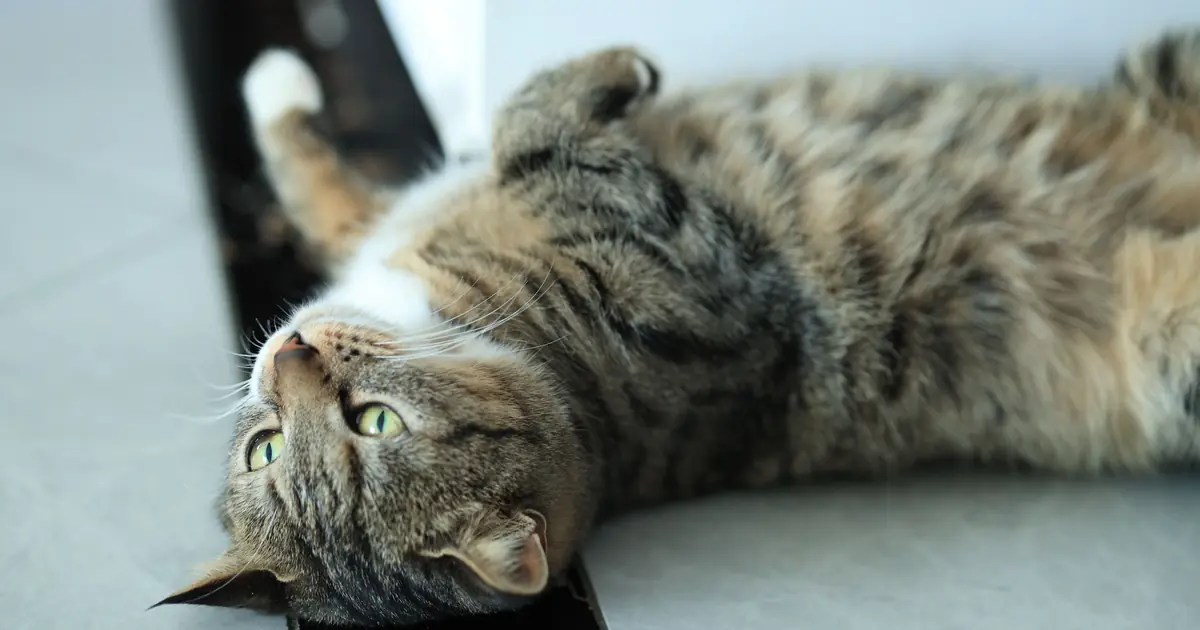
You know the scene. Your cat flops onto her back, paws in the air, belly on full display. It looks like the ultimate invitation. So you reach in for a rub, and in half a second you’ve got four paws wrapped around your wrist and a mouth clamped on your hand.
Welcome to the belly trap. Almost every cat parent falls for it at least once, and it’s not because your cat is being mean or confusing. She’s actually telling you something real, you’re just reading it wrong. Let’s get into why cats show their belly, why most of them hate having it touched anyway, and where to pet them instead so you both come out unscratched.
- Most cats do not enjoy belly rubs, and a belly-up pose is a trust signal, not a touch request.
- A cat’s belly protects vital organs like the heart, lungs, and intestines, so cats defend it by instinct.
- Reaching for a cat’s belly often triggers “bunny kicking,” where the back legs grab and rake at your arm.
- Cats generally prefer being petted around the base of the ears, cheeks, under the chin, and the base of the tail.
- A small number of cats do genuinely enjoy belly rubs, and you can usually tell from loose body language and no tail flicking.
Do Cats Like Belly Rubs?
No, most cats do not like belly rubs. The belly is one of the most vulnerable spots on a cat’s body, and touching it usually triggers a defensive reaction rather than a happy one. Your cat isn’t being dramatic. She’s protecting the same soft area that, in the wild, a predator would go for first.
That doesn’t mean every cat hates it. A small minority genuinely relax into belly rubs, especially cats who were handled a lot as kittens. But as a general rule, treat the exposed belly as a “look, don’t touch” situation. According to International Cat Care, the belly, legs, and paws sit near the bottom of most cats’ list of preferred petting spots.
Why Do Cats Show Their Belly If They Don’t Want It Rubbed?
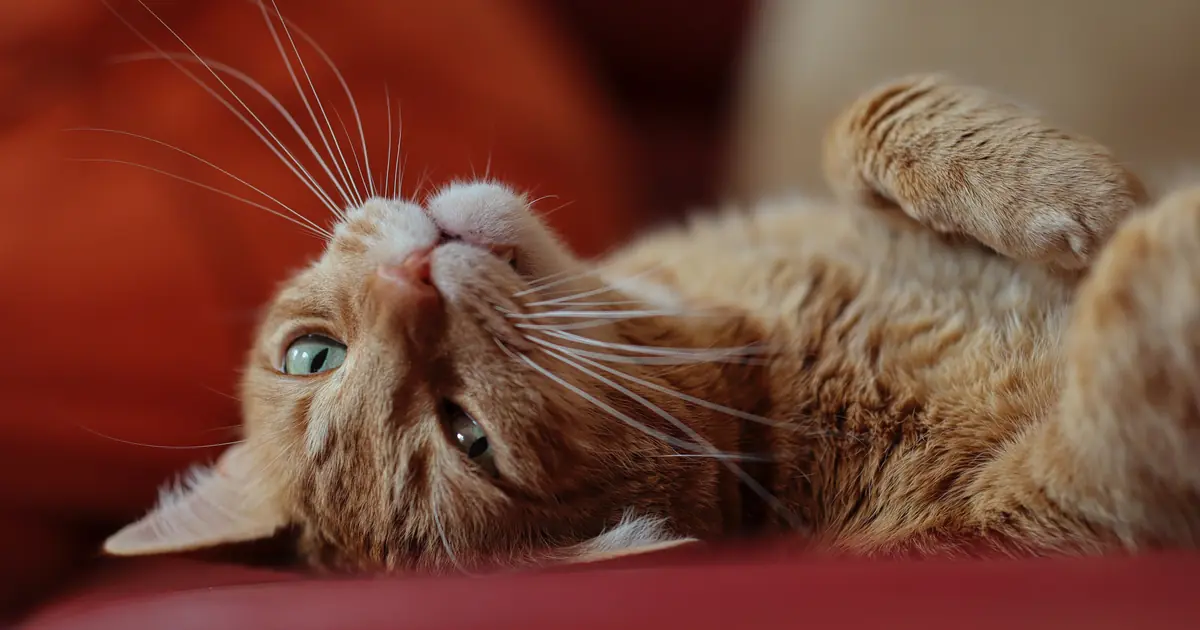
Cats expose their belly to show they feel safe, not to ask for a rub. Rolling onto the back and lying belly-up is a vulnerable position, so a cat only does it around people or animals she trusts. It’s closer to a compliment than an invitation.
Think of it as your cat saying “I feel comfortable enough here to let my guard down.” She’s not thinking about your hand at all. Once that hand actually moves toward her stomach, the calculation changes fast, and her instincts take over. You can learn more about what this pose and other postures mean in our guide to cat body language.
Why Is a Cat’s Belly So Sensitive?
A cat’s belly is sensitive because it has thin muscle coverage and sits right over the heart, lungs, liver, and intestines. There’s very little bone or padding protecting those organs, which is exactly why cats guard the area so fiercely, even with people they love.
This instinct goes back to how cats are built as both predator and prey. In a fight, a cat’s belly is its biggest weakness, so it curls to protect it and uses its back legs to fight off anything that gets too close. That’s the same reflex kicking in on your couch, it’s just aimed at your hand instead of a rival. The Cornell Feline Health Center notes that cats rely heavily on these instinctive defensive behaviors, even in a safe home environment.
How Can You Tell If Your Cat Actually Likes Belly Rubs?
You can tell your cat likes belly rubs if her body stays loose and relaxed the entire time, her tail stays still or gives slow, gentle swishes, and she leans into your hand instead of tensing up. If any of that shifts, stop right away.
Try a light, brief touch first instead of diving in with both hands. Watch her ears (forward, not pinned), her pupils (not suddenly huge), and her tail (not thumping or lashing). A cat who genuinely enjoys it will often stay flopped over and might even show her belly again a minute later. A cat who’s tolerating it will tense up, and one who hates it will grab your hand within a second or two. Every cat sets her own rules here, and it’s worth learning your own cat’s specific signals rather than assuming.
Where Do Cats Actually Like to Be Petted?
Cats generally prefer being petted around the base of their ears, their cheeks, under the chin, and around the base of the tail. These spots line up with where cats have scent glands, and rubbing there feels more like mutual grooming than a threat to their soft parts.
Here’s a quick breakdown of where to aim your hand, and where to leave alone unless you know your specific cat is the exception.
| Where cats usually like to be petted | Where to avoid (usually) |
|---|---|
| Base of the ears | Belly and chest |
| Cheeks and jawline | Paws and toes |
| Under the chin | Tail (especially the base if overstimulated) |
| Base of the tail (light touch) | Whisker pads and ears (inside) |
| Back, near the shoulders | Lower back, close to the tail, for long sessions |
If your cat rubs her cheek against your hand or headbutts you, that’s basically her showing you exactly where she wants attention. Our post on why cats headbutt you breaks down that behavior in more detail, and it pairs naturally with knowing where to pet.
What Is Petting-Induced Aggression, and How Do You Avoid It?
Petting-induced aggression happens when a cat suddenly bites or swats during a petting session that seemed fine seconds earlier. It’s not aggression in the angry sense, it’s overstimulation, and the belly is one of the fastest places to trigger it.
Repetitive touch on a sensitive area can build up sensory overload in a cat’s nervous system until she reaches a threshold and reacts fast, often with little warning beyond a tail flick or skin twitch. The VCA Animal Hospitals lists petting-induced aggression as one of the more common reasons cats bite people they otherwise trust. If your cat has bitten you mid-pet before, our guide on why cats bite when you pet them covers the warning signs step by step.
To avoid it, keep petting sessions short, stick to the preferred zones, and stop the moment you see a tail twitch, skin ripple, or ears flattening. Let your cat come back for more instead of chasing extra pets in. And skip the belly rub test altogether if you’ve been bitten there before. It’s not worth the blood draw.
Does Refusing Belly Rubs Mean My Cat Doesn’t Love Me?
No, refusing belly rubs does not mean your cat doesn’t love you. Plenty of deeply affectionate cats never let anyone near their stomach. Love, for a cat, shows up in other ways, following you room to room, slow blinks, kneading, sleeping near you, or head-bumping your hand.
If you’re second-guessing the whole relationship over one rejected belly rub, take a breath. Cats show affection on their own terms, and it rarely lines up with how dogs or people do it. For a fuller picture of the signs that actually count, check out how to tell if your cat loves you.
Frequently Asked Questions About Cats and Belly Rubs
Q: Why does my cat bite me when I rub her belly?
Your cat bites during belly rubs because the belly is a protective instinct zone, not a preferred petting spot. The touch feels threatening to her nervous system, so she reacts with a defensive bite or grab, often called a “bunny kick” once the back legs join in.
Q: Is it bad to rub a cat’s belly?
It’s not harmful, but it’s usually unwelcome. Most cats tense up, bite, or scratch when their belly is touched, so it can damage trust between you and your cat over time if you keep doing it after she’s told you to stop.
Q: Why does my cat show me her belly but not let me touch it?
A cat showing her belly is displaying trust and relaxation, not requesting touch. It’s a body language signal, similar to a stretch or a slow blink, and it means she feels safe enough with you to expose her most vulnerable spot, nothing more.
Q: Do any cats actually enjoy belly rubs?
Yes, a minority of cats genuinely enjoy belly rubs, often ones who were handled gently and often as kittens. You can tell by loose body language, a still or slow-swishing tail, and no biting or grabbing when you try a light touch.
Q: Where do cats like to be pet the most?
Cats most often prefer petting around the base of the ears, the cheeks, under the chin, and the base of the tail. These areas hold scent glands, so petting there feels similar to how cats groom and mark each other.
Q: How do I know if my cat is getting overstimulated during petting?
Watch for a twitching tail, rippling skin along the back, flattened ears, dilated pupils, or a sudden stillness before a bite. These are early warning signs of overstimulation, and stopping the moment you see them helps prevent a bite or scratch.
Q: Why is a cat’s belly so sensitive to touch?
A cat’s belly is sensitive because it sits directly over vital organs like the heart, lungs, and intestines, with very little muscle or bone protecting them. Cats guard this area by instinct, even indoors, because it’s their biggest physical weak point.
Q: Should I stop trying to pet my cat’s belly altogether?
If your cat has ever bitten or scratched you during a belly rub, it’s best to stop reaching for that spot. Stick to areas she actually enjoys, like her cheeks, chin, and the base of her ears, and let her show you if she ever wants the belly included.

Hello and welcome to The Ideal Cat!
We are some passionate cat owners from different professions. We love our cats and have a lot of experience in how to care for our pets. We are incredibly excited to share our knowledge, experience, and research with you. So you can take good care of your loving cat. We will answer most of the common questions about owning cats, taking care of them, etc. If you have any question contact with us. Thanks for visiting! Enjoy the content.
)