
You’re playing with your kitten, things get a little wild, and you end up with a thin red scratch across your hand. A few weeks later, the lymph node under your arm feels swollen and sore. Sound familiar?
That combo has a name: cat scratch disease. It’s a real infection people can catch from cats, and the name says exactly how it usually starts. The good news is that most cases are mild and get better on their own. But it helps to know what’s happening, who needs to be careful, and how to lower the risk in the first place.
This article is educational and isn’t a substitute for medical or veterinary care. If you’re worried about symptoms in yourself or your cat, talk to a doctor or vet.
- Cat scratch disease (CSD) is a human infection caused by the bacterium Bartonella henselae, not a disease of cats.
- People catch it from an infected cat’s scratch, bite, or a lick on an open wound, and kittens are the most common source.
- An estimated 30 to 40% of cats carry Bartonella henselae at some point, usually with no signs of illness at all.
- Fleas spread the bacteria between cats, so flea control is the single best way to protect both your cat and you.
- About 12,000 people in the US are diagnosed with cat scratch disease each year, most often children aged 5 to 9.
- Most cases clear up in 2 to 4 weeks, but people with weakened immune systems can get seriously ill and need a doctor.
What is cat scratch disease?
Cat scratch disease is a bacterial infection in people caused by Bartonella henselae. You catch it when an infected cat scratches, bites, or licks broken skin, and the bacteria get into your body. Despite the name, this is a human illness, not a sickness your cat is suffering from.
Doctors also call it cat scratch fever or bartonellosis. According to the CDC, most infected cats seem perfectly healthy and never show a single symptom, so a scratch from a happy, playful cat can still pass it along. The infection is common but usually mild, and in healthy people it often resolves without any treatment at all.
What are the symptoms of cat scratch disease in humans?
The classic signs of cat scratch disease are a small bump at the scratch site followed by swollen, tender lymph nodes near it. The bump (a papule or blister) usually shows up 3 to 10 days after the scratch. Then, 1 to 3 weeks later, the nearby lymph nodes swell and get sore, often in the armpit, neck, or groin.
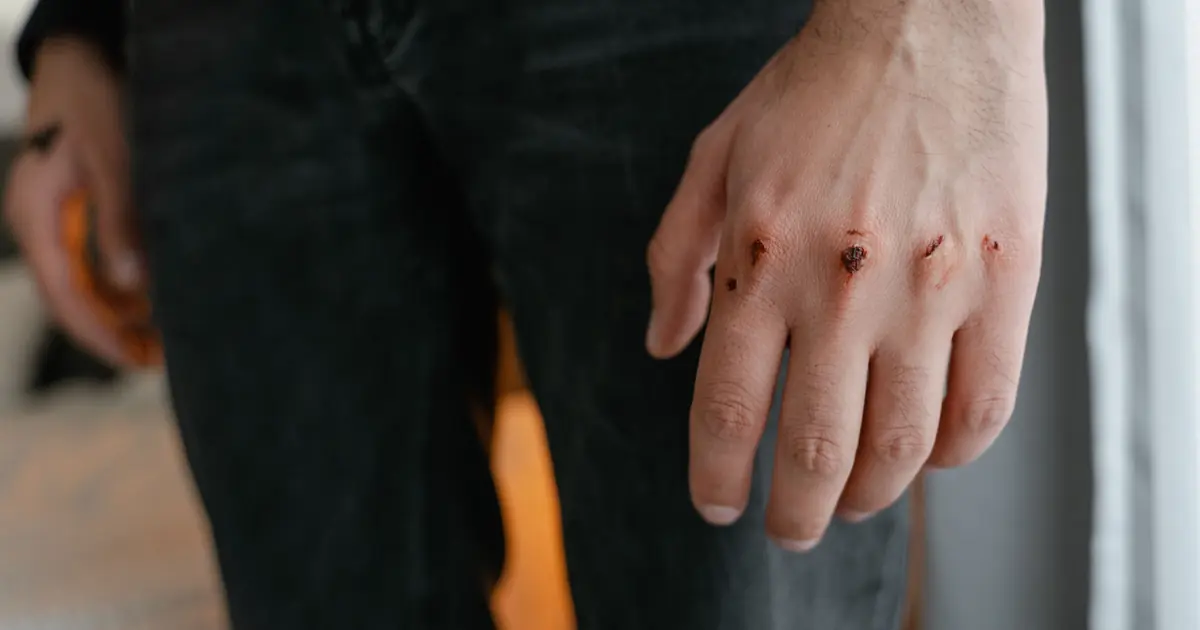
Alongside the swollen glands, many people feel run-down. Common symptoms include:
- A raised bump, blister, or small sore where the scratch or bite happened
- Swollen, painful lymph nodes near the scratch (the biggest tell-tale sign)
- Low-grade fever, usually under 102°F
- Tiredness, headache, and a general “off” feeling
- Body aches or a reduced appetite
The swollen lymph nodes are the hallmark. They can stay enlarged for two to four weeks, sometimes longer, even after everything else feels back to normal. Most people never need more than rest and time.
When cat scratch disease gets serious
In a small number of cases, cat scratch disease can move beyond swollen glands and affect the eyes, brain, liver, spleen, bones, or heart valves. This is uncommon in healthy people but more likely in those with weakened immune systems. The MSD Vet Manual notes that these disseminated forms need prompt medical treatment, so don’t wait them out.
How do you get cat scratch disease?
You get cat scratch disease when Bartonella henselae from an infected cat enters your body through broken skin. That usually happens one of three ways: a scratch, a bite, or a lick over an open cut or scrape. The bacteria often live in a cat’s saliva and under its claws, especially after the cat has groomed itself.
Here’s where fleas come in. Cats pick up Bartonella from infected flea droppings, then carry the bacteria on their claws and in their mouth. So the chain usually runs flea to cat to person. You can’t catch it directly from a flea bite, and it doesn’t spread from person to person.
| Route | How it spreads | Risk level |
|---|---|---|
| Cat scratch | Bacteria under the claws break the skin | Most common cause |
| Cat bite | Bacteria in saliva enter through the puncture | Common |
| Lick on broken skin | Saliva touches an open cut, scrape, or wound | Possible |
| Flea to cat | Cats get infected from flea feces, then pass it to people | The source of most cat infections |
| Flea bite to person | Fleas do not directly infect humans with CSD | Not a route |
| Person to person | Cat scratch disease does not spread between people | Not a route |
Kittens under a year old are the most likely to be carrying the bacteria and the most likely to scratch and bite during play. If your home has fleas, tackling them fast matters. Our guide on how to get rid of cat fleas walks through it step by step, and knowing what a flea bite looks like on a cat helps you catch an infestation early.
How common is cat scratch disease?
Cat scratch disease is fairly common but rarely dangerous for healthy people. About 12,000 people in the United States are diagnosed each year, and roughly 500 are sick enough to need hospital care, according to CDC research. Children aged 5 to 9 are affected most often, likely because they play closely with kittens.
On the cat side, the bacteria are widespread. An estimated 30 to 40% of cats carry Bartonella henselae at some point in their lives, and kittens are more likely to carry it than adults. The reassuring part: carrying the bacteria and passing it to a person are two different things, and most scratches never lead to infection.
Does my cat seem sick if it carries the bacteria?
No, most cats that carry Bartonella henselae look and act completely healthy. They eat, play, and purr like normal, and they usually clear the bacteria on their own over time. Some cats run a mild, brief fever when first infected, but many owners never notice a thing.
Because the bacteria rarely make cats sick, vets generally don’t test or treat a healthy cat for Bartonella. The Cornell Feline Health Center points to flea control and gentle handling as the real priorities. If your cat is battling fleas or worms, staying on top of a solid cat parasite treatment plan protects your whole household.
How is cat scratch disease treated?
Most cases of cat scratch disease need no treatment and clear up on their own within 2 to 4 weeks. For healthy people, doctors often recommend rest, over-the-counter pain relief, and warm compresses for sore lymph nodes while the body handles the rest.
When treatment is needed, doctors may prescribe antibiotics to speed up recovery or shrink stubborn swollen glands. Antibiotics are strongly recommended for anyone with a weakened immune system or a more serious infection. Only a doctor should decide if and which antibiotic is right, so don’t try to self-treat.
See a doctor if you notice any of these red flags:
- A fever that lasts more than a few days, or keeps climbing
- Lymph nodes that swell for weeks, become very painful, or ooze
- Vision changes, eye redness, or eye pain
- Severe headache, confusion, or a stiff neck
- Any symptoms at all if you’re pregnant, immunocompromised, or on chemotherapy
- A cat bite that looks infected (spreading redness, warmth, pus)
How can I prevent cat scratch disease?
You can prevent most cat scratch disease with flea control, gentle handling, and quick wound care. You don’t need to rehome a cat or panic over every scratch. A few steady habits do almost all the work.
- Keep your cat on flea prevention year-round. Fleas are how cats get the bacteria in the first place, so this is the top step. Our roundup of the best cat flea treatments can help you choose.
- Wash any scratch or bite right away. Use soap and running water for a good rinse. This simple step lowers the risk a lot.
- Don’t let your cat lick open cuts or wounds. As sweet as it is, a lick on broken skin is a real route in.
- Play gently and skip the rough hand games. Use wand toys instead of fingers so play doesn’t turn into scratches and bites.
- Keep your cat’s nails trimmed. Shorter claws mean shallower, less-likely-to-break-skin scratches.
- Wash your hands after handling cats, especially kittens and stray or feral cats, which carry the bacteria more often.
If you or someone in your home has a weakened immune system, the CDC suggests choosing a calm adult cat over a kitten and being extra careful with flea control and scratches. Adopting sensibly and keeping cats indoors both cut the risk further.
Cat scratch disease FAQ
Q: How long does cat scratch disease last?
Cat scratch disease usually lasts 2 to 4 weeks in healthy people, though swollen lymph nodes can linger for a couple of months. Most cases clear on their own without antibiotics. See a doctor if symptoms are severe or you have a weakened immune system.
Q: What is the incubation period for cat scratch disease?
A small bump usually appears at the scratch site 3 to 10 days after exposure. Swollen, tender lymph nodes then develop 1 to 3 weeks after the scratch or bite. So the full picture can take a few weeks to show up.
Q: Can you get cat scratch disease from a scratch that didn’t break the skin?
It’s unlikely. Cat scratch disease needs the bacteria to enter through broken skin, so a scratch, bite, or a lick over an open cut is the usual way in. Washing any scratch with soap and water right away lowers the risk further.
Q: Should I get rid of my cat if I have cat scratch disease?
No. The CDC does not recommend giving up or testing a healthy cat. Focus instead on year-round flea control, gentle play, keeping nails trimmed, and washing any scratches quickly. These steps protect you without losing your cat.
Q: How do I know if my cat carries Bartonella?
You usually can’t tell, because most infected cats look and act completely healthy. An estimated 30 to 40% of cats carry the bacteria at some point, especially kittens. Vets generally don’t test healthy cats, since flea control and safe handling matter more than testing.
Q: Is cat scratch disease dangerous?
For most healthy people, cat scratch disease is mild and resolves on its own. It can be serious for young children, pregnant people, and anyone with a weakened immune system, sometimes affecting the eyes, brain, or heart. Those groups should see a doctor promptly if symptoms appear.
Q: Can indoor cats give you cat scratch disease?
Yes, but the risk is lower. Indoor cats can still carry Bartonella henselae if fleas ever reach them or if they were infected as kittens. Consistent flea prevention keeps that risk small, even for cats that never go outside.
Q: Do I need antibiotics for cat scratch disease?
Usually not. Healthy people typically recover in 2 to 4 weeks without antibiotics. Doctors may prescribe them to speed recovery or for people who are immunocompromised or have a serious infection. Always let a doctor decide, and never self-medicate.
Bottom line: cat scratch disease is common, usually mild, and largely preventable. Keep your cat flea-free, play gently, wash scratches right away, and watch for swollen glands after a scratch. Your cat isn’t a health hazard, and with a few simple habits, you both get to enjoy the cuddles worry-free.

Hello and welcome to The Ideal Cat!
We are some passionate cat owners from different professions. We love our cats and have a lot of experience in how to care for our pets. We are incredibly excited to share our knowledge, experience, and research with you. So you can take good care of your loving cat. We will answer most of the common questions about owning cats, taking care of them, etc. If you have any question contact with us. Thanks for visiting! Enjoy the content.
