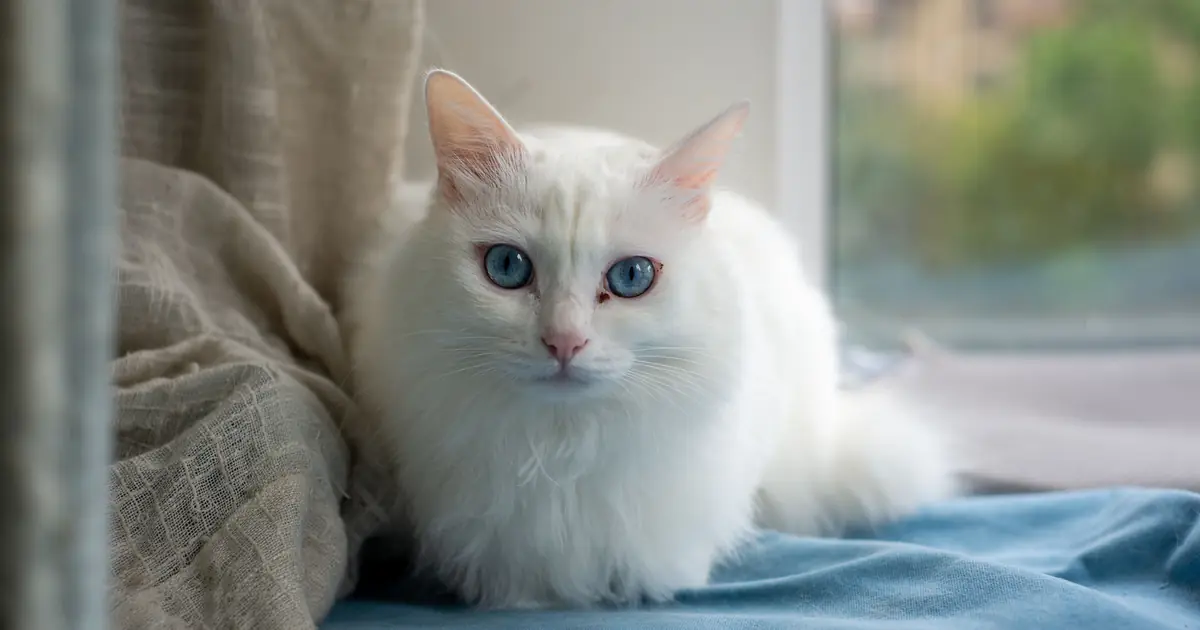
There’s something about a snow-white cat that stops people in their tracks. Maybe it’s the striking look against a pair of blue or gold eyes, or just how rare that pure white coat feels next to a room full of tabbies and tuxedos. But if you’re thinking about bringing one home (or you already share your couch with one), you’ve probably wondered whether all that white comes with a catch.
It sort of does, but not in the way you might fear. White cats aren’t fragile or chronically sick. They just carry a couple of specific, well-documented risks tied directly to their coat color: hearing loss and sun-related skin damage. Once you know what to watch for, both are manageable. Let’s get into exactly what’s going on and how to keep a white cat happy and healthy for years.
- White cats are not inherently unhealthy; their main health risks are congenital deafness and sun-related skin damage, both linked directly to their coat color genetics.
- About 65 to 85 percent of white cats with two blue eyes are born deaf, according to commonly cited figures from feline genetics research.
- White cats sunburn easily, especially on the thin-furred skin of the ears and nose, which raises their risk of squamous cell carcinoma over time.
- Odd-eyed white cats (one blue eye, one non-blue eye) are usually deaf only in the ear on the blue-eyed side of the head.
- Deaf cats can live full, happy lives indoors with a few handling adjustments, like using visual cues and keeping them away from outdoor hazards they can’t hear coming.
Do white cats have health problems?
White cats mostly have the same health as any other cat, but they carry two specific risks that come straight from their coat color: a higher chance of congenital deafness and a higher chance of sunburn and skin cancer. Neither one means a white cat is doomed to a hard life. It just means their owners need to pay attention to a couple of things that owners of, say, an orange tabby, don’t usually have to think about.
Both risks trace back to the same genetic root: the dominant white gene, often labeled the W gene, that gives a cat its all-white coat. This gene doesn’t just switch off pigment. It can also interfere with the development of the inner ear, which is why deafness shows up so much more often in white cats than in the general cat population. Outside of these two issues, white cats aren’t more prone to heart disease, kidney problems, or any other major feline illness just because of their color.
Why are white cats more likely to be deaf?
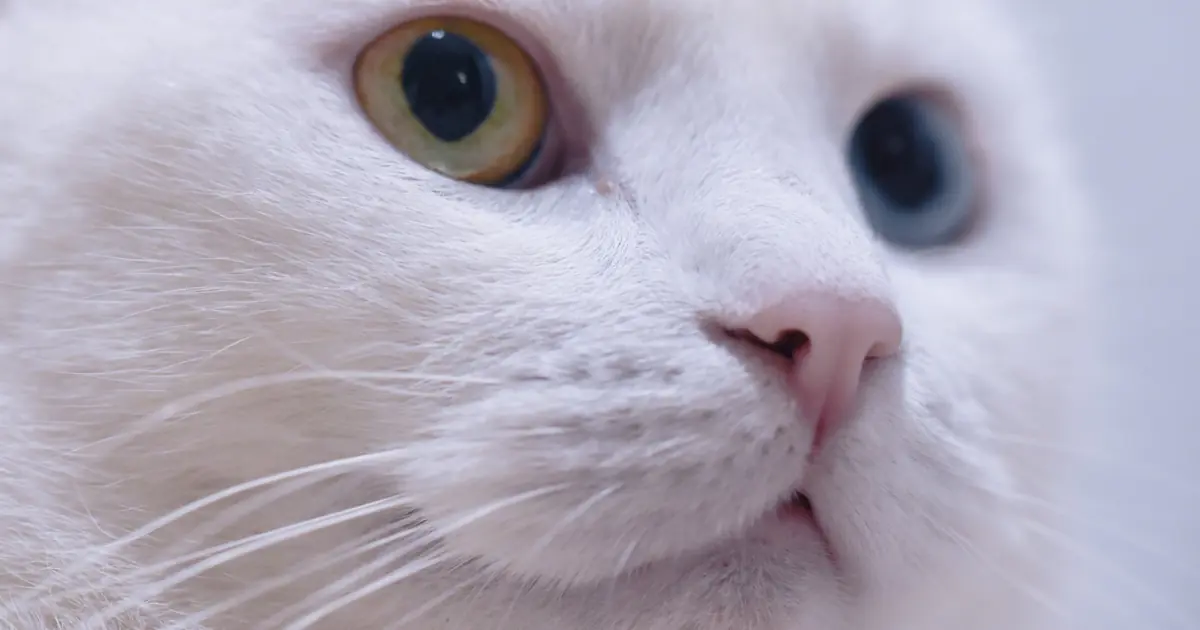
White cats are more likely to be deaf because the same gene that produces a solid white coat can also disrupt the nerve cells inside the inner ear before a kitten is even born. This is called congenital deafness, meaning it’s present from birth rather than something that develops later in life. The connection is strongest in white cats with blue eyes.
According to figures widely cited in feline genetics research, about 65 to 85 percent of white cats with two blue eyes are deaf. The risk drops for white cats with gold, green, or copper eyes, and it sits somewhere in between for odd-eyed cats. If you want the full breakdown of how the white gene works and why blue eyes are part of the picture, our guide on how rare white cats really are covers the genetics in more depth.
An odd-eyed white cat, one with one blue eye and one non-blue eye, usually isn’t deaf in both ears. Most of the time, deafness affects only the ear on the same side of the head as the blue eye. So a cat with a blue left eye and a green right eye is likely to be deaf in the left ear and hearing in the right. It’s a strange but well-documented pattern, and it’s a good reminder that “deaf” doesn’t always mean “deaf in both ears.”
How can you tell if your white cat is deaf?
You can usually tell a cat is deaf by watching how it reacts, or doesn’t react, to sound. A deaf cat won’t startle at a slammed door, won’t come running for a can opener, and won’t wake up when you call its name from another room. Kittens are often tested with simple sound checks, like clapping or crinkling paper out of their line of sight, to see if they turn toward the noise.
A few other signs to watch for:
- The cat sleeps through loud noises that would wake other pets in the house
- It meows unusually loudly, since it can’t hear its own voice to moderate it
- It startles easily when touched or approached from behind, because it didn’t hear you coming
- It doesn’t respond to squeaky toys or the sound of a treat bag
If you suspect deafness, a veterinarian can confirm it with a test called BAER (brainstem auditory evoked response), which measures the brain’s electrical response to sound. It’s the gold-standard way to know for sure whether one or both ears are affected.
Can a deaf white cat live a normal, happy life?
Yes, a deaf white cat can absolutely live a full, happy, and safe life. Deaf cats adapt fast. They lean more heavily on their eyesight, whisker sensitivity, and vibrations they can feel through the floor, and most owners say daily life barely looks different once everyone adjusts.
A few adjustments make it easier for everyone:
- Keep a deaf cat indoors only. They can’t hear approaching cars, dogs, or other dangers, which makes outdoor life genuinely risky.
- Use visual cues, like a flashlight flicker or a stomp on the floor they can feel, instead of calling their name.
- Approach slowly and let them see you coming before you touch them, so you don’t startle them awake or mid-nap.
- Consider a bell on other pets in the house so a deaf cat gets a little extra warning that something’s nearby (they’ll feel the vibration more than hear the sound, but it still helps in a multi-pet home).
According to the International Cat Care, deaf cats generally cope extremely well as long as they’re kept safely indoors and their owners understand how they communicate.
Why do white cats sunburn so easily, and can it lead to skin cancer?
White cats sunburn easily because their skin has little to no pigment to absorb and deflect UV rays, and the fur on their ears and nose is often too thin to offer much shade. Over time, repeated sun exposure can damage skin cells enough to cause squamous cell carcinoma (SCC), a type of skin cancer that shows up most often on the tips of the ears, the eyelids, and the nose of white and light-colored cats.
This isn’t rare. Cats with white or light-colored ears that spend a lot of time in the sun, especially outdoor and indoor-outdoor cats, are considered a recognized risk group for SCC. The Merck Veterinary Manual lists sun exposure on unpigmented skin as a known risk factor for this type of tumor in cats.
Here’s what tends to happen in stages: sunburned skin looks pink or reddened at first, then can crust, flake, or look scabby with repeated exposure. Left unchecked over months or years, that damaged skin can develop into a persistent sore or growth that doesn’t heal, which is the point where it needs a vet’s attention, fast.
How do you protect a white cat from sun damage?
You protect a white cat from sun damage mainly by limiting midday sun exposure and covering or shading vulnerable skin. Cats love a good sunbeam (if you’ve ever wondered why cats like to sunbathe so much, warmth and vitamin D are a big part of it), but for a white cat, that habit needs a little supervision.
- Keep your white cat indoors, or limit outdoor time, during peak UV hours, roughly 10am to 4pm.
- Provide shaded resting spots near windows so they can still enjoy the sun without direct, prolonged exposure through unfiltered glass.
- Ask your vet about a pet-safe sunscreen for the ears and nose if your cat does spend time outdoors. Never use human sunscreen, since some ingredients are unsafe for cats.
- Check the ears and nose regularly for redness, crusting, or sores, especially in summer months.
- Book a vet visit right away if you spot a sore that scabs over, bleeds, or doesn’t heal within a couple of weeks.
Do white cats have eye problems too?
Some white cats, particularly those with blue eyes, are more prone to eye-related sensitivity, but white cats don’t generally have more eye disease than other cats. It’s worth clearing up one common mix-up here: a solid white coat is usually caused by the dominant white (W) gene, not albinism. True albino cats exist but are extremely rare, and they lack pigment in their eyes as well as their skin, which is a different genetic story. Most white cats have normal, healthy blue, green, gold, or odd-colored eyes with typical pigment in the iris. If you’re curious about the full range of eye colors cats can have and what causes them, that’s covered in our guide to cat eye colors.
Is being a white cat itself a disease?
No, being white is not a disease. It’s simply a coat color caused by the dominant white gene, the same way orange, black, or tabby patterns come from other genes. A white cat isn’t born sicker or weaker because of its color. The color itself just happens to sit close, genetically, to a couple of traits (inner ear development and skin pigment) that can carry extra risk. Plenty of white cats live long, healthy lives with zero hearing loss and zero skin issues.
| Health Risk | Who’s Most Affected | How to Help Prevent or Manage It |
|---|---|---|
| Congenital deafness | White cats with blue eyes (highest risk); odd-eyed white cats (partial risk, usually one ear) | Can’t be prevented since it’s present from birth; manage with indoor living, visual cues, and gentle handling |
| Sunburn | Any white or pale-skinned cat, especially on ears and nose | Limit midday sun, provide shade, use vet-approved pet sunscreen on exposed skin |
| Skin cancer (squamous cell carcinoma) | White cats with repeated, long-term sun exposure on ears, nose, or eyelids | Sun protection over time, plus regular checks and prompt vet visits for sores that don’t heal |
How do you take care of a white cat’s specific needs day to day?
Taking care of a white cat mostly comes down to two habits: protecting their skin from the sun and adjusting how you interact with them if they’re deaf. Neither one is complicated once it’s part of your routine.
- Do a quick skin check on the ears and nose every week or two, especially in summer, feeling for scabs, crusting, or new bumps.
- Keep sun exposure moderate and shaded rather than cutting it out completely; cats still need some natural light and warmth.
- If your cat is deaf, keep it as an indoor-only cat and stick to visual or vibration-based cues instead of calling out.
- Schedule regular vet checkups, and mention that your cat is white so your vet knows to keep an eye on ear and nose skin during the exam.
- Get a hearing test done early if you have a blue-eyed white kitten, so you know from the start whether you’re working with a hearing cat or a deaf one.
According to the Cornell Feline Health Center, routine wellness exams are one of the best ways to catch skin changes and other emerging issues early, before they become harder to treat.
When should you take a white cat to the vet?
You should take a white cat to the vet if you notice a sore, scab, or growth on the ears or nose that hasn’t healed within a couple of weeks, or if you suspect your cat can’t hear. Both situations are worth checking sooner rather than later.
Red flags to watch for:
- A scab, sore, or crusty patch on the ear tips or nose that keeps coming back or won’t heal
- Any new lump, discoloration, or thickened skin on light-furred areas
- No reaction to loud noises, calling their name, or a can opener (possible deafness)
- Excessive scratching or rubbing at the ears or nose
- A newly adopted white kitten who hasn’t had a hearing check yet
A quick note on health advice: this article is meant to help you understand common white-cat health topics, not to replace a real exam. Non-healing sores on the ears or nose can be early signs of skin cancer and need a veterinarian’s evaluation, not a wait-and-see approach. Blue-eyed white cats should be checked for deafness, ideally as kittens, so you know what you’re working with. And regardless of hearing status, keep white cats out of intense midday sun to protect that unpigmented skin. When in doubt, a vet visit costs a lot less worry than guessing.
Frequently Asked Questions
Q: Are all white cats deaf?
No. Most white cats can hear just fine. Deafness risk is highest in white cats with two blue eyes, where studies commonly cite a rate of about 65 to 85 percent. White cats with gold or green eyes have a much lower risk.
Q: Why do white cats get skin cancer more often?
White cats lack the pigment that protects skin from UV rays, so their skin is more vulnerable to sun damage. Over years of sun exposure, that damage can develop into squamous cell carcinoma, most often on the ears, nose, and eyelids.
Q: Is a white cat with blue eyes always deaf in both ears?
No. A white cat with two blue eyes has the highest deafness risk and can be deaf in both ears, but an odd-eyed white cat (one blue eye, one different color) is usually only deaf in the ear on the same side as the blue eye.
Q: Can you test if a white kitten is deaf?
Yes. A veterinarian can run a BAER test (brainstem auditory evoked response), which measures the brain’s electrical activity in response to sound and confirms whether one or both ears can hear.
Q: Do white cats need sunscreen?
White cats that spend time outdoors, especially with thin fur on the ears and nose, can benefit from a vet-approved pet sunscreen on those areas. Never use human sunscreen on a cat, since some ingredients are toxic to them.
Q: Is white fur caused by albinism?
Usually not. Most white cats get their coat from the dominant white (W) gene, which is different from albinism. True albino cats are extremely rare and lack pigment in their eyes as well as their fur.
Q: Can a deaf white cat live a normal life?
Yes. Deaf cats adapt well and can live full, happy lives, especially when kept indoors and given visual or vibration-based cues instead of verbal ones. Many owners say it barely changes daily life once everyone adjusts.
Q: What are the first signs of sun damage on a white cat’s ears?
Early signs include pink or reddened skin, followed by crusting, scabbing, or flaking on the ear tips or nose after sun exposure. Any sore that doesn’t heal within a couple of weeks should be checked by a vet.

Hello and welcome to The Ideal Cat!
We are some passionate cat owners from different professions. We love our cats and have a lot of experience in how to care for our pets. We are incredibly excited to share our knowledge, experience, and research with you. So you can take good care of your loving cat. We will answer most of the common questions about owning cats, taking care of them, etc. If you have any question contact with us. Thanks for visiting! Enjoy the content.
