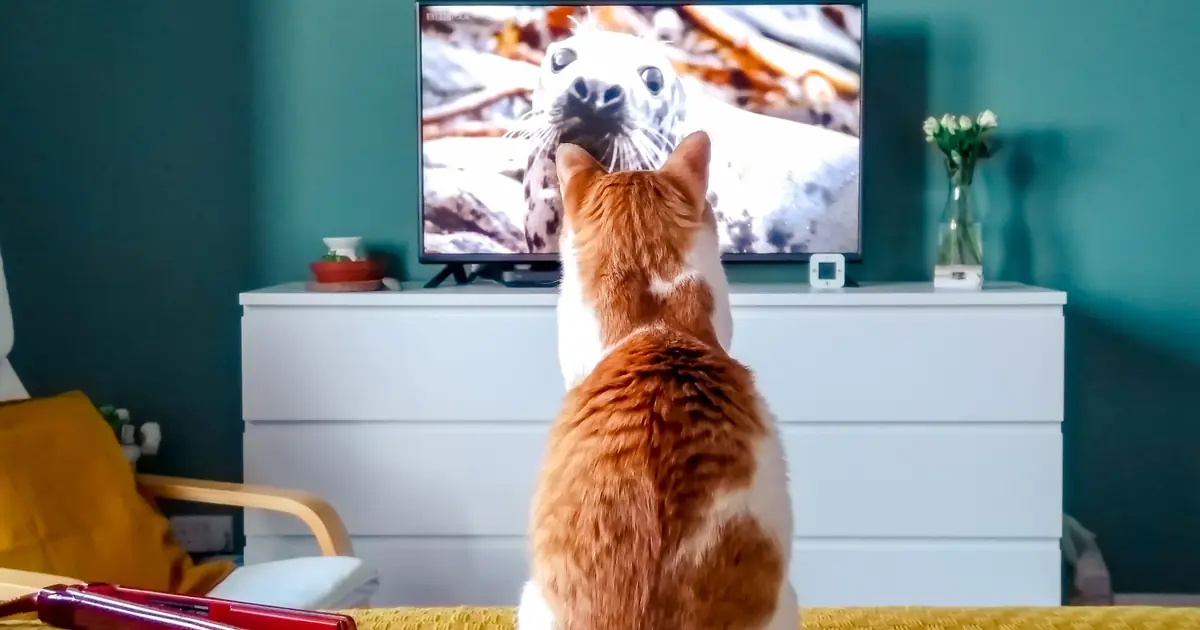
If you’ve ever watched your cat lock onto a bird video, tail twitching, butt wiggling, ready to launch at the screen, you’ve seen cat TV work its magic. It’s adorable. But it also makes you wonder: is cat TV actually good for your cat, or is it just cute chaos? Here’s the honest answer, plus how to use it the right way.
- Cat TV is screen content made for cats, usually footage of birds, fish, rodents, or bugs that triggers a cat’s natural hunting drive.
- Cat TV works best for understimulated indoor cats and is a supplement to play, not a substitute for interactive hunting games.
- Most behavior experts suggest limiting cat TV to roughly 10 to 30 minutes per session, once or twice a day, to avoid overstimulation.
- Some cats ignore the screen entirely, and others get frustrated swatting at prey they can never catch, so cat TV is not right for every cat.
- Always end a cat TV session with a real toy your cat can catch, which lets the hunt feel finished and prevents built-up frustration.
Is cat TV good for cats? Here’s the honest answer
Cat TV is good for many cats when used in moderation, especially bored indoor cats who need more mental stimulation. Watching prey-like movement on screen activates a cat’s hunting instinct and gives the brain something to do. The catch is simple: cat TV is enrichment, not a replacement for the real play and outlets your cat needs every day.
Think of cat TV like a window into a world your indoor cat rarely visits. Outdoor cats stalk birds, chase leaves, and patrol territory. Indoor cats often have none of that, and boredom can show up as overgrooming, scratching furniture, or pestering you at 3am. A few minutes of bird footage can scratch that mental itch.
Hill’s Pet describes screen time as supplemental enrichment for indoor cats, and many shelters and behavior pros use prey-style videos to lower stress in cats who can’t get outside. So the science-backed takeaway is encouraging: cat TV can genuinely help, as long as you use it as one piece of a bigger enrichment picture.
What is cat TV and what’s actually on it?
Cat TV is video content designed to grab a cat’s attention, usually showing close-up footage of birds at a feeder, fish swimming, squirrels, mice, or crawling bugs. The goal is to mimic the movement of prey so your cat’s hunting brain switches on. You’ll find hours of it free on YouTube and on streaming apps made just for cats.
The footage that works best tends to share a few traits. Small animals move quickly across a natural background, the camera stays fairly still, and there are real sounds like chirps and rustling. Cats respond to movement and sound far more than to story or color, so a calm shot of finches hopping around a feeder often beats a flashy cartoon.
Not every cat cares, and that’s normal. Some cats are glued to the screen, some watch lazily from the couch, and some completely ignore it. A cat’s interest usually depends on personality, age, and how strong that prey drive is.
Why do cats watch TV in the first place?
Cats watch TV because their eyes and brains are wired to track fast, small movement, the same skill they’d use to hunt. When a bird darts across the screen, your cat’s predatory instinct reads it as potential prey, even though part of them knows it isn’t real. Movement, not the plot, is the whole draw.
Here’s the thing about how cats see a screen. Cats have what’s often called dichromatic vision, meaning they see blues and yellows well but struggle with reds and greens. So the vivid colors that pop for you look muted to your cat. What grabs them is motion.
Cats are also sensitive to flicker, sometimes catching flicker that humans miss. On old tube TVs, a cat might have seen an annoying flicker where we saw smooth motion. On modern high-refresh LED and LCD screens, the picture looks much smoother to feline eyes, which is one reason cat TV is more engaging now than it was years ago.
Is cat TV good for cats of every age and type?
Cat TV is good for cats of many ages and types, but it shines most for indoor cats who need mental stimulation that fights boredom and stress. Indoor cats often lack the sights, sounds, and movement they’d find outside, and prey-style videos help fill that gap. A mentally engaged cat is usually a calmer, better-behaved cat.
Cat TV can be especially helpful for specific cats and moments:
- Bored, under-stimulated indoor cats who need more to do during long days alone.
- Cats recovering from illness or surgery who can’t run and jump but still need mental activity.
- Senior cats who enjoy low-effort watching from a cozy spot.
- Shy or stressed cats in shelters or new homes, where calm prey footage can ease tension.
- Cats home alone for stretches of the day who benefit from light background stimulation.
The good news is that this kind of low-pressure enrichment costs almost nothing and is easy to try. If your cat enjoys it, you’ve added a simple new outlet to their day.
Can cat TV be bad for cats? The risks to know
Cat TV can be bad for some cats when it leads to frustration, overstimulation, or an injured pet or screen. The biggest concern is the frustration that builds when a cat gears up to hunt but can never make the catch: your cat lunges and hits glass instead of prey. Repeated again and again, that unfinished hunt can build stress instead of relieving it, the same effect seen with laser pointers.
Watch for these specific downsides:
- Predatory frustration. A cat that never “catches” the prey can grow agitated, and that tension sometimes spills over as swatting, redirected aggression toward another pet, or even attacking the TV.
- Overstimulation. Long, nonstop screen sessions can wind a cat up rather than calm them down.
- Physical risks. A cat that pounces can knock over an unsecured TV or scratch the screen, which can hurt your cat and your wallet.
- Over-reliance. If cat TV becomes the only entertainment, a cat may play less, explore less, and interact with you less.
None of this means cat TV is cruel. It means cat TV needs to be used thoughtfully, in short doses, with a way for your cat to actually “win” the hunt afterward.
Benefits vs. risks of cat TV at a glance
| Benefit | Matching Risk to Manage |
|---|---|
| Triggers natural hunting instinct | Frustration if the cat can never catch the “prey” |
| Eases boredom in indoor cats | Over-reliance, so the cat plays and explores less |
| Provides low-effort mental activity | Overstimulation during long, nonstop sessions |
| Helps recovering, senior, or stressed cats | Physical injury from pouncing at an unsecured screen |
How long should a cat watch cat TV?
Most behavior experts suggest limiting cat TV to about 10 to 30 minutes per session, once or twice a day. Short sessions deliver the fun of the hunt without tipping your cat into frustration or overstimulation. There’s no need to leave cat TV running for hours.
Watch your individual cat for cues. A relaxed, curious cat with a swishing tail is enjoying the show. A cat with flattened ears, a lashing tail, growling, or frantic body-slamming into the screen has had enough, so turn it off and switch to a hands-on toy. Every cat is different, so let your cat’s body language set the limit, not the clock alone.
How do I use cat TV the right way?
The right way to use cat TV is in short sessions that always end with real interactive play your cat can actually catch. Letting your cat “complete the hunt” with a toy gives the satisfying payoff a screen can’t, which is the single best way to prevent frustration. Treat cat TV as a warm-up, not the main event.
Here’s a simple routine that works:
- Start a short session. Play cat TV for 10 to 30 minutes while you’re nearby to watch your cat’s mood.
- Read the body language. Keep going if your cat is happily engaged, and stop early if you see tension or agitation.
- End with a real hunt. Grab a wand toy or toss a kicker toy so your cat can chase, pounce, and catch something solid.
- Reward the catch. Offer a treat or a meal right after, mimicking the natural hunt-catch-eat cycle cats are built for.
- Keep it varied. Rotate cat TV with climbing spots, puzzle feeders, window perches, and training so no single activity becomes the only outlet.
Pairing the screen with real play matters more than anything else here. Cat TV starts the hunt in your cat’s brain, and a catchable toy finishes it. If you want to add more brain games to the mix, teaching simple cues is a great companion activity.
How do I protect my TV (and my cat) from pouncing?
To protect your TV and your cat, secure the screen so it can’t tip over and add a barrier against scratches. A pouncing cat can topple an unanchored TV onto themselves, so safety comes first. A few low-cost steps prevent most accidents.
- Anchor the TV. Wall-mount it, or use anti-tip straps to secure it to a stand or wall so a leaping cat can’t knock it down.
- Add a screen protector. A clear acrylic or plastic TV screen protector guards against claw scratches during enthusiastic pounces.
- Supervise pouncers. If your cat tends to charge the screen, only play cat TV when you’re in the room, not while you’re out.
- Create distance. Place a cat tree or perch a short hop away so your cat can watch from a stable spot instead of launching directly at the TV.
- Redirect the energy. The moment your cat starts body-slamming the screen, switch to a wand toy to channel that drive somewhere safe.
A little setup goes a long way. Once your TV is anchored and protected, you can relax and let your cat enjoy the show without worrying about a crash.
A quick note on your cat’s wellbeing
This article is educational and isn’t a substitute for personalized advice from your veterinarian. Cat TV is generally safe for most cats, but if your cat seems anxious, obsessive, or aggressive around screens, or if a sudden behavior change appears, check in with a licensed vet. Sudden obsessive staring, frantic pacing, or aggression that won’t settle can occasionally signal an underlying issue worth ruling out.
Frequently Asked Questions About Cat TV
Q: Is cat TV good or bad for cats?
Cat TV is good for many cats when used in moderation, offering mental stimulation that eases boredom in indoor cats. It can be bad if it leads to frustration from never catching the prey, so keep sessions short and always follow up with real interactive play your cat can actually catch.
Q: How long should I let my cat watch cat TV?
Most experts suggest about 10 to 30 minutes per cat TV session, once or twice a day. Longer, nonstop viewing can overstimulate or frustrate a cat. Always watch your cat’s body language and stop early if you see flattened ears, a lashing tail, or agitation.
Q: Can cats actually see what’s on the TV?
Cats can see TV, but not the way humans do. Cats focus on movement rather than the story, and their dichromatic vision makes blues and yellows clearer than reds and greens. Modern high-refresh screens look smoother to cats than old tube TVs, since cats can catch flicker that humans miss.
Q: Why does my cat ignore cat TV?
Some cats ignore cat TV simply because of personality and a lower prey drive. Age, mood, screen quality, and content all play a role too. If your cat isn’t interested, try slower bird or fish footage with natural sounds, or skip it and offer wand toys and puzzle feeders instead.
Q: Does cat TV hurt a cat’s eyes?
There’s no good evidence that normal cat TV viewing harms a cat’s eyes. The bigger concern is frustration and overstimulation from long sessions, not eye damage. Keeping sessions short and ending with real play addresses the actual risks far more than worrying about screen exposure.
Q: What are the best videos for cats to watch?
The best videos for cats feature small prey like birds, fish, squirrels, mice, or bugs moving against a natural background with real sounds. Calm, steady footage of a bird feeder often works better than fast, flashy clips. Free cat TV channels on YouTube are an easy place to start.
Q: Can I leave cat TV on while I’m at work all day?
It’s better not to leave cat TV running all day, since long, unsupervised viewing can frustrate a cat or lead to a pounced-over TV. Short supervised sessions work best. For all-day stimulation, rely on safer options like window perches, puzzle feeders, and cat trees instead.
Q: Is cat TV a substitute for playing with my cat?
No, cat TV is not a substitute for interactive play. A screen starts the hunt in your cat’s brain but can’t deliver the catch, which is the satisfying part. Real wand-toy play, where your cat chases and catches, remains essential for a happy, well-balanced cat.
So, is cat TV good for cats? For most bored indoor cats, yes, it’s a fun, low-cost way to add mental stimulation to their day. Just keep cat TV sessions short, secure your screen, and always finish with real play your cat can catch. Used that way, cat TV becomes one happy piece of a richer, more engaging life for your cat.

Hello and welcome to The Ideal Cat!
We are some passionate cat owners from different professions. We love our cats and have a lot of experience in how to care for our pets. We are incredibly excited to share our knowledge, experience, and research with you. So you can take good care of your loving cat. We will answer most of the common questions about owning cats, taking care of them, etc. If you have any question contact with us. Thanks for visiting! Enjoy the content.
