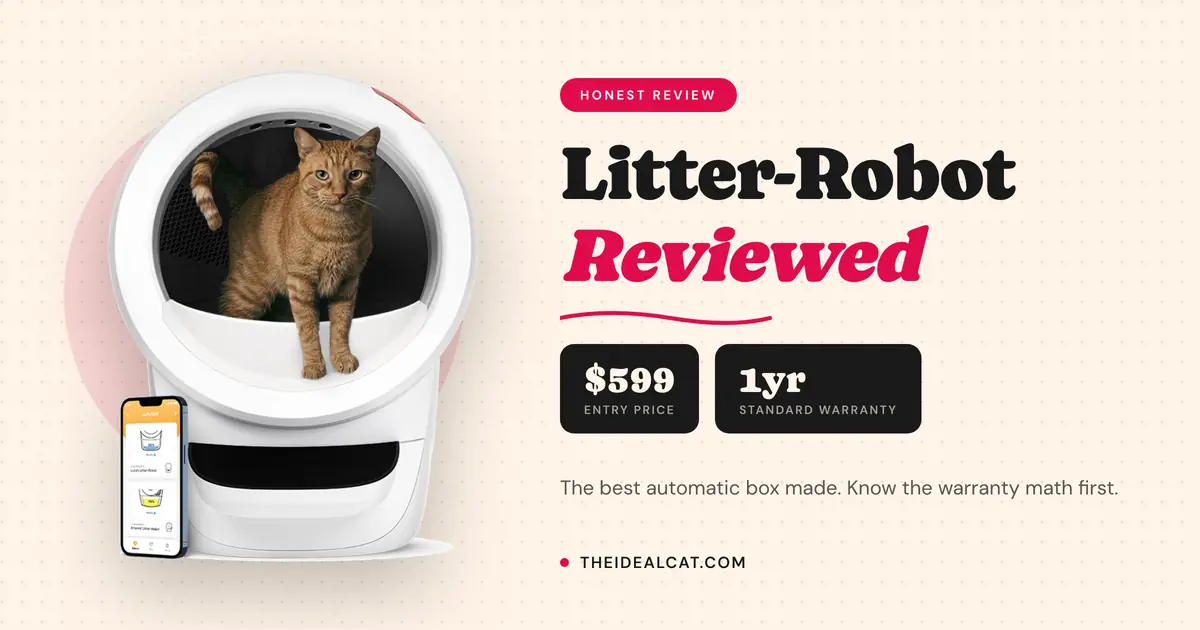
Six hundred dollars. For a litter box.
The Litter-Robot is the most recommended automatic litter box in existence, and mostly it deserves that. Most long-term owners get five years or more out of one with no mechanical trouble at all.
But there is a pattern in the complaints worth knowing before you spend the money, and it has a lot to do with when the warranty runs out.
- The Litter-Robot is made by Whisker and costs between $599 for the EVO and $799 for the Litter-Robot 4 with accessories.
- Litter-Robot units ship with a 1-year WhiskerCare warranty that can be extended to a total of 3 years.
- Reported failures cluster in the 12 to 24 month window, which begins just after the standard 1-year warranty expires.
- Most long-term Litter-Robot owners report five or more years of reliable operation with no mechanical failure.
- The Litter-Robot’s weight sensors log each cat’s visits, which can flag weight loss or urinary changes before symptoms are visible.
Our Top Picks
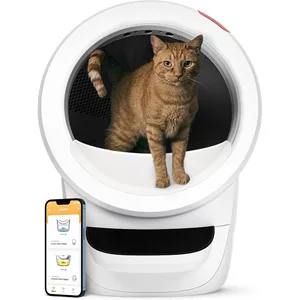
Whisker Litter-Robot 4 Automatic Self-Cleaning Cat Litter Box, White
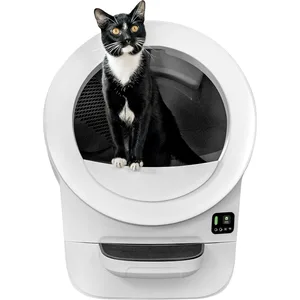
Whisker Litter-Robot EVO Automatic Self-Cleaning Cat Litter Box, White
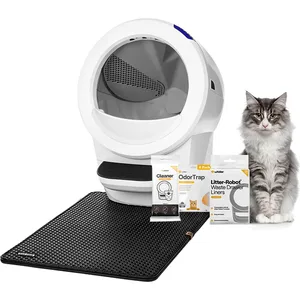
Whisker Litter-Robot 4 with Step & Core Accessories Kit Cat Litter Box, White
Litter-Robot models compared
| Product | Best for | Colour | Price | Model |
|---|---|---|---|---|
| Whisker Litter-Robot 4 Automatic Self-Cleaning Cat Litter Box, White | Best overall | White | $699.00 | Litter-Robot 4 |
| Whisker Litter-Robot EVO Automatic Self-Cleaning Cat Litter Box, White | Best value | White | $599.99 | Litter-Robot EVO |
| Whisker Litter-Robot 4 Automatic Self-Cleaning Cat Litter Box, Black | Best in black | Black | $699.00 | Litter-Robot 4 |
| Whisker Litter-Robot 4 with Step & Core Accessories Kit Cat Litter Box, White | Best bundle | With accessories | $799.00 | Step & core kit |
| Whisker Litter-Robot 4 LitterHopper Cat Litter Refill System, White | Best add-on | White | $99.00 | LitterHopper |
| Whisker Litter-Robot 4 Cat Ramp, Black | Best accessory | Black | $65.00 | Cat ramp |
The 12 to 24 month problem
This is the single most useful thing to know about the Litter-Robot, and almost no review leads with it.
Most owners have no trouble. The majority report five years or more of reliable running, which is genuinely good for a machine doing this job in this environment. But when failures are reported, they cluster in the 12 to 24 month window, and the standard warranty runs for 12 months.
The commonly reported faults are consistent: WiFi connectivity dropping, the unit refusing to cycle, red status lights, repeated drawer full errors when the drawer is not full, and holes wearing through the base liner.
What to do about it. WhiskerCare extends cover to a total of three years. Normally an extended warranty is a poor bet, and normally I would tell you to skip it. Here the failure distribution sits almost exactly in the window the extension covers, which makes this one of the few cases where the maths genuinely favours buying it.
Customer service reports are mixed: some owners describe short waits and knowledgeable technical staff, others describe struggling to reach anyone when a fault persisted. Budget for that possibility rather than assuming it away.
What the weight sensors are actually for
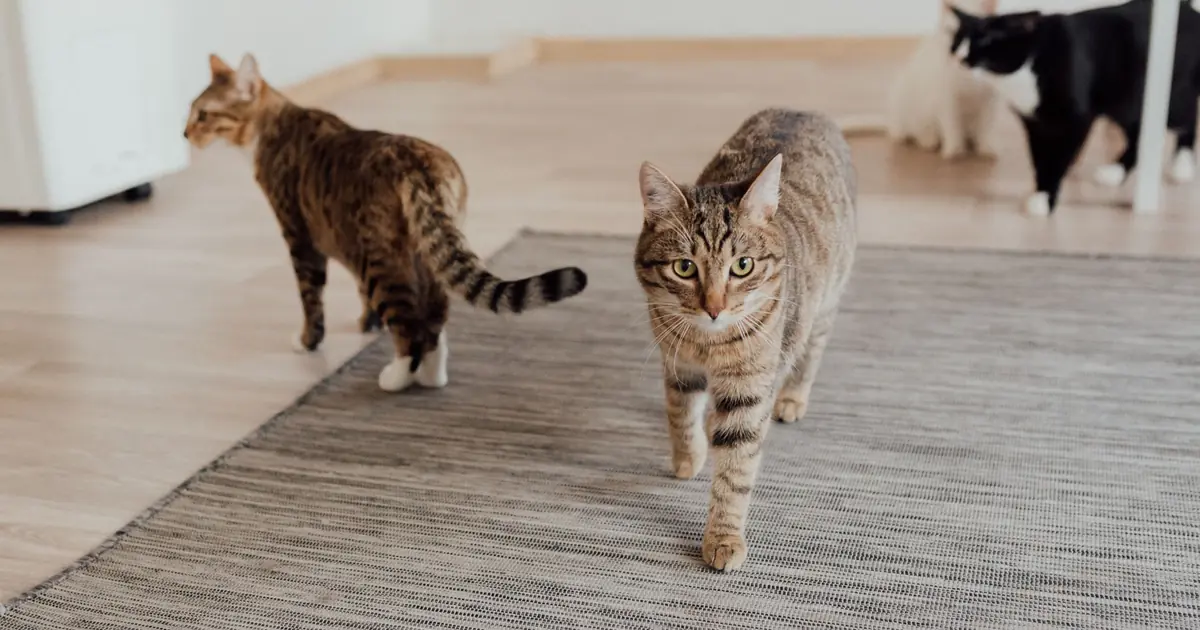
The scooping is the obvious selling point. The data is the one that matters more, and it is the reason this costs what a plain box does not.
Cats conceal illness. It is instinct rather than stubbornness: a visibly weak animal gets predated, so cats hide weakness until they cannot. The AAHA weight guidelines note that gradual weight change is one of the earliest measurable signals of illness. By the time you notice, a condition has often been building for months.
- Weight. Gradual weight loss is an early sign of hyperthyroidism, diabetes, kidney disease and cancer. You will not spot half a pound on a cat you see every day. A box that weighs them at every visit will.
- Visit frequency. A sudden increase often points to diabetes or kidney disease, both of which raise thirst and urine output. Frequent visits producing very little points instead at urinary tract trouble.
- Multi-cat caveat. The unit distinguishes cats by weight, so two cats of similar size can blur together. Check that the app is attributing visits correctly before you trust a trend.
None of this is a diagnosis. The box tells you something changed and your vet tells you what it means. A male cat straining and producing nothing is an emergency the same day, not the next morning, and the Cornell Feline Health Center sets out the warning signs.
The 6 Litter-Robot products, reviewed
Whisker Litter-Robot 4 Automatic Self-Cleaning Cat Litter Box, White: best overall
The Litter-Robot 4 is the model most people should buy and the one the reputation is built on. A sealed globe rotates after your cat leaves, sifting waste into a carbon-filtered drawer below. Weight sensors track each cat and the app logs visits, which is the part that quietly earns its keep.
Whisker Litter-Robot EVO Automatic Self-Cleaning Cat Litter Box, White: best value
The EVO is the newer, cheaper way into the range at a hundred dollars less than the 4. You keep the rotating globe and the core sifting mechanism. If the price of the 4 is the only thing stopping you, this is the honest alternative rather than a downgrade you will regret.
Whisker Litter-Robot 4 Automatic Self-Cleaning Cat Litter Box, Black: best in black
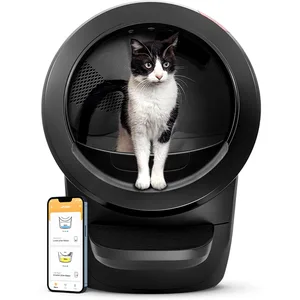
Identical to the white Litter-Robot 4 in every functional way. Worth mentioning only because this unit is large and lives in your house, and colour genuinely matters when the thing is the size of a bedside table.
Whisker Litter-Robot 4 with Step & Core Accessories Kit Cat Litter Box, White: best bundle
The 4 bundled with the ramp and core accessories. Buying the kit costs less than adding the ramp later, and the ramp is not optional for a kitten, a senior or an arthritic cat, because the entry sits high off the floor.
Whisker Litter-Robot 4 LitterHopper Cat Litter Refill System, White: best add-on
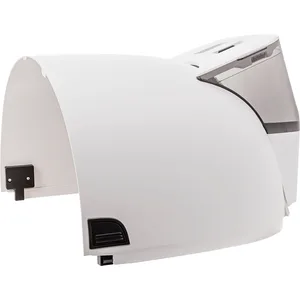
The LitterHopper auto-refills litter into the globe as the level drops, which turns a weekly top-up into a monthly one. Genuinely useful if you travel. It does not reduce how often you empty the waste drawer, so it solves half the chore rather than all of it.
Whisker Litter-Robot 4 Cat Ramp, Black: best accessory
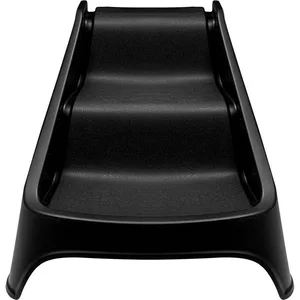
The ramp, sold separately if you did not take the bundle. Buy it for any cat who hesitates at the entrance. Cats hide joint pain well, and a cat who stops using a high-sided box is often telling you it hurts rather than that they dislike the box.
Who it does not suit
An expensive box is still the wrong box for some cats, and no amount of engineering changes that.
- Kittens under about six months are too light to trigger the sensors reliably, and Whisker advises against unsupervised use at that size.
- Cats who cannot climb. The entry sits high. Seniors and arthritic cats need the ramp, and some will still refuse.
- Nervous cats. The globe rotates and makes noise. A cat frightened by it will find somewhere else to go, and that is a much bigger problem than scooping.
- Very large cats. Maine Coons and Ragdolls fit, but check the entry dimensions rather than assuming.
- It does not change the arithmetic. You still want one box per cat plus one spare, as our guide to how many litter boxes per cat explains.
How it compares
- Against PETKIT and CATLINK: those undercut it substantially and offer similar health tracking. The Litter-Robot’s advantage is the longest track record in the category.
- Against PetSafe ScoopFree: ScoopFree is a rake rather than a globe and costs a third as much, but has no real health monitoring.
- Against a plain box: a large open pan and a daily scoop is a perfectly good litter box. The Litter-Robot buys you time and data, not better hygiene.
- Running cost is low, since it takes ordinary clumping clay rather than proprietary trays.
Who should buy a Litter-Robot
Buy one if you want the most refined automatic box made, you will read the health data, and you buy the extended warranty with it. For one or two adult cats in a settled home it is the best in the category.
Skip it if your cat is a kitten, nervous, or unable to climb comfortably. Compare the field in our best self-cleaning litter box guide, or see PETKIT and CATLINK for cheaper alternatives.
The bottom line on the Litter-Robot
It is the best automatic litter box on the market and most owners get years of trouble-free use. The sifting works, the health data is genuinely useful, and it runs on ordinary clay litter.
Go in with the warranty math in mind. Failures cluster right after the standard year ends, so extend the cover at purchase rather than gambling. Whisker Litter-Robot 4 Automatic Self-Cleaning Cat Litter Box, White is the model to buy. This article is educational rather than veterinary advice.
Frequently asked questions
Q: Is the Litter-Robot worth it?
The Litter-Robot is worth it if you want the most refined automatic litter box available and will use the health data it collects. It costs $599 to $799, and most long-term owners report five or more years of reliable operation.
Q: How long does a Litter-Robot last?
Most long-term owners report five years or more without mechanical failure. When failures are reported they cluster between 12 and 24 months of ownership, which begins just after the standard 1-year warranty expires.
Q: Should I buy the extended Litter-Robot warranty?
In this case, probably yes. The standard WhiskerCare warranty runs 1 year and can be extended to 3 years total. Because reported failures cluster in the 12 to 24 month window, the extension covers exactly the period of highest risk.
Q: What is the difference between the Litter-Robot 4 and EVO?
The Litter-Robot 4 costs around $699 and the newer EVO around $599. Both use the same rotating globe and sifting mechanism, so the EVO is the value option rather than a significant downgrade.
Q: Is the Litter-Robot safe for kittens?
Kittens under about six months are usually too light to trigger the weight sensors reliably, and Whisker advises against unsupervised use at that size. A conventional open litter box is the safer choice until they grow.
Q: What litter does the Litter-Robot use?
The Litter-Robot works with ordinary clumping clay litter rather than proprietary trays or refills, which keeps the running cost low compared with automatic boxes that require branded consumables.
Q: Can the Litter-Robot tell my cats apart?
It distinguishes cats by weight, so cats of noticeably different sizes are tracked separately. Two cats of similar weight can be confused, so check the app is attributing visits correctly before trusting any trend in the data.

Hello and welcome to The Ideal Cat!
We are some passionate cat owners from different professions. We love our cats and have a lot of experience in how to care for our pets. We are incredibly excited to share our knowledge, experience, and research with you. So you can take good care of your loving cat. We will answer most of the common questions about owning cats, taking care of them, etc. If you have any question contact with us. Thanks for visiting! Enjoy the content.
