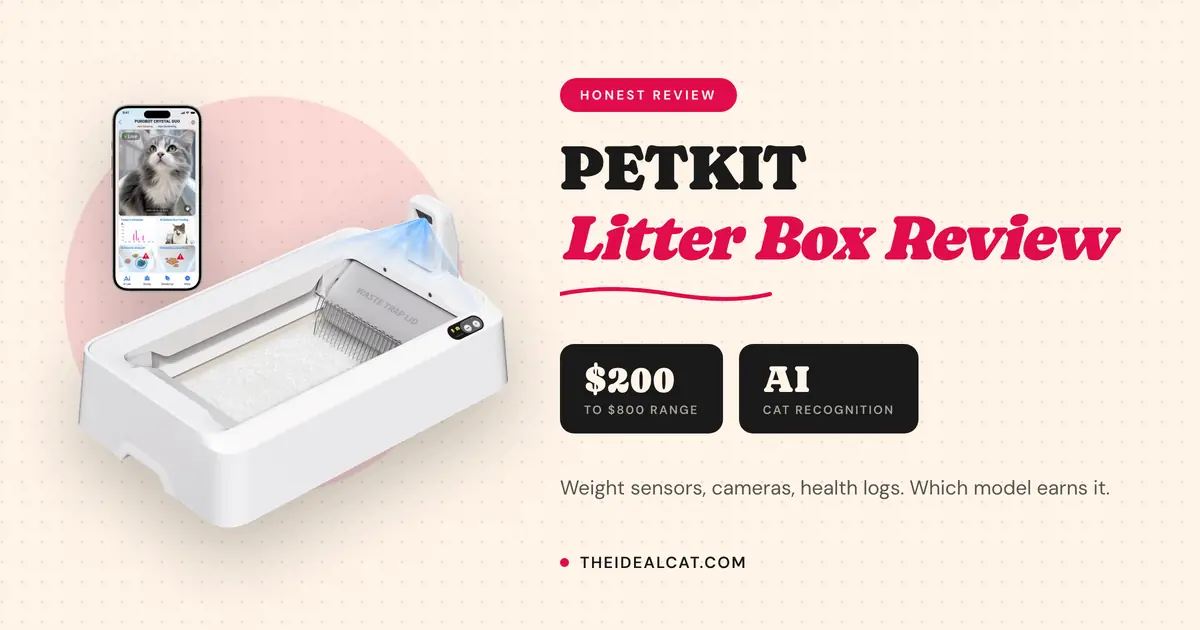
Eight hundred dollars. For a litter box.
That is the top of PETKIT’s range, and the entry point is two hundred. Between those two numbers is a genuinely useful idea and a lot of expensive refinement.
The useful idea is not the scooping. It is that the box weighs your cat and counts their visits, and those two numbers catch illness earlier than you will.
The cheapest box here has the highest running cost. The Purobot Crystal Duo is $199.99, but it only works with PETKIT’s own crystal litter trays. A four-pack of trays is $79.99 on Chewy, and PETKIT says each tray lasts up to 30 days, so plan on about $20 a month, roughly $240 a year, for one cat.
The drum models, the PuraMax 2 and the Purobot Max Pro 2, run on ordinary clumping litter you can buy anywhere. Over two years, that gap eats most of the Crystal Duo’s head start on price.
The health tracking is the actual point
Scooping is a chore. It is not a two-hundred-dollar problem, let alone an eight-hundred-dollar one. What justifies this category of product is the data, and it is worth understanding why.
Cats hide illness. It is not stubbornness, it is instinct: a visibly weak animal in the wild gets predated, so cats conceal weakness until they cannot. By the time you notice something is wrong, a condition has often been developing for months.
Two numbers give the game away earlier than your eyes will.
- Weight. Steady weight loss is one of the earliest signs of hyperthyroidism, diabetes, kidney disease and cancer. You will not notice half a pound on a cat you see every day, and a box that weighs them at every visit will.
- Visit frequency. A cat suddenly using the box far more often is a classic early sign of diabetes or kidney disease, both of which increase thirst and urine output. Going more often and producing little points at urinary tract trouble instead.
This is genuinely useful information and it is the reason to buy one of these rather than a plastic pan. What it is not is a diagnosis. The box tells you something changed; your vet tells you what it means. The Cornell Feline Health Center covers the conditions these patterns point toward.
And the tracking only works if the box knows who it is weighing. In a single-cat house any model does that. In a multi-cat house you need a model that can tell cats apart. PETKIT says the Max Pro 2 and the Crystal Duo both do it with a camera plus weight. Without that, the numbers are an average of several cats and tell you nothing.
Here is the range side by side. Cat recognition is as PETKIT describes it.
| Product | Price | How it works | Tells cats apart? | Pick it if |
|---|---|---|---|---|
| Purobot Crystal Duo | $199.99 | Open-top rake over PETKIT crystal trays | Camera plus weight | One cat that dislikes hoods, and you will pay about $20 a month for trays. |
| PuraMax 2 | $359.99 | Rotating drum, clumping litter, 24-in | Weight tracking, no camera | You have a large cat and do not want a camera. |
| Purobot Max Pro 2 | $465.99 | Rotating drum with AI camera | Camera plus weight | You have two or more cats. Our pick for multi-cat homes. |
| Purobot Ultra | $799.98 | Drum, rotating camera photographs stool | Facial recognition | You want a photo of every clump. Few homes need it. |
| Occult Blood Test Tofu Litter | $27.99 (2 x 5.2 lb) | Changes color within seconds if urine has hidden blood | No | You want a cheap urine check in any clumping box. |
What goes wrong with automatic litter boxes
These are machines with moving parts sitting in the wettest, dirtiest job in your house. Three problems come up repeatedly across the whole category, not just this brand.
- Urine leakage. If the drum seal is imperfect or the box is not level, urine escapes underneath and you get a smell you cannot find. Check the floor under the unit when you clean it.
- Sensor faults. Weight sensors drift and infrared sensors get dirty. A sensor covered in litter dust is a safety sensor that is not working, so wipe them when you empty the box.
- Tray size. The most common complaint from owners of large cats. Measure your cat nose to tail base and buy the X-Large if there is any doubt.
- Entry height. Automatic boxes sit higher than a pan. Kittens, senior cats and arthritic cats may struggle, which is what the ramp is for.
None of this makes them bad products, and the same list applies to CATLINK and Meowant. It means an automatic box needs maintenance, not that it removes maintenance.
One rule that does not change: you still need one box per cat plus one spare. An automatic box removes the scooping, not the arithmetic, as our guide to how many litter boxes per cat explains.
Which model should you actually buy?
- One average-sized cat: the Purobot Crystal Duo at around $200. You get the camera and the health data, but budget about $20 a month for its crystal trays.
- One large cat: the PuraMax 2 at 24 inches. Size is a functional requirement, not a luxury.
- Two or more cats: the Purobot Max Pro 2, because without facial recognition the health data is an unusable average.
- A nervous cat, or a tight budget: none of them. A large open pan and a daily scoop is a perfectly good litter box, and some cats will never accept a machine that moves.
Should you buy a PETKIT litter box?
Buy one if you want early warning on your cat’s health and you will actually read the app. That is the honest test: the data only helps if someone looks at it.
Skip it if you just want to stop scooping, where a cheaper box does the same job. Compare the field in our best self-cleaning litter box guide, or see the PetSafe ScoopFree range for a simpler rake-based approach.
The hardware is good and the health monitoring is the real product. Weight and visit frequency catch illness earlier than an attentive owner does, and that is worth money.
It is rarely worth eight hundred dollars, though, because camera and weight tracking start at two hundred, as long as you budget for the crystal trays. Buy PETKIT Purobot Crystal Duo Automatic Cat Litter Box with Camera unless your cat is large or you have several. This article is educational rather than veterinary advice, and any change the app flags is a reason to call your vet rather than to wait.
PETKIT questions
Q: Is a PETKIT litter box worth it?
A PETKIT litter box is worth it if you will use the health data. The weight sensor and visit logging can flag illness before you notice symptoms. The Purobot Crystal Duo at around $200 offers that tracking for a quarter the price of the flagship.
Q: Which PETKIT litter box should I buy?
The Purobot Crystal Duo suits one average-sized cat, the PuraMax 2 suits a large cat because of its 24-inch size, and the Purobot Max Pro 2 suits multi-cat homes because its facial recognition tells cats apart.
Q: How does a litter box track my cat’s health?
It weighs your cat at each visit and logs how often and how long they use the box. Steady weight loss is an early sign of hyperthyroidism, diabetes, kidney disease and cancer, and a sudden increase in visits often points to diabetes or urinary problems.
Q: Do automatic litter boxes work with multiple cats?
Only if the box can tell your cats apart. Without facial recognition, the weight and visit data is an average across several cats and cannot flag which one has changed. PETKIT says the Purobot Max Pro 2 and the Crystal Duo both identify individual cats using a camera and weight.
Q: What problems do PETKIT litter boxes have?
The most common complaints across automatic litter boxes are urine leakage when the unit is not level, sensor faults from litter dust, and a tray that is too small for large cats. Regular cleaning of the sensors prevents most of them.
Q: Are automatic litter boxes safe for cats?
Modern automatic boxes use weight and infrared sensors to stop the cycle when a cat enters. Those sensors only work when clean, so wipe them whenever you empty the box. Kittens and arthritic cats may also struggle with the higher entry.

Hello and welcome to The Ideal Cat!
We are some passionate cat owners from different professions. We love our cats and have a lot of experience in how to care for our pets. We are incredibly excited to share our knowledge, experience, and research with you. So you can take good care of your loving cat. We will answer most of the common questions about owning cats, taking care of them, etc. If you have any question contact with us. Thanks for visiting! Enjoy the content.
