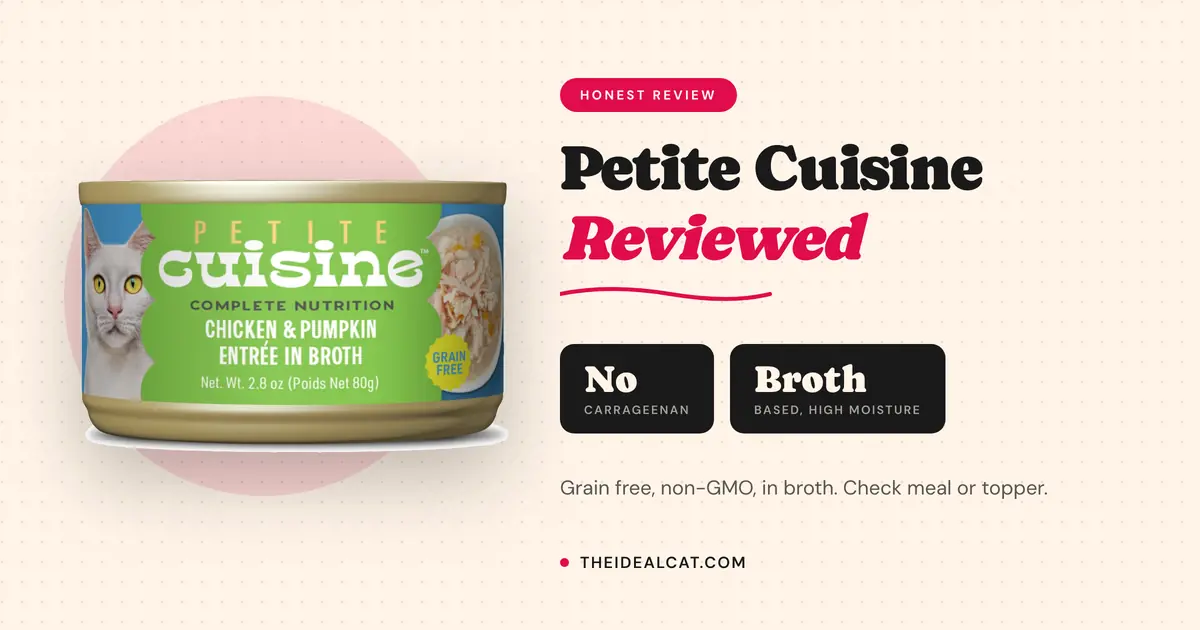
Two cans from the same brand, sitting next to each other on the shelf, at roughly the same price.
One is a complete meal your cat can live on. The other is a topper that will slowly make them ill if you feed it as dinner.
Nothing on the front of either can tells you which is which. That is the single most important thing to know about Petite Cuisine, and it is true of a lot of brands.
There is a price clue, too. The two Petite Cuisine products you should not feed as a meal cost the most per ounce. The Consomme topper pouches work out at about $1.09 an ounce and the Lickables at about $1.71. The complete entrees in broth come to roughly 57 to 60 cents.
So the topper is not a cheaper way to feed this brand. Per ounce it is the most expensive way.
Complete or supplemental? How to read the can
This is the most useful skill in the entire pet food aisle, and it takes about four seconds once you know where to look.
Every cat food sold in the US carries an AAFCO statement, usually in small print on the back or side. It says one of two things, and the difference is enormous.
- “Complete and balanced” means the food provides everything your cat needs. It will also name a life stage: growth (kittens), adult maintenance, or all life stages. Your cat can eat this and nothing else.
- “For intermittent or supplemental feeding only” means it is not a complete diet. Toppers, broths, lickables and most treats carry this. It is fine alongside a complete food and unsafe as a replacement for one.
Petite Cuisine sells both. The entrees are complete meals. The toppers and the Lickables are supplemental. They sit in the same brand block on the same shelf and the packaging looks similar.
Why it genuinely matters. Cats cannot make enough taurine themselves and must get it from food. Sustained taurine deficiency causes dilated cardiomyopathy, a serious heart condition, and retinal degeneration leading to blindness. Complete foods are formulated to prevent that. Supplemental ones are not required to.
So check the label rather than the marketing, on this brand and every other. The AAFCO consumer guide explains exactly what the statement means and where to find it.
Here is how the six products split, using Chewy prices.
| Product | Type | Pack | Cost per ounce | Use it for |
|---|---|---|---|---|
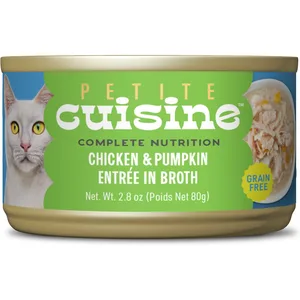
| Chicken & Pumpkin Entree | Entree in broth | 24 x 2.8 oz, $40.56 | $0.60 | Everyday meals. The easiest starting case. |
| Chicken & Sweet Potato Entree | Entree in broth | 24 x 2.8 oz, $40.56 | $0.60 | A second chicken recipe for rotation. |
| Tuna, Pumpkin & Tilapia Entree | Entree in broth | 24 x 2.8 oz, $38.50 | $0.57 | Fish-loving cats. The cheapest per ounce. |
| Variety Pack | 4 entree recipes | 12 x 2.8 oz, $20.28 | $0.60 | Testing what your cat likes for half the outlay. |
| Consomme Chicken Topper | Supplemental | 12 x 1.3 oz, $17.04 | $1.09 | Pouring over a complete food. Never as dinner. |
| Lickables Chicken | Treat | 12 x 2 oz, $40.92 | $1.71 | Hand-fed treats and pill time. |
The variety pack costs the same per ounce as a full case, so there is no penalty for testing first.
What broth-based food does for hydration
Petite Cuisine builds its entrees on broth rather than pate, and that is a real functional difference rather than a texture preference.
Cats descend from desert animals and have a weak thirst drive relative to their needs. In the wild nearly all their water arrives inside prey, which is roughly 70 percent water. A cat fed dry food has to make up that shortfall at the bowl, and most simply do not.
Moisture ranks roughly like this: broth and gravy recipes carry the most water, then pate, then dry food a long way behind. If your cat rarely visits the water bowl, moving them onto broth-based wet food does more than any supplement will.
Chronic low-level dehydration is linked to feline lower urinary tract disease, and urethral blockage in male cats is a genuine emergency: a cat straining in the box and producing nothing needs a vet the same day. Our guide to the best wet cat food covers the wider options, and Soulistic takes a similar high-moisture approach at a lower price.
The other thing worth noting: no carrageenan. Carrageenan is a seaweed-derived thickener used in a lot of wet food, and while regulators consider it safe, plenty of owners prefer to avoid it. Petite Cuisine leaves it out, which is a fair reason to choose it over a cheaper can.
How it compares
- Against budget wet food: better ingredients, no carrageenan, higher moisture, and roughly double the price.
- Against Weruva or Tiki Cat: similar philosophy and similar pricing, with a much narrower range here.
- Range size is the real limitation. Around half a dozen complete recipes plus toppers and treats, so building a long rotation means bringing in another brand.
- Wet food only. There is no dry option, so this is a brand you pair with something else rather than a whole feeding plan.
Should you buy Petite Cuisine?
Buy it if you want clean, broth-based wet food and your cat drinks very little. The entrees are genuinely good, and the variety pack is a cheap way to test acceptance before spending forty dollars on a case.
Skip it if you need a wide protein rotation, since the range runs out quickly. Compare across the market in our main cat food guide, and see Weruva for a similar approach with far more recipes.
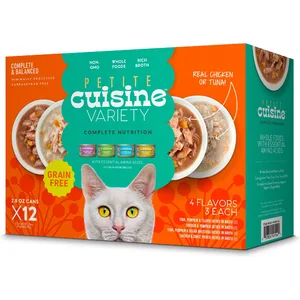
Good food, short range, fair price for what it is. Grain free, carrageenan free, non-GMO, broth based, with visible whole ingredients rather than uniform paste.
Just read the AAFCO statement before you buy, because two of the six products here are a topper and a treat rather than meals. Start with Petite Cuisine Chicken & Pumpkin Entrée in Broth Grain-Free Wet Cat Food, 2.8-oz can, case of 24, which is a complete food. This article is educational rather than veterinary advice, so talk to your vet before changing the diet of a cat with a health condition.
Petite Cuisine questions
Q: Is Petite Cuisine complete and balanced?
Some of it. The entrees are complete and balanced meals, while the toppers and Lickables are supplemental and must not be fed as a sole diet. Check the AAFCO statement on the label of each product.
Q: What happens if I feed only supplemental cat food?
Feeding a supplemental food as a sole diet risks nutritional deficiency. Cats cannot make enough taurine themselves, and sustained taurine deficiency causes dilated cardiomyopathy, a serious heart condition, and retinal degeneration leading to blindness.
Q: Does Petite Cuisine contain carrageenan?
No. Petite Cuisine recipes are carrageenan free. Carrageenan is a seaweed-derived thickener common in wet cat food, and while regulators consider it safe, many owners prefer to avoid it.
Hello and welcome to The Ideal Cat!
We are some passionate cat owners from different professions. We love our cats and have a lot of experience in how to care for our pets. We are incredibly excited to share our knowledge, experience, and research with you. So you can take good care of your loving cat. We will answer most of the common questions about owning cats, taking care of them, etc. If you have any question contact with us. Thanks for visiting! Enjoy the content.
