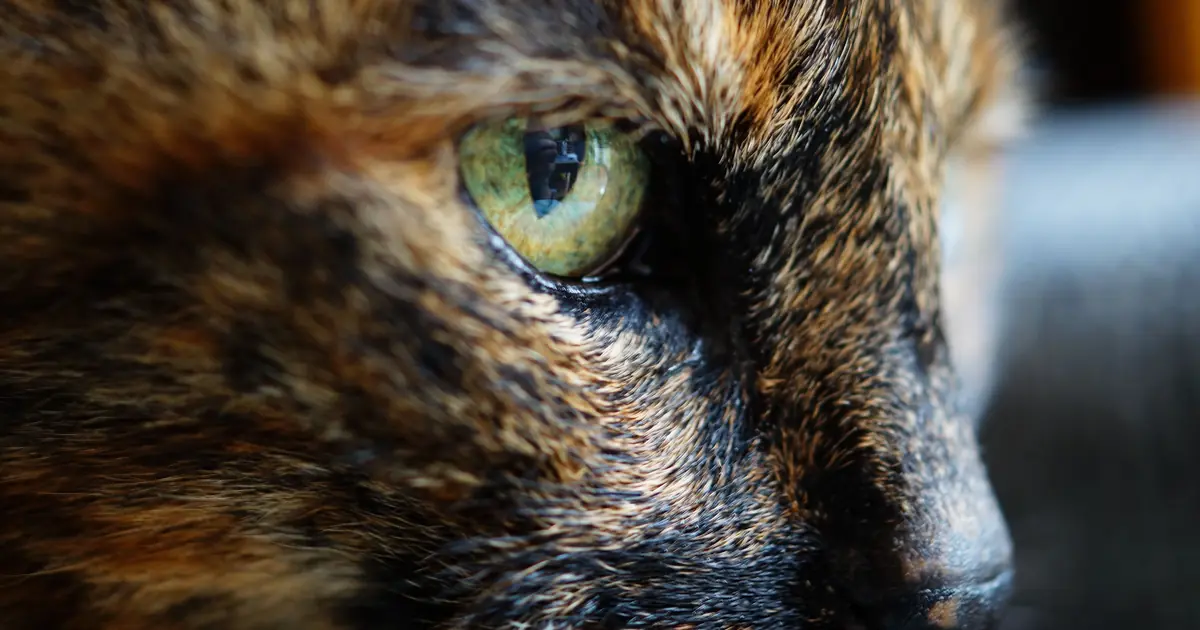
If you’ve ever met a cat whose coat looks like someone swirled black and orange paint together and never quite blended it, you’ve met a tortoiseshell. They’re striking, they’re a little mysterious, and almost every single one of them is a girl. So what is a tortoiseshell cat, really? Let’s clear it up.
- Tortoiseshell is a coat color pattern, not a cat breed, so a tortie can be a Maine Coon, Persian, domestic shorthair, or many other breeds.
- A tortoiseshell coat mixes two colors, typically black and red (orange), in a brindled or patched pattern, usually with little or no white.
- Roughly 99.9% of tortoiseshell cats are female, and only about 1 in 3,000 is male, according to research cited by feline organizations.
- Male tortoiseshell cats usually carry an extra X chromosome (XXY, called Klinefelter syndrome), which usually makes them sterile, though rare chimera males can occasionally be fertile.
- A calico cat has the same colors plus large white patches, while a true tortie has little to no white.
What is a tortoiseshell cat, in one sentence?
A tortoiseshell cat is a cat with a mottled coat that blends two colors, usually black and red (orange), into a brindled or patched pattern. Tortoiseshell is a coat coloring, not a breed, named for its resemblance to the brown-and-amber pattern of real tortoiseshell material. Cat lovers shorten the name to “tortie.”
Here’s the thing people get wrong most often: you can’t adopt a “tortoiseshell breed,” because there isn’t one. The tortoiseshell pattern can appear in a domestic shorthair from a shelter, a fluffy Maine Coon, a Persian, and plenty of others. It describes the paint job, not the cat underneath.
The two colors in a tortie coat always come from two pigment families. One is eumelanin (black, and its lighter versions like blue, chocolate, and lilac). The other is phaeomelanin (red or cream). Black plus red is the classic combo you picture when someone says “tortoiseshell.”
Why are almost all tortoiseshell cats female?
Almost all tortoiseshell cats are female because the genes for black and red coat color sit on the X chromosome. Female cats have two X chromosomes, so they can carry one color on each and display both. That double dose of X is the whole reason a tortie coat exists.
To make the two colors show up in patches, female cats rely on a process called X-inactivation (sometimes called lyonization). Very early in development, each cell randomly switches off one of its two X chromosomes for good. Some cells keep the “black” X active, others keep the “red” X active, and the result is a patchwork of black and red fur across the body.
Male cats normally have one X and one Y chromosome (XY). With only one X to work from, a male cat usually ends up all black-family or all red, not both. That single X is why a tortoiseshell pattern almost never lands on a male cat. According to The International Cat Association, about 99.9% of tortoiseshell and calico cats are female.
Can a tortoiseshell cat be male?
Yes, a tortoiseshell cat can be male, but it’s very rare, roughly 1 in 3,000 torties. A male tortoiseshell needs two X chromosomes to show both colors, which happens through a genetic quirk rather than normal inheritance.
Most male tortoiseshell cats carry an extra X chromosome, giving them an XXY pattern instead of the usual XY. This condition is called Klinefelter syndrome. The extra X gives the cat the second color gene it needs, so the tortoiseshell coat can appear. In rarer cases, a male tortie is a chimera, meaning two embryos fused early on and the cat carries two sets of cells.
Male torties usually can’t have kittens. The extra X chromosome in XXY males typically makes them sterile, so a breeder can’t simply pair two of them to produce more. That rarity is also why male tortoiseshells are sometimes priced far higher, though paying a premium for one is not something most cat experts encourage.
What’s the difference between a tortoiseshell and a calico cat?
The main difference between a tortoiseshell and a calico cat is white. A calico cat has large white patches along with black and red, while a tortoiseshell has its colors blended together with little or no white at all.
Both calicos and torties are almost always female, and both rely on the same X-linked color genetics. The white in a calico comes from a separate “spotting” gene that leaves patches of fur unpigmented. When a cat has that white-spotting gene plus the tortoiseshell colors, the black and red break up into distinct blocks instead of mixing, and you get the classic three-color calico look.
| Feature | Tortoiseshell (Tortie) | Calico |
|---|---|---|
| Colors | Black and red (orange), often blended | Black, red (orange), and white |
| White fur | Little to none | Large white patches |
| Pattern look | Mottled, brindled, swirled | Distinct blocks of color |
| Sex | About 99.9% female | About 99.9% female |
| Is it a breed? | No, it’s a coat color | No, it’s a coat color |
What are the types of tortoiseshell cats?
Tortoiseshell cats come in a few recognized variations, mainly dilute torties, chocolate torties, and torbies. Each type still mixes one eumelanin color with one phaeomelanin color, just in different shades or patterns.
- Classic tortoiseshell: Rich black mixed with red or orange. This is the pattern most people picture.
- Dilute tortoiseshell: A softer, smoky version where the colors are lightened by a dilution gene. Black becomes blue (gray) and red becomes cream, giving a muted pastel coat.
- Chocolate or cinnamon tortoiseshell: The eumelanin shows up as warm brown (chocolate) or reddish-brown (cinnamon) instead of black, mixed with red or cream.
- Torbie (tortoiseshell tabby): A tortie that also carries the tabby pattern, so you’ll see stripes or swirls inside the colored areas. “Torbie” is just a blend of “tortie” and “tabby.”
A torbie is where tortoiseshell and tabby patterns overlap on the same cat. If you want the full picture on stripes and the tabby gene, that’s a topic of its own.
What is “tortitude,” and is it real?
“Tortitude” is the popular belief that tortoiseshell cats have feistier, more strong-willed personalities than other cats. It’s a fun idea, but there’s little solid scientific evidence that coat color drives temperament.
Plenty of tortie owners swear their cats are sassy, independent, and full of opinions. One 2016 UC Davis owner survey did report that tortoiseshell and calico cats were perceived as slightly more reactive toward people during handling, grooming, and vet visits. Even so, the differences were small, and the authors cautioned that coat color is a weak predictor of behavior. No study has proven a genetic link between coat color and a fixed personality type.
So if your tortie has a big personality, enjoy it, but credit her individual nature, environment, and upbringing rather than her fur. Every cat is her own creature. Coat color just isn’t a reliable predictor of attitude.
What breeds can be tortoiseshell?
Many cat breeds can carry the tortoiseshell pattern because tortoiseshell is a coat color, not a breed of its own. You’ll find tortie coats on mixed-breed domestic cats and on a long list of pedigreed breeds.
Breeds that commonly show tortoiseshell coloring include the domestic shorthair and domestic longhair (the everyday cats in most homes), Maine Coon, Persian, British Shorthair, American Shorthair, and Cornish Rex, among others. The pattern is especially prized in the Japanese Bobtail, where tricolor cats hold a special cultural place.
If you’re hoping for a specific look, remember you’re choosing a pattern, not a temperament or a guaranteed size. A tortie Persian and a tortie domestic shorthair share a coat color and almost nothing else about how they’ll act or how big they’ll get.
Are tortoiseshell cats good luck?
In many cultures, tortoiseshell cats are seen as good luck, though that’s folklore rather than fact. The belief is strongest in Japan, where torties were once thought to protect sailors and bring fortune.
Japanese fishermen historically kept tortoiseshell cats aboard their boats, believing the cats warded off storms and ghosts, and tricolor cats are tied to the lucky “beckoning cat” imagery. In parts of the United States, torties have even been nicknamed “money cats.” None of this affects the cat’s health or behavior, but it’s a charming bit of history that follows torties around the world.
How long do tortoiseshell cats live, and are they healthy?
Tortoiseshell cats live about as long as any cat, typically 12 to 18 years, because coat color does not affect lifespan or general health. A well-cared-for indoor tortie often reaches the upper end of that range.
The tortoiseshell pattern itself carries no special health risks for female cats. The one exception is rare male torties, who carry an extra X chromosome (XXY) and may face health and fertility issues tied to that chromosomal difference. For the vast majority of torties, who are female, the usual feline health basics apply: good nutrition, dental care, parasite prevention, and regular checkups.
This article is educational and not a substitute for veterinary advice. If your tortoiseshell cat shows red-flag signs like not eating for more than 24 hours, repeated vomiting, straining in the litter box, trouble breathing, or sudden lethargy, contact a licensed veterinarian right away.
The Bottom Line on Tortoiseshell Cats
A tortoiseshell cat is a cat wearing one of nature’s most beautiful coat colors, a blend of black and red that’s almost always worn by a female. Remember that a tortoiseshell cat is defined by color, not breed, so you’re choosing a gorgeous pattern that can come in many shapes, sizes, and personalities. Whatever breed your tortie turns out to be, you’ve got a one-of-a-kind coat and, very likely, a one-of-a-kind cat.
Frequently Asked Questions
Q: Is a tortoiseshell cat a breed?
No, a tortoiseshell cat is not a breed. Tortoiseshell is a coat color pattern that can appear in many breeds, including the Maine Coon, Persian, and ordinary domestic shorthairs. The word describes the fur, not the type of cat.
Q: Why are tortoiseshell cats almost always female?
Tortoiseshell cats are almost always female because the black and red color genes are carried on the X chromosome. Female cats have two X chromosomes, so they can display both colors, while males usually have only one X and show just one color. About 99.9% of torties are female.
Q: How rare is a male tortoiseshell cat?
Male tortoiseshell cats are very rare, roughly 1 in 3,000. Most are born with an extra X chromosome (XXY, known as Klinefelter syndrome), and a small number are chimeras. Male torties are usually sterile, though a rare chimera male can occasionally be fertile.
Q: What is the difference between a tortoiseshell and a calico cat?
The difference between a tortoiseshell and a calico cat is white fur. A calico has large white patches along with black and red, while a tortoiseshell blends its colors with little or no white. Both are almost always female.
Q: What is a dilute tortoiseshell cat?
A dilute tortoiseshell cat has a softened version of the tortie coat, where black becomes blue (gray) and red becomes cream. A dilution gene lightens the colors, giving a muted, pastel-toned appearance instead of the bold black-and-orange of a classic tortie.
Q: Do tortoiseshell cats really have “tortitude”?
There’s little scientific evidence that tortoiseshell cats have a distinct personality. Many owners report feisty, strong-willed torties, but the genes that create the coat color don’t control temperament. Each tortie’s personality comes from her individual nature and environment.
Q: How long do tortoiseshell cats live?
Tortoiseshell cats typically live 12 to 18 years, the same as most cats, because coat color does not affect lifespan. Indoor torties with good care often reach the higher end of that range.
Q: Are tortoiseshell cats expensive?
Most tortoiseshell cats are affordable, often available through shelter adoption for a small fee. Pedigreed torties from breeders can cost more, and rare male tortoiseshells sometimes carry high prices because of their scarcity, though buying for rarity alone is not recommended.

Hello and welcome to The Ideal Cat!
We are some passionate cat owners from different professions. We love our cats and have a lot of experience in how to care for our pets. We are incredibly excited to share our knowledge, experience, and research with you. So you can take good care of your loving cat. We will answer most of the common questions about owning cats, taking care of them, etc. If you have any question contact with us. Thanks for visiting! Enjoy the content.
