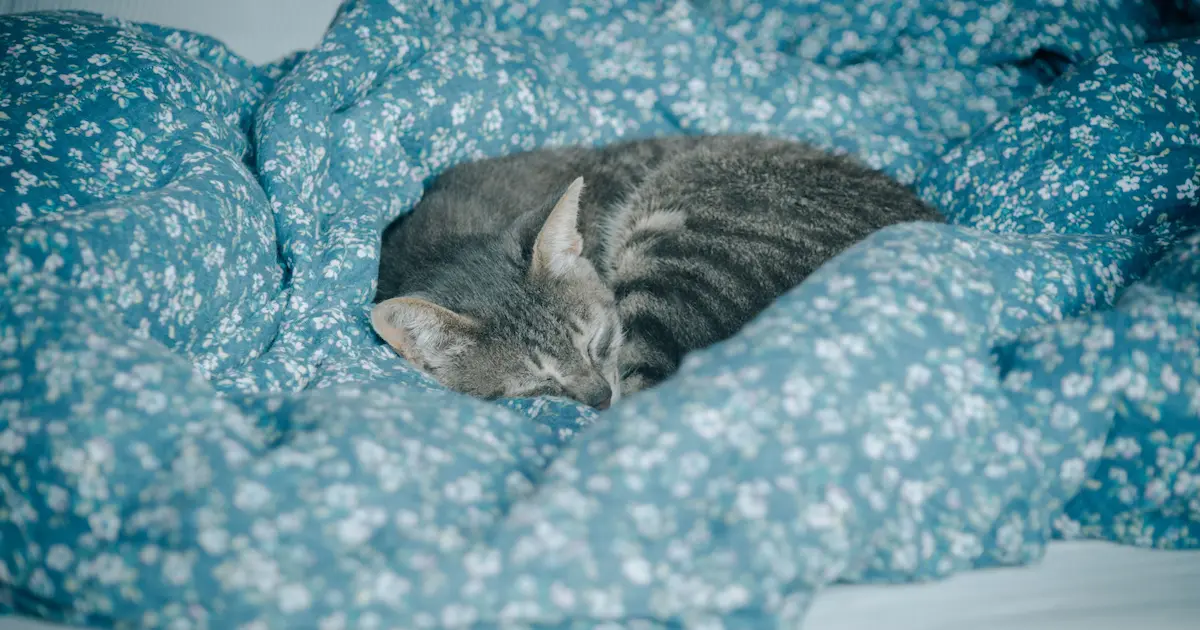
You climb into bed, and within seconds there’s a warm little body pressing into your shins. Or your chest. Or your scalp. If you’ve ever wondered whether that spot actually means something, you’re not imagining it. It does.
Cats are picky about where they sleep, and your bed is prime real estate. The exact spot your cat claims is a quiet little message about how safe, bonded, and comfortable they feel with you. Here’s how to read it, spot by spot.
- A cat that sleeps on your bed at all already trusts you, since cats sleep deeply only where they feel safe.
- Spots closer to your head and chest signal the strongest bonding; spots toward your feet show affection plus a desire for an easy exit.
- Cats run warmer than humans, around 100.5 to 102.5°F, so they actively seek out the warmest spots like your head and the gap between your legs.
- A sudden change in where your cat sleeps, paired with hiding, appetite loss, or restlessness, can signal pain or illness and is worth a vet visit.
- Infants and babies should never share a bed with a cat, and people with weak immune systems should weigh the small zoonotic risk.
Where your cat sleeps on your bed and what it means
Where your cat sleeps on your bed reflects how they balance affection against their instinct to stay alert. The closer to your head and chest, the stronger the bond and the more your cat craves your scent and warmth. The closer to your feet and the edge of the bed, the more your cat wants an easy escape route while still staying near you. Here’s the full map at a glance.
| Sleeping Spot | What It Usually Means |
|---|---|
| On your head or pillow | Strong bonding and scent-seeking; your head is the warmest, most still spot on the bed |
| On your chest | Deep attachment; your heartbeat and breathing rhythm soothe them like a nursing kitten |
| At your feet | Affection with independence; warmth plus a clear view of the room and an easy exit |
| Between your legs | Nesting for warmth and security; your legs form a protected, enclosed den |
| Next to you, not touching | Trust and contentment; some cats simply bond without needing physical contact |
| Under the covers | Comfort and high trust; the enclosed warmth mimics a safe hiding den |
None of these spots ranks higher than another. A confident, independent cat may love you just as much from the foot of the bed as a clingy one does from your chest. The spot tells you about their personality, not the size of their heart.
Why does my cat sleep on my head or pillow?
Cats sleep on your head or pillow because it’s the warmest, stillest, and most scent-rich spot on the whole bed. Humans lose a lot of heat through their heads, and since you usually sleep with everything but your head under the covers, the area around your scalp stays toasty. Your head also moves the least while you sleep, so your cat gets fewer disturbances.
There’s a bonding layer too. Your face and scalp carry your strongest natural scent, and cats find that smell deeply reassuring. Choosing to sleep right beside your strongest scent is a sign your cat feels secure with you. Some behaviorists also think head-sleeping cats are subtly keeping watch over you, staying near your eyes and ears, the parts of you that would notice danger first.
Why does my cat sleep on my chest?
Cats sleep on your chest because they’re drawn to your warmth, your heartbeat, and the gentle rise and fall of your breathing. These sensations echo what a kitten feels nestled against its mother while nursing, which makes your chest one of the most comforting places a cat can be. Chest-sleeping cats are often the most bonded to their main person in the household.
Sleeping on your chest also lets your cat lay their scent on you while they doze. Cats have scent glands across their face and body, and rubbing or resting against you marks you as part of their trusted circle. In cat language, that’s a quiet way of saying you belong to them.
Why does my cat sleep at my feet?
A cat that sleeps at your feet is showing affection while holding on to a bit of independence. The foot of the bed gives your cat your warmth and closeness, plus a clear view of the whole room and a quick, unblocked exit if anything startles them. Cats with a watchful, slightly cautious personality tend to favor this spot.
Here’s the reassuring part. Sleeping at your feet is not a sign your cat loves you less. Cats are both predator and prey by instinct, so many feel calmer resting somewhere they can spring up and move fast. Your feet let them stay close to you without feeling boxed in.
Why does my cat sleep between my legs?
Cats sleep between your legs because the space forms a warm, enclosed den that satisfies their instinct to rest in protected, walled-in spots. Your legs act as natural barriers on both sides, which makes your cat feel hidden and safe, the same reason cats love boxes and cozy covered beds.
Warmth plays a big role too. The gap between your legs traps body heat from both sides, making it one of the warmest spots on the bed. For a heat-loving cat, that’s hard to resist. Just know this position can get uncomfortable for you, even though it’s blissful for your cat.
Why does my cat sleep next to me but not on me?
A cat that sleeps next to you without touching still considers you a source of comfort and safety. Not every cat shows love through physical contact, and choosing to sleep nearby in a relaxed, vulnerable state already signals real trust. Plenty of deeply bonded cats simply prefer their own little patch of mattress.
Some cats also run hot and find direct contact too warm, so they settle a few inches away to cool off while staying close. Others just like a touch of personal space. If your cat sleeps beside you every night, that’s companionship, not rejection.
Why does my cat sleep with me and not my partner?
Your cat likely sleeps with you and not your partner because of warmth, sleeping position, and routine, not favoritism in the way humans mean it. If you run warmer, lie still, or sleep on your back, you offer a more inviting surface than a partner who shifts around or sleeps curled up. Cats gravitate toward the most comfortable, predictable option.
Bonding and scent matter too. Cats often pick the person who feeds them, plays with them most, or whose scent and rhythm they find most familiar. If your partner wants in on the cuddles, feeding the cat, daily play, and a calm, still sleeping posture can shift the cat’s preference over time.
Is it OK to let your cat sleep in your bed?
For most healthy adults, letting your cat sleep in your bed is perfectly fine and can even feel comforting for both of you. The decision comes down to your sleep quality, any allergies, and who else shares the home. There are a few real safety points worth knowing before you make it a habit.
- Babies and young children: Infants should never share a bed, crib, bassinet, or cot with a cat, because of a genuine suffocation risk. Keep cats out of any sleep space used by a baby or toddler.
- Allergies: Even if you tolerate a cat in the house, sleeping with one means more dander against your face all night, which can worsen symptoms for allergy sufferers.
- Weak immune systems: People who are immune-compromised, elderly, or very young face a slightly higher risk of zoonotic illnesses like cat scratch disease or ringworm, so co-sleeping is worth discussing with a doctor.
- Your sleep: Cats are most active at dawn and dusk, so a bed-sharing cat may wake you early. If your sleep suffers, a cozy cat bed beside yours is a fair compromise.
Healthy individuals who keep their cat on a regular vet schedule and parasite prevention have a low risk overall. For many cat parents, the extra bonding time is well worth it.
When a change in where your cat sleeps is worth a vet visit
A sudden change in where your cat sleeps is usually harmless, but it can occasionally signal pain, stress, or illness, especially when other symptoms show up alongside it. Cats often shift sleeping spots for ordinary reasons: a new room temperature, a different scent, a noise, or simply a mood to mix things up. Context is what tells you whether to relax or pay attention.
A cat that suddenly seeks much more closeness, or one that suddenly retreats and stops sleeping with you, can both be worth a closer look. Cats in pain may become restless or hide, and cats that feel unwell sometimes cling for reassurance. Watch for these red flags and call your vet if the spot change comes with any of them:
- Loss of appetite or noticeable weight change
- Hiding, withdrawal, or sudden avoidance of you
- Lethargy, restlessness, or trouble settling
- Excessive meowing, especially at night
- Limping, stiffness, or sensitivity when touched
- Changes in litter box habits
This article is educational and not a substitute for veterinary care. If your cat’s behavior changes suddenly and is paired with any physical symptom, have a licensed veterinarian check them out. A spot change on its own, with a happy and healthy cat otherwise, is almost always nothing to worry about.
Frequently Asked Questions
Q: What does it mean when my cat sleeps in the loaf position on my bed?
The loaf position, with paws tucked under and head upright, means your cat is resting while staying lightly alert. Loafing cats are relaxed in their environment but keep their paws ready to move. Cool temperatures can also encourage loafing, since tucking the paws in helps your cat hold onto body heat.
Q: Why does my cat sleep on its back with its belly exposed next to me?
A cat sleeping belly-up is showing the highest level of trust. The belly is a cat’s most vulnerable area, so exposing it means they feel completely safe with you and their surroundings. Not every cat does this, so take it as a real compliment. Resist the belly rub, though, since many cats will still swat if you touch that sensitive spot.
Q: Why does my cat move sleeping spots in the middle of the night?
Cats move spots at night to chase warmth, follow your movements, or adjust to noise and light. As you shift in your sleep, a warm pocket opens up somewhere else on the bed, and your cat relocates to it. This is normal behavior and not a sign of anything wrong as long as your cat is otherwise healthy and content.
Q: Does my cat have a favorite person based on where it sleeps?
Yes, many cats choose a favorite person and show it through where they sleep. Cats tend to pick the human who offers the most warmth, food, play, and a calm, predictable presence. If your cat consistently sleeps closest to one person, that person is likely their most trusted human in the home.
Q: Do cat sleeping positions change as they get older?
Yes, cat sleeping habits often change with age. Kittens tend to sprawl and pile up, while older cats may seek warmer, softer, more enclosed spots to ease stiff joints. A senior cat that suddenly changes where it sleeps could be managing arthritis or discomfort, so mention any sudden change to your vet.
Q: Why does my cat sleep on me only when I’m sick or sad?
Cats are sensitive to your warmth, scent, and emotional state, and many respond to it by staying close. When you’re sick, your body may run warmer or you may rest more, both of which draw a cat in. Some cats also seem to offer comfort by sticking near you, though this is closeness and reassurance rather than a medical sense for diagnosis.
Q: Should I let my cat sleep under the covers with me?
Letting your cat sleep under the covers is usually safe for a healthy adult, since cats can move freely and won’t suffocate the way an infant might. Make sure your cat can get out easily and isn’t overheating. If you have allergies or breathing issues, keeping the cat on top of the blanket is the better choice.
Q: My cat suddenly stopped sleeping with me. Is something wrong?
A cat that stops sleeping with you is often just chasing a more comfortable or quieter spot, especially after a change in temperature, scent, or routine. It becomes a concern only when paired with other signs like hiding, appetite loss, or lethargy. If your cat seems happy and healthy otherwise, the change is almost certainly harmless.

Hello and welcome to The Ideal Cat!
We are some passionate cat owners from different professions. We love our cats and have a lot of experience in how to care for our pets. We are incredibly excited to share our knowledge, experience, and research with you. So you can take good care of your loving cat. We will answer most of the common questions about owning cats, taking care of them, etc. If you have any question contact with us. Thanks for visiting! Enjoy the content.
