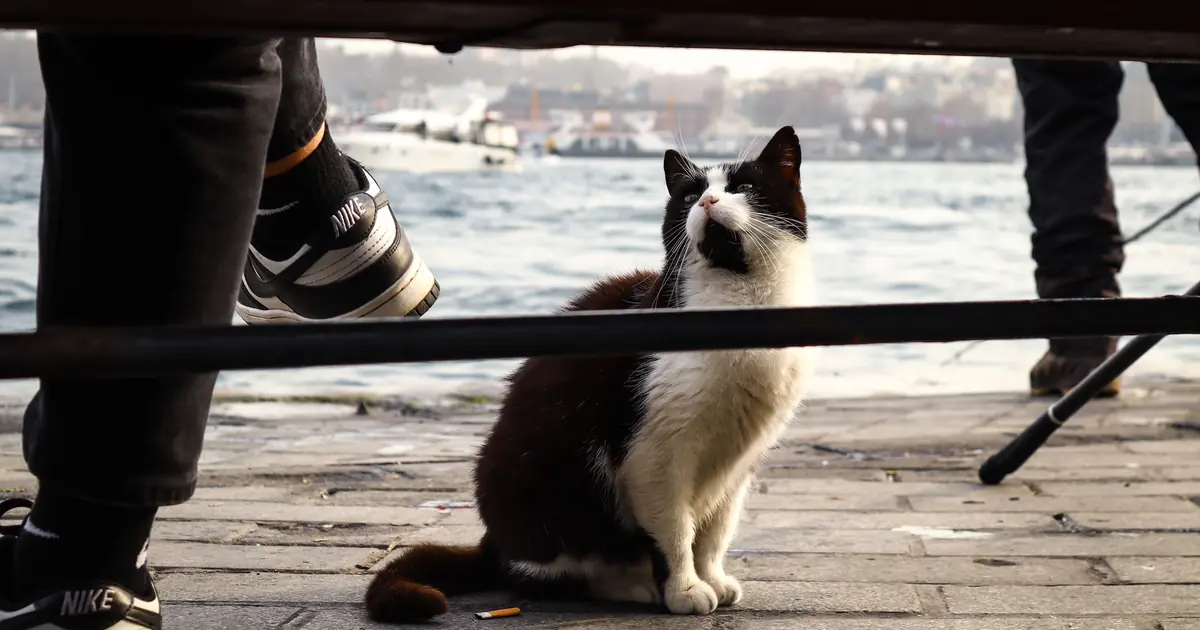
You walk into the bedroom and there she is: curled up in your left sneaker like it’s a five-star cat bed, one ear twitching, completely unbothered that your foot has to go somewhere else tonight. Or maybe it’s your work boots she rubs her cheek all over the second you take them off, purring like she just found the best thing in the house.
Here’s the thing: your cat isn’t confused about what a shoe is for. She’s not trying to wear it. She’s reading it, the same way you’d read a text from a friend. Shoes are basically a scent diary of your whole day, and cats find that irresistible.
- Cats have 45 to 80 million scent receptors in their nose, compared to roughly 5 to 20 million in a human, which is why a shoe’s smell means so much more to them.
- Shoes carry your scent plus outdoor pheromones, sweat, and dirt, which is why cats often sniff, rub, or curl up on them.
- Rubbing against a shoe with the cheek or head is a behavior called bunting, and it’s a cat’s way of scent-marking you and your belongings as part of its territory.
- Cats have a flehmen response, an open-mouthed grimace, that helps their vomeronasal organ analyze strong scents like sweat and pheromones on a shoe.
- Chewing on shoelaces can be a choking or intestinal blockage risk, so keep laces and small shoe parts out of reach of cats that like to chew.
Why Do Cats Like Shoes So Much?
Cats like shoes because shoes hold a concentrated dose of your scent along with everything you walked through that day. A cat’s nose is built for this kind of detective work. Cats have somewhere between 45 and 80 million olfactory receptors, while people get by with about 5 to 20 million. Your shoes smell like you, like your workplace, like the sidewalk, and like every dog or squirrel you passed. To your cat, that’s basically the evening news.
It’s not just about novelty either. Your cat already knows your scent better than almost anything else in its world, and finding a strong, concentrated version of it on a shoe is comforting, not just interesting. Think of it as your cat checking in on you, one sniff at a time.
Why Is the Smell of Shoes So Powerful to a Cat?
Shoes are powerful to cats because they combine three things a cat’s nose is wired to care about: your personal scent, outdoor smells, and sweat-based pheromones. Feet have a high concentration of sweat glands, and that sweat carries chemical signals cats are built to pick up on.
When a cat gets a really strong whiff, you might catch it doing that odd, open-mouthed grimace with its lips curled back. That’s called the flehmen response, and it looks a little like your cat just smelled something scandalous. It’s actually your cat routing air over its vomeronasal organ (also called the Jacobson’s organ), a special scent-processing structure on the roof of the mouth just behind the front teeth. According to VCA Animal Hospitals, this organ lets cats analyze pheromones in a way that’s been described as tasting and smelling a scent at the same time. Shoes, loaded with sweat and outdoor pheromones from other animals, are basically a jackpot for that system.
Why Do Cats Sleep On or Curl Up in Your Shoes?
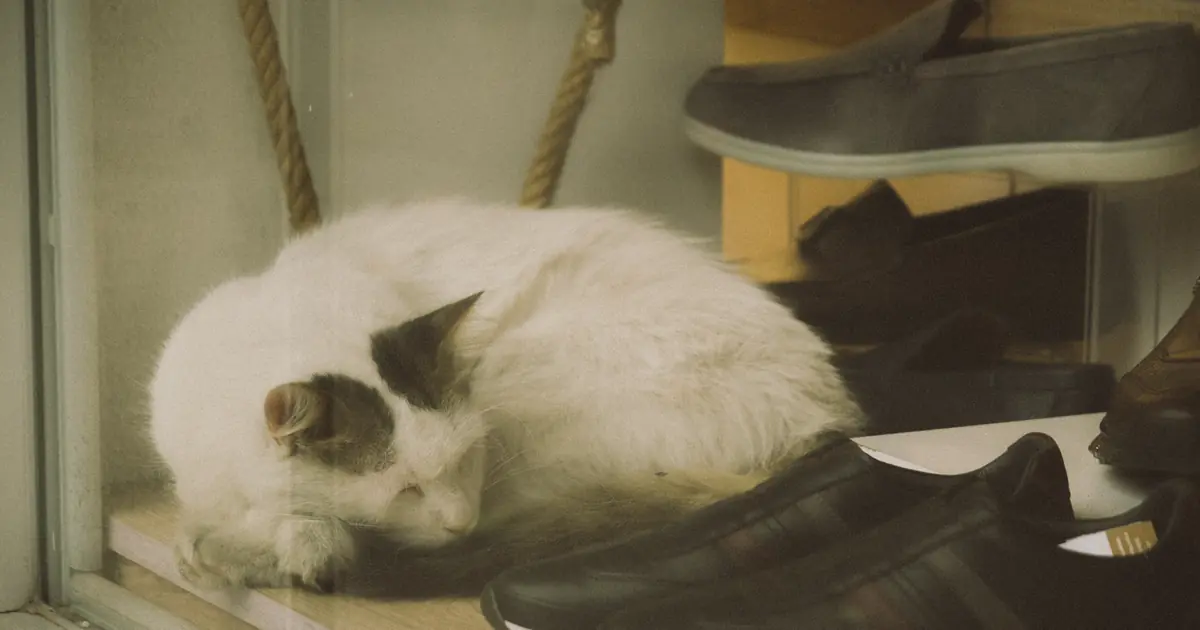
Cats sleep on or in shoes because the shape is small and enclosed, and it’s soaked in your scent, which reads as safe. Cats are natural fans of tight, tucked-away spaces. A shoe checks the same boxes as a box or a paper bag: snug walls, low visibility, one entrance. Add your scent to that setup and it’s basically a security blanket you can wear.
This is closely related to why cats gravitate toward other warm, personal spots around the house, like your favorite heating pad or sunny windowsill. Comfort, warmth, and your scent all pull a cat toward the same kinds of resting spots, shoes included.
Why Do Cats Rub Their Face or Body Against Your Shoes?
Cats rub against shoes to scent-mark them and claim them as part of their territory. This behavior has a name: bunting. Cats have scent glands on their cheeks, chin, forehead, and the base of their tail, and rubbing those glands against an object deposits their own scent right on top of yours.
According to International Cat Care, bunting is generally a form of territorial and social scent-marking, and it tends to happen most in the areas a cat considers its safest, most familiar territory. That’s exactly why your cat headbutts and cheek-rubs your shoes right by the front door: it’s the same bonding gesture your cat uses when it headbutts you, and it’s closely related to the greeting behavior behind why your cat puts its butt in your face as a sign of trust.
Why Do Some Cats Bite or Chew Shoelaces?
Cats bite or chew shoelaces because the thin, dangling texture triggers their play and prey drive. A shoelace moves in short, jerky little tugs whenever you walk, and that’s basically the same motion as a mouse tail or a dragged toy. For a cat, that’s an invitation to pounce.
For some cats it’s also just about texture. Laces are fun to chew because they’re thin, a little stretchy, and easy to grip with front teeth. If your cat treats shoelaces like a chew toy rather than a passing swat, it’s worth reading up on why cats bite in general, since play biting and prey biting often overlap.
Is It Safe for Cats to Play With or Sleep on Shoes?
Sleeping on or sniffing shoes is safe for most cats, but chewing laces or licking outdoor soles carries real risk. A shoelace that gets swallowed, even partially, can cause choking or a linear foreign body obstruction in the intestines, which usually needs a vet visit or surgery to fix. Small shoe parts like grommets, tips, or decorative beads carry the same risk if a cat manages to pull one loose.
Outdoor shoe soles are the other thing to think about. They can track in de-icing salt, lawn chemicals, antifreeze residue, or other substances that aren’t meant to be licked. The ASPCA notes that redirecting a cat’s attention toward safe, appropriate objects works far better than just removing every tempting item, which is good news since you probably can’t hide every shoe in the house forever.
This article is educational and not a substitute for veterinary advice. If your cat swallows part of a shoelace or shoe, or suddenly stops eating, vomits repeatedly, or seems lethargic, call your vet or an emergency animal hospital right away.
How Do You Redirect a Cat’s Shoe Obsession?
You can redirect a cat’s shoe obsession by giving it a similar, safer outlet: a worn t-shirt with your scent, a snug cat cave bed, or a wand toy with dangling fabric strips. Store shoes in a closed closet or cabinet if your cat is a serious chewer, especially overnight when nobody’s watching.
A few things that tend to work well:
- Give your cat an old, unwashed t-shirt or sock to sleep on instead of your shoes.
- Swap shoelace-chewing for a wand toy with a fabric or feather tail your cat can safely bite and “kill.”
- Store shoes with dangling laces inside a closet, bin, or shoe rack with a door.
- Add more scratching, climbing, and play time, since a bored cat often finds its own entertainment, laces included.
Shoe Behaviors and What They Mean
| Shoe Behavior | Why Cats Do It |
|---|---|
| Sleeping or curling up in a shoe | Enclosed, snug shape plus your scent reads as safe and comforting |
| Rubbing cheeks or head on a shoe (bunting) | Scent-marking to claim the shoe, and you, as part of its territory |
| Sniffing intensely, sometimes with an open-mouth grimace | Investigating sweat and pheromones, often triggering the flehmen response |
| Biting or chewing a shoelace | Prey drive triggered by the lace’s movement, plus enjoyment of the texture |
Frequently Asked Questions
Q: Why does my cat sleep on my shoes specifically, and not other objects?
Your cat sleeps on your shoes because they’re one of the most concentrated sources of your personal scent in the house, combined with a snug, enclosed shape cats naturally seek out for napping. Other objects rarely combine both of those things as well as a shoe does.
Q: Is it bad for my cat to sleep in my shoes?
Sleeping in a shoe is generally harmless for most cats and is just a comfort behavior. The main concerns are hygiene, since outdoor soles can carry dirt or chemical residue, and safety if the shoe has laces or small parts a cat could chew loose and swallow.
Q: Why does my cat like the smell of my dirty shoes?
Dirty shoes carry a stronger, more concentrated version of your scent along with sweat-based pheromones, and cats have 45 to 80 million scent receptors built to pick up on exactly that kind of chemical detail. The stronger the smell, the more information your cat gets.
Q: What is the flehmen response and why does my cat make that face near my shoes?
The flehmen response is an open-mouthed, lip-curled grimace cats make when they route a strong scent to their vomeronasal organ, a scent-processing structure on the roof of the mouth. Sweaty shoes and outdoor pheromone traces are common triggers for this response.
Q: Why does my cat rub its face all over my shoes when I get home?
Your cat is bunting, which means it’s depositing its own scent from glands on its cheeks and forehead onto your shoes. This mixes its scent with yours and marks you, and your shoes, as part of its territory and social group.
Q: Are shoelaces dangerous for cats to chew on?
Yes, shoelaces can be dangerous if a cat manages to bite off and swallow a piece. Long, thin strings and laces can cause a linear foreign body obstruction in the intestines, which is a real medical emergency that usually requires veterinary treatment.
Q: How do I stop my cat from being obsessed with my shoes?
Give your cat a similar but safer scent outlet, like an old t-shirt or sock, and store tempting shoes inside a closed closet, cabinet, or bin. Adding more daily play and enrichment also helps, since cats that are bored or under-stimulated often redirect that energy toward shoes and laces.
Q: Do all cats like shoes, or is this a specific personality trait?
Not every cat fixates on shoes, since interest depends on how scent-driven and playful an individual cat is. Kittens and younger cats tend to show more shoelace-chasing behavior, while the sleeping-in-shoes habit shows up in cats of any age that are drawn to your scent and enclosed spaces.

Hello and welcome to The Ideal Cat!
We are some passionate cat owners from different professions. We love our cats and have a lot of experience in how to care for our pets. We are incredibly excited to share our knowledge, experience, and research with you. So you can take good care of your loving cat. We will answer most of the common questions about owning cats, taking care of them, etc. If you have any question contact with us. Thanks for visiting! Enjoy the content.
