
If you’ve ever walked into a room and found your cat frozen at the window, tail twitching, eyes locked on something you can’t even see, you know the look. It’s total focus. Half hunter, half couch potato with a great view.
Cats spend a huge chunk of their lives napping, but when they’re awake, they want a job. A window gives them one: a front-row seat to birds, bugs, falling leaves, and every other tiny drama happening outside your walls.
- Cats are drawn to windows mainly for three reasons: visual stimulation (“cat TV”), warmth from the sun, and the ability to monitor their territory from a safe spot.
- Watching birds and squirrels through a window triggers a cat’s natural hunting instinct, even though the glass keeps the actual hunt out of reach.
- The chattering or chirping sound cats make at birds is thought to be linked to hunting frustration or excitement, though the exact cause is still debated by researchers.
- Window perches and enrichment like this are considered valuable for indoor cats, since they provide mental stimulation that helps prevent boredom and stress.
- Secure window screens matter: cats can fall from open windows, a serious risk vets call “high-rise syndrome.”
Why do cats like sitting at windows?
Cats like sitting at windows because it gives them a safe, elevated spot to satisfy three instincts at once: watching prey, staying warm, and keeping an eye on their territory. A window ledge or sill checks all three boxes without your cat ever leaving the couch, letting a natural-born observer gather information about what’s moving nearby, minus the risk of running into a raccoon.
Why do cats stare out the window for hours (“cat TV”)?
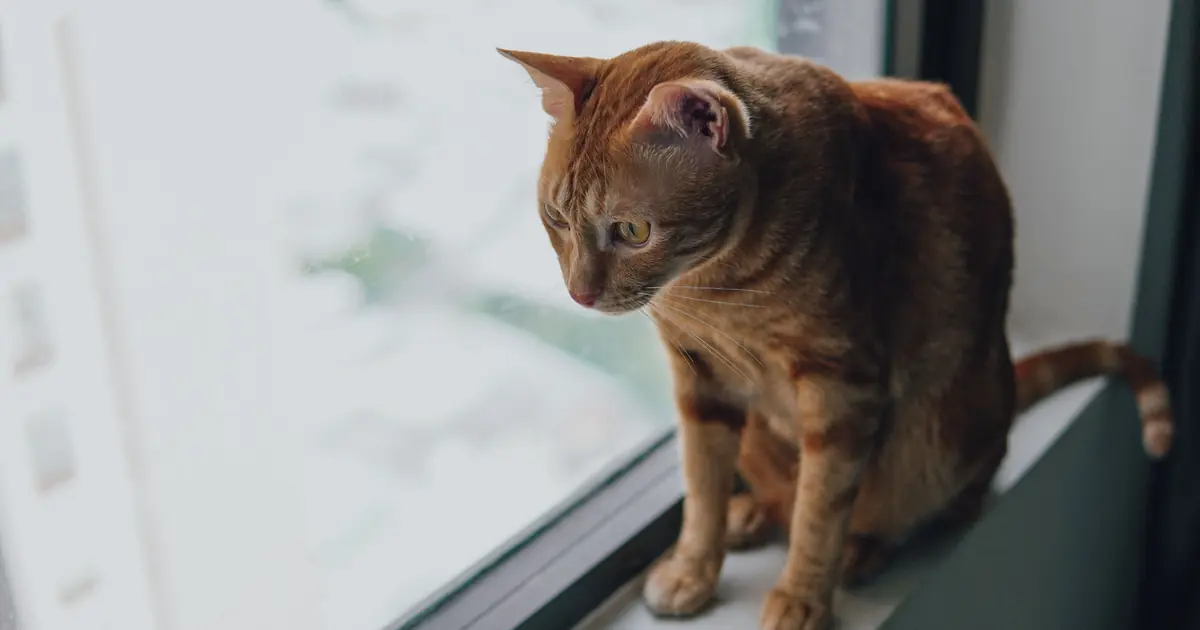
Cats stare out the window because moving birds, squirrels, and insects trigger their hunting instinct, the same drive that makes them chase a laser pointer or a toy mouse. Cat parents often call this “cat TV,” and it’s a fitting name. It’s genuinely entertaining to a predator’s brain.
Domestic cats retain a strong prey drive even after generations indoors, and International Cat Care notes that this kind of visual stimulation is one of the best ways to keep an indoor cat mentally engaged. A bird on a feeder or a squirrel darting across the yard can hold a cat’s attention for a surprisingly long time. If your cat enjoys screens too, you might see similar focus while watching videos of birds on TV, though a real window usually wins thanks to the smells and sounds that come with it.
Why do cats like sitting in sunny windows?
Cats like sunny windows because the warmth feels good and helps them conserve energy, something their bodies are wired to seek out. A sunbeam on a windowsill is basically a free heating pad, and cats have a naturally higher normal body temperature than humans (generally 100.5 to 102.5 degrees Fahrenheit), so that warmth genuinely feels better to them than it does to us. If your cat rotates around the house like a little sundial, that’s why. Our guide on why cats like to sunbathe covers this in more depth.
Why do cats guard windows like they’re watching over their territory?
Cats guard windows because it lets them monitor their territory from a safe, elevated vantage point, a habit rooted in their instinct to know what’s happening on their turf. Even indoor cats treat the view outside as part of their domain. You might notice a favorite window, or a favorite hour, when the mail carrier or a neighborhood cat tends to pass by, since that view becomes part of their daily patrol even if the patrol happens entirely from a cushion.
Why do cats sniff at open windows and screens?
Cats sniff at open windows because fresh air carries scents and information they can’t get anywhere else in the house, like other animals, plants, and food smells drifting by. A cat’s sense of smell is far sharper than a human’s, so a cracked window, even behind a secure screen, is basically a scent newsfeed worth investigating nose-first.
Why do cats chatter or chirp at birds through the window?
Cats chatter or chirp at birds because they’re reacting to prey they can see and hear but can’t reach, a mix of excitement and hunting frustration. That fast jaw-clacking sound, sometimes paired with little chirping noises, tends to show up specifically when a bird or squirrel is close but separated by glass.
Researchers don’t have one single confirmed explanation. Some think it mimics the killing bite cats use on small prey, others think it’s an involuntary reaction to frustration. Either way, it’s a normal hunting-related behavior, not a sign of distress. Our full breakdown of why cats chatter at birds digs into the leading theories.
Can window-watching ever be bad for cats?
Yes, window-watching can turn stressful when your cat spots another cat, a stray, or a dog it can’t chase off, and that stress sometimes spills into what’s called redirected aggression: a cat, worked up over something outside, swats or bites a nearby person or pet simply because it needs somewhere to put that energy. Watch for growling or hissing at the glass, dilated pupils, a puffed tail, or sudden snappiness right after leaving the window.
If your cat has ever lashed out seemingly out of nowhere after staring outside, read up on sudden aggression in cats, since redirected aggression is one of the more common, and more misunderstood, causes.
Is window-watching good enrichment for indoor cats?
Yes, window-watching is genuinely good enrichment for indoor cats, since it provides mental stimulation and a low-effort way to prevent boredom. The ASPCA lists window access among the recommended ways to enrich an indoor cat’s environment, since bored cats are more prone to weight gain and destructive scratching. Pairing window time with a few minutes of interactive play with toys each day rounds things out nicely.
How do you make a window safe and cat-friendly?
You make a window cat-friendly by adding a secure perch, double-checking that screens can’t be pushed out, and managing the view if it’s causing your cat stress.
- Install a window-mounted perch or hammock rated for your cat’s weight, at a comfortable height.
- Check that screens are locked in and sturdy, not just resting in the frame, since cats can push through weak ones.
- Never leave a window open without a secure screen, since falls from height (“high-rise syndrome”) can cause serious injury.
- Keep furniture that could help a cat squeeze past a screen pushed away from open windows.
- If a stray cat or dog outside is causing stress, use frosted film or a curtain to block that specific sightline.
Cats that lounge on flat surfaces sometimes also gravitate toward paper or cardboard on the sill (see our piece on why cats like sitting on paper). For a dedicated setup, check our guide to the best cat window hammocks.
What makes a window appealing to a cat? A quick comparison
| Window feature | Why cats love it |
|---|---|
| Movement outside (birds, squirrels, insects) | Triggers natural hunting and prey-tracking instincts |
| Direct sunlight | Provides warmth and helps cats conserve body heat |
| Elevated view of the yard or street | Lets cats monitor and “guard” their perceived territory |
| Fresh air through a screen | Carries scents and sounds cats can’t get indoors |
| Quiet, cushioned perch | Combines comfort with a good vantage point for napping |
A quick safety note: window perches are wonderful enrichment, but only if the screen is genuinely secure. Falls from windows, known as high-rise syndrome, send cats to the vet every year, and even calm cats can be startled into pushing against a screen. If your cat becomes noticeably agitated after watching another animal outside, manage the view rather than assuming it will pass. This article is educational, not a substitute for guidance from a licensed veterinarian, especially if you see ongoing stress or aggression.
Frequently Asked Questions
Q: Why does my cat sit in the window all day?
Your cat sits in the window all day because it combines three favorite things: something to watch, a warm sunny spot, and a good view of their territory. For a cat with limited outdoor access, it can be the most stimulating spot in the house.
Q: Is it bad for cats to stare out the window for hours?
No, that’s normal and often a form of enrichment rather than a problem. It only becomes a concern if your cat seems distressed or shows aggression toward people or other pets right after watching something outside.
Q: Why does my cat make weird noises at birds through the window?
Cats make chattering or chirping noises at birds through a window as a reaction to seeing prey they can’t reach, likely tied to hunting excitement or frustration. It’s considered a normal behavior and isn’t a sign of pain or illness.
Q: Can cats fall out of windows?
Yes, cats can fall from open windows, and veterinarians refer to the resulting injuries as high-rise syndrome. Always use a secure, properly fitted screen, since cats can misjudge distances or get startled while perched on a sill.
Q: Do cats get stressed watching other cats outside?
Yes, some cats get visibly stressed watching a stray cat wander through their territory. This can lead to growling, pacing, or redirected aggression toward a nearby person or pet, so blocking that specific view can help if it becomes a pattern.
Q: Should indoor cats have access to a window?
Yes, window access is widely recommended as enrichment for indoor cats, since it gives them visual stimulation and a way to safely engage their natural instincts. A secure perch with an active view tends to get the most use.
Q: What is redirected aggression in cats?
Redirected aggression happens when a cat gets worked up over something it can’t reach, like an animal outside a window, and then turns that frustration on a nearby person or pet. It can look sudden and unprovoked, but it usually traces back to whatever triggered the cat moments earlier.
Q: How high should a cat window perch be?
A cat window perch should sit at a comfortable, stable height your cat can reach easily, typically mounted directly on the sill rather than somewhere requiring a big jump. It should also be weight-rated and installed securely so it can’t tip or slide.

Hello and welcome to The Ideal Cat!
We are some passionate cat owners from different professions. We love our cats and have a lot of experience in how to care for our pets. We are incredibly excited to share our knowledge, experience, and research with you. So you can take good care of your loving cat. We will answer most of the common questions about owning cats, taking care of them, etc. If you have any question contact with us. Thanks for visiting! Enjoy the content.
