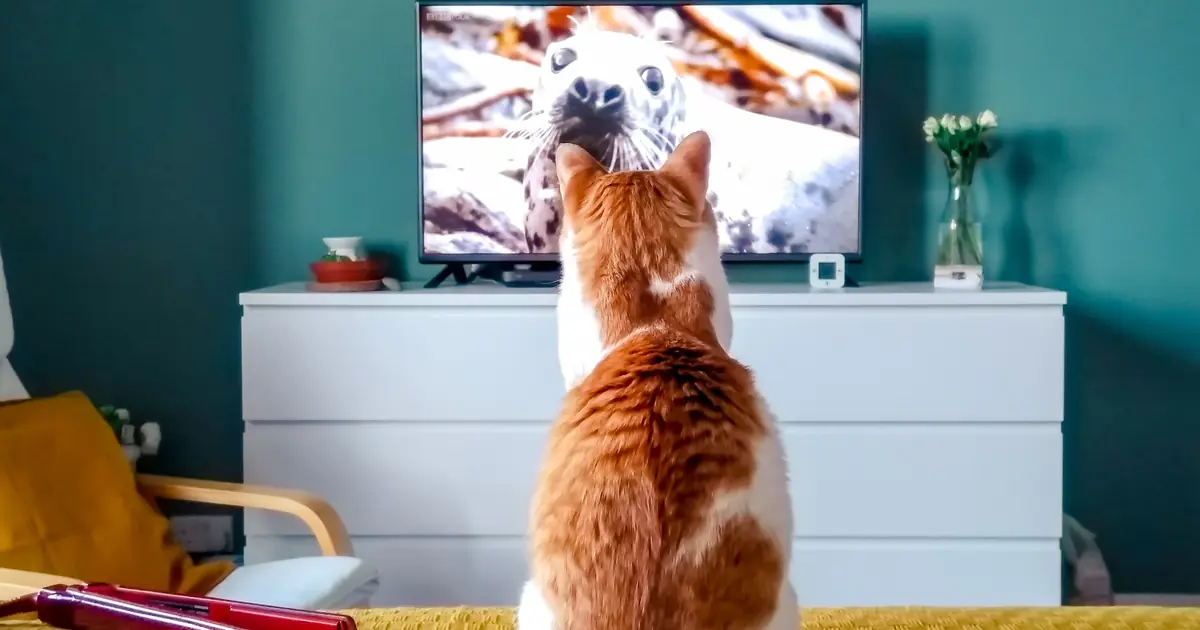
Picture this: you sit down to watch a nature documentary, and halfway through the bird migration scene your cat is suddenly glued to the screen. Ears forward, tail twitching, maybe even a paw creeping toward the TV stand. It’s not your imagination, and it’s not just you.
Cats really can watch and react to television, though what’s happening in their brain while they do it is a little different from what happens in yours. Some cats will sit through an entire fish tank video like it’s the season finale of their favorite show. Others glance at the screen once and go back to napping. Both reactions are completely normal.
- Cats have a higher flicker fusion rate than humans, so old low-refresh TVs looked like flickering strobe lights to them, while modern high-refresh screens look smooth and lifelike.
- Cats are dichromatic, meaning they see the world mainly in blues and yellows and have a much harder time picking out reds and greens.
- Fast, erratic motion (birds, fish, mice, “cat TV” prey videos) grabs a cat’s attention far more than slow talking scenes or static shots.
- Cats respond to motion and sound on screen, but they don’t follow storylines or understand that what they’re watching isn’t real.
- TV can work as light mental enrichment, but it should never replace real interactive play and hunting-style toys.
Can Cats Actually Watch TV?
Yes, cats can watch TV, and plenty of them do it on purpose. Cats have good motion detection and enough vision to register shapes moving across a screen, especially when those shapes move the way prey animals do. A cat staring at a squirrel scampering across your television isn’t confused, it’s using the same instincts it would use staring out a window.
What separates cats from us here is intent, not ability. You watch TV to follow a plot. Your cat watches because something on it is moving fast and looks a lot like something it would normally chase.
What Do Cats Actually See When They Look at a Screen?

Cats see a blurrier, less colorful, but motion-sharp version of what’s on screen compared to what you see. Two things drive this: their color vision and their flicker sensitivity.
Cats have dichromatic vision, meaning they have only two types of color-sensing cones instead of the three humans have. According to veterinary vision research summarized by AAHA, this means cats see blues and yellows fairly well but struggle with reds and greens, similar to a red-green colorblind person. A bright red cardinal on a nature show doesn’t pop for your cat the way it does for you. It’s the bird’s movement, not its color, that catches their eye.
Flicker fusion rate is the speed at which a series of still images stops looking like a flicker and starts looking like smooth motion. Humans max out around 60 flickers per second. Research referenced by the Cornell Feline Health Center suggests cats process motion at noticeably higher rates than that. Old CRT televisions ran around 60Hz, right at the edge of what a cat’s eyes could smoothly process, so those old screens may have looked like a flickering strobe to a cat rather than a clear picture. Modern TVs commonly run at 120Hz or higher, which clears that bar and looks smooth to feline eyes too. That’s a big part of why cats seem far more interested in screens today than they did a couple decades ago.
Why Are Cats Drawn to Certain Shows and Not Others?
Cats key in on fast, erratic prey-like motion, which is why bird, fish, and rodent footage grabs them so reliably. Small, quick, unpredictable movement mimics exactly what a mouse or a sparrow looks like in real life, and a cat’s brain is wired to notice it instantly.
That’s exactly why “cat TV” videos, full of birds at a feeder or fish in a tank, have become so popular. They’re a highlight reel of everything a cat’s hunting instinct is built to notice. A slow-panning shot of a talking head on the news barely registers. There’s no darting, nothing that says “prey” to a cat’s brain.
If your cat already goes wild for a laser pointer, expect the same intensity when a mouse scurries across the screen during a movie.
Do Cats Understand What’s Happening on TV?
No, cats don’t understand plots, characters, or storylines the way people do. They react to motion and sometimes sound in the moment, but they aren’t following a narrative or recognizing the birds on screen as the “same” birds from scene to scene.
Your cat isn’t rooting for a character or waiting to see how an episode ends. It’s reacting, almost reflexively, to a specific stimulus: something small and fast moving across a flat glowing surface. Turn off the sound and keep the birds flying and most cats stay just as interested. Add sound with no motion, like a podcast over a still image, and most cats lose interest fast. Motion is doing nearly all the work.
Is Watching TV Good or Bad for Cats?
Watching TV is generally fine for cats in small doses and can work as light mental enrichment, but it should never replace real play. A screen can hold a cat’s attention for a few minutes and give an under-stimulated indoor cat something to focus on.
Here’s the catch though: TV offers zero physical payoff. A cat can watch a mouse dart across the screen all day and never actually pounce, bite, or “catch” anything, and that lack of resolution can be mildly frustrating rather than satisfying. International Cat Care notes that indoor cats need real opportunities to express hunting behavior, not just visual stimulation, to stay mentally healthy. Treat cat TV like background noise: a nice extra, never the main event. Pair screen time with actual play using interactive cat toys that let your cat finish the hunt by actually catching something.
What If My Cat Pounces or Scratches at the Screen?
If your cat swats, pounces, or claws at the TV, treat it as a sign their hunting instinct is fully engaged and redirect that energy to a toy right away. Screens aren’t built to survive claws, and an excited cat mid-pounce isn’t thinking about your electronics bill.
A few practical fixes:
- Keep a wand toy or plush mouse within arm’s reach during TV time so you can redirect a pounce instantly.
- Avoid leaving cat TV videos running unattended if your cat gets physical with the screen, especially with a wall-mounted TV.
- Trim your cat’s nails regularly or use soft nail caps if scratching at screens is a recurring habit.
- Give your cat a scratching post near the TV area as an obvious, acceptable outlet.
If this kind of screen-triggered burst of energy looks familiar, read up on why cats get the zoomies, since it’s often the same pent-up hunting drive showing up differently.
Do All Cats Like Watching TV?
No, not every cat cares about television, and that’s completely normal. Interest in screens comes down to personality, prey drive, and how much a cat relies on vision versus smell and hearing to explore the world.
Some cats are visual hunters through and through and will track anything that moves, screen or not. Others are more scent and sound driven and barely glance at a TV even at full volume. Age plays a role too. Kittens and younger cats tend to engage with screens more than laid-back senior cats who’d rather nap through the whole thing.
| What’s On Screen | Typical Cat Interest Level |
|---|---|
| Fast prey motion (mice, insects, darting animals) | Very high |
| Birds and fish (“cat TV” style videos) | High |
| High-pitched chirps, squeaks, or crinkling sounds | Moderate to high |
| Slow-moving talking-head shows or news | Low to none |
Should You Let Your Cat Watch TV Regularly?
Yes, occasional TV time is perfectly safe for most cats, as long as it supplements real enrichment rather than replacing it. A few minutes of a bird video while you fold laundry isn’t going to hurt anyone, and for a bored indoor cat it can genuinely help break up a long day.
Just keep an eye on the basics. Make sure your cat still gets daily interactive play and has plenty of other things to sniff, climb, and scratch besides the TV. If your cat also seems curious about what’s happening outside a window at night, you might enjoy learning more about whether cats like the dark and how their night vision compares to their daytime vision.
Frequently Asked Questions
Q: Can cats see TV screens clearly?
Cats see TV screens reasonably well for motion, but their overall visual sharpness is lower than a human’s. Cats are estimated to have roughly 20/100 to 20/200 vision compared to a healthy human’s 20/20, so fine detail stays blurry while movement stands out clearly.
Q: Why did old TVs seem to bother cats more than modern TVs?
Old televisions typically ran at around 60Hz, right at the edge of a cat’s flicker fusion rate, the speed at which flickering images blend into smooth motion. That refresh rate may have looked like a flickering strobe to cats, while today’s TVs commonly run at 120Hz or higher and look smooth to feline eyes.
Q: Do cats prefer certain colors on screen?
Cats see blues and yellows more clearly than reds and greens, since they’re dichromatic with only two types of color-sensing cones instead of three. Still, motion matters far more than color to a cat watching TV.
Q: Is it bad for a cat’s eyes to watch TV?
No, occasional TV watching isn’t known to damage a cat’s eyes. There’s no evidence that normal screen brightness causes eye strain in cats, though it’s still smart to keep the volume reasonable and skip marathon screen sessions.
Q: What is “cat TV” exactly?
Cat TV is a genre of video, often looping footage of birds at a feeder, fish in a tank, or small rodents, made to catch a cat’s visual attention. These videos lean on fast, erratic prey-style motion, the single biggest trigger for feline interest on any screen.
Q: Can watching TV replace playtime for my cat?
No, TV should never replace real interactive play. A screen gives a cat visual stimulation but no physical outlet, so it can’t satisfy the full hunt-catch-kill sequence that real toys and play sessions provide.
Q: Why does my cat only react to some parts of a show?
Cats respond to specific triggers like sudden fast motion or high-pitched sounds, not to the show as a whole. A cat might snap to attention during a chase scene and completely ignore a slow dialogue scene minutes later.
Q: Is it safe to leave the TV on for my cat while I’m out?
Yes, leaving the TV on at a reasonable volume is generally safe and can offer mild background stimulation for a cat home alone. It’s not a substitute for enrichment like puzzle feeders or window perches, but it’s a harmless extra if your cat already enjoys it.

Hello and welcome to The Ideal Cat!
We are some passionate cat owners from different professions. We love our cats and have a lot of experience in how to care for our pets. We are incredibly excited to share our knowledge, experience, and research with you. So you can take good care of your loving cat. We will answer most of the common questions about owning cats, taking care of them, etc. If you have any question contact with us. Thanks for visiting! Enjoy the content.
