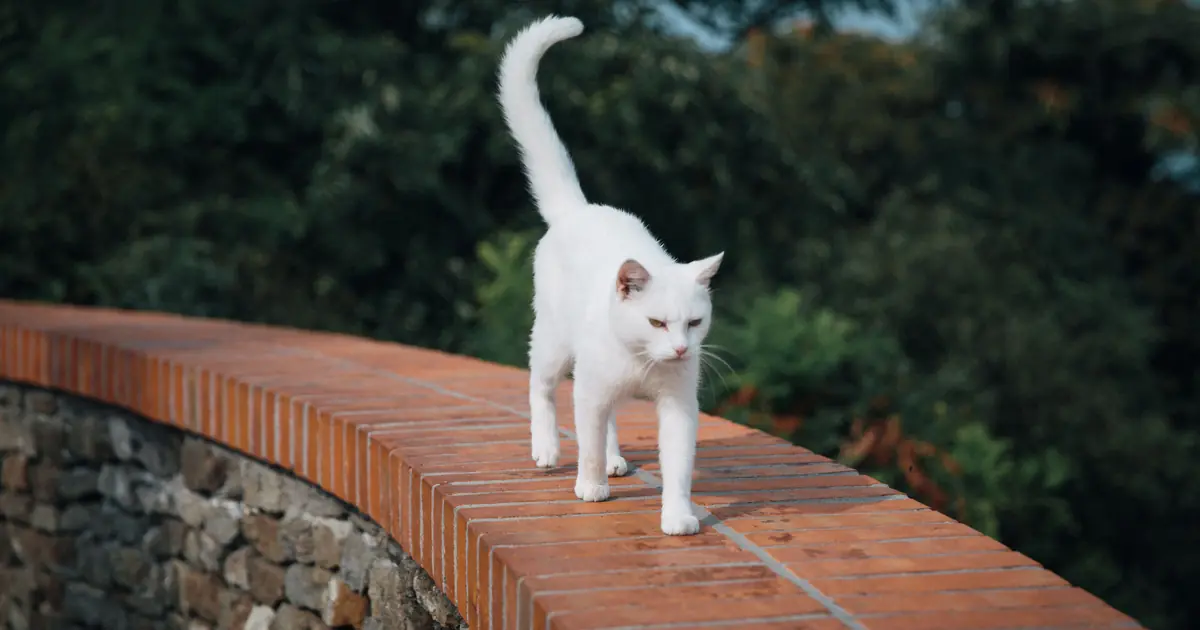
Watch a cat stroll along a skinny fence or twist mid-fall to land upright, and it’s clear these animals are balance geniuses. So how do they actually do it?
Here’s the fascinating teamwork of body parts that keeps a cat so perfectly poised.
- A cat’s balance starts in the inner ear’s vestibular system, its built-in gyroscope.
- The flexible spine and tail act as a counterweight and rudder for fine adjustments.
- The “righting reflex” lets falling cats twist to land on their feet.
- Whiskers, sensitive paws, and sharp vision all feed the cat’s sense of position.
- Sudden loss of balance (stumbling, head tilt, circling) is a vet emergency.
How do cats balance?
Cats balance through a coordinated system led by the inner ear, supported by the spine, tail, whiskers, paws, and eyes. The vestibular system in the inner ear senses head position and motion, acting like a built-in gyroscope, while the flexible spine and tail make constant micro-adjustments to keep the body centered. Whiskers and sensitive paw pads add fine spatial awareness, and sharp vision helps judge distances. Working together, these give cats their famous, seemingly effortless balance.
What role does the inner ear play?
The inner ear’s vestibular system is the core of a cat’s balance. Inside it, fluid-filled canals and tiny sensors detect every tilt, turn, and acceleration of the head, sending that information to the brain to keep the cat oriented in space. This is the same system humans have, but a cat’s is highly refined. It’s what tells a cat which way is up, even in mid-air, and it’s the foundation for the righting reflex that flips a falling cat feet-first.
How does the tail and spine help?
A cat’s flexible spine and tail act as a counterbalance and steering system. The unusually supple spine lets a cat shift and rotate its body to stay centered on narrow surfaces, while the tail works like a tightrope walker’s pole, swinging to offset the body’s movements. When a cat leans one way, the tail counters to keep it from toppling. This is why cats can walk fence tops and railings with ease, and it ties into how much control cats have over their tails.

What is the righting reflex?
The righting reflex is the automatic ability that lets a falling cat rotate to land on its feet. When a cat falls, the vestibular system instantly senses its orientation, and the cat twists its flexible spine, front then back, to bring its paws downward, often within a very short distance. Kittens develop this reflex by a few weeks old. While it makes cats remarkably good at landing safely, it does not make them injury-proof, and falls can still hurt them, as we explain in do cats get hurt when they fall.
The parts of a cat’s balance system
Here’s how each component contributes.
| Body part | Role in balance |
|---|---|
| Inner ear (vestibular system) | Senses head position and motion, the master gyroscope |
| Spine | Flexes and rotates to keep the body centered |
| Tail | Counterweight and rudder for fine adjustments |
| Whiskers | Detect surroundings and spatial position |
| Paws | Sensitive pads sense the surface and grip |
| Eyes | Judge distance and orientation |
All this coordination also powers their athleticism, part of why cats are such incredible jumpers, covered in can cats jump higher than dogs.
When is a balance problem a health concern?
Sudden loss of balance is a medical emergency and needs a vet right away. Warning signs include stumbling, falling, a head tilt, circling, rapid eye flicking, or disorientation, which can indicate a vestibular disorder, ear infection, injury, poisoning, or neurological problem. A normally sure-footed cat that suddenly can’t balance is not being clumsy, it’s telling you something is wrong. This article is educational and not a substitute for veterinary care; seek prompt help for any sudden balance changes. Trusted background on the feline vestibular system comes from the VCA and the Cornell Feline Health Center.
Frequently Asked Questions
Q: How do cats keep their balance?
Cats balance using the inner ear’s vestibular system as a gyroscope, plus a flexible spine and tail for counterbalancing, and whiskers, paws, and eyes for spatial awareness. Together these let them walk narrow ledges and land on their feet.
Q: Why can cats walk on narrow surfaces?
Their supple spine and tail make constant micro-adjustments to stay centered, like a tightrope walker’s pole, while the inner ear tracks every tilt. Sensitive paws and sharp vision add precision, letting cats stroll fences and railings.
Q: How do cats always land on their feet?
Through the righting reflex. The inner ear senses the cat’s orientation as it falls, and the flexible spine twists, front then back, to point the paws downward. Cats develop this reflex young, though it doesn’t make falls injury-proof.
Q: Does a cat’s tail help it balance?
Yes. The tail acts as a counterweight and rudder, swinging to offset the body’s movements and keep the cat steady, especially on narrow surfaces or during quick turns. Tailless cats manage, but the tail is a real balancing aid.
Q: Why is my cat suddenly losing its balance?
Sudden imbalance, stumbling, head tilt, circling, or disorientation, is a medical emergency. It can signal a vestibular disorder, ear infection, injury, poisoning, or neurological issue. See a vet promptly rather than assuming clumsiness.
Q: Do kittens have good balance?
Kittens develop their balance and righting reflex within the first few weeks of life, improving quickly as they grow. Young kittens can be wobbly at first, but they rapidly become the sure-footed acrobats cats are known for.

Hello and welcome to The Ideal Cat!
We are some passionate cat owners from different professions. We love our cats and have a lot of experience in how to care for our pets. We are incredibly excited to share our knowledge, experience, and research with you. So you can take good care of your loving cat. We will answer most of the common questions about owning cats, taking care of them, etc. If you have any question contact with us. Thanks for visiting! Enjoy the content.
