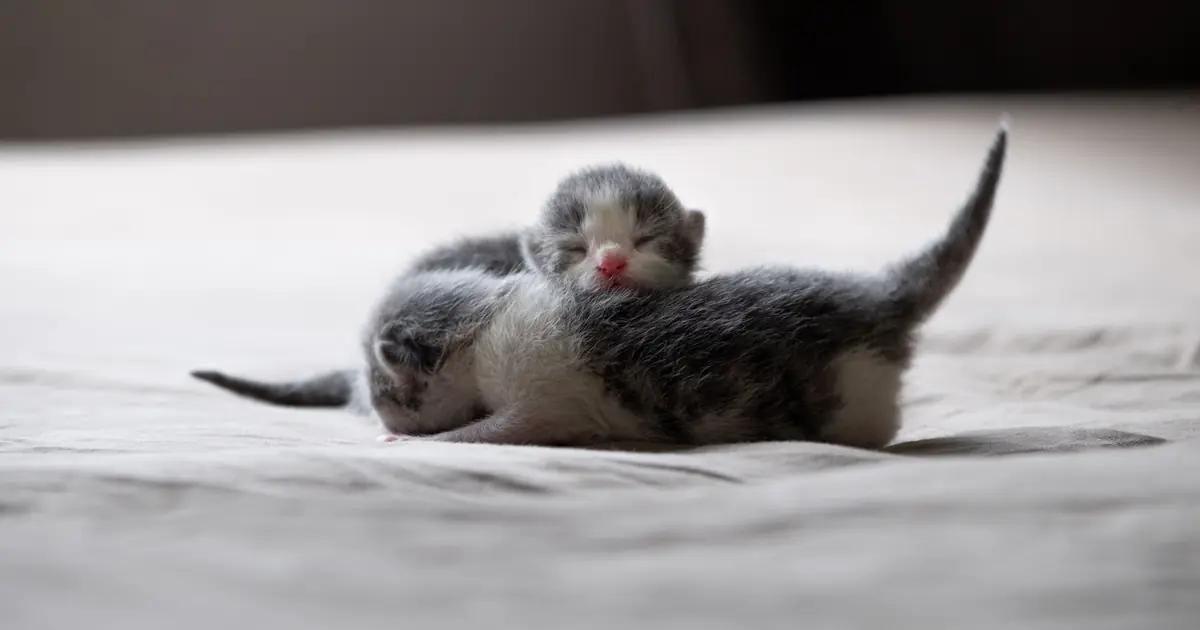
You’ve got a brand new kitten on your hands and everyone keeps asking the same question. Boy or girl? And you keep giving the same shrug, because honestly, kitten bits are tiny and not exactly labeled.
The good news is you don’t need a vet degree to figure it out. Breeders and shelter volunteers have used the same simple trick for decades, and once you know what to look for, it takes about ten seconds. Here’s exactly how to check, what the “punctuation trick” means, and why that orange kitten in your litter is probably a boy.
- A kitten’s gender is determined by the anogenital distance, the gap between the anus and the genital opening, which is much shorter in females than in males.
- Female kittens have a vertical slit close to the anus (shaped like an upside-down exclamation point or apostrophe), while male kittens have a round opening set farther away with a scrotal bulge in between (shaped like a colon).
- Around 80 percent of orange cats are male, because the orange color gene sits on the X chromosome and males only need one copy to show it.
- Calico and tortoiseshell coats need two different color genes on two X chromosomes, so about 99.97 percent of calico cats are female.
- Checking gets noticeably easier once a kitten reaches 6 to 8 weeks old, when the testicles have descended in males.
How Can You Tell If a Kitten Is Male or Female?
You tell a kitten’s gender by looking at the anogenital distance, the space between the anus and the genital opening underneath the tail. Male kittens have more distance between the two openings, plus a small bulge for the scrotum. Female kittens have almost no gap at all, just a small vertical slit sitting right up against the anus. PetMD describes this same anogenital distance method as the standard way vets and breeders sex young kittens.
It’s not complicated once you’ve seen it once or twice. Good light and a calm kitten help a lot. Newborns are trickier since everything is small and pink, but the same basic shapes hold true from day one.
How Do You Check a Kitten’s Gender Step by Step?

Here’s the exact process breeders and shelter staff use. Go slow, keep the kitten relaxed, and stop if it starts squirming or crying.
- Wash your hands first. Kittens are fragile and their immune systems are still developing, so clean hands protect them from picking up germs.
- Hold the kitten gently but securely. Cradle the kitten in one hand, supporting its chest and belly, or have someone else hold it against their body so it feels secure instead of dangled in the air.
- Lift the tail slowly and carefully. Use one finger to lift the base of the tail upward, just enough to see underneath. Don’t pull or tug on the tail itself, since kitten tails are delicate.
- Find the anus first. This is the small opening closest to the base of the tail. It’s the same in every kitten and gives you a reference point.
- Look at the space right below it. If there’s almost no gap and you see a small vertical slit, you’re likely looking at a female. If there’s a visible gap with a round opening and a bulge in between, you’re likely looking at a male.
- Use the punctuation trick to confirm. Picture the shapes as punctuation marks: a female looks like an upside-down exclamation point, close together and vertical. A male looks like a colon, two separate dots stacked with room between them.
- Feel gently for a scrotal bulge if you’re still unsure. By around 6 to 8 weeks, male kittens usually show a small, soft bulge between the anus and the genital opening as the testicles descend. Females never have this bulge.
- Let the kitten go and reward it. Set the kitten back down, give it a scratch or a treat, and keep the whole check under a minute so it stays a non-event for the kitten.
If you’re still not sure after all that, don’t stress. Even experienced breeders occasionally get young kittens wrong. There’s no harm in waiting a few weeks and checking again, or asking your vet to confirm at the next visit.
What Is the “Punctuation Trick” for Sexing Kittens?
The punctuation trick is a memory shortcut cat people use to describe what they see under the tail. A female kitten’s anatomy looks like an upside-down exclamation point, a single vertical mark right next to the anus with barely any space. A male kitten’s anatomy looks like a colon, two distinct openings with a gap between them. It sounds a little silly, but it’s visual and easy to remember with a wiggly kitten who isn’t going to hold still for long.
| Trait | Male Kitten | Female Kitten |
|---|---|---|
| Anogenital distance | Larger gap between anus and genital opening | Very small to no gap, opening sits right next to the anus |
| Opening shape | Round opening, looks like a colon (:) | Vertical slit, looks like an upside-down exclamation point or apostrophe |
| Scrotum | Small furry bulge visible by 6 to 8 weeks | No bulge present |
| Coat color odds | About 80 percent of orange or ginger cats are male | About 99.97 percent of calico or tortoiseshell cats are female |
Why Are Most Orange Cats Male?
Most orange cats are male because the gene for orange fur sits on the X chromosome. Male cats have one X and one Y chromosome, so a single copy of the orange gene is enough to turn them orange or ginger. Female cats have two X chromosomes, so they need a copy of the orange gene on both to end up fully orange, which happens far less often. Stanford Medicine researchers confirmed this X-linked mutation in 2025, calling it one of the clearest examples of genetics you can literally see on a cat.
That’s why, if you’re scanning a litter for a quick clue before you even lift a tail, an orange or ginger kitten is a good bet to be male. It’s not a guarantee, just good odds. If you’re weighing boy cat names or hunting for the perfect orange cat name, this genetic quirk is exactly why so many name lists lean masculine for gingers.
Are All Calico and Tortoiseshell Cats Female?
Nearly all calico and tortoiseshell cats are female, and the reason comes down to the same X chromosome trick in reverse. A calico coat needs both an orange gene and a black or non-orange gene showing up in patches, which only happens when a cat has two X chromosomes carrying different color genes.
Male calicos do exist, but they’re rare, roughly 1 in 3,000. When a male cat turns out calico, it’s usually because he was born with an extra X chromosome (XXY, a condition called Klinefelter syndrome), and these males are almost always infertile. If you love the pattern, our guide to calico cats goes deeper into what makes that coat so unusual, and whether calico cats can get pregnant like any other female cat.
At What Age Is It Easiest to Tell a Kitten’s Gender?
It gets noticeably easier to tell a kitten’s gender by 6 to 8 weeks old. By then the testicles have usually descended in males, making the scrotal bulge visible, and the anatomy has grown enough that the gap between males and females is much clearer.
You can technically sex a kitten at birth, since the anogenital distance is present from day one, but newborns are so small that mistakes are common even for experienced hands. If you can wait a few weeks before you commit to a name, you’ll save yourself a possible “actually, surprise” moment later.
When Should You Just Ask a Vet?
Ask a vet whenever you’re not confident in what you’re seeing, especially with a very young or single kitten with nothing to compare it to, or one you’re planning to get spayed or neutered soon. Vets check gender as a routine part of any kitten wellness visit, and it costs nothing extra to have them confirm it while they’re already examining your kitten.
This is also a good moment to start planning ahead. Most vets recommend spaying or neutering kittens around 5 to 6 months old, though some clinics do it earlier, and knowing your kitten’s sex is the first step toward booking that appointment. The International Cat Care sexing guide and your own vet are both reliable ways to double check.
Once you know your kitten’s sex, it’s worth reading up on how old a cat needs to be to get fixed and comparing notes on spaying versus neutering so you’re ready when the appointment rolls around.
Frequently Asked Questions
Q: Can you tell a kitten’s gender right after birth?
Yes, technically. The anogenital distance is present from birth, but newborn kittens are so tiny and the differences so subtle that even experienced breeders sometimes get it wrong. Waiting until 6 to 8 weeks makes the check far more reliable.
Q: What does the “colon versus exclamation point” trick actually mean?
It’s a visual shortcut. A male kitten’s anatomy looks like a colon, two openings stacked with a gap between them. A female kitten’s anatomy looks like an upside-down exclamation point or apostrophe, a single vertical slit close to the anus.
Q: Are all orange cats male?
No, but most are. Roughly 80 percent of orange or ginger cats are male because the orange gene sits on the X chromosome, and one copy is enough to color a male cat orange. Female cats need the gene on both X chromosomes, so orange females do exist, just less commonly.
Q: Can a male cat be calico?
It’s rare but possible, happening in roughly 1 in 3,000 calico cats. Male calicos usually carry an extra X chromosome, a condition called Klinefelter syndrome, and these cats are almost always infertile.
Q: Does nipple count tell you a kitten’s gender?
No. Both male and female kittens have nipples, usually 6 to 8 of them, so nipple count is not a reliable way to determine sex. Stick to checking the anogenital distance instead.
Q: Why did my vet get my kitten’s gender wrong at first?
It happens most often with very young or newborn kittens, where the anatomy is tiny and not fully developed yet. It’s not a sign of a bad vet, just a normal limitation of checking kittens before they’re a few weeks old.
Q: How long does it take to check a kitten’s gender?
Only a few seconds once you know what to look for. Gently lift the tail, glance at the space below the anus, and compare it to the colon versus exclamation point shapes. Keep the whole handling brief so the kitten stays comfortable.
Q: Should I confirm my kitten’s gender before choosing a name?
It’s a good idea if you want a gender-specific name. Waiting until 6 to 8 weeks, or having your vet confirm it at the first checkup, avoids the awkward situation of renaming a kitten a few weeks in.

Hello and welcome to The Ideal Cat!
We are some passionate cat owners from different professions. We love our cats and have a lot of experience in how to care for our pets. We are incredibly excited to share our knowledge, experience, and research with you. So you can take good care of your loving cat. We will answer most of the common questions about owning cats, taking care of them, etc. If you have any question contact with us. Thanks for visiting! Enjoy the content.
