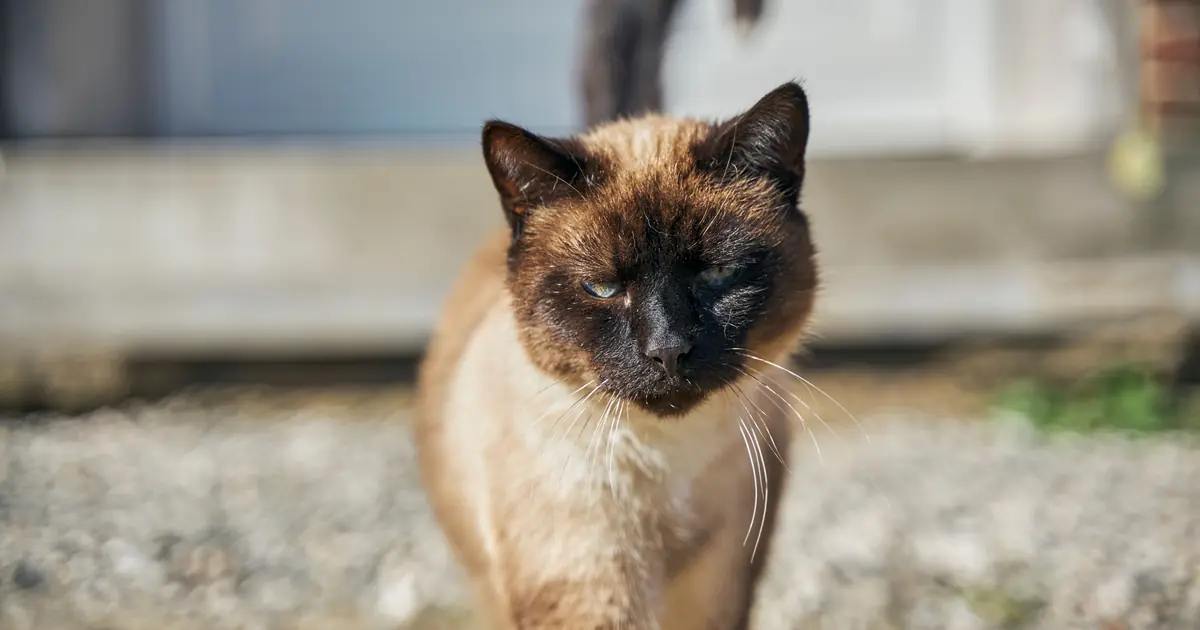
You’ve probably seen a photo online of a jet-black cat with that same sleek, wedge-shaped Siamese head, and wondered if you were looking at a black Siamese. It’s a fair question. Siamese cats are famous for their striking color, so it makes sense to wonder how far that color can go.
Here’s the short version: a true, purebred Siamese is never solid black. Their whole look is built around a gene that keeps the body pale and only lets darker color show up on the ears, face, paws, and tail. Once you understand how that gene works, the “black Siamese” mystery mostly solves itself.
- A purebred Siamese cat cannot be solid black because the pointed gene only lets dark pigment develop on the cooler parts of the body.
- Siamese cats come in four traditional point colors: seal, chocolate, blue, and lilac, plus newer variations like flame, cream, lynx, and tortie points.
- A dark seal point Siamese can look almost black, especially on older cats or cats living in cold climates, but the body still stays lighter than the points.
- The Oriental Shorthair shares the Siamese body type and is bred in solid colors, including a true jet-black color called ebony.
- A Siamese mix can be solid black because crossbreeding can introduce a non-pointed coat gene that overrides the pointed pattern.
Can Siamese cats be black?
No. A genetically pure Siamese cat cannot have a solid black coat. Every real Siamese carries the pointed gene, which is a form of partial albinism that keeps most of the body pale and only allows pigment to build up in the coolest spots, like the ears, mask, legs, and tail. Since the body itself never gets warm enough for that pigment gene to fully switch off, an all-over black Siamese is genetically off the table. When someone points to a black cat and calls it a Siamese, they’re usually looking at a very dark seal point, a Siamese mix, or a different breed entirely like the Oriental Shorthair.
What gene stops a Siamese from being black?
The pointed pattern comes from a mutation in an enzyme called tyrosinase, which cats need to produce pigment (melanin) in their fur. In a Siamese, this version of the enzyme is temperature sensitive: it barely works at normal body temperature, but it switches on in cooler areas of the skin. That’s why the points, the ears, face, legs, tail, stay dark while the warmer torso stays pale cream or white. According to the The International Cat Association, this is technically a form of temperature-sensitive albinism, not a simple coat color. Because the gene needs a cool zone to activate, there’s no scenario where a genetically pointed cat ends up evenly black from nose to tail.
Why do some Siamese cats look almost black?
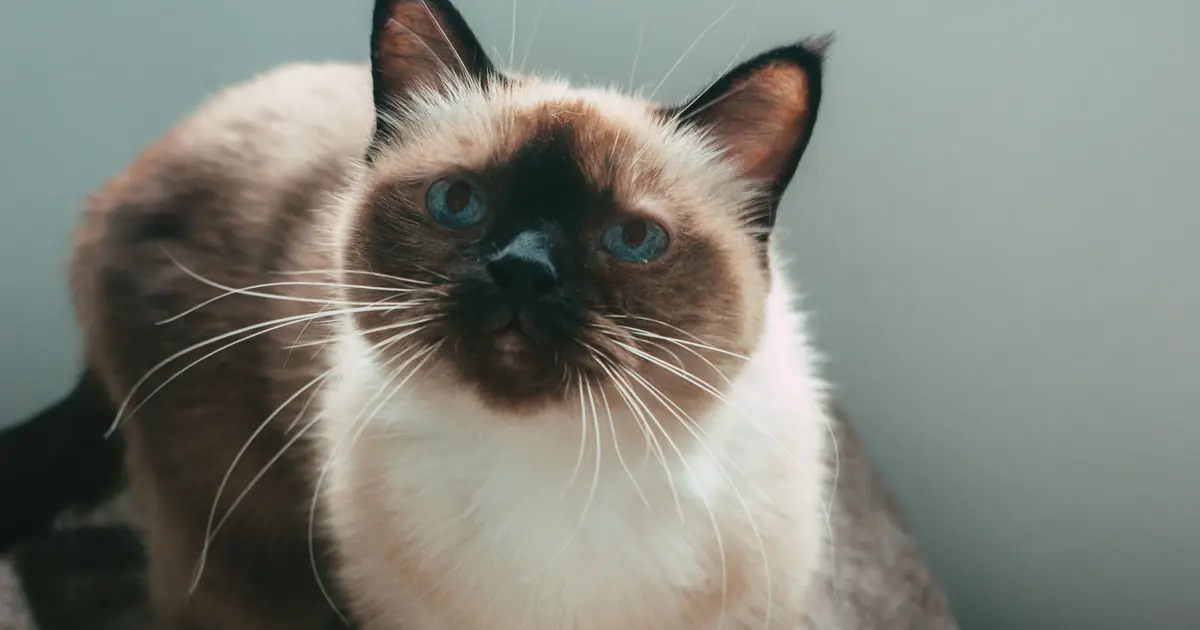
A seal point Siamese, the darkest and most classic point color, can look close to black, especially on the points themselves. Seal point color is a deep, warm brown-black, and it tends to darken further as a cat ages or lives somewhere cold, since cooler skin temperatures let the pigment gene work harder. Kittens are born almost pure white and develop their points gradually over the first year of life. Even at their darkest, though, a seal point’s body stays a lighter fawn or pale brown by comparison. If you set a seal point Siamese next to a truly solid black cat, the contrast between the pale body and dark points gives it away immediately.
Is a black Siamese-looking cat actually an Oriental Shorthair?
Most of the time, yes. The Oriental Shorthair shares the Siamese’s sleek body, wedge-shaped head, and big ears, but it doesn’t carry the pointed gene. Instead, Orientals come in solid colors across the whole body, including a true, glossy jet-black color breeders call ebony. The Cat Fanciers’ Association recognizes ebony as one of the breed’s official solid colors, describing it as a dense coal black coat with no rusty tinge. If you’ve spotted a solid black cat with a Siamese-style build and bright green eyes rather than blue, you’re very likely looking at an Oriental, not a Siamese. Our Oriental Shorthair breed guide covers the full color range if you want to dig deeper.
| Cat type | Can it be solid black? | Notes |
|---|---|---|
| Purebred Siamese | No | Pointed gene keeps the body pale; only the points darken. |
| Dark seal point Siamese | No, but can look close | Points can look nearly black, especially with age or cold climates, but the body stays lighter. |
| Oriental Shorthair | Yes | Bred in solid colors including ebony (true black), same body type as Siamese. |
| Siamese mix | Yes | Crossbreeding can bring in a non-pointed gene that produces a solid black coat. |
Can a Siamese mix be black?
Yes, a Siamese mix can absolutely be solid black. Once a Siamese breeds with a non-pointed cat, the kittens can inherit a normal, non-temperature-sensitive color gene instead of the pointed version. That means a Siamese mix might grow up solid black, tabby, tuxedo, or almost any other pattern, while still showing some Siamese traits like a slim body, a loud voice, or striking blue-tinted eyes if the pointed gene is still in the mix somewhere. This is exactly why shelters often list cats as “Siamese mix” even when their coat looks nothing like a classic Siamese. Body shape and personality hint at the ancestry more than coat color does.
What point colors do real Siamese cats come in?
Purebred Siamese cats come in four traditional point colors: seal (dark brown-black), chocolate (warm milk-chocolate brown), blue (cool slate gray), and lilac (pale pinkish-gray, the lightest of the four). Newer, non-traditional variations recognized by some registries add flame or red points, cream points, tortie points, and lynx (tabby-striped) points. Every one of these still follows the same rule: the body stays pale and only the points carry the deeper color. You can see how these develop and shift over a cat’s life in our guide to why Siamese cats change color, and our breakdown of the different types of Siamese cats if you want to compare them side by side. The Cat Fanciers’ Association Siamese breed standard only recognizes these four classic colors for championship Siamese, though other registries accept a wider range.
How can you tell a dark Siamese apart from a black cat or an Oriental?
Look at the contrast between the body and the extremities, and check the eye color. A real Siamese, even a dark seal point, always has a noticeably paler body than its ears, mask, paws, and tail, and it almost always has striking blue eyes, a trait tied to the same pointed gene. Our piece on why Siamese cats sometimes have crossed eyes explains more about that genetic link. A solid black cat or a black Oriental, on the other hand, has one even color from nose to tail and usually has green or gold eyes instead of blue. If a cat is uniformly black and has blue eyes, that combination is unusual enough that it’s worth asking a vet or breeder to look closer, since it doesn’t fit the typical pattern for either group.
Coat and eye color are useful clues, but they’re not a lineage test. A cat labeled “Siamese mix” at a shelter can come in almost any color, and even breeders sometimes get surprised by how a litter turns out. If you’re trying to confirm whether a cat is a true Siamese, an Oriental, or a mix for a specific reason, a vet or a reputable breeder familiar with the Siamese breed can help you read the signs, or point you toward genetic testing. This article is meant to help you understand what you’re looking at, not replace that kind of hands-on expertise.
Frequently Asked Questions
Q: Can a purebred Siamese cat ever be born solid black?
No. A genetically pure Siamese always carries the pointed gene, which keeps the body pale and only darkens the ears, face, paws, and tail. A solid black coat from birth would mean the cat isn’t a true pointed Siamese.
Q: What is the darkest color a Siamese cat can be?
Seal point is the darkest official Siamese color, a deep brown-black shade on the points. It can look almost black, especially as the cat ages, but the body still stays noticeably lighter than the points.
Q: Is an all-black cat with a Siamese body shape an Oriental Shorthair?
Very likely, yes. The Oriental Shorthair has the same sleek body and wedge head as the Siamese but comes in solid colors, including a true black color called ebony, so a solid black “Siamese-looking” cat is usually an Oriental.
Q: Why do Siamese cats have color only on their ears, face, paws, and tail?
Siamese cats carry a temperature-sensitive version of the tyrosinase enzyme, which only produces pigment in cooler areas of the skin. The warmer torso stays pale while the cooler extremities, called points, develop darker color.
Q: Can two Siamese cats produce a black kitten?
Two purebred Siamese cats cannot produce a solid black kitten, since both parents only carry pointed color genes. A black kitten from a Siamese litter usually means at least one parent wasn’t a purebred Siamese.
Q: What eye color do black Siamese-mix cats usually have?
Most solid black Siamese mixes have green or gold eyes rather than the blue eyes typical of a pointed Siamese, since the blue-eye trait is linked to the pointed gene. A solid black cat with true blue eyes is unusual for either group.
Q: Do Siamese kittens change color as they get older?
Yes. Siamese kittens are born almost pure white or cream and develop their point color gradually over the first several months to about a year, as their skin temperature settles and the pigment gene activates in the cooler areas.
Q: Are black Siamese cats rare or just misidentified?
They’re misidentified rather than rare, since a truly solid black purebred Siamese doesn’t exist. Cats sold or described as “black Siamese” are usually dark seal points, Siamese mixes, or Oriental Shorthairs.

Hello and welcome to The Ideal Cat!
We are some passionate cat owners from different professions. We love our cats and have a lot of experience in how to care for our pets. We are incredibly excited to share our knowledge, experience, and research with you. So you can take good care of your loving cat. We will answer most of the common questions about owning cats, taking care of them, etc. If you have any question contact with us. Thanks for visiting! Enjoy the content.
