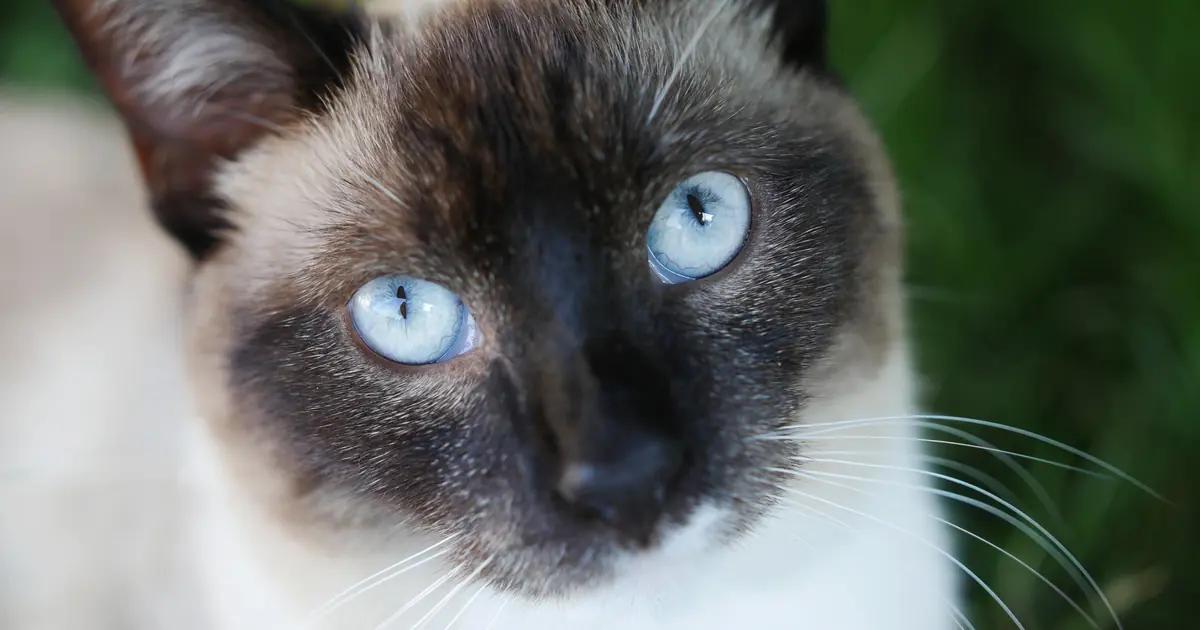
If you’ve ever locked eyes with a Siamese cat and thought “wait, are you looking at my nose or mine?”, you’re not imagining things. That slightly cross-eyed stare is a real, well-documented quirk of the breed, and it’s got a genetics lesson behind it that’s honestly pretty fascinating.
It’s not bad luck, and it’s not a birth defect in the way we usually think of one. It’s a side effect of the exact same gene that gives Siamese cats their chocolate-brown points and cream bodies. Stick with us, because once you see the connection, you’ll never look at a Siamese cat’s face the same way again.
- Crossed eyes in Siamese cats come from the same temperature-sensitive albino gene that produces their pointed coat pattern.
- The gene causes extra optic nerve fibers to cross to the wrong side of the brain at a junction called the optic chiasm.
- Some Siamese cats turn their eyes inward, a condition called strabismus, to help their brain re-align the miswired visual signals.
- Crossed eyes present from birth in a Siamese cat are usually harmless and rarely need treatment.
- Selective breeding since the mid-1900s has made crossed eyes far less common in modern show-line Siamese cats.
Why do Siamese cats have crossed eyes?
Siamese cats get crossed eyes from a genetic mutation at the albino locus, the same stretch of DNA responsible for their pointed coat color. This mutation affects an enzyme called tyrosinase, which controls pigment production. It turns out that enzyme also plays a role in how nerve fibers wire themselves in the developing brain, and in Siamese cats, that wiring goes a little sideways (literally).
In a cat with a normal visual system, some of the nerve fibers from each eye cross over to the opposite side of the brain at a junction called the optic chiasm, and some stay on the same side. That balance lets the brain build one seamless picture from two eyes. In Siamese cats, an unusually high number of those fibers cross over to the wrong side. Some Siamese cats compensate by turning their eyes inward, which realigns the images enough for the brain to make sense of them again. That inward turn is what we see as “crossed eyes,” and vets call it strabismus, a term for any abnormal, misaligned positioning of the eyes.
What’s the science behind the crossed-eye gene?
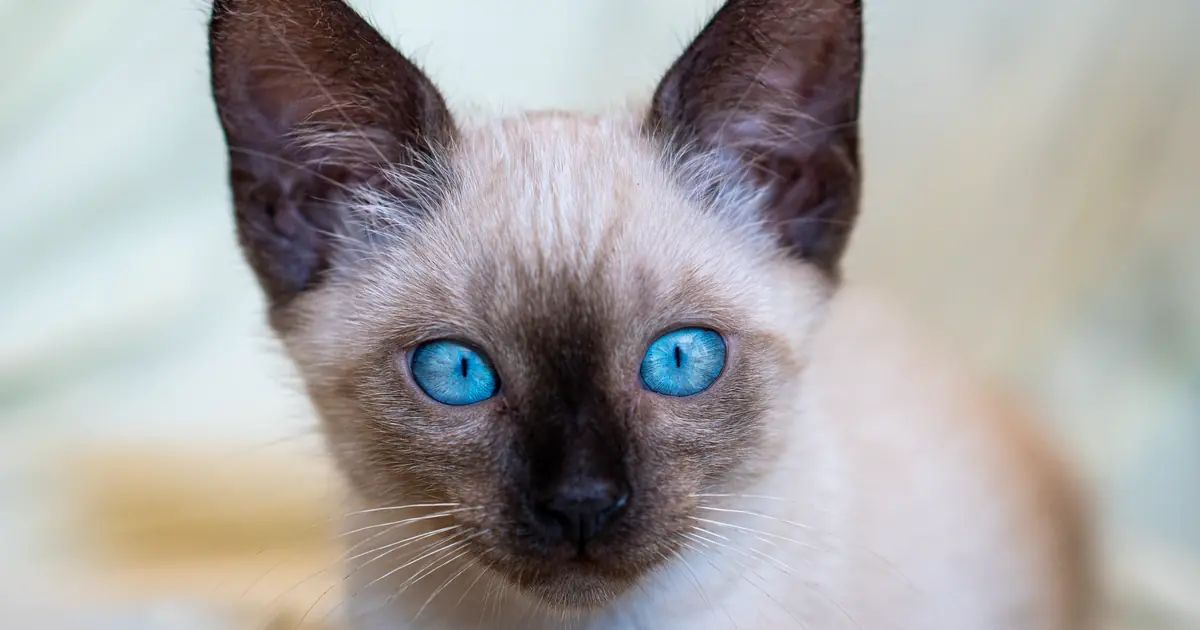
The short version: pigment and vision share a genetic pathway in Siamese cats, and that overlap is what causes the cross-eyed look. Cat researchers studying the Siamese visual system in the 1970s and 80s found that the albino mutation disrupts normal development of the retina and optic pathways before a kitten is even born, not just coat color after birth.
Here’s the connection in plain terms. Melanin, the pigment tyrosinase helps produce, also guides how nerve cells find their way to the right side of the brain during development. Because Siamese cats carry a mutated, temperature-sensitive version of tyrosinase (it’s also why their coat is darker on the cooler extremities, like the ears, paws, and tail), the same flaw that mutes their pigment also throws off the wiring of their optic nerves. According to PetMD, this inherited link between coat pattern and eye muscle and nerve development is well documented in pointed breeds. It’s one gene, doing two jobs, and not doing either one quite the “typical” way.
Is it a genetic defect or a clever adaptation?
It’s really both, depending on how you look at it. The optic nerve miswiring itself is a developmental quirk, essentially a genetic side effect nobody bred for on purpose. The inward eye turn, though, looks a lot like the brain’s own fix for that problem. By crossing the eyes slightly, the cat’s brain can shift the two overlapping, jumbled images back into rough alignment and still get usable depth and motion cues.
Scientists still debate how much this “fix” actually helps versus how much it’s just a visible symptom of the wiring problem. Either way, it’s not a disease. It’s a package deal that came bundled with the coat color humans fell in love with centuries ago.
Do all Siamese cats have crossed eyes?
No, most Siamese cats today don’t have crossed eyes. The trait was far more common in old-style, apple-headed Siamese cats from the early and mid-1900s, when strabismus and a kinked tail tip were considered normal, expected breed features. Once cat fanciers began selectively breeding away from both traits (partly for looks, partly because crossed eyes were seen as a flaw in the show ring), the frequency dropped a lot in modern, wedge-headed show-line Siamese.
You’ll still spot a cross-eyed Siamese now and then, especially in cats with more old-style or mixed ancestry, and there’s nothing wrong with them. It’s just less of a “given” than it used to be.
Does being cross-eyed affect a Siamese cat’s vision?
Most cross-eyed Siamese cats see just fine for everyday life. Their brains adapt remarkably well, using the inward eye turn along with other cues like motion, head movement, and whisker feedback to build a workable picture of the world. What can be slightly off is depth perception, since accurately judging distance relies on both eyes aiming at the exact same point.
In practice, this rarely slows a cat down. You might notice your cross-eyed Siamese misjudge a jump onto the couch once in a while, or bat at a toy a beat later than expected. That’s about the extent of it for most cats. They’re not struggling through life half-blind. They’re just working with a slightly different set of visual wiring, and cats are famously good at adapting.
What’s the myth about crossed eyes and kinked tails?
Old cat lore ties crossed eyes and kinked tails together, and there’s actually some truth buried in the legend. In traditional Siamese folklore, the kinked tail was explained as a princess’s ring holder, and the crossed eyes came from a temple cat staring so intently at a sacred vase that its eyes never quite straightened out again. Charming stories, but the real explanation is genetic, not devotional.
Both traits, the crossed eyes and the kinked tail, really were common together in early Siamese cats, likely because both trace back to the same small founding population and overlapping genetics. Breeders phased out the kinked tail hard over the 20th century (it’s now considered a fault in most show standards), and crossed eyes followed a similar, though less strict, decline. So if you’ve heard someone say “the crossed eyes and the kinky tail go together,” they’re not entirely wrong about the history, even if the vase story isn’t literally true.
When are crossed eyes actually a concern?
Crossed eyes are a concern when they show up suddenly in an adult cat, or when they come with other symptoms like head tilt, wobbliness, or obvious discomfort. Lifelong congenital strabismus, the kind a Siamese kitten is born with, is a cosmetic trait, not a medical problem. Sudden-onset crossed eyes in a cat of any breed is a different story entirely, and it can point to an underlying issue with the eye itself, the inner ear, or the nervous system.
According to Cats.com, acquired strabismus that appears later in life often signals a problem needing prompt veterinary attention, unlike the harmless congenital form seen in pointed breeds. Don’t wait it out if your adult cat’s eyes suddenly start crossing.
| Feature | Harmless breed strabismus | Concerning new strabismus |
|---|---|---|
| Onset | Present since kittenhood | Appears suddenly in an adult cat |
| Other signs | None; cat is bright, active, and eating normally | Head tilt, stumbling, circling, vomiting, or squinting |
| Typical cause | Inherited albino-gene optic pathway trait | Inner ear infection, neurological issue, or eye injury |
| Action needed | None; just a breed quirk | Same-day or next-day vet visit |
How do you care for a cross-eyed Siamese cat?
You care for a cross-eyed Siamese exactly like you’d care for any other cat, since congenital strabismus doesn’t need special treatment or accommodations. There’s no surgery, eye drops, or corrective gear needed for the harmless, inherited kind of crossed eyes. Your cat has lived with this visual setup since birth and has already adapted to it completely.
The one thing worth doing is keeping an eye (no pun intended) on any changes. If a cat that’s always had a mild inward turn suddenly develops a more severe cross, or starts bumping into furniture she used to navigate fine, that’s worth a vet visit. Otherwise, just enjoy the look. It’s part of what makes a Siamese a Siamese, right alongside those Siamese cats changing color with the seasons and that unmistakable raspy voice.
A quick, friendly note: this article is educational and isn’t a substitute for a real veterinary exam. A lifelong mild eye turn in a Siamese is almost always harmless, but eyes that suddenly cross, especially alongside a head tilt, stumbling, or pain, are a reason to call your vet, not wait it out at home.
Frequently Asked Questions
Q: Are all Siamese cats born cross-eyed?
No. Crossed eyes were far more common in old-style Siamese cats decades ago, but modern selective breeding has reduced the trait a lot. Plenty of Siamese cats today have perfectly straight eyes.
Q: Can crossed eyes in a Siamese cat be fixed?
There’s no standard treatment for inherited, lifelong strabismus in Siamese cats, and none is usually needed. It’s a cosmetic trait tied to their genetics, not a medical condition causing pain or vision loss.
Q: Do crossed eyes hurt a Siamese cat?
No, congenital strabismus isn’t painful. It’s a structural difference in how the eyes align, not an injury or inflammation, so cats born with it don’t show any signs of discomfort from the crossing itself.
Q: What breeds besides Siamese get crossed eyes?
Other pointed breeds that share the same albino-related coat gene can show the same trait, including Himalayans, flame-point Persians, and some Balinese and Tonkinese cats, since they all carry a version of the coat-pattern mutation linked to it.
Q: Is a kinked tail related to crossed eyes in Siamese cats?
Historically, yes, the two traits often appeared together in early Siamese cats and both trace back to the breed’s original small gene pool. Modern breeding has reduced both, and today most Siamese cats have straight tails and straight (or nearly straight) eyes.
Q: Can a cross-eyed Siamese cat see normally?
Most cross-eyed Siamese cats function completely normally day to day. Their depth perception can be slightly less precise than a cat with typically aligned eyes, but their brains adapt well enough that most owners never notice a difference in behavior.
Q: When should I worry about my cat’s crossed eyes?
Worry if the crossing is new, appeared suddenly, or shows up alongside a head tilt, loss of balance, squinting, or one pupil looking different from the other. Those signs suggest a possible ear, eye, or neurological issue that needs a vet visit, not a harmless breed trait.
Q: Does the crossed-eye gene affect the Siamese cat’s personality?
No, there’s no known link between the optic-pathway gene and temperament. A cross-eyed Siamese is just as likely to be the chatty, people-focused, velcro cat the Siamese cat breed is famous for as one with straight eyes.
Crossed eyes are just one small, charming quirk that comes with the territory of loving a Siamese cat. Pair it with their striking blue eye color, their pointed coat, and that loud, opinionated voice, and you’ve got a cat that was never going to blend into the background anyway. Whether your Siamese’s eyes are dead straight or give you that classic slight inward stare, it’s simply part of what makes her, her.

Hello and welcome to The Ideal Cat!
We are some passionate cat owners from different professions. We love our cats and have a lot of experience in how to care for our pets. We are incredibly excited to share our knowledge, experience, and research with you. So you can take good care of your loving cat. We will answer most of the common questions about owning cats, taking care of them, etc. If you have any question contact with us. Thanks for visiting! Enjoy the content.
