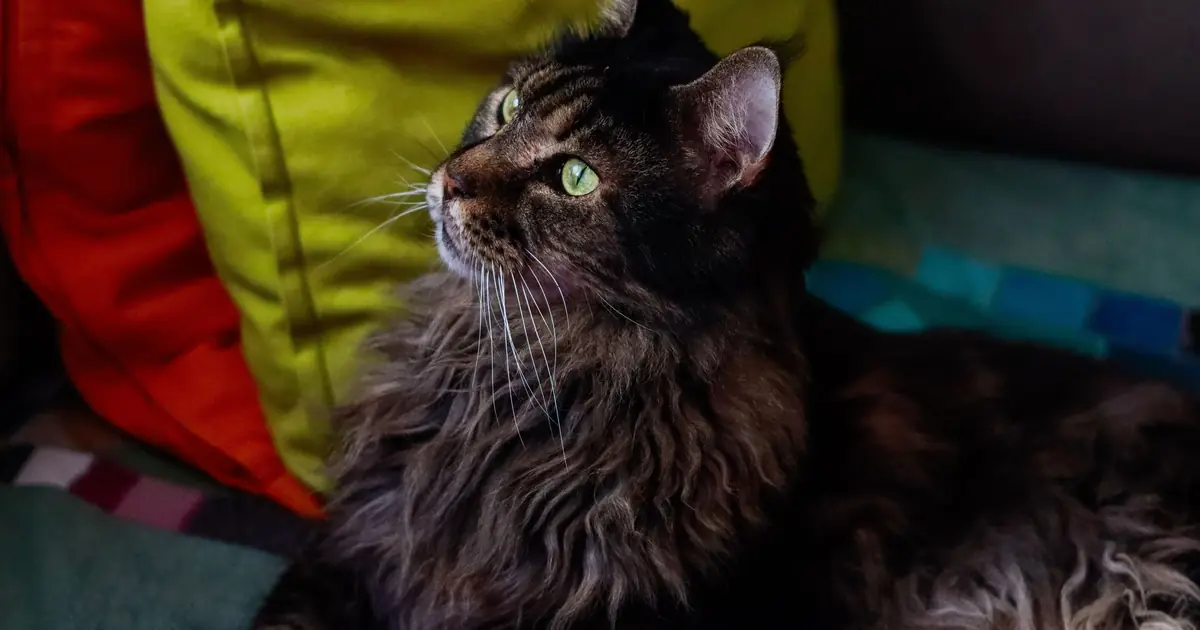
You already know Maine Coons are big. But “big” doesn’t quite cover a cat that stretches longer than a baseball bat and greets guests at eye level. When people ask about the world record largest Maine Coon cat, they’re usually picturing exactly that: a gentle giant that looks almost too large to be real.
So let’s settle it. Here are the actual record holders, how they measured up, and why this one breed keeps taking the crown.
- Stewie holds the record for longest domestic cat ever: 48.5 inches (123 cm), set in 2010.
- Barivel, from Italy, is the longest living cat, measuring 47.2 inches (120 cm).
- Guinness measures cats by length (nose to tail-tip), not by weight.
- Both record holders are Maine Coons, the breed famous for its huge, long-bodied build.
- A typical Maine Coon is far smaller, usually 10 to 25 pounds and up to about 40 inches long.
What is the world record for the largest Maine Coon cat?
The world record for the largest Maine Coon, and the largest domestic cat ever, goes to a cat named Mymains Stewart Gilligan, better known as Stewie. On August 28, 2010, Stewie measured 48.5 inches (123 cm) from the tip of his nose to the tip of his tail, earning the Guinness World Records title for longest domestic cat. He also held the record for the longest tail on a domestic cat, at 6.34 inches.
Stewie lived in Reno, Nevada, and was known as a friendly therapy cat. He passed away in 2013 at age 8. According to Guinness World Records, his record for longest cat ever still stands.
Who is the biggest Maine Coon cat alive today?
The biggest Maine Coon alive today is Barivel, an Italian cat who holds the Guinness title for longest living domestic cat at 47.2 inches (120 cm), just an inch shy of Stewie. Born in September 2016, Barivel took the record in 2018 and became a local celebrity in Pavia, Italy, where he’s known for being calm and famously photogenic.
Here’s a detail that trips people up: “longest ever” and “longest living” are two different Guinness categories. Stewie holds the all-time record, while Barivel holds the record among cats alive now. Both are Maine Coons, which tells you something about the breed.
| Cat | Record | Length | Year |
|---|---|---|---|
| Stewie | Longest domestic cat ever | 48.5 in (123 cm) | 2010 |
| Barivel | Longest living domestic cat | 47.2 in (120 cm) | 2018 |
Why are Maine Coons so big?
Maine Coons are so big because of their genetics and cold-climate origins, not because of any special diet or breeding gimmick. The breed developed in the harsh winters of the northeastern United States, where a large, sturdy body, dense water-resistant coat, and long bushy tail were survival advantages. Over generations, that produced one of the largest domestic cat breeds in the world.
They also grow slowly. While most cats reach full size by 1 to 2 years, Maine Coons keep filling out until 3 to 5 years old, which adds to their impressive final dimensions. To learn more about the breed itself, see our full Maine Coon cat guide. If you love big cats, the Norwegian Forest Cat, Siberian, and Savannah are also worth a look.
How big is a normal Maine Coon compared to the record?
A typical Maine Coon is much smaller than the record holders, so don’t expect a four-foot cat at home. Most Maine Coons weigh 10 to 25 pounds and measure up to about 40 inches long, with males larger than females. The record cats are extraordinary outliers, not the breed average.
That’s worth keeping in mind if you’re shopping for a kitten and see “giant” or “XXL” Maine Coon claims. A healthy, well-bred Maine Coon is naturally large, but a responsible breeder won’t promise record-breaking size. Focus on health and temperament, and enjoy the fact that even an “average” Maine Coon is a genuinely big, lovable cat that can live a good, long life (here’s how long cats typically live).
Largest Maine Coon cat FAQ
Q: What is the largest Maine Coon cat ever recorded?
Stewie, officially Mymains Stewart Gilligan, at 48.5 inches (123 cm) long. He set the Guinness World Records title for longest domestic cat in 2010 and still holds the all-time record.
Q: How much did the record Maine Coon weigh?
Guinness measures cats by length, not weight, so official records track how long a cat is nose to tail. Large Maine Coons often weigh in the 20-plus pound range, but weight isn’t how the record is judged.
Q: Is Barivel bigger than Stewie?
No. Barivel measures 47.2 inches, about an inch shorter than Stewie’s 48.5 inches. Barivel holds the “longest living” record, while Stewie holds the “longest ever” record.
Q: How big do Maine Coons normally get?
Most Maine Coons weigh 10 to 25 pounds and can reach around 40 inches long, with males typically larger than females. Record-setting cats are rare exceptions, not the norm.
Q: Why do Maine Coons hold the record?
The breed was shaped by cold northeastern US winters, favoring a large, sturdy frame and long body. They also grow slowly, reaching full size at 3 to 5 years, which contributes to their record-setting dimensions.
Q: Are giant or XXL Maine Coons a real thing?
Maine Coons are genuinely large, but “giant” or “XXL” is marketing language, not an official size class. A reputable breeder prioritizes health and temperament over promises of record-breaking size.
The bottom line: Stewie remains the longest domestic cat ever at 48.5 inches, and Barivel carries the torch among living cats. Both prove why the Maine Coon is the undisputed heavyweight of the cat world, though your own gentle giant will be plenty big, and plenty lovable, without breaking any records.

Hello and welcome to The Ideal Cat!
We are some passionate cat owners from different professions. We love our cats and have a lot of experience in how to care for our pets. We are incredibly excited to share our knowledge, experience, and research with you. So you can take good care of your loving cat. We will answer most of the common questions about owning cats, taking care of them, etc. If you have any question contact with us. Thanks for visiting! Enjoy the content.
