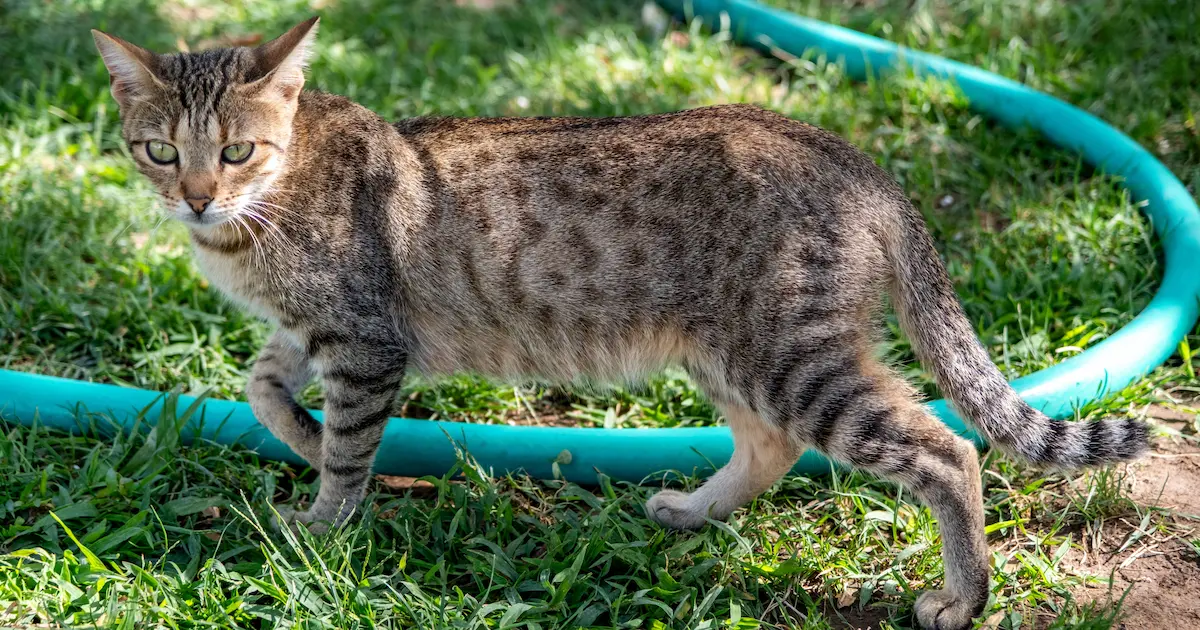
Picture this. You walk into your kitchen at 6 a.m. and a tall, spotted cat is standing on top of your refrigerator, watching you like a tiny leopard deciding whether you’re worth its time. It chirps. It leaps eight feet to the counter without touching anything in between. Then it knocks your coffee mug into the sink, on purpose, while holding eye contact.
Welcome to life with a Savannah cat.
These cats look like they walked off a nature documentary, and a lot of that wild beauty is real. But the Savannah is also one of the most misunderstood cats you can bring home. Some are loving, leash-walking, water-loving companions. Others are far more than a first-time owner bargained for. The difference usually comes down to one thing most websites gloss over, and we’ll spend real time on it here.
Savannah Cat at a Glance
| Origin | United States, 1980s |
| Weight (Male) | 12 to 25 lbs (early generations run largest) |
| Weight (Female) | 11 to 20 lbs |
| Lifespan | 12 to 20 years |
| Coat | Short to medium, dense, slightly coarse |
| Colors | Brown spotted tabby, silver spotted tabby, black, black smoke |
| Energy Level | High |
| Grooming Needs | Low |
| Good With Kids | Later generations, with supervision |
| Good With Other Pets | Slow intro; not safe with small prey pets |
| Average Price | $1,500 to $25,000+ depending on generation |
What Is a Savannah Cat, Really?
Here’s the simple version. A Savannah cat is what you get when you cross a domestic cat with an African serval, a long-legged wild cat from the grasslands of sub-Saharan Africa. That serval blood is where the spots, the height, and the big personality come from.
The catch is that “Savannah cat” isn’t one single thing. A cat with a serval as a parent is wildly different from one whose serval ancestor was five generations back. One might need an enclosure and an exotic vet. The other curls up and watches TV with you. They share a name and a look, but living with them can feel like owning two different animals.
That’s why the very first thing you need to understand isn’t the price or the personality. It’s the generation. So let’s start there.
The F1 to F5 Generations, Explained Without the Jargon
You’ll see Savannah cats labeled F1, F2, F3, and so on. The “F” stands for filial, which just means how many generations removed the cat is from its wild serval ancestor. The lower the number, the closer to the serval, and the wilder the cat tends to be.
Think of it as a dial that turns from “small wild cat” toward “spotted house cat.” Here’s roughly where each setting lands.
F1 Savannah (about 50% serval)
The biggest, tallest, and most expensive. An F1 has a serval as one parent. These cats can weigh 20 pounds or more and stand close to 17 inches tall. They’re stunning. They’re also the most demanding, the most likely to need special housing, and the most likely to be restricted or banned where you live. F1s are for serious, experienced hybrid owners only.
F2 Savannah (about 25% serval)
A serval grandparent. Still large, still full of wild antics, still a big commitment. F2s keep a lot of the F1’s intensity in a slightly more manageable package, but “slightly” is doing heavy lifting in that sentence.
F3 Savannah (about 12.5% serval)
Many breeders call this the sweet spot for a first Savannah. Still tall and athletic, still clever and curious, but noticeably easier to live with than an F1 or F2. Friendly with kids and other pets when raised right.
F4 and F5 Savannah (further removed)
From here on, the cats settle into a fairly consistent size and a much more domestic temperament. An F5 in daily life feels like a very athletic, very nosy house cat rather than a wild animal you’re managing. This is the generation most families should be looking at.
A Short History of the Savannah Cat
The Savannah is a young breed, which surprises people given how established it looks. The very first Savannah kitten was born on April 7, 1986, when a breeder crossed a male serval with a domestic female cat. The kitten was named Savannah, and the name stuck to the whole breed.
Through the late 1980s and 1990s, a small group of breeders worked to develop a consistent type and write a breed standard. The International Cat Association accepted the Savannah for registration in 2001 and granted it full championship status in 2012. By cat-breed standards, that’s practically yesterday, which is part of why the breed still feels exotic and rare.
Appearance: Why People Stop and Stare
You don’t have to be a cat expert to spot a Savannah across a room. The look is the whole point of the breed, and it’s striking.
Start with the height. The Savannah is widely considered the tallest domestic cat, with long legs and a lean, leggy build that makes it look bigger than the scale says. The body is long and muscular with a deep chest and a tucked tummy, and the back legs sit slightly higher than the front, giving that athletic, ready-to-pounce stance.
Then the head. It’s small in proportion to the body, with huge upright ears set high, and slightly hooded eyes that give the Savannah that watchful, wild expression. The coat is short to medium, dense, and a little coarse, scattered with bold dark spots. Recognized colors include brown spotted tabby, silver spotted tabby, black, and black smoke.
One thing worth knowing: Savannahs take their time growing up. It can take around three years for one to reach full adult size, so that gangly kitten will keep filling out long after most cats have settled.
Personality and Temperament: What Living With One Is Actually Like
People love to call the Savannah “dog-like,” and for once the cliche earns its keep. These cats follow you room to room, greet you at the door, learn their name, play fetch, and can be trained to walk on a leash. Many bond hard to one person and want to be wherever you are.
They’re also loud and chatty in their own way. Instead of a standard meow you’ll hear chirps, trills, and the occasional dramatic yowl. And then there’s the water thing, which is very real. A lot of Savannahs love water, so don’t be shocked if yours wants to join you at the sink, the tub, or a dripping faucet.
Now the part the glossy breed pages skip. A Savannah without enough to do does not sit quietly and wait. A bored one redecorates. Think curtains climbed, shelves cleared, doors and cabinets opened, and anything small relocated to a hiding spot you’ll find in six months. This isn’t a defect. It’s a smart, athletic cat with energy that has to go somewhere.
Honesty matters here, because there are real cautionary tales of people who bought an impressive early-generation Savannah, couldn’t meet its needs, and ended up frustrated, scratched, and trying to rehome an animal that never should have been a casual purchase. The cat wasn’t broken. The match was.
Is a Savannah Cat Right for You?
Let’s be a good friend about this instead of a salesperson. A Savannah can be an incredible companion, but only for the right home. Run yourself through these honestly.
A Savannah might be a great fit if you:
- Are home often or have another pet for company
- Want an interactive, trainable, almost dog-like cat
- Have vertical space, room to run, and tolerance for chaos
- Can budget for a high purchase price and ongoing costs
- Enjoy daily play sessions and don’t expect a couch potato
A Savannah is probably the wrong choice if you:
- Want a calm lap cat who mostly sleeps
- Travel constantly or work very long hours
- Have small prey pets like birds, fish, or hamsters
- Live somewhere it’s restricted or banned (check before anything else)
- Are buying mainly for the wow factor of the look
The good news is that later generations soften almost every demand on that first list. If the personality appeals to you but the intensity worries you, an F4 or F5 is your friend.
Are Savannah Cats Legal Where You Live?
This is the section that saves people from heartbreak, so read it before you put down a deposit anywhere.
Savannah cats sit in a legal gray zone because they descend from a wild animal. Rules vary by state, by county, and even by city, and they often depend on the generation. An F5 can be perfectly legal in a place where an F1 or F2 is banned as a wild or exotic animal.
A few patterns to know, with the loud reminder that these change and you must verify locally:
- Some states have banned the breed outright at various points, with Georgia, Hawaii, Nebraska, and Rhode Island commonly named.
- Several states allow only later generations, often F4 and up, including places like Alaska, Colorado, Iowa, Massachusetts, New Hampshire, and Vermont. New York state has leaned toward F5 and later.
- Some cities add their own bans on top of state law. New York City and Denver have restricted ownership even where the state is more permissive.
- A few states allow all generations but require registration or a permit. Texas is a frequently cited example.
- California uses hybrid-animal rules that tend to restrict earlier generations while sometimes allowing later ones.
Health Issues to Know About
The good news first. Savannahs benefit from what breeders call hybrid vigor, and they’re generally a hardy, resilient breed. They tend to avoid a lot of the inherited problems that plague heavily inbred lines.
That said, there are a few conditions worth having on your radar.
Pyruvate kinase (PK) deficiency. A genetic condition that affects red blood cells and can lead to anemia. The reassuring part is that a simple DNA test exists, so responsible breeders test their breeding cats. Ask to see the paperwork showing the parents are clear.
Progressive retinal atrophy (PRA). An inherited eye condition that slowly damages the retina and can lead to vision loss. Again, genetic testing of parents is the protection here, so this is a question for your breeder before it’s a worry for you.
Heart and general feline issues. Like many cats, Savannahs can be prone to heart conditions such as hypertrophic cardiomyopathy, plus the usual dental and weight concerns. Regular checkups catch most problems early.
One practical note: find a vet who’s comfortable with the breed before you bring one home, especially for an earlier generation. A little planning beats a frantic phone search later.
Grooming and Care
Here’s a rare bit of easy news with this breed. Grooming a Savannah is genuinely low effort. The short, dense coat does most of the work itself.
A quick brush once a week keeps loose hair down and gives you a moment to check skin, ears, and weight. They’re moderate shedders, not the fur-tumbleweed type. Add regular nail trims, ear checks, and dental care, and you’ve covered the basics. Bonus: many Savannahs don’t mind water, so the occasional bath is far less of a wrestling match than with most cats.
Feeding and Diet
Savannahs are lean, muscular, and built to move, so protein is the foundation of their diet. Look for a high-quality food with real named meat like chicken or turkey near the top of the ingredient list, and plenty of animal protein overall.
Some owners and breeders, especially of earlier generations, lean toward raw or fresh diets to match the cat’s nature, but a complete and balanced commercial diet that meets AAFCO standards keeps a Savannah thriving too. A mix of quality wet and dry food works well for most homes.
Watch the portions. These cats look like athletes, but they can still gain weight if they overeat, and treats should stay to a small slice of daily calories. Match the food to the life stage, since kittens, adults, and seniors all have different needs.
Exercise and Enrichment
If there’s one section to take seriously, it’s this one. Savannahs need real daily exercise, in the ballpark of 30 to 60 minutes of active play, and they need mental work to go with it.
Give them height. Tall cat trees, shelves, and safe perches let a natural climber and jumper do its thing. Rotate interactive toys, wand toys, and puzzle feeders so the novelty doesn’t wear off. Many Savannahs take happily to leash and harness walks, which burns energy and feeds that curious brain at the same time.
Picture it this way: a Savannah that gets a good workout and a puzzle to solve is a delight. A Savannah that gets neither will invent its own entertainment, and you won’t love the script it writes.
Living With Kids, Dogs, and Other Cats
Socialization and generation are everything here. Later-generation Savannahs raised around people usually do well with respectful older kids and with cat-friendly dogs. They’re confident and playful, and they often enjoy having a buddy around, especially if you’re out of the house a lot.
Two honest cautions. First, those strong hunting instincts mean a Savannah and a pet bird, fish, or small rodent are a bad combination, full stop. Second, early generations can be less predictable around very young children or smaller animals, so they fit best in calm adult homes. Slow, supervised introductions win every time.
Lifespan and Aging Tips
Savannahs are long-lived for such a big, active cat, commonly reaching 12 to 15 years and sometimes pushing toward 20 with good care. To get the most years out of yours, keep up the routine vet visits, stay on top of dental care, and don’t let the weight creep up.
As your Savannah ages, the wild energy mellows, but the curiosity rarely does. Older cats appreciate easier access to favorite perches, a bit more warmth, and gentler play. Keep the brain engaged, and a senior Savannah stays a charming, involved companion right to the end.
How Much Does a Savannah Cat Cost?
Let’s talk real numbers, because the sticker price is only half the story.
Purchase price runs from roughly $1,500 for a later-generation kitten up to $25,000 or more for an F1 from a top breeder. The closer to the serval, the higher the price, since early generations are harder to breed and far rarer.
Now the part that catches people off guard. The ongoing costs of a Savannah can outrun the purchase price over a lifetime:
- A high-protein or fresh diet that isn’t cheap to maintain
- Exotic-savvy vet care, especially for earlier generations
- Sturdy enrichment: tall trees, perches, harnesses, puzzle toys
- A secure outdoor enclosure or catio for many owners
- Pet insurance, which many Savannah owners choose to carry
None of this is meant to scare you off. It’s meant to make sure that if you say yes, you’re saying yes with eyes open and a budget that fits.
Where to Find a Savannah Cat Ethically
Savannahs almost never turn up in shelters, though breed-specific rescues do exist and are worth a look if you’re open to an adult. Most people go through a breeder, and this is where doing your homework pays off.
Green flags in a breeder: they health-test parents for PK deficiency and PRA and show you the results, they’re TICA-registered, they raise kittens underfoot in the home, they ask you as many questions as you ask them, and they’re upfront about generation, legality, and the breed’s demands.
Red flags to walk away from: no health testing, no paperwork, multiple litters always available, vague answers about generation, pressure to buy fast, or a “breeder” who’s really just a neighbor with an unplanned litter. Be especially wary of anyone selling an early generation to a first-time owner without a single hard question.
Savannah vs Bengal and Other Cats to Consider
The Savannah isn’t the only wild-looking, high-energy cat out there. If you love the look but want to weigh your options, here are a few worth a glance.
- Bengal: The closest comparison. Smaller, slightly less demanding, usually a bit cheaper, and still gorgeous and athletic. Often the better pick for a first wild-looking cat.
- Egyptian Mau: A naturally spotted, athletic breed without any wild hybrid status, so far fewer legal headaches.
- Ocicat: All the spotted, wildcat looks with a fully domestic background and an easygoing, social streak.
- Abyssinian: Not spotted, but ticked and elegant, with the same restless curiosity and love of climbing.
- Oriental Shorthair: If it’s the chatty, people-obsessed personality you want more than the spots, this talkative breed delivers.
Common Myths and Misconceptions
This breed collects myths the way it collects your small belongings. Let’s clear up the big ones.
Myth: A Savannah is basically a tame wild cat. Later generations are domestic cats with a wild ancestor several steps back. An F5 isn’t a serval in disguise. It’s a house cat with great genetics and a lot of energy.
Myth: They’re hypoallergenic. They are not. Savannahs produce the same Fel d1 protein behind most cat allergies. Less shedding doesn’t equal allergy-free.
Myth: Savannahs are aggressive or dangerous. A well-bred, well-socialized Savannah is affectionate and playful, not vicious. Problems come from poor breeding, poor socialization, or an owner who couldn’t meet the cat’s needs, not from the breed being a monster.
Myth: Every Savannah is huge. Only the earliest generations reach those eye-popping sizes. Many F4 and F5 cats are comparable in weight to other large house cats and just look taller.
Frequently Asked Questions
Q: Are Savannah cats legal to own?
It depends on your state, city, and the cat’s generation. Some places ban the breed or restrict early generations, while later generations like F4 and F5 are legal in many areas. Always confirm with your state wildlife agency and local animal control before buying.
Q: How big do Savannah cats get?
It varies hugely by generation. Early F1 and F2 cats can weigh 20 pounds or more, while later F4 and F5 cats usually fall between 11 and 18 pounds. The Savannah is considered the tallest domestic cat breed thanks to its long legs.
Q: Are Savannah cats good pets for families?
Later-generation Savannahs can be wonderful family pets with older, respectful kids and proper socialization. Early generations are better suited to experienced adult homes. They aren’t safe around small prey pets like birds or hamsters.
Q: Do Savannah cats really like water?
Many do, yes. Unlike most cats, plenty of Savannahs enjoy playing in water and may join you at the sink or tub. It’s one of their most charming and surprising traits.
Q: How much does a Savannah cat cost?
Prices range from about $1,500 for a later-generation kitten to $25,000 or more for an F1 from a reputable breeder. Ongoing costs for diet, vet care, and enrichment add up significantly over the cat’s life.
Q: Are Savannah cats hypoallergenic?
No. No cat breed is truly hypoallergenic, and Savannahs still produce the Fel d1 protein that triggers most cat allergies. Lower shedding may help slightly, but it won’t prevent reactions.
Q: Can you train a Savannah cat?
Absolutely. Savannahs are highly intelligent and often learn faster than other cats. With positive reinforcement, many can be clicker-trained, taught tricks, and walked on a leash and harness.
Q: How long do Savannah cats live?
Most Savannahs live 12 to 15 years, and with excellent care some reach close to 20. Routine vet visits, dental care, and a healthy weight all help them live a long, active life.
The Final Verdict: Should You Get a Savannah Cat?
Here’s the honest bottom line. A Savannah cat is one of the most rewarding cats you can share a home with, if you’re the right person for it. The bond is deep, the personality is huge, and the day-to-day is genuinely fun in a way few breeds match.
But this is not a casual cat, and it’s not a decoration. It needs your time, your space, your budget, and a real check that it’s legal where you live. Get an early generation without that groundwork and you’ll struggle. Choose a later generation, do your homework, and meet the cat with open eyes, and you’ll have a brilliant, leaping, chirping companion for years.
If you finished this and thought, “Yes, that sounds like my kind of chaos,” a Savannah cat might be exactly your match. If you thought, “That sounds exhausting,” trust that instinct too. Either way, you now know what you’d actually be signing up for, and that’s the whole point.

Hello and welcome to The Ideal Cat!
We are some passionate cat owners from different professions. We love our cats and have a lot of experience in how to care for our pets. We are incredibly excited to share our knowledge, experience, and research with you. So you can take good care of your loving cat. We will answer most of the common questions about owning cats, taking care of them, etc. If you have any question contact with us. Thanks for visiting! Enjoy the content.
