
Ever flipped off the bedroom light and watched your cat relax, stretch out, and start washing a paw like nothing happened? That’s not an accident. Cats aren’t just tolerating the dark. In a lot of ways, they’re built for it.
This trips up a lot of cat parents, especially anyone who remembers being scared of the dark as a kid. So let’s clear it up: your cat isn’t bracing for something scary when the lights go out. Darkness is closer to home turf for them than daylight ever is.
- Cats are crepuscular, not nocturnal, meaning they’re wired to be most active at dawn and dusk when light is dim, not in complete darkness.
- A cat’s eyes need only about one sixth the light a human’s eyes need, thanks to a reflective layer called the tapetum lucidum and a retina packed with light-sensitive rod cells.
- No cat, no matter the breed, can see in total darkness. Some light always has to be present for their eyes to work.
- Cats don’t need a nightlight. Leaving one on is more for the owner’s comfort than the cat’s.
- Nighttime zoomies are usually leftover hunting instinct and pent-up energy, not anxiety about the dark itself.
Do Cats Actually Like the Dark?
Cats are genuinely comfortable in dim and dark spaces, not just putting up with them. A dark room doesn’t trigger fear in a healthy cat the way it might in a small child. Plenty of cats seek out dark, enclosed spots on purpose: a closet, a cardboard box, the space under the bed.
This comfort is instinct, not personal taste. Wild cat ancestors did most of their hunting in low light, so a house cat’s brain still treats dim spaces as normal, even a little bit safe. A dark corner can feel like cover, which matters to a cat even when the only “predator” in the house is the vacuum cleaner.
Why Does Darkness Feel Natural to Cats?
Darkness feels natural to cats because their bodies evolved specifically for low-light conditions. Cats are crepuscular animals, meaning their internal clock pushes them to be most alert during dawn and dusk, the hours when light is lowest but not fully gone. That’s when their wild ancestors had the best odds of catching prey while avoiding bigger predators.
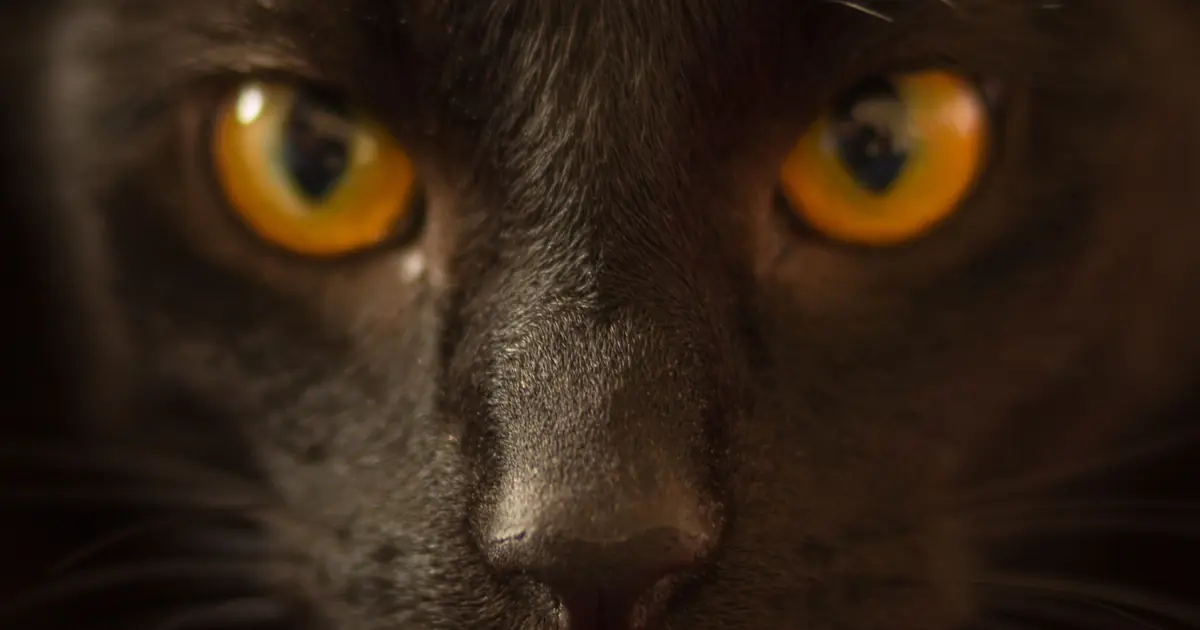
Their eyes back this up. A cat’s retina has far more rod cells than a human’s, and rods do the heavy lifting in dim light. Cats also have a mirror-like layer behind the retina called the tapetum lucidum, which bounces light back through the eye for a second pass. Between the two, cats need only about one sixth of the light a person needs to see clearly. For the full mechanics behind that, our guide on whether cats can see in the dark breaks down how their eyes and pupils pull it off.
Speaking of pupils, you’ve probably noticed your cat’s go huge the moment a room dims. That’s why a cat’s pupils get big in low light: they’re opening wide to let in every bit of available light, and it’s a normal, healthy response, not a sign of stress on its own.
Do Cats Need a Light Left On at Night?
No, healthy cats do not need a light left on at night. A cat’s low-light vision is so far ahead of ours that a completely dark house is easy for them to move through safely, whether they’re heading to the food bowl or the litter box. Leaving a lamp on overnight is almost always about making the owner feel better, not the cat.
There’s a practical downside too. A bright light can throw off a cat’s natural rhythm, since cats, like most animals, use light and dark cues to regulate rest. If your cat seems unsettled at night, the fix is rarely more light. It’s usually more play, food, or attention earlier in the evening.
Are Cats Scared of the Dark?
Cats are not scared of the dark itself. What can make a cat nervous is something unfamiliar happening inside that darkness, a strange sound, a new object they can’t quite identify, or a sudden movement they didn’t expect. The dark isn’t the trigger. The uncertainty is.
If your cat seems on edge at night, watch for other signals before blaming the darkness. Crouching low, a puffed tail, flattened ears, or hiding for long stretches are worth noting. Our guide to signs of stress in cats walks through what real anxiety looks like, and it usually traces back to a new pet, a loud noise, or a change at home, not the lights being off.
Why Do Cats Get So Active When It Gets Dark?
Cats get more active as it gets dark because dusk lines up with their crepuscular hunting instinct, not because darkness switches on some kind of nervous energy. Those sudden sprints across the living room, tail puffed and eyes wild, are your cat’s version of a dusk hunting run with no actual prey to chase.
A Cornell University veterinarian has pointed out that a lot of nighttime activity in house cats is really just built-up energy from a day spent napping, combined with hunting instincts that never fully switched off.1 Our explainer on why cats get the zoomies covers this in more depth. A solid play session an hour or two before bed, using a wand toy that mimics prey, does more to calm this down than any nightlight ever will.
Can Cats See in Total Darkness?
No, cats cannot see in total, pitch-black darkness. Vision depends on light bouncing off something and reaching the eye, and that’s true for every creature on earth, cats included. In a room with zero light, like a windowless basement with the door shut, a cat’s eyes have nothing to work with, exactly like yours.
What sets cats apart is how little light they need, and how well they cope once vision runs out. Their whiskers detect tiny changes in air currents to map nearby objects, their hearing picks up frequencies well beyond human range, and their sense of smell fills in the rest. Even in near-total darkness, a cat is rarely lost. They’re just navigating with a different set of tools.
| Lighting Condition | How Well a Cat Can See | How Comfortable a Cat Is |
|---|---|---|
| Bright daylight | Good, though slightly less sharp than human daytime vision | Comfortable, but many cats prefer shadier spots to nap |
| Dim light or twilight (dawn/dusk) | Excellent, this is peak performance for a cat’s eyes | Very comfortable, this is their natural active window |
| Near-darkness (moonlight, hallway nightlight) | Very good, still enough light to move around confidently | Comfortable and relaxed |
| Total pitch darkness (zero light) | None, no animal can see without any light present | Still calm, relies on whiskers, hearing, and smell instead |
Should You Ever Leave a Light On for a Cat?
For most healthy cats, no, a light isn’t necessary at all. But there are real exceptions. Senior cats and cats with diagnosed vision problems can benefit from a dim nightlight near stairs, litter boxes, or furniture edges, since age-related vision loss removes the sharp low-light backup younger cats rely on. Cornell’s Feline Health Center specifically recommends nightlights to help older cats with fading eyesight move around confidently after dark.2
Outside of those cases, save the lighting for your own peace of mind. A soft nightlight in a hallway is fine if it helps you find the litter box at 2am. Just don’t feel like you’re doing your cat any favors by leaving the overheads on.
Frequently Asked Questions About Cats and the Dark
Q: Do cats prefer light or dark rooms?
Cats don’t strongly prefer one over the other. Many gravitate toward dim, enclosed spots for napping because it mimics the hidden resting spots their wild ancestors used during the day.
Q: Why does my cat stare into the dark like it’s watching something?
Your cat is almost always picking up on a real sound, scent, or tiny movement your senses missed. It’s not a sign anything supernatural is happening. Our piece on whether cats can see ghosts digs into why this looks so eerie.
Q: Is it cruel to leave a cat in the dark overnight?
No, it’s not cruel. A healthy cat’s eyes and other senses are well suited to a fully dark room, and plenty of house cats sleep through a pitch-black house without any trouble finding food, water, or the litter box.
Q: Do cats see color in the dark?
No, color vision drops out almost entirely once light gets very low, for cats and humans alike. Cats already see a narrower color range than people do in daylight, and our guide on what colors cats can see covers which shades stand out to them.
Q: Why is my cat more playful at night than during the day?
Your cat is following a crepuscular schedule, so dusk and the hours after are naturally more active for them. It’s instinct lining up with lower light, not the dark itself causing the extra energy.
Q: Should kittens sleep with a light on?
No. A kitten’s low-light vision develops early, usually within the first few weeks of life, and a dark room is just as comfortable for a kitten as it is for an adult cat.
Q: Can cats get anxious specifically because of darkness?
Rarely about darkness on its own. Real anxiety usually ties to a specific trigger inside that dark room, like an unfamiliar noise, a new pet, or a recent change at home.
Q: How much light does a cat actually need to see?
Roughly one sixth of the light a human needs, thanks to the tapetum lucidum and a rod-dense retina. Below that threshold, in true zero-light conditions, a cat’s vision stops working entirely, just like ours does.
If your cat’s nighttime behavior ever feels genuinely off, like new hiding, crying, or disorientation in the dark, it’s worth a quick check with your vet rather than assuming it’s just a dark-room thing. This article is meant to inform, not replace advice from a licensed veterinarian who knows your cat.

Hello and welcome to The Ideal Cat!
We are some passionate cat owners from different professions. We love our cats and have a lot of experience in how to care for our pets. We are incredibly excited to share our knowledge, experience, and research with you. So you can take good care of your loving cat. We will answer most of the common questions about owning cats, taking care of them, etc. If you have any question contact with us. Thanks for visiting! Enjoy the content.
