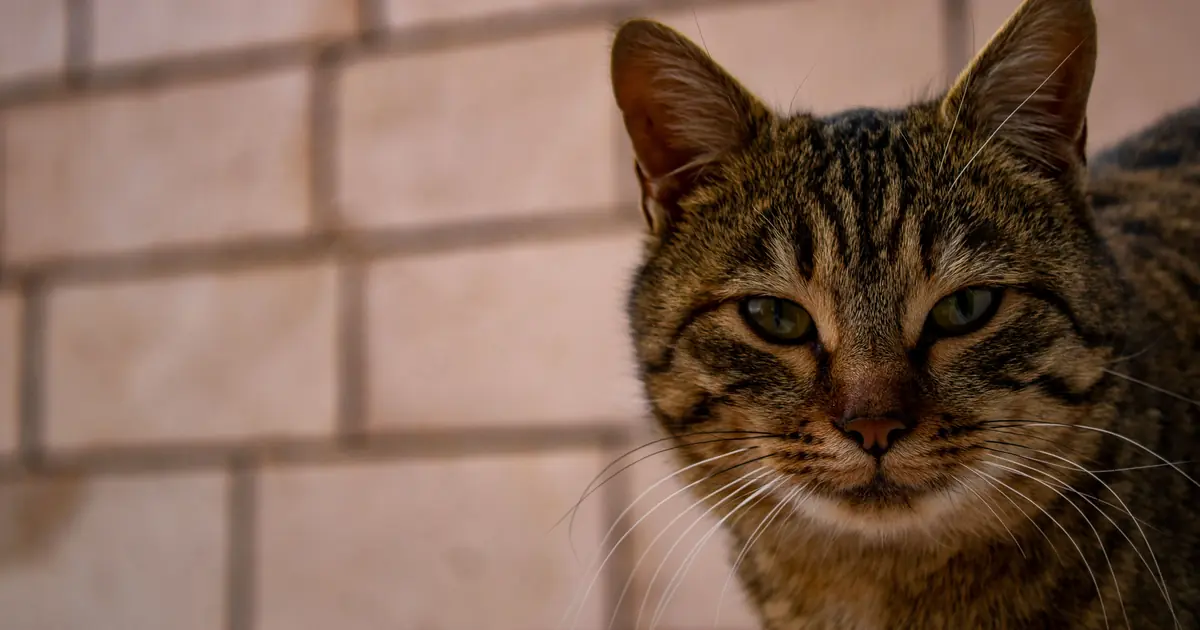
Picture this: it’s 11pm, the house is quiet, and your cat is frozen in the hallway staring at a blank patch of wall. Ears up. Tail twitching. Not blinking. You look. There’s nothing there. You look again anyway, because now you’re a little spooked too. Sometimes the staring comes with sound and your cat meows at the wall.
So can cats see ghosts? It’s one of the internet’s favorite cat mysteries. Cats really do stare at “nothing,” track invisible somethings across a ceiling, and occasionally sprint out of a room like they saw a spirit. The honest answer isn’t spooky. It’s biology. Cats have senses that outperform ours in almost every category, and that gap is what makes them look like tiny ghost hunters.
- There is no scientific evidence that cats can see ghosts or detect the supernatural.
- Cats can hear frequencies up to roughly 79 kHz, far above the human limit of about 20 kHz, so they pick up sounds you’ll never notice.
- A cat’s whiskers can sense faint air currents, letting them “feel” a moving object or draft before they ever see it.
- Cats have a wider peripheral field of view than humans and are highly sensitive to small motion in low light, which is why they seem to catch dust or shadows out of nowhere.
- New or constant blank staring in an older cat can rarely signal a real medical issue, like high blood pressure, feline cognitive dysfunction, or seizures, and is worth a vet visit.
Can cats really see ghosts?
No. There’s no scientific proof cats can see ghosts, spirits, or anything paranormal. What cats have instead is a sensory toolkit built for detecting things humans miss entirely: high-pitched sounds, tiny movements, faint smells, and subtle air currents. A cat staring at an empty corner isn’t communing with the beyond. It’s running a sensory scan on something real, like a mouse behind the drywall or a moth you haven’t spotted yet.
What can cats detect that humans can’t?
Cats detect sounds, movements, and smells that sit outside human range, and that gap explains most of the behavior people call ghost-hunting.
- Ultrasonic sound: Cats hear frequencies up to about 79 kHz, while human hearing tops out around 20 kHz. A mouse’s ultrasonic squeak, an electronic whine, or pipes settling in the wall are all completely silent to you and obvious to your cat.
- Tiny movement: Cat vision is tuned for motion, especially at the edges of their field of view. A dust mote drifting in a sunbeam or a shadow shifting as a car passes outside can catch a cat’s eye instantly.
- Air currents: A cat’s whiskers, called vibrissae, are packed with nerve endings that pick up the faintest changes in air movement. A vent kicking on or a door closing down the hall creates a draft your cat feels immediately.
- Smell: Cats have roughly 45 to 200 million scent receptors compared to a human’s 5 million, plus a second smell organ called the vomeronasal (Jacobson’s) organ, for reading scents we can’t.
- Reflections and vibration: Light bouncing off a window or a phone screen can throw a moving glint across a wall. Cats also feel vibration through their paws, so footsteps upstairs can register before you’d notice.
Curious how this stacks up against your own eyes? Our guide to how cats really see breaks down the differences in color, detail, and field of view.
Why does my cat stare at nothing on the wall?
Your cat is almost always tracking something real when they stare at a blank wall, even if you can’t see, hear, or smell it. A few culprits show up over and over.
- Insects. A tiny spider, moth, or gnat is often invisible to you from across the room but obvious to a cat’s motion-tuned eyes.
- Sound behind the wall. Mice, pipes, or wiring can make faint noises that fall right in a cat’s hearing sweet spot.
- Light play. Sunlight through blinds, or a reflection off a mirror or TV screen, creates flickers a cat can’t ignore.
- Habit and memory. Cats are creatures of routine. If something interesting once happened at that exact spot, they may keep checking it.
- Just zoning out. Sometimes a cat is resting with eyes open and mid-thought. It looks intense because cats blink less often than people do.
Reading your cat’s posture helps you tell curious from actually alarmed. Ears forward and tail loose means alert interest, not fear. Our guide to cat body language walks through the tells for genuine stress versus simple focus.
Why does my cat suddenly run away from an empty room?
A cat bolting from an empty room has almost always heard, smelled, or felt something startling that you missed. Cats are prey animals as well as predators, and their nervous system is wired to react first and figure it out second. A sudden ultrasonic sound, an unexpected draft, or a fast-moving shadow can trigger a full flight response before the sound or sight even registers with you.
This is also where a cat’s low-light vision comes in. Cats see far better than people in dim rooms, thanks to a reflective layer behind the retina called the tapetum lucidum, so a shape that’s genuinely invisible to you at dusk can be perfectly clear to your cat. For more, see our breakdown of how well cats can see in the dark.
Do cats and ghosts have a real history in folklore?
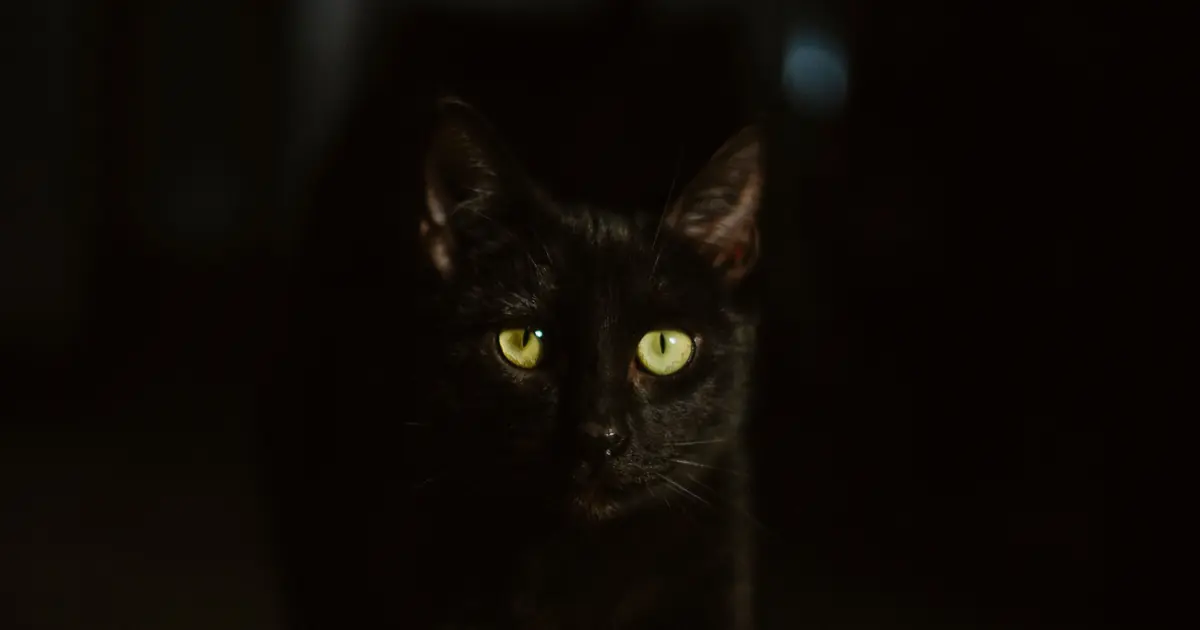
Cats have been tied to the supernatural for thousands of years, though none of it is backed by evidence. Ancient Egyptians associate
d cats with the goddess Bastet and treated them as near-sacred. Medieval European folklore swung the opposite way, linking cats (especially black ones) to witches and bad luck, a superstition that still lingers today. Japanese folklore has the “bakeneko,” a supernatural cat said to gain powers with age. Even modern ghost-hunting shows love to film a cat staring at a corner as “proof” of activity in the house.
It’s a fun thread of human history. It just isn’t evidence of anything paranormal. The staring, the bolting, the 3am zoomies: all explainable by senses sharper than ours, not anything otherworldly.
Spooky behavior vs. the real explanation
| “Spooky” behavior | What’s actually happening |
|---|---|
| Staring fixedly at a blank wall | Tracking an insect, dust particle, light reflection, or sound behind the wall |
| Suddenly bolting from a quiet room | Startled by an ultrasonic noise, draft, or fast shadow outside human perception |
| Watching something “move” across the ceiling | Following a reflection, a shadow, or an insect using highly sensitive motion vision |
| Hissing at an empty doorway | Picking up an unfamiliar scent or sound carried in from outside |
| Freezing mid-play with a fixed stare | Occasionally a focal seizure in older cats; worth a vet check if it’s new or repeats |
When does wall-staring need a vet visit?
Occasional wall-staring in a healthy cat is normal. But if the staring is new, constant, or comes with confusion or unresponsiveness, it’s worth a trip to the vet. In older cats, frequent blank staring can rarely point to something medical rather than sensory: high blood pressure (hypertension), feline cognitive dysfunction (the cat version of dementia), or a type of seizure that looks like a sudden freeze with a fixed stare instead of convulsing. None of these are things to diagnose at home. This article is educational, not a substitute for a licensed veterinarian, so if the behavior is new or paired with changes like appetite loss, get your cat checked out. Curious whether unusual focus could be linked to something like autism in cats? We covered that in our piece on wall-staring and odd focus in cats.
The International Cat Care team notes that sudden behavior changes are usually a cat’s way of responding to its environment, and the Cornell Feline Health Center flags hypertension and cognitive decline as real, treatable causes of disorientation in senior cats. The ASPCA recommends routine checkups as cats age, since these conditions are easier to manage the earlier they’re caught.
Frequently Asked Questions
Q: Can cats see ghosts or spirits?
There’s no scientific evidence cats can see ghosts. What looks like “seeing” something invisible is almost always a cat detecting a real sound, smell, or movement outside human perception.
Q: Why does my cat stare at one spot on the wall for a long time?
Your cat is likely tracking an insect, a reflection, or a faint sound behind the wall. Cats have highly sensitive motion vision, so tiny movements you’d never notice can hold their full attention.
Q: Why does my cat suddenly run from a room for no reason?
Cats react fast to stimuli you may have missed, like a high-pitched sound or a sudden draft. It’s a fear reflex triggered by real sensory input, not a paranormal encounter.
Q: Can cats hear things humans can’t?
Yes. Cats hear frequencies up to about 79 kHz, while human hearing tops out around 20 kHz. That range lets them pick up rodents behind walls or electronics that are completely silent to people.
Q: Do cats have better night vision than humans?
Yes, cats see far better than humans in low light thanks to a reflective layer behind the retina called the tapetum lucidum. That’s why they spot movement in a dim room that looks pitch black to you.
Q: Is it true that black cats are bad luck?
That’s folklore, not fact. Black cats picked up a bad-luck reputation in medieval European superstition, while other cultures, like ancient Egypt, saw cats as protective and sacred.
Q: Should I worry if my older cat stares at walls a lot?
Occasional staring is normal, but frequent or new blank staring in a senior cat is worth mentioning to your vet. It can rarely signal high blood pressure, cognitive dysfunction, or a seizure that looks like a fixed stare.
Q: What is a cat actually doing when it “tracks” something invisible across the ceiling?
It’s usually following a real moving object, most often a light reflection, a shadow, or an insect. A cat’s eyes are built to catch small motion, especially at the edges of their vision.

Hello and welcome to The Ideal Cat!
We are some passionate cat owners from different professions. We love our cats and have a lot of experience in how to care for our pets. We are incredibly excited to share our knowledge, experience, and research with you. So you can take good care of your loving cat. We will answer most of the common questions about owning cats, taking care of them, etc. If you have any question contact with us. Thanks for visiting! Enjoy the content.
