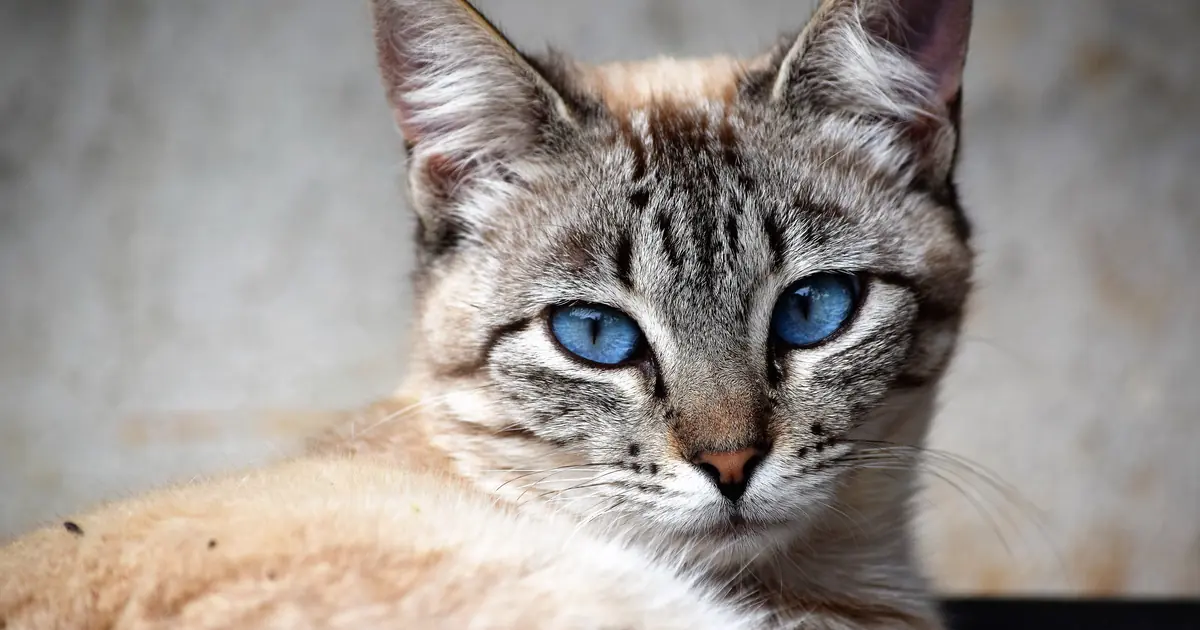
Picture a cat with a coat like any other. Tortoiseshell, tabby, black, whatever you like. Then it looks up at you, and the eyes stop you cold. Deep, glacier blue. The kind of blue you only expect on a snow-white cat or a Siamese.
Except this cat is neither. That is the whole magic of the Ojos Azules.
Here is the catch, and it is a big one. You will almost certainly never meet one. The Ojos Azules may be the rarest cat breed on the planet, and the reason why is a genetics story that is part wonder, part heartbreak.
| Origin | United States (New Mexico), 1984 |
| Weight (Male) | 8 to 12 lbs |
| Weight (Female) | 6 to 10 lbs |
| Lifespan | 10 to 15 years |
| Coat | Short or long, fine and soft |
| Colors | Almost any color or pattern, except solid white |
| Energy Level | Moderate |
| Grooming Needs | Low to moderate (depends on coat length) |
| Good With Kids | Yes, by all early reports |
| Good With Other Pets | Yes, with normal introductions |
| Average Price | Often listed at $700 to $3,000, but realistically almost unavailable |
What Is an Ojos Azules Cat?
The Ojos Azules is a rare domestic cat breed whose signature trait is deep blue eyes that show up regardless of coat color. The name is Spanish for “blue eyes,” and it fits perfectly.
Here is what makes this breed genuinely one of a kind. In most cats, blue eyes come bundled with pale fur. White cats, colorpoint cats like the Siamese, and many odd-eyed cats all get their blue from genes that also strip color out of the coat. The Ojos Azules broke that rule. It carries a separate gene, called the dominant blue eye gene (DBE for short), that paints the eyes blue while leaving the coat completely alone.
So you can have a deep brown tabby, a calico, a black cat, with those same icy blue eyes. No other breed does that. And honestly, that is what makes Ojos Azules photos look almost edited when you first see them.
History and Origin: Where Did the Ojos Azules Come From?
The Ojos Azules story starts in New Mexico in 1984. Breeders noticed a feral tortoiseshell cat with strikingly blue eyes, which was odd, because her coat had plenty of color. Tortie cats are not supposed to have blue eyes. They named her Cornflower, and she became the founding cat of the whole breed.
When Cornflower was bred to ordinary cats, something interesting happened. Every single kitten inherited the blue eyes. That told breeders the trait was dominant, meaning a kitten needs only one copy of the gene to show it. A dominant blue-eye gene that ignored coat color had never been documented before.
The International Cat Association (TICA) accepted the Ojos Azules for registration in 1991, in both shorthair and longhair forms. For a moment, it looked like a brand-new breed was on its way up.
Then the genetics caught up with everyone.
What Does an Ojos Azules Look Like?
An Ojos Azules is a small-to-medium cat with a balanced, lightly muscular build. Nothing about its body screams “exotic.” The drama is all in the eyes.
Those famous blue eyes
The eyes are large, expressive, and a deep, saturated blue, often compared to sapphire rather than the paler aqua you see in some Siamese. Because the blue comes from the DBE gene and not from coat-color genes, the eyes stay just as vivid on a dark cat as on a light one.
Some Ojos Azules are odd-eyed too, meaning one blue eye and one of another color. That is part of the same gene’s range.
Coat and colors
The coat can be short or long, and it tends to be soft and fine. Color-wise, almost anything goes: solid, tabby, tortoiseshell, calico, you name it. The one combination breeders avoid is a fully solid white coat, because pairing white with the blue-eye trait raises the same deafness risk seen in regular white cats (more on that below).
One quirky marking
Breeders described a few small physical “tells” linked to the gene, including a flattened or slightly kinked tail tip and occasional white patches on the face, paws, or the very end of the tail. These were considered markers of the trait rather than flaws.
Kittens vs adults
Like most kittens, Ojos Azules babies are born with the bluish eyes all kittens start with. The difference is that their blue does not fade to green, gold, or copper as they grow. It stays blue for life, which is exactly the point of the breed.
Ojos Azules Personality and Temperament
Let me be straight with you here. We have very little solid data on Ojos Azules personality, simply because so few have ever existed. Anyone who tells you they know exactly how this breed behaves is guessing.
That said, the handful of Ojos Azules that breeders raised were generally described as affectionate, friendly, gentle, and playful. People reported sociable, people-loving cats that enjoyed being around their humans and stayed reasonably active and curious into adulthood.
Because the breed was built from regular domestic cats, its temperament leans toward that easygoing, adaptable “house cat” range rather than the loud intensity of a Siamese or the velcro clinginess of a Ragdoll. Think pleasant and balanced, not extreme.
If you ever did meet one, you would probably notice a normal, sweet cat with one unforgettable feature. The eyes do the talking.
Is the Ojos Azules Cat Right for You?
Here is the honest version: for almost everyone reading this, the answer is “it cannot be,” and that is not a knock on you.
The Ojos Azules is so rare that “choosing” one is not really on the table. There is no waiting list to join, no cluster of breeders to compare. So the real question is not “is this breed right for me,” but “what am I actually hoping to get from it?”
If you love the look of blue eyes on a normal-colored cat, this breed is the dream. If you want a cat you can realistically bring home this year, you will need to look at the similar breeds further down this guide. There is no shame in that. It is just the reality of a near-mythical breed.
This breed could suit a calm family home if one ever became available, since early reports describe friendly, kid-tolerant cats. But planning your home around a cat you almost certainly cannot find is a setup for frustration.
Ojos Azules Health Issues and Genetics
This is the heart of the Ojos Azules story, and it deserves care rather than drama. The same gene that makes this breed beautiful is also what nearly ended it.
The dominant blue-eye gene is fine in a single copy. A kitten with one copy gets the lovely blue eyes and is otherwise a healthy cat. The problem appears when a kitten inherits two copies, one from each parent. In that homozygous form, the gene becomes lethal.
Two copies have been linked to serious cranial and skeletal defects: a domed or enlarged skull, wide-set eyes, a small curled tail, white fur, and other deformities, often ending in stillbirth or death soon after birth. Geneticists have compared the pattern to the kind of damage seen in double-merle dogs.
Why breeders pair blue eyes with a non-blue-eyed mate
Because two copies are deadly, responsible breeding always meant mating one blue-eyed Ojos Azules with a non-blue-eyed cat. That way no kitten can ever get two copies of the gene. The math works out to roughly half the kittens inheriting the blue eyes and half not, with none at risk of the lethal pairing.
This single rule is the reason the breed stayed microscopic. You can never simply mate two Ojos Azules to “lock in” the look, which is how most breeds grow their numbers. That hard limit, plus genetic investigation in the 1990s that confirmed the lethal effect, led many breeders to step away entirely. TICA eventually moved the breed to registration-only status in 2014, and most experts now describe it as functionally extinct or vanishingly rare.
Blue eyes here do not mean deaf
One common mix-up worth clearing up: in white cats, blue eyes often come with congenital deafness. The Ojos Azules gene is different. The DBE gene that gives these cats their blue is not tied to the deafness seen in blue-eyed white cats. The deafness risk only shows up if a solid white coat is in the mix, which is exactly why white was kept out of the breed.
A heterozygous Ojos Azules, the normal blue-eyed version, is generally expected to be as healthy as any well-bred domestic cat, with a typical lifespan in the 10-to-15-year range.
None of this replaces real veterinary advice. This guide is educational, and any genetic or health question about a specific cat should go to a licensed vet, ideally one familiar with feline genetics.
Grooming and Care for an Ojos Azules
Grooming an Ojos Azules is refreshingly low-drama, and it depends entirely on coat length.
A shorthaired Ojos Azules needs little more than a weekly brush to clear loose hair and keep the coat shiny. A longhaired one does best with two or three brushings a week to head off tangles and mats, especially around the belly and behind the legs.
Beyond that, the care list looks like any well-cared-for cat: regular nail trims, the occasional ear check, and good dental habits. Brushing your cat’s teeth a few times a week genuinely pays off over a lifetime. Pair that with a quiet routine and most cats settle into grooming without a fuss.
Feeding and Diet
There is no special diet for an Ojos Azules. The breed has no documented food sensitivities or breed-specific nutrition needs, so the usual rules apply.
Feed a complete, balanced cat food that meets AAFCO standards for your cat’s life stage, keep an eye on portions to avoid the slow creep toward an overweight cat, and always keep fresh water available. Many cats do well with some wet food in the mix, which helps with hydration. Your vet can fine-tune the plan as your cat ages.
Exercise and Enrichment
Early reports describe the Ojos Azules as moderately active and playful, which puts it squarely in “normal house cat” territory for exercise.
A couple of short play sessions a day, a wand toy, a scratching post, and somewhere to climb will keep this cat happy. Puzzle feeders and a window perch for bird-watching go a long way too. Nothing exotic. Just the steady enrichment any indoor cat thrives on.
Living With Kids, Dogs, and Other Cats
By the limited accounts we have, the Ojos Azules is a sociable, gentle cat, the kind that tends to fit well into a busy household.
With children, early descriptions lean positive, suggesting a tolerant, friendly cat. As with any cat, teach kids to be calm and respectful, and give the cat an easy escape route to a quiet spot.
With dogs and other cats, normal slow introductions should do the trick. Swap scents first, use a baby gate or a cracked door, and let everyone set the pace. Since the breed came from everyday domestic cats, it does not carry the territorial edge some high-strung breeds have.
Lifespan and Aging Tips
A healthy, well-bred Ojos Azules can be expected to live somewhere around 10 to 15 years, in line with other domestic shorthair and longhair cats.
To help any cat age well, stay on top of yearly vet visits (twice a year once they hit their senior years), keep weight in a healthy range, and watch for the quiet signs of aging: drinking more, eating less, stiffness, or changes in litter box habits. Catching problems early is the single best thing you can do for an older cat. Soft bedding and easy-to-reach litter boxes help senior cats stay comfortable.
How Much Does an Ojos Azules Cost?
You will see Ojos Azules prices quoted anywhere from around $700 to $3,000, depending on the source. Here is the honest part: those numbers are mostly theoretical.
Because so few of these cats exist, there is effectively no real market to set a price. A listing claiming to sell Ojos Azules kittens at a tidy price should make you suspicious, not excited. The breed is too rare for a steady supply of kittens to be sitting around waiting for buyers.
| What people expect | The reality |
|---|---|
| A breeder waiting list you can join | Almost no active breeders exist |
| A clear “kitten price” | Quoted prices are estimates, not a true market |
| Choosing color and coat length | You take whatever rare litter, if any, exists |
| Buying online from a listing | High scam risk; likely a mislabeled cat |
So budget less for a “purchase price” and more for the patience to keep looking, plus normal cat costs like food, litter, vet care, and insurance once you do have a cat.
Where to Find an Ojos Azules Ethically
Realistically, you cannot just go out and find an Ojos Azules, and I would rather tell you that plainly than sell you a fantasy.
There are no well-known, active Ojos Azules breeders today. The breed sits at registration-only status with TICA and is widely considered extinct or nearly so. That means the honest “where to find one” answer is mostly a list of cautions.
- Be very wary of any “Ojos Azules kittens for sale” ad. Most are scams or ordinary blue-eyed cats wearing a fancy label.
- A blue-eyed cat is not automatically an Ojos Azules. White cats, colorpoint cats, and some mixes have blue eyes for completely different reasons.
- Ask for genuine TICA registration paperwork and the parents’ history. Real documentation is the only thing that would back up the claim, and it will be extremely hard to produce.
- If you fall in love with the look, adopt a blue-eyed cat from a shelter instead. You will not get the rare gene, but you will get the eyes and a cat that genuinely needs a home.
Similar Breeds to Consider
Since the Ojos Azules is off the table for almost everyone, here are realistic blue-eyed (or strikingly eyed) alternatives you can actually find.
| Breed | Why it might suit you |
|---|---|
| Siamese | Classic vivid blue eyes, very social and talkative, easy to find. |
| Ragdoll | Big, mellow, blue-eyed lap cat that goes limp when you pick it up. |
| Birman | Sapphire-blue eyes, white “gloves” on the paws, gentle nature. |
| Khao Manee | A rare Thai breed famous for blue or odd-colored eyes on a white coat. |
| Balinese | The longhaired cousin of the Siamese, same blue eyes and chatty charm. |
Common Myths and Misconceptions About the Ojos Azules
This breed attracts confusion, partly because it is so rarely seen. Let me clear up the big ones.
Myth: Any cat with blue eyes is an Ojos Azules
No. Plenty of cats have blue eyes. White cats, Siamese, Ragdolls, and many kittens (whose eyes later change). What sets the true Ojos Azules apart is a specific dominant gene that produces blue eyes on a fully colored coat.
Myth: Ojos Azules cats are deaf because of their blue eyes
Not from the breed’s gene. The DBE gene behind Ojos Azules eyes is not linked to the deafness seen in blue-eyed white cats. Deafness risk enters only when a white coat is involved, which is why solid white was avoided.
Myth: You can breed two Ojos Azules to get more blue-eyed kittens
This one is dangerous. Mating two blue-eyed Ojos Azules risks kittens with two copies of the gene, which causes fatal skull defects. Responsible breeding always pairs a blue-eyed cat with a non-blue-eyed one.
Myth: They are extinct, so they never really existed
They existed, and a few likely still do in scattered lines. “Extinct” here means there is no active, organized breeding program, not that the gene vanished overnight.
Frequently Asked Questions
Q: Is the Ojos Azules the rarest cat breed?
The Ojos Azules is widely considered one of the rarest cat breeds in the world, and possibly the rarest. So few were ever bred that the breed is now at registration-only status with TICA and is often described as functionally extinct.
Q: Why is the Ojos Azules so rare?
The Ojos Azules is rare because its blue-eye gene is lethal when a kitten inherits two copies, causing fatal skull defects. To stay safe, breeders could only pair a blue-eyed cat with a non-blue-eyed one, which made the breed almost impossible to grow.
Q: How much does an Ojos Azules cat cost?
Prices are often quoted between $700 and $3,000, but these figures are mostly theoretical. The breed is so rare that there is effectively no real market, and most “Ojos Azules for sale” listings are scams or mislabeled blue-eyed cats.
Q: What causes blue eyes in the Ojos Azules cat?
Blue eyes in the Ojos Azules come from a dominant blue-eye (DBE) gene that is separate from coat-color genes. That is why these cats can have deep blue eyes on any coat color, unlike white or colorpoint cats whose blue eyes are tied to pale fur.
Q: Can you actually buy an Ojos Azules?
Realistically, no. There are no well-known active Ojos Azules breeders today, and the breed is considered nearly extinct. Any listing claiming to sell Ojos Azules kittens should be treated with strong suspicion.
Q: Are Ojos Azules cats deaf?
Not because of their blue eyes. The breed’s DBE gene is not linked to the deafness common in blue-eyed white cats. Deafness risk only appears when a solid white coat is present, which is why white was kept out of the breed.
Q: How big do Ojos Azules cats get?
The Ojos Azules is a small-to-medium cat. Males typically weigh 8 to 12 pounds and females 6 to 10 pounds, with a balanced, lightly muscular build rather than a large or heavy frame.
Q: What is the difference between an Ojos Azules and a Khao Manee?
Both are rare blue-eyed breeds, but they differ in coat. The Khao Manee is always solid white and may have blue or odd-colored eyes, while the Ojos Azules can have blue eyes on any coat color, including dark and tabby coats.
Final Verdict: Should You Get an Ojos Azules?
The Ojos Azules is one of those cats that feels almost too good to be true, and in a practical sense, it is. Deep blue eyes on any coat color is a genuinely unique trait, and the breed earns every bit of its near-mythical reputation.
But the same gene that makes it special is what kept it so rare and, for most breeders, ended the program. So if you came here hoping to bring one home, I will give it to you straight: that is almost certainly not going to happen, and that is okay.
Love the Ojos Azules for the fascinating, slightly bittersweet story it is. Then, if those blue eyes have your heart, go meet a Siamese, a Ragdoll, a Birman, or a shelter cat with eyes like the sky. You will get the gaze that stopped you in your tracks, and a cat who actually gets to come home with you.

Hello and welcome to The Ideal Cat!
We are some passionate cat owners from different professions. We love our cats and have a lot of experience in how to care for our pets. We are incredibly excited to share our knowledge, experience, and research with you. So you can take good care of your loving cat. We will answer most of the common questions about owning cats, taking care of them, etc. If you have any question contact with us. Thanks for visiting! Enjoy the content.
