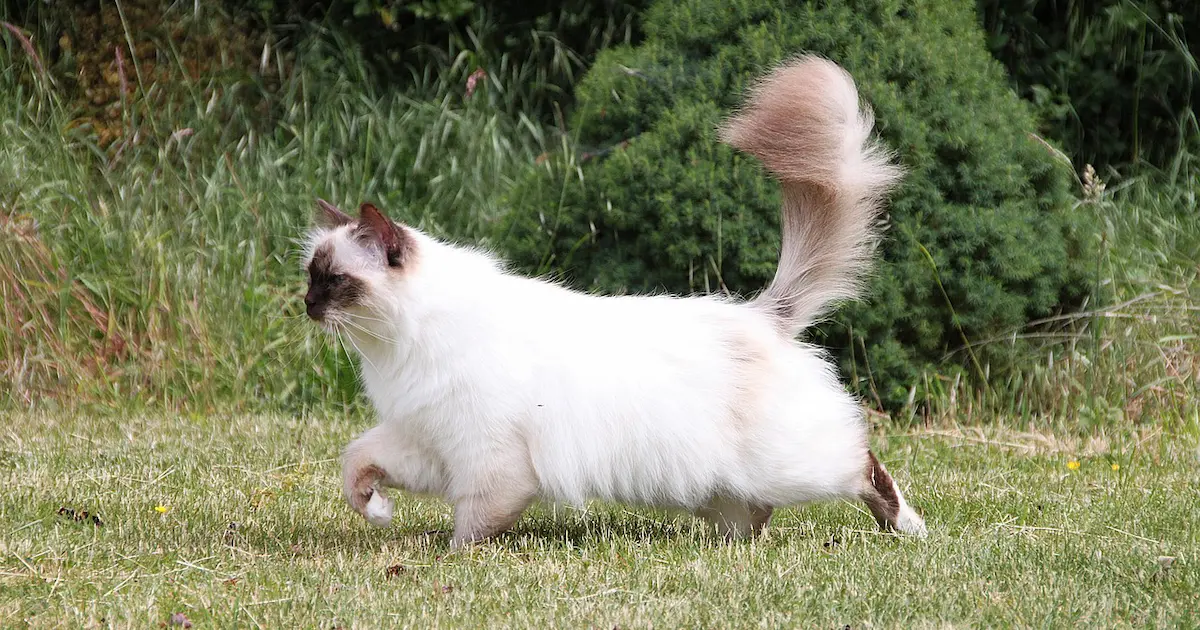
Picture this. You reach down to greet a fluffy, cream-colored cat with deep blue eyes, and you notice something odd. All four paws are dipped in pure white, like the cat slipped on a set of little gloves before meeting you. That’s a Birman, and those gloves are no accident. Breeders spent generations getting them exactly right.
The Birman cat comes wrapped in legend. Old stories tie it to temple priests in Burma and a goddess who turned a white cat golden. Lovely tale. The real history is messier and, honestly, more interesting.
Here’s the thing though. The Birman is also one of the most mixed-up breeds in the cat world. People call it a Burmese, a Ragdoll, or “that long-haired Siamese.” It’s none of those. So before you fall for the eyes, let’s get you the full, honest picture of what living with one is actually like.
| Origin | Burma (Myanmar) by legend, developed in France, early 1900s |
| Weight (Male) | 9 to 12 lbs |
| Weight (Female) | 7 to 10 lbs |
| Lifespan | 9 to 16 years |
| Coat | Medium-long, silky, single coat with little undercoat |
| Colors | Seal, blue, chocolate, lilac, red, cream, plus tortie and lynx points |
| Energy Level | Moderate |
| Grooming Needs | Low to Moderate |
| Good With Kids | Yes |
| Good With Other Pets | Yes, with a slow intro |
| Average Price | $600 to $1,500 (show lines $1,500 to $3,000+) |
The Legend and Real History of the Birman
Let’s start with the fairy tale, because it’s a good one. The story goes that white temple cats lived alongside priests in old Burma. When one priest died, a goddess rewarded his loyal cat by turning its coat golden and its eyes blue, while the paws stayed white where they touched the holy man. Hence the gloves. It’s why people still call the breed the Sacred Cat of Burma.
Sweet story. There’s almost no hard evidence for it.
What we can actually trace starts in France in the early 1900s. A pair of these cats was shipped over from Asia, and the breed took shape on French soil from there. France formally recognized the Birman by 1925. So while the soul of the breed feels eastern, the breed as we know it was really built in Europe.
Then came the rough part. World War II nearly wiped the Birman out. The breeding stock crashed so hard that the whole breed was rebuilt from a tiny handful of cats. To save it, breeders crossed Birmans with other longhaired and pointed cats, then carefully bred back toward the original look. That comeback story matters more than the legend, and we’ll come back to why when we talk about health.
What a Birman Cat Actually Looks Like
The Birman is a study in contrast. The body is pale, often a soft eggshell or warm golden cream. The face, ears, legs, and tail carry darker color, called points. That’s the same pointing you see on a Siamese, just on a fluffier frame.
Now the signature features. First, the gloves. Every Birman has four white paws, and a proper Birman has them in a clean, even line across the front feet. On the back legs, the white runs up the back of the hock into a point. Breeders call those the laces. Getting both perfectly symmetrical is genuinely hard, which is part of why well-bred Birmans aren’t cheap.
Second, the eyes. Always blue. The deeper and more vivid, the better. They’re nearly round with a soft, sweet expression that melts most people on sight.
The coat is medium-long and silky, with a light ruff around the neck and a fluffy tail. Because it’s mostly a single coat with little undercoat, it doesn’t mat the way a Persian’s does. You’ll also see a faint golden shimmer over the back on many cats, which breeders prize.
Here’s a fun part for new owners. Birman kittens are born almost pure white. The color in the points comes in slowly over weeks and months, so the cat you bring home will keep changing for a while. A kitten’s true coloring isn’t fully settled until it’s a few years old.
Living With a Birman: Personality and Temperament
If you want a cat that treats you like the center of its universe, the Birman delivers. People often call them velcro cats, and it fits. Your Birman will follow you from room to room, supervise your cooking, and settle near you the moment you sit down.
The good news is they’re gentle about it. Birmans tend to be calm and patient rather than demanding. They’ll greet guests instead of hiding, and they usually take chaos in stride. That easygoing nature is a big reason they suit families, couples, and seniors alike.
They’re also wonderfully quiet. This trips people up, because the Birman is related to the Siamese, and the Siamese is famously loud. Your Birman will chat, but in a soft, conversational way. No marathon yowling at 3 a.m.
One honest note. That devotion has a flip side. A Birman left alone all day, every day, can get lonely and a little anxious. They’re not built for empty houses. More on who that rules out in a second.
Birman vs Ragdoll vs Siamese vs Burmese
This is where most guides leave you confused, so let’s fix that. Four breeds get tangled together constantly. Here’s how to tell them apart in plain terms.
Birman vs Burmese. These share a name and a homeland and almost nothing else. The Burmese is a short-haired, solid-colored cat with gold or yellow eyes and a chatty, busy personality. The Birman is long-haired, pointed, blue-eyed, and gloved. If someone says “Burmese” but the cat has white paws and blue eyes, they mean Birman.
Birman vs Siamese. Both are pointed with blue eyes. But the Siamese is sleek, short-haired, very vocal, and high-energy. The Birman is fluffy, soft-spoken, and mellow. Think of the Siamese as the extrovert and the Birman as the gentle homebody. If you’ve read our guides on the Flame Point Siamese or the Lynx Point Siamese, the Birman is the calmer cousin in the same color family.
Birman vs Ragdoll. This is the toughest one. Both are big, fluffy, pointed, blue-eyed, and sweet. The clearest tell is the paws. Birmans have those crisp white gloves on all four feet. Ragdolls usually have larger white patterns and tend to be bigger and heavier overall. Ragdolls also famously go limp when you pick them up, while Birmans stay a bit more upright.
Is a Birman Right for You?
Time for the honest part. The Birman is a fantastic cat for the right home and a frustrating one for the wrong home. Run yourself through this quick gut-check.
A Birman is likely right for you if: someone is home most of the day, you want a cat that’s involved in your life, you have kids or other pets and need a peaceful temperament, and you’d rather snuggle than chase a high-octane athlete around the house.
A Birman is probably wrong for you if: you work long hours and travel a lot with nobody home, you want a fiercely independent cat that ignores you, or you’re hoping for a hypoallergenic pet. Birmans are not hypoallergenic, and they shed.
Trust me on the alone-time issue. People fall for the looks, bring one home into a quiet, empty apartment, then wonder why the cat seems clingy or sad. The Birman didn’t change. It just needs company. If your home is empty most days, consider adopting two so they keep each other company.
Health Issues to Know About
Birmans are generally a sturdy breed, and many live well into their teens. One UK study of vet records even put their average life expectancy above 14 years, higher than cats overall. That’s encouraging. But there are real issues worth knowing before you commit.
The big one is hypertrophic cardiomyopathy, or HCM. It’s the most common heart disease in cats, and it thickens the heart muscle so the heart can’t pump as well. Here’s the part other breed sites skip. Screening studies of Birmans have found cardiomyopathy in roughly 1 in 10 cats tested, with HCM the most common form. Early on there are often no symptoms at all. Later you might see fast or labored breathing, low energy, or sudden weakness. There is no cure, but early detection and medication can manage it and improve quality of life.
And here’s the honest catch. For breeds like the Maine Coon and Ragdoll, there’s a genetic test for known HCM mutations. For Birmans, that breed-specific test doesn’t exist yet. So the best protection is regular vet checkups and heart screening as your cat ages, not a one-time DNA result.
Other things to watch: kidney function as they get older, dental disease (start brushing those teeth early), and weight. Birmans love their food and can pack on pounds, which strains the heart and joints over time.
One more piece, and it connects back to that WWII bottleneck. Because the breed was rebuilt from so few cats, Birmans carry low genetic diversity compared to many breeds. That’s exactly why buying from a careful breeder who health-screens really does matter. It’s not a sales pitch. It’s the difference between a healthy cat and an avoidable heartbreak.
Grooming and Coat Care
Good news here. That gorgeous coat is far less work than it looks. Because the Birman has little undercoat, it rarely mats, so you won’t be fighting tangles the way Persian owners do.
A thorough brushing two or three times a week keeps it silky and cuts down on shed hair around your home. Most Birmans actually enjoy the attention, so it becomes bonding time rather than a battle. Use a gentle brush or comb that reaches the longer fur on the tail and ruff.
Beyond that, the basics. Trim nails every couple of weeks, check ears for gunk, and brush teeth as often as you can manage. Dental care early in life pays off big as they age.
Feeding and Diet
There’s no special Birman-only diet, but a few things help. Feed a high-quality food with real animal protein as the first ingredient, and watch portions closely. This breed gains weight easily, and extra pounds are hard on a heart already prone to HCM.
Scheduled meals beat free-feeding for most Birmans. It keeps you in control of how much goes in. Go easy on treats, keep fresh water available, and ask your vet about the right calorie target for your cat’s size and age.
Exercise and Enrichment
Birmans sit in the moderate zone. They’re not couch potatoes, but they won’t bounce off the walls either. A couple of good play sessions a day keeps them happy and trim.
They’re smart and a little playful well into adulthood, so they love puzzle feeders, wand toys, and a tall perch to survey their kingdom. Since they bond so hard to people, the best enrichment is often you. Ten minutes of interactive play means more to a Birman than a basket of toys it plays with alone.
Keep your Birman indoors. They’re trusting and friendly to a fault, which makes them easy targets for theft, traffic, and trouble outside. A cat tree by a sunny window gives them all the adventure they need.
Birmans With Kids, Dogs, and Other Cats
This is where the breed really shines. The Birman’s patient, gentle nature makes it one of the better choices for a busy household.
With kids, they’re tolerant and rarely scratch or snap, though you should always teach children to handle any cat kindly. With dogs, a calm dog and a confident Birman usually become friends, especially with a slow, supervised introduction. With other cats, the Birman’s social streak helps, but give any new pairing time and separate spaces at first.
Picture this. You bring home a second cat, and instead of hissing for a week, your Birman is curious and a little hopeful. That’s the typical reaction. They genuinely like company, which is a gift when you’re building a multi-pet home.
Lifespan and Aging Tips
Most Birmans live somewhere between 9 and 16 years, and plenty reach the upper end with good care. To get there, lean into prevention.
In the kitten and young-adult years, focus on socializing, vaccines, and building good dental habits. In the middle years, keep weight in check and don’t skip annual vet visits. As a senior, ask your vet about heart screening and kidney checks, since both HCM and kidney issues tend to show up later in life. Watch for slowing down, weight changes, or breathing that seems off, and get those looked at early.
How Much Does a Birman Cost?
Birmans aren’t cheap, and there’s a reason. They’re relatively rare, with only a handful of registered breeders in the US at any time.
From a reputable breeder, expect roughly $600 to $1,500 for a pet-quality kitten. Show or breeding lines with champion pedigrees climb to $1,500, $3,000, or more. Adoption through a rescue, when you can find one, usually runs about $100 to $400.
Then there’s the rest of life. Budget for initial supplies (litter box, carrier, scratching posts, toys), which can run $150 to $300. Add routine vet care, quality food, and the occasional surprise. Over a Birman’s whole life, you’re realistically looking at many thousands of dollars. Going in with eyes open beats being blindsided later.
Sourcing red flags: a “breeder” with kittens always available, no health testing, no contract, prices that seem too good, or anyone willing to send a kitten home before about 12 weeks. Walk away from all of those.
Where to Find a Birman Ethically
Because of that narrow gene pool, who you buy from matters more with Birmans than with many breeds. A careful breeder is your best defense against heart and genetic problems down the road.
Start with breeders registered through the Cat Fanciers’ Association or The International Cat Association, since both keep listings you can check. A good breeder will happily talk about the health of their lines, let you see how the kittens are raised, provide records, and ask you plenty of questions in return. That back-and-forth is a great sign.
Don’t rule out rescue, either. Purebred Birmans do turn up in breed-specific rescues and occasionally in shelters. It takes patience, but adopting an adult Birman can be a wonderful, lower-cost path, and you’ll know the cat’s grown-in personality from day one.
Similar Breeds to Consider
Not totally sold on the Birman? Here are a few cats in the same neighborhood, and why you might pick each.
- Ragdoll: bigger and floppier, with the same sweet temperament, if you want more cat to cuddle.
- Siamese: sleeker, louder, and busier, for someone who wants a chatty, high-energy companion.
- Persian: a calm lap cat with even more glamour, if you don’t mind heavier grooming.
- Maine Coon: a big, friendly, dog-like longhair with a playful streak, for owners wanting size and personality.
- Snowshoe: pointed and gloved like a Birman but short-haired, for less coat upkeep.
Common Myths and Misconceptions
Myth: Birmans and Burmese are the same cat. Not even close. Different coat, different eyes, different personality. The shared name is the only overlap.
Myth: Birmans are loud like Siamese. Nope. They talk softly and infrequently. One of the quieter pointed breeds you’ll meet.
Myth: That long coat is high-maintenance. It looks like a lot, but with little undercoat it rarely mats. A couple of brushings a week does the job.
Myth: Birmans are hypoallergenic. They aren’t. No cat truly is, and Birmans shed and produce the usual allergens.
Myth: Kittens are born with their colors. Birman kittens arrive nearly all white. The points develop with age.
Birman Cat FAQ
Q: Are Birman cats good for first-time owners?
Yes. Their calm, friendly, low-drama nature makes them one of the easier purebreds for beginners. The main thing to plan for is company, since they don’t love being alone for long stretches.
Q: Do Birman cats shed a lot?
They shed a moderate amount, more during seasonal coat changes. The upside is the silky single coat doesn’t mat much, so brushing two or three times a week keeps loose hair under control.
Q: Are Birman cats rare?
Yes, fairly. The breed nearly went extinct after World War II and was rebuilt from a small number of cats. Today there are relatively few registered breeders, which is part of why kittens cost more.
Q: Why are Birman cats so expensive?
They’re rare, hard to breed correctly (those symmetrical gloves take skill), and responsible breeders invest in health screening. Pet-quality kittens usually run $600 to $1,500, with show lines higher.
Q: Do Birman cats get along with dogs?
Usually, yes. Their easygoing temperament suits a calm dog well, especially with a slow, supervised introduction. Many Birmans end up genuinely fond of a canine housemate.
Q: How long do Birman cats live?
Typically 9 to 16 years, and often into the mid-teens with good care. One UK study even found an average above 14 years, higher than cats in general.
Q: What’s the difference between a Birman and a Ragdoll?
Both are big, fluffy, pointed, and blue-eyed. The clearest tell is the paws: Birmans have crisp white gloves on all four feet, while Ragdolls tend to be larger with broader white patterns and go limp when held.
Q: Are Birman cats lap cats?
Very much so. They’re affectionate velcro cats that want to be near you, and most happily settle on a lap or beside you for hours.
Final Verdict: Should You Get a Birman?
If you want a cat that’s stunning to look at and even better to live with, the Birman cat is hard to beat. You get those gloved paws and sapphire eyes, a soft voice, a gentle heart, and a companion that genuinely wants to be part of your day.
Just go in clear-eyed. Give it company, watch the weight, screen the heart as it ages, and buy from someone who breeds responsibly. Do that, and you’ll have a devoted friend curled at your side for many years. For the right home, the Birman isn’t just a pretty cat. It’s the cat you’ll wish you’d gotten sooner.

Hello and welcome to The Ideal Cat!
We are some passionate cat owners from different professions. We love our cats and have a lot of experience in how to care for our pets. We are incredibly excited to share our knowledge, experience, and research with you. So you can take good care of your loving cat. We will answer most of the common questions about owning cats, taking care of them, etc. If you have any question contact with us. Thanks for visiting! Enjoy the content.
