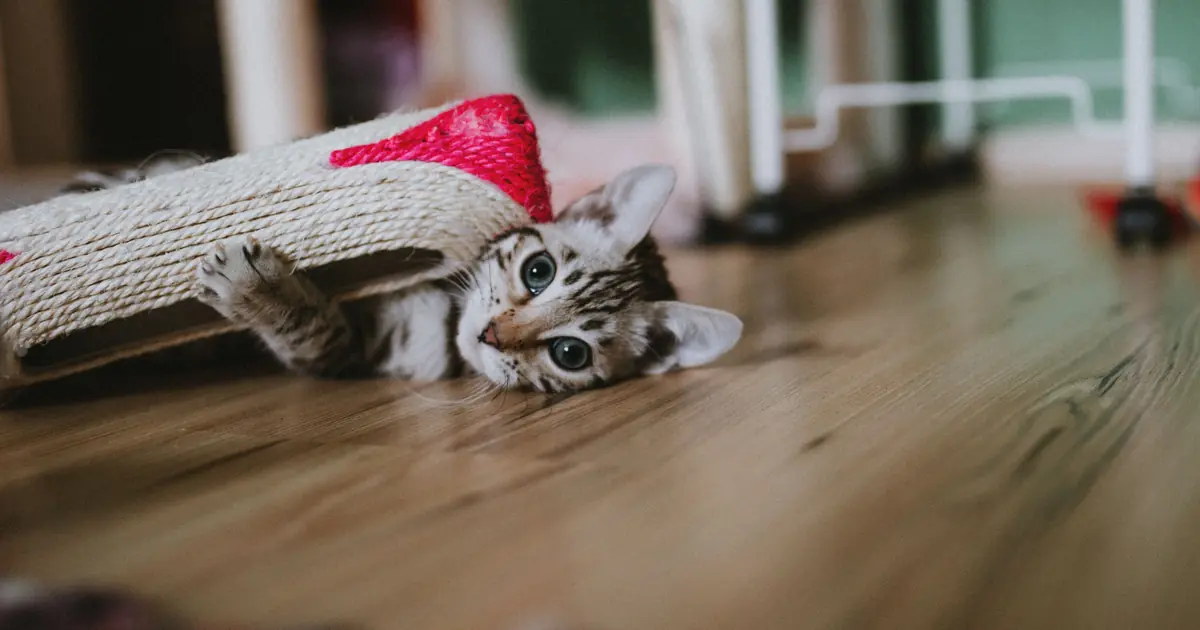
Picture this: your cat pounces on a toy mouse, wraps its front paws around it in a death grip, then flips onto its side and starts machine-gunning it with its back feet. It looks brutal. It also looks a little hilarious. That move is called the bunny kick, and almost every cat does it at some point.
The same move shows up during rough play with your arm, during a wrestling match with a housemate cat, and sometimes in a moment of real fear. The kick itself doesn’t change much. What changes is why your cat is doing it, and that context is what actually matters.
- The bunny kick is a rapid, alternating rake of both hind legs, delivered while the front paws grab and hold onto prey, a toy, or a hand.
- Wild cats use this exact move to disembowel prey during a hunt, which is why domestic cats still perform it on toys and hands even though they’ve never hunted for food.
- Kittens practice the bunny kick constantly during play because it builds the leg strength and coordination they’d need to take down real prey.
- A bunny kick during play looks loose and bouncy, while a bunny kick from fear or pain comes with flattened ears, a puffed tail, or a low growl.
- Letting a cat bunny-kick your bare hand teaches it that human skin is a fair target, so redirecting the behavior onto a toy early on prevents scratches later.
Why do cats kick their back legs?
Cats kick their back legs because it’s built into their hunting instinct, not something they learn or copy. A cat’s hind legs are loaded with power, built for explosive pounces and quick sprints. When a cat catches something with its front paws, whether that’s a mouse, a feather toy, or your sock-covered foot, the instinct is to pull the “prey” close to its belly and rake it with the back feet. Even a cat who has never seen a live mouse in its life will do this, because the wiring is instinctive, not taught.
What’s the predatory instinct behind the bunny kick?
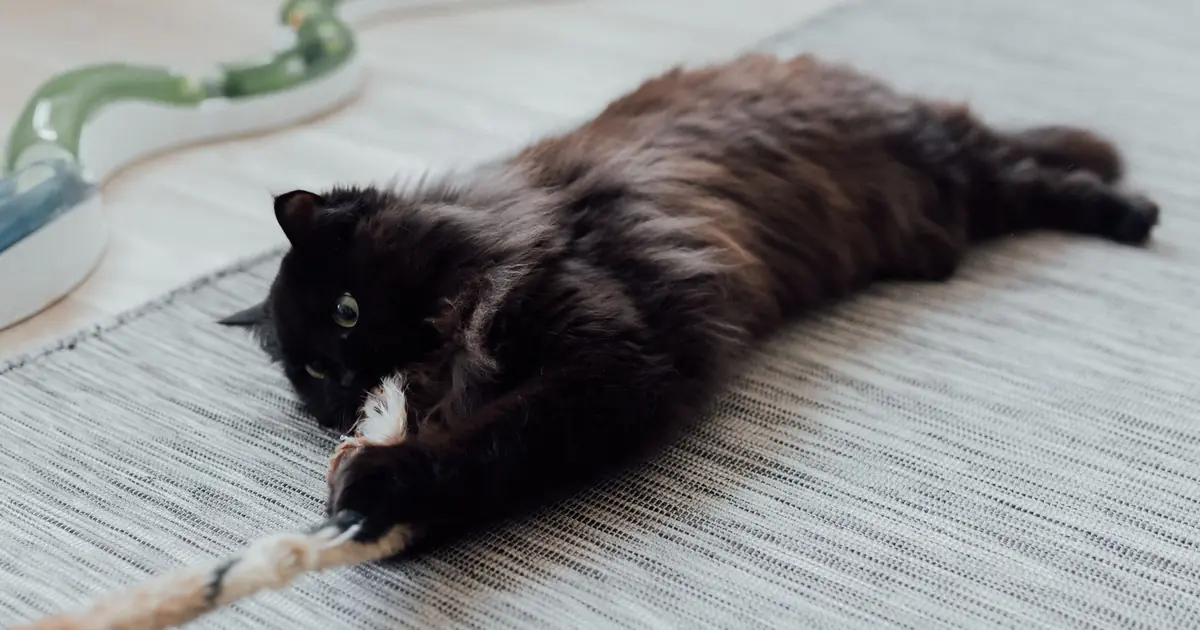
The bunny kick is a leftover hunting move designed to finish off prey quickly. In the wild, a cat’s ancestors needed to subdue small, fast, sometimes dangerous animals (a rat can bite back). Grabbing with the front paws pins the prey in place, and raking with the back claws does the real damage, disemboweling or immobilizing it fast. According to International Cat Care, this predatory sequence (stalk, pounce, grab, bite, kick) is largely hardwired and shows up in kittens as young as a few weeks old, long before they’ve ever hunted anything real.
Why do cats bunny-kick during play?
Cats bunny-kick during play because play is practice hunting, and the kick is part of the full sequence their brain wants to run. Watch a cat go after a kicker toy (one of those long, plush toys made for exactly this) and you’ll see the whole routine: stalk, pounce, grab with front paws, then a flurry of back-leg kicks. This is why kicker toys exist. They’re shaped and sized so a cat can wrap all four legs around them and go to town without hurting themselves or you.
The same thing happens during wrestling matches between cats who live together. One cat grabs the other around the middle and starts kicking, and the other one usually kicks right back. It looks like a scuffle, but between cats who are actually friends, it’s mutual and nobody gets hurt. If you’ve ever wondered whether that tussle is real fighting, hissing during otherwise playful wrestling is one of the clearest signs to watch for.
Is bunny-kicking aggression or play?
Bunny-kicking is usually play, not aggression, but the body language around it tells you which one you’re dealing with. A playful bunny kick comes with a relaxed body, soft or forward-facing ears, and no vocalizing beyond maybe a light chirp or purr. Your cat might flop onto its side mid-kick, which is a relaxed, trusting posture. A defensive or fear-driven kick looks completely different: flattened ears, dilated pupils, a puffed-up tail, and often a growl or hiss layered underneath. The kick is the same motion in both cases. The context around it is what separates a game from a warning.
Why shouldn’t you let your cat bunny-kick your hands?
You shouldn’t let your cat bunny-kick your bare hands because it teaches your cat that human skin and clothing are acceptable targets for claws and teeth. It’s cute when a kitten does it. It’s a lot less cute when a 10-pound adult cat does the same move and leaves scratch marks up your forearm. Every time your cat successfully “hunts” your hand, that behavior gets reinforced. The fix is simple: the moment your cat grabs for your hand, swap it out for a wand toy or a kicker toy instead. If your cat already treats hands as fair game, our guide on why cats bite during play walks through how to retrain that habit step by step.
Do cats bunny-kick when they’re scared or fighting?
Yes, cats use the bunny kick as a self-defense move when they feel cornered or threatened, not just during play. If a cat ends up on its back during a real confrontation, whether that’s with another cat, a dog, or a person reaching in the wrong way, the back legs become its best weapon. A cat pinned on its back can still deliver a serious raking kick to whatever’s grabbing it, which is exactly why “the cat is on its back, it must want a belly rub” is one of the more common misreadings of cat body language. A relaxed, playful kick and a defensive one share the same mechanics but almost never the same body language.
Do all cats bunny-kick?
Most cats bunny-kick at some point, and kittens do it far more often than adults. Kittens are still building the muscle memory and coordination for hunting, so littermates spend hours wrestling and kicking each other as practice. Adult cats keep the instinct but usually save it for toys, favorite people, or the occasional wrestling buddy. Some cats, especially high-energy or particularly playful breeds, keep bunny-kicking well into adulthood, while calmer cats may do it rarely. If your cat has suddenly picked up the zoomies alongside more intense kicking and pouncing sessions, that’s usually just excess energy looking for an outlet, covered in our piece on why cats get the zoomies.
How does bunny-kicking compare to other back-leg movements?
The bunny kick is only one of several back-leg behaviors cats show, and each one means something different. Kicking litter after using the box is a covering instinct, not aggression or play. Shaking a single back paw is usually just your cat flicking off something it doesn’t like the feel of, like a wet floor or litter dust. Treading, sometimes called kneading when it’s the front paws, is that rhythmic pressing motion cats do when they’re relaxed and content, often before settling in to nap; you can read more in our guide to why cats knead. None of these involve the fast, alternating rake of a true bunny kick, so it’s easy to tell them apart once you know what you’re looking at.
| Bunny Kick in Play | Bunny Kick in Fear or Aggression |
|---|---|
| Trigger: a toy, a hand during a game, or wrestling with a familiar cat | Trigger: feeling cornered, threatened, grabbed, or overstimulated |
| Body language: relaxed body, soft ears, may flop onto its side | Body language: flattened ears, puffed tail, dilated pupils |
| Sound: silent, or a light purr or chirp | Sound: growling, hissing, or spitting |
| What to do: keep using a toy, let the game continue | What to do: back away slowly, give your cat space, stop handling it |
The easiest fix for hand-kicking is redirecting the habit onto a proper toy every single time, not just when it’s convenient. A good interactive toy gives your cat somewhere to put all that hunting energy instead of your knuckles. And if a normally gentle, easygoing cat suddenly starts kicking or biting defensively out of nowhere, that’s worth a vet visit. Sudden aggression can point to pain, an injury, or an underlying illness rather than a behavior problem, and it’s always worth ruling that out. This article is educational and isn’t a substitute for a hands-on exam from your vet.
Frequently Asked Questions
Q: Why does my cat bunny-kick my hand when I pet its belly?
Many cats find belly touching overstimulating rather than relaxing, so the bunny kick is a fast, reflexive way to push your hand away. The ASPCA notes that petting-induced overstimulation is common in cats and usually shows up as a sudden grab-and-kick response. The safest move is to stick to head, cheek, and chin scratches instead.
Q: Is the bunny kick painful for the toy or hand it’s aimed at?
A soft plush toy can handle a full-force bunny kick without any issue, which is exactly what it’s designed for. Bare skin can’t, since a cat’s hind claws are sharp enough to leave real scratches even during friendly play.
Q: At what age do kittens start bunny-kicking?
Kittens typically start showing bunny-kick behavior around 4 to 8 weeks old, once basic play and motor skills develop. This lines up with the same window when kittens start stalking, pouncing, and wrestling with littermates as part of learning to hunt.
Q: Should I use my hand to play with my kitten so it learns the bunny kick is fine?
No, hands should never be used as play toys, even for young kittens. Wand toys, kicker toys, and other interactive cat toys let a kitten practice the full hunting sequence, including the bunny kick, without ever learning that human skin is an acceptable target.
Q: Why does my cat only bunny-kick certain toys and not others?
Cats tend to reserve the bunny kick for toys they can wrap both front paws around, like long plush kicker toys or stuffed animals close to prey-sized. Smaller or flatter toys don’t give a cat enough to grab onto, so the pounce-and-kick sequence doesn’t trigger the same way.
Q: Can two cats bunny-kicking each other turn into a real fight?
Yes, playful wrestling can escalate if one cat gets overstimulated or the other cat isn’t actually enjoying it. Watch for growling, hissing, or one cat trying to flee while the other keeps pursuing; those are signs it’s time to step in and separate them.
Q: Does declawing stop a cat from bunny-kicking?
Declawing doesn’t stop the kicking behavior itself, since it’s a muscle and instinct-driven motion, not a claw-driven one. Removing the claws only reduces the damage a kick can cause and comes with significant welfare concerns, which is why veterinary groups like the AVMA discourage the procedure except in rare medical cases.
Q: My cat bunny-kicks and bites at the same time. Is that normal?
Yes, grabbing with the front paws and mouth while kicking with the back legs is the complete predatory sequence, and it’s normal during rough play. If the biting regularly breaks skin, that’s your cue to switch to toys and stop hands-on wrestling altogether, since a cat can’t easily tell the difference between “fun rough play” and a bite that actually hurts you.

Hello and welcome to The Ideal Cat!
We are some passionate cat owners from different professions. We love our cats and have a lot of experience in how to care for our pets. We are incredibly excited to share our knowledge, experience, and research with you. So you can take good care of your loving cat. We will answer most of the common questions about owning cats, taking care of them, etc. If you have any question contact with us. Thanks for visiting! Enjoy the content.
