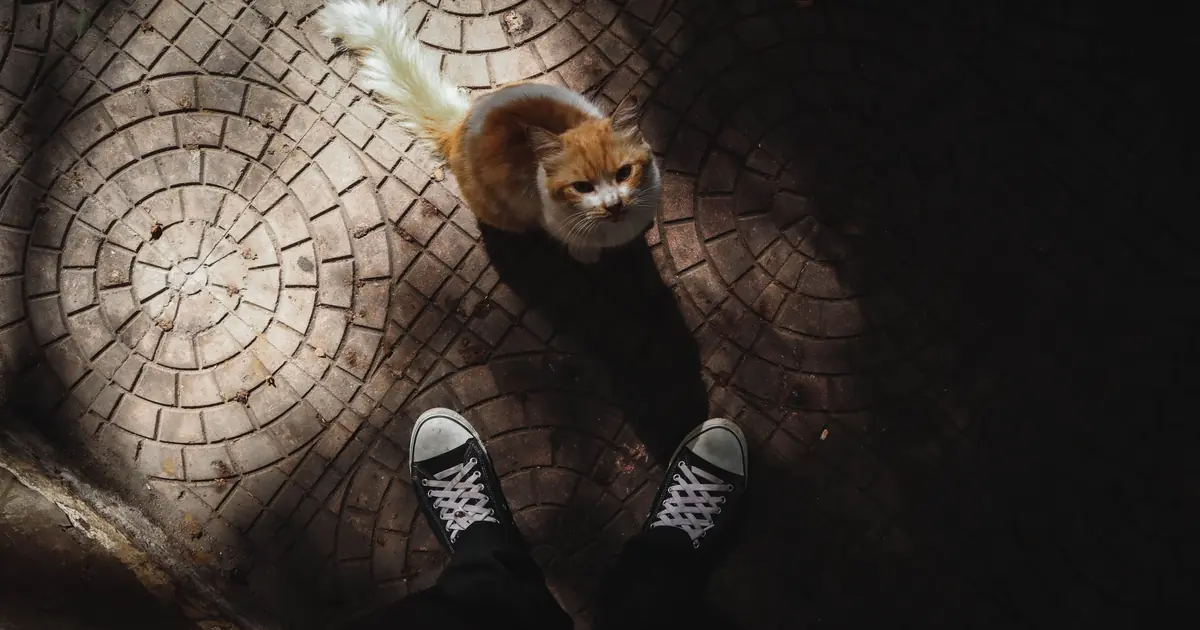
You’re standing at the counter making coffee, and suddenly there’s a warm, purring weight parked right on top of your toes. You freeze, half amused and half afraid to move. Sound familiar?
This is one of those cat habits that seems random until you know what’s driving it. Your cat isn’t picking your feet by accident, and she’s definitely not trying to trip you (most of the time). There’s real feline logic behind it, and once you understand it, the behavior actually feels pretty sweet.
- Cats sit on feet mainly for warmth, since a resting foot can run several degrees warmer than the surrounding floor.
- Cats have scent glands in their cheeks and paws, so lying on your feet mixes their scent with yours, a behavior called scent-mixing or allorubbing.
- Sitting on your feet keeps a cat close to you while staying low and out of the way, which feels safer than being out in the open.
- Your feet are usually the first part of you to move, so a cat resting there gets an early warning when you’re about to get up.
- Sudden or unusually intense clinginess, especially in an older cat, is worth mentioning to a vet since it can occasionally point to pain or illness.
Why does my cat sit on my feet?
Cats sit on your feet because it checks several boxes at once: warmth, your scent, safety, and closeness to you without being picked up or held. Feet are low to the ground, so a cat can settle there without much effort, and they’re almost always near you when you’re standing still, cooking, working, or brushing your teeth. Think of it as your cat’s version of pulling up a chair right next to yours.
Most cats who do this are comfortable cats. It’s a behavior rooted in comfort-seeking and social bonding, not something to worry about on its own.
Are my feet actually warm enough to matter to my cat?
Yes. Feet and the floor space right around them are often warmer than a cat expects, especially near vents, heaters, or simply from your own body heat radiating down. Cats have a slightly higher body temperature than humans, typically around 100.5 to 102.5 degrees Fahrenheit, and they’re drawn to warm spots the way most of us are drawn to a cozy blanket on a cold morning.
According to International Cat Care, cats naturally seek out warm resting spots because it helps them conserve energy, a trait left over from their desert-dwelling ancestors. Your feet, especially if you’ve been walking around or you’re wearing socks, can feel like a tiny personal heater.
Does my scent have anything to do with it?
It has a lot to do with it. Cats have scent glands in their cheeks, chin, and paw pads, and rubbing against or resting on something covered in your scent is a way of blending your smell with theirs. Researchers call this scent-mixing, and it’s the same instinct behind head-butting your leg or kneading your lap.
Your feet carry a strong, unique scent trail from walking around the house all day, which makes them an easy, obvious target. By sitting there, your cat is essentially saying “this is part of my territory, and so are you.” It’s a small act with a fairly deep meaning in cat language.
The ASPCA notes that scent marking through rubbing is one of the main ways cats build and maintain their social bonds, including bonds with the people they live with.
Is sitting on my feet about feeling safe?
Yes, security is a big piece of this puzzle. Sitting on your feet lets your cat stay close to you while keeping a low profile, tucked near the ground with a quick escape route in any direction. It’s a middle ground between full exposure out in the open room and disappearing entirely under the bed.
This matters more than it might seem. Cats are both predators and prey animals in the wild, and that instinct never fully switches off, even in the safest living room. Being near your feet gives your cat the benefits of your company (protection, warmth, familiarity) without feeling boxed in or trapped the way being picked up sometimes does.
Why does my cat sit on my feet right before I move?
Because your feet almost always move first. A cat resting on or near your feet gets instant feedback the second you shift your weight, which gives her a head start to react, whether that means scooting away or following you to the next room. It’s less about blocking you and more about staying plugged into your movements.
This is also why cats seem to have uncanny timing when you’re trying to sneak away. She’s not reading your mind. She’s reading your feet.
Is my cat asking for attention or food when she sits on my feet?
Sometimes, yes. Sitting or standing on your feet is one of the more polite ways a cat can say “notice me,” especially compared to yowling at 5am or knocking a pen off the desk. If it happens most often right before mealtime or when you’ve been ignoring her for a while, food or attention is probably part of the message.
Cats learn fast which behaviors get a reaction. If sitting on your feet reliably earns a look down, a pet, or a trip to the food bowl, she’ll keep doing it, the same way she might learn that a soft following you everywhere routine gets her fed sooner.
Is this affection or is my cat trying to control me?
It’s affection, not control. Cats don’t sit on feet as a power move or a way to manipulate you into staying put. It’s much closer to how cats choose to sit on laps or press against your leg when they walk by: a comfort behavior built on trust.
A cat who didn’t feel safe with you wouldn’t get this close, this often, in this vulnerable a position. Sitting directly on your feet means she’s decided you’re not a threat and you’re worth being near, which is honestly one of the nicer compliments a cat can give.
Does sitting on my feet mean my cat is anxious or clingy?
Usually not. For most cats, this is a normal, low-key affection habit, no different from wanting to sleep with their owners at night. Cats are naturally social with their favorite humans, and sticking close to your feet during the day is a mild version of that same bond.
It’s worth paying closer attention if the behavior turns into constant shadowing, panic when you’re out of sight, or distress when you leave the room. Those signs point more toward genuine separation anxiety than simple foot-sitting, and it may be a good time to read up on why your cat is so clingy to figure out whether something has changed.
Should I move my cat off my feet or just let her stay there?
Let her stay, unless it’s genuinely getting in your way or putting you both at risk (hello, stairs). This is a harmless, low-effort way for your cat to bond with you, and there’s no real downside to enjoying it. If it’s inconvenient, like when you’re cooking or heading out the door, gently nudge her aside and set up a warm cat bed nearby instead.
A heated bed or a sunny spot near where you usually stand can redirect the habit without hurting her feelings. Most cats will happily trade your feet for a cozy alternative if it’s warm and close enough to still count as “with you.”
Reasons cats sit on your feet, compared
| Reason | What it means |
|---|---|
| Warmth | Your feet and the floor near them are often warmer than the rest of the room, which cats find comfortable and energy-saving. |
| Scent | Resting on you blends your scent with hers, a bonding behavior called scent-mixing. |
| Security | Staying low and close to you feels safer than being out in the open, with an easy escape route. |
| Attention or food | A gentle way to get noticed, especially if it happens near mealtimes. |
This article is for general education and isn’t a substitute for veterinary advice. A sudden shift toward intense clinginess, especially in a senior cat, or foot-sitting paired with other new behaviors like hiding, appetite changes, or vocalizing more than usual, is worth mentioning to a vet. Occasionally, increased neediness can be linked to pain, anxiety, or an underlying medical issue, and it’s always better to rule that out early. The Cornell Feline Health Center is a solid resource if you want to read more about normal versus concerning feline behavior changes.
Frequently Asked Questions
Q: Why does my cat sit on my feet instead of my lap?
Feet are easier to access than a lap, especially when you’re standing, cooking, or working at a desk. Your cat doesn’t need you to sit down or hold still, she can settle on your feet whenever she wants without waiting for an invitation.
Q: Why does my cat sit on my feet when I’m in the bathroom?
Bathroom moments are one of the few times you’re sitting still and undistracted, which makes your feet an easy, predictable warm spot. Some cats also treat closed-door moments as a chance to check in, since they can’t see or hear you doing anything else.
Q: Is it bad for my cat to sleep on my feet at night?
No, it’s generally harmless and a common way cats choose to stay close overnight. The only real downside is reduced legroom for you, so if it disrupts your sleep, a nearby cat bed is a simple fix.
Q: Why does my cat only sit on my feet and not my partner’s?
Cats often form a stronger scent and comfort bond with one household member, usually whoever feeds them, handles them gently, or spends the most relaxed time nearby. It’s not personal to your partner, it’s just a preference built over repeated positive experiences.
Q: Does my cat sitting on my feet mean she loves me?
It’s a strong sign of trust and affection, yes. Cats don’t waste time being physically vulnerable near something or someone they don’t feel safe with, so choosing your feet, again and again, says a lot.
Q: Why does my cat sit on my feet and then bite them?
This is usually playful predatory behavior, especially if your feet are moving under a blanket or wiggling toys under socks. It’s more common in kittens and young cats and can often be redirected with a wand toy instead of bare feet.
Q: Should I encourage my cat to sit on my feet?
You don’t need to do anything special, most cats will keep doing it on their own if they find it comfortable. If you want to encourage it, staying still for a few extra minutes and offering a calm scratch under the chin reinforces that it’s a welcome behavior.
Q: Why does my cat sit on my feet more in winter?
Cold weather makes warm spots, including your feet, socks, and slippers, noticeably more appealing. Indoor heating changes airflow too, so the warm zone right around your feet can become one of the coziest spots in the room.

Hello and welcome to The Ideal Cat!
We are some passionate cat owners from different professions. We love our cats and have a lot of experience in how to care for our pets. We are incredibly excited to share our knowledge, experience, and research with you. So you can take good care of your loving cat. We will answer most of the common questions about owning cats, taking care of them, etc. If you have any question contact with us. Thanks for visiting! Enjoy the content.
