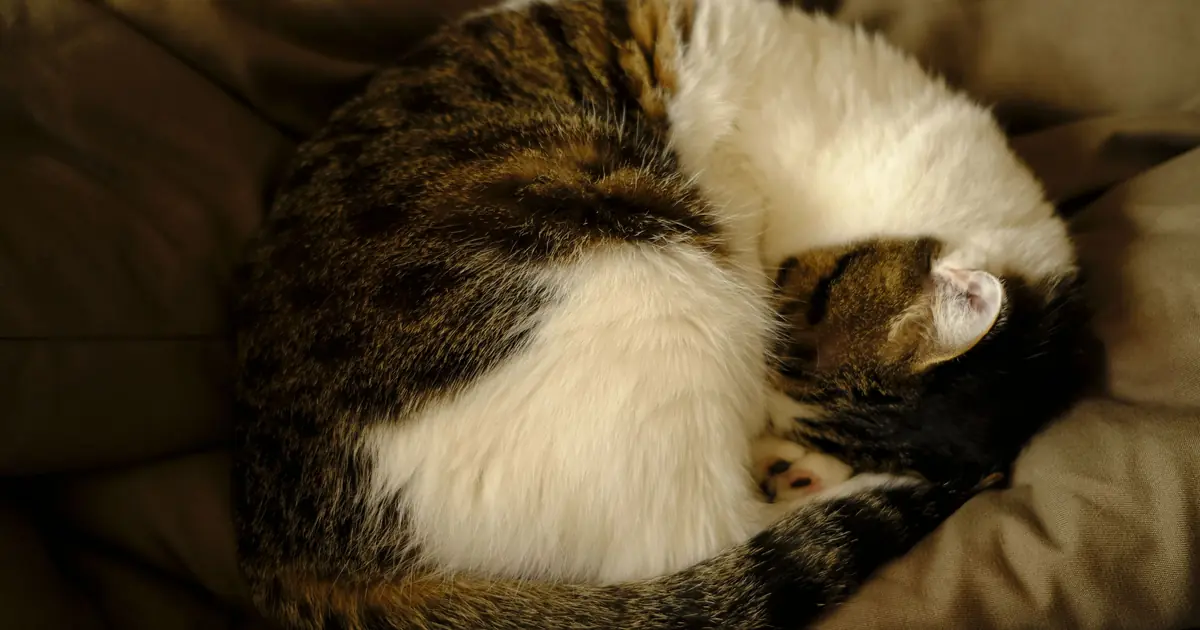
If you have ever watched your cat fast asleep, paws paddling, whiskers flicking, tail giving little jerks, you have probably wondered: why does my cat twitch in her sleep? Maybe it is 2am, she is curled on the bed, and a sudden twitch made your stomach drop. Take a breath. In almost every case, a cat twitching in her sleep is completely normal, and it usually means she is dreaming. The same goes for the small noises cats make while they sleep.
Here is the thing. Cats are champion sleepers, and their sleeping brains are surprisingly busy. Those tiny movements are usually just your cat acting out a dream about pouncing on a toy or chasing a moth. Below, we will walk through the 7 real reasons cats twitch while they sleep, and the handful of warning signs that mean it is time to call your vet.
- Cat twitching during sleep is usually normal and happens during REM (rapid eye movement) sleep, the stage when cats dream.
- Normal sleep twitches are small and brief, affecting the paws, whiskers, ears, or tail, and the cat wakes easily if you call her name.
- Kittens and senior cats twitch more in their sleep than healthy adult cats, which is expected and not a problem on its own.
- A seizure looks different from a dream: it brings stiffness or violent paddling, drooling, loss of consciousness, and the cat cannot be woken, usually lasting 1 to 3 minutes.
- Call your vet if twitching happens while your cat is fully awake, lasts more than a couple of minutes, or comes with disorientation, drooling, or loss of bladder control.
Why does my cat twitch in her sleep?
Your cat twitches in her sleep mainly because she has entered REM sleep and is dreaming. REM (rapid eye movement) sleep is the deep, active stage of sleep where the brain becomes highly active, almost as busy as when a cat is awake. During this stage, the brain sends out movement signals that leak through as small twitches of the paws, whiskers, ears, and tail.
Cats sleep a lot, on average 12 to 16 hours a day, and a good chunk of that is REM sleep. A cat’s full sleep cycle runs roughly 20 to 30 minutes, with REM periods lasting about 5 to 7 minutes at a time. So if your cat naps several times a day, you have plenty of chances to catch her mid-dream, legs running and nose wiggling.
Researchers have actually studied this. In the 1950s and 1960s, French sleep scientist Michel Jouvet ran landmark experiments on cats and discovered REM sleep and the “muscle paralysis” that normally keeps a sleeping body still. When he interfered with that off-switch in his studies, the cats began acting out their dreams, walking, pouncing, and swatting while still asleep. That is strong evidence cats dream, and that the twitches you see are little flickers of those dreams getting through.
What does normal sleep twitching look like in cats?
Normal sleep twitching in cats is small, brief, and relaxed. You will usually see a paw twitch, whiskers flicker, an ear flick, the tail give a little jerk, or the mouth move like a silent meow. Your cat stays soft and floppy, breathes steadily, and the movements come and go in short bursts of a few seconds.
Common normal sleep movements include:
- Paw paddling or “running”, as if she is chasing something in a dream.
- Whisker and nose twitches, often along with tiny mouth movements.
- Ear flicks, like she is tracking a sound that is not there.
- Tail jerks or flicks while the rest of her body stays relaxed.
- Soft chirps, squeaks, or muffled meows, the dream version of talking.
- Rapid eye movement under closed lids, which is exactly where REM sleep gets its name.
The big tell that twitching is normal: your cat looks peaceful, and she wakes up easily and acts completely normal if you say her name or gently touch her. A dreaming cat snaps awake, blinks, maybe stretches, and carries on. That easy wake-up is one of the clearest signs you are watching a dream, not a medical problem.
7 reasons cats twitch in their sleep
Cats twitch in their sleep for a handful of reasons, and most of them are completely harmless. The most common cause is dreaming during REM sleep, but a few other normal and not-so-normal triggers can cause twitching too. Here are the 7 reasons cats twitch while they sleep, from most to least common.
| Reason | What’s happening | Normal or worth a vet call? |
|---|---|---|
| 1. Dreaming during REM sleep | The brain is highly active and sends movement signals that show up as paw, whisker, ear, and tail twitches. | Normal |
| 2. Hypnic jerks (falling-asleep starts) | Sudden single twitches as your cat drifts off, just like the “sleep starts” humans feel. | Normal |
| 3. Being a kitten | Kittens sleep up to 20 hours a day, spend more time in REM, and twitch a lot as their nervous system develops. | Normal |
| 4. Being a senior cat | Older cats can twitch more in their sleep, sometimes from lighter sleep or minor age-related changes. | Usually normal, mention at next checkup |
| 5. Itchy skin, fleas, or allergies | An itch, flea bite, or skin irritation can cause twitching or skin-rippling even during light sleep. | Treatable, check her skin |
| 6. Feline hyperesthesia syndrome | A “twitchy skin” condition that mostly shows up while a cat is awake, with rippling skin over the lower back. | See a vet |
| 7. A seizure | Abnormal electrical activity in the brain causing stiff or violent, uncontrolled movements and loss of awareness. | See a vet promptly |
Dreaming during REM sleep
Dreaming is the number one reason cats twitch in their sleep. During REM sleep, a cat’s brain is nearly as active as it is when she is awake, and those busy brain signals slip out as small twitches. The paw paddling, whisker flicks, and tiny meows are most likely your cat replaying a hunt, a play session, or a stroll around the house.
Hypnic jerks as she falls asleep
Hypnic jerks are sudden, single muscle twitches that happen as your cat is drifting off to sleep. People get these too, that “falling” jolt right before sleep. In cats they look like one quick jerk of a leg or the whole body, then your cat settles right back down. Hypnic jerks are harmless and very common.
She is a kitten
Kittens twitch in their sleep more than adult cats, and that is exactly what you want to see. Kittens sleep up to 20 hours a day and spend more of that time in REM sleep, which supports their fast-growing brains and bodies. All that REM means lots of twitching, paddling, and squeaking. It is a sign of healthy development, not a problem.
She is a senior cat
Senior cats can also twitch more in their sleep than they did in their prime. Older cats sometimes sleep more lightly and may have minor age-related changes that show up as extra movement. On its own, a bit more twitching in an older cat is usually fine. If you notice it alongside new confusion, weakness, or pacing, mention it at your next vet visit.
Itchy skin, fleas, or allergies
Itchy skin can make a cat twitch even while she dozes. A flea bite, dry skin, or an allergy can cause skin twitches, sudden scratching, or that quick “skin rippling” over the back. Part the fur near the base of the tail and look for tiny black flecks (flea dirt) or red, irritated skin. Good flea prevention and a vet check usually clear this up fast.
If itchy, irritated skin seems to be behind the twitching, a soothing medicated shampoo can help while you sort out the cause with your vet.
Vetericyn FoamCare Medicated Shampoo
This is a spray-on foaming shampoo made to clean and soothe itchy, dry, or irritated skin, and it is safe to use on cats. It can ease the surface itch that triggers skin twitches, though it will not treat fleas or allergies on its own. Best as a comfort step alongside proper flea control and a vet check.
Feline hyperesthesia syndrome
Feline hyperesthesia syndrome (FHS), sometimes called “twitchy cat syndrome” or rolling skin disease, is a condition where a cat has uncontrollable muscle twitching and extreme skin sensitivity, usually over the lower back. The key difference from sleep twitching is that FHS episodes mostly happen while the cat is awake. You may see the skin ripple, the pupils go wide, sudden frantic running, biting at the flank or tail, and loud meowing, often in bursts of about 20 to 30 seconds. Siamese, Burmese, Abyssinian, and Persian cats seem more prone to it. FHS needs a vet, because diagnosis means ruling out skin problems, pain, and seizures first.
A seizure
A seizure is the one reason for twitching that is genuinely worth worrying about, and the good news is it looks quite different from a dream. A seizure is a burst of abnormal electrical activity in the brain that causes uncontrolled movement and a loss of awareness. Instead of soft, small twitches, you see stiffness or violent jerking, often with drooling, and the cat cannot be woken. The next section breaks down exactly how to tell a dream from a seizure.
Cat sleep twitching vs seizure: how can I tell the difference?
You can usually tell a dream from a seizure by how your cat looks and whether she can be woken. Normal sleep twitching is small, brief, and relaxed, and your cat wakes easily and acts fine. A seizure brings stiff or violent whole-body movement, often with drooling, loss of consciousness, and no response when you call her, and it is typically followed by a dazed, disoriented recovery.
Here is a side-by-side comparison you can check in the moment.
| Normal sleep twitching (a dream) | Seizure (call your vet) |
|---|---|
| Small, gentle movements: paws, whiskers, ears, tail | Stiff, rigid body or violent paddling of all four legs |
| Body stays soft and relaxed | Muscles go rigid, body may arch or convulse |
| Brief bursts of a few seconds, on and off | Continuous movement, usually lasting 1 to 3 minutes |
| Breathing stays steady | May involve drooling, foaming, or loss of bladder or bowel control |
| Wakes easily when you call her name or touch her | Cannot be woken, no awareness of you during the episode |
| Acts completely normal right after waking | Dazed, wobbly, confused, or temporarily blind afterward (the recovery phase) |
| Only happens while asleep | Can happen while awake or asleep |
One more reassuring point. Most cats that truly have seizures also show other signs while they are awake, like sudden staring spells, confusion, or collapse. If your cat is bright, eating, playing, and acting like herself the rest of the day, sleep movements are very unlikely to be seizures.
What should I do if my cat is twitching in her sleep?
If your cat is twitching in her sleep and looks peaceful, the best thing to do is leave her be and let her finish her nap. Waking a dreaming cat is not harmful, but she needs that sleep, and startling her can lead to a confused swat. If you want to be sure it is just a dream, you can do a simple wake test.
- Watch for a few seconds first. Notice whether the movements are small and soft (likely a dream) or stiff and violent (possible seizure).
- Gently say her name from nearby. A dreaming cat usually stirs, opens her eyes, and responds. A seizing cat will not respond.
- Do not grab or shake her. If she does not wake and the movements look like a seizure, do not put your hands near her mouth, and gently clear away anything she could bump into.
- Record a short video. If anything looks off, film 20 to 30 seconds on your phone. Vets can tell a lot from footage, and it beats trying to describe it later.
- Note the time and length. Jot down when it started and how long it lasted. Duration is one of the most important details for your vet.
If she passes the wake test and pops up like nothing happened, you almost certainly just watched a good dream. If she does not wake, or the episode lasts more than a couple of minutes, treat it as a possible seizure and contact your vet right away.
When should I worry about my cat twitching in her sleep?
You should worry about sleep twitching, and call your vet, when the movements stop looking like a relaxed dream. Most twitching is harmless, but a few red flags mean it is time for a professional. Reach out to your veterinarian if you notice any of the following.
- Twitching while fully awake, not just during sleep.
- Stiff, rigid, or violent whole-body movements rather than small, soft twitches.
- Drooling, foaming, or loss of bladder or bowel control during an episode.
- Your cat cannot be woken or seems unaware of you during the movement.
- Disorientation, wobbliness, or confusion afterward that lasts more than a minute or two.
- Episodes that are getting longer, stronger, or more frequent.
- Other new symptoms, like appetite changes, hiding, vomiting, weakness, or skin that ripples and bothers her when touched.
One clear rule for emergencies: a single seizure usually lasts 1 to 3 minutes. If a seizure lasts longer than 5 minutes, or your cat has several seizures in a row without fully recovering in between, that is a true emergency called status epilepticus. Get to an emergency vet immediately.
A quick, honest note: this article is here to help you understand normal cat sleep, not to diagnose your cat. Cat health is sensitive, and only a licensed veterinarian can examine your cat and tell you what is really going on. If something feels off, trust your gut and call your vet. You know your cat best.
Frequently asked questions about cats twitching in their sleep
Q: Is it normal for cats to twitch in their sleep?
Yes, it is completely normal for cats to twitch in their sleep. The twitching happens during REM sleep, the dreaming stage, when the brain is very active and sends movement signals to the paws, whiskers, ears, and tail. As long as the movements are small and your cat wakes easily, sleep twitching is healthy and harmless.
Q: Do cats dream when they twitch in their sleep?
Cats very likely dream when they twitch in their sleep. The twitches happen during REM sleep, the same stage when humans dream. Classic cat sleep studies by researcher Michel Jouvet showed that when the brain’s normal sleep “off-switch” was removed, cats acted out hunting and exploring behaviors while asleep, strong evidence that the twitches reflect dreams.
Q: Why does my cat twitch her paws and whiskers while sleeping?
Your cat twitches her paws and whiskers while sleeping because her brain is firing during REM sleep. The motor part of the brain stays active during dreams, so small signals leak through as paw paddling, whisker flicks, and ear twitches. Many experts believe she is dreaming about chasing or pouncing on prey.
Q: How do I know if my cat is dreaming or having a seizure?
You can tell a dream from a seizure by the movement and whether your cat wakes. Dreams cause small, soft twitches, and the cat wakes easily and acts normal. A seizure causes stiff or violent movement, often with drooling and loss of consciousness, the cat cannot be woken, and she is dazed afterward. Seizures usually last 1 to 3 minutes.
Q: Do kittens twitch in their sleep more than adult cats?
Yes, kittens twitch in their sleep more than adult cats. Kittens sleep up to 20 hours a day and spend more time in REM sleep, which supports their rapidly developing brains and bodies. All that REM sleep means more paw paddling, twitching, and squeaking, and it is a normal sign of healthy growth.
Q: Why does my cat’s skin twitch or ripple, even when she is not asleep?
Skin that twitches or ripples while a cat is awake can point to feline hyperesthesia syndrome, fleas, or a skin irritation. Feline hyperesthesia, sometimes called twitchy cat syndrome, causes rippling skin over the lower back, dilated pupils, and sudden frantic behavior. Because awake skin twitching is different from normal sleep twitching, it is worth a vet visit.
Q: Should I wake my cat up if she is twitching in her sleep?
No, you usually should not wake your cat if she is twitching peacefully in her sleep. The twitching is just dreaming, and your cat needs that rest. Waking her is not harmful, but a startled cat may swat or seem disoriented for a moment. If the movements look stiff or violent, watch closely and call your vet instead of shaking her awake.
Q: When should I take my cat to the vet for twitching?
Take your cat to the vet if twitching happens while she is fully awake, looks stiff or violent, comes with drooling or loss of bladder control, or she cannot be woken. Any seizure lasting more than 5 minutes, or repeated seizures without recovery, is an emergency. When in doubt, record a video and call your veterinarian.
So, why does your cat twitch in her sleep? Almost always because she is dreaming, and that is a wonderful, normal part of being a cat. Watch for the rare warning signs, keep an eye on anything that happens while she is awake, and lean on your vet whenever something feels off. Most nights, though, you can just smile at those paddling paws and let your dreaming cat chase her imaginary mouse in peace.

Hello and welcome to The Ideal Cat!
We are some passionate cat owners from different professions. We love our cats and have a lot of experience in how to care for our pets. We are incredibly excited to share our knowledge, experience, and research with you. So you can take good care of your loving cat. We will answer most of the common questions about owning cats, taking care of them, etc. If you have any question contact with us. Thanks for visiting! Enjoy the content.
