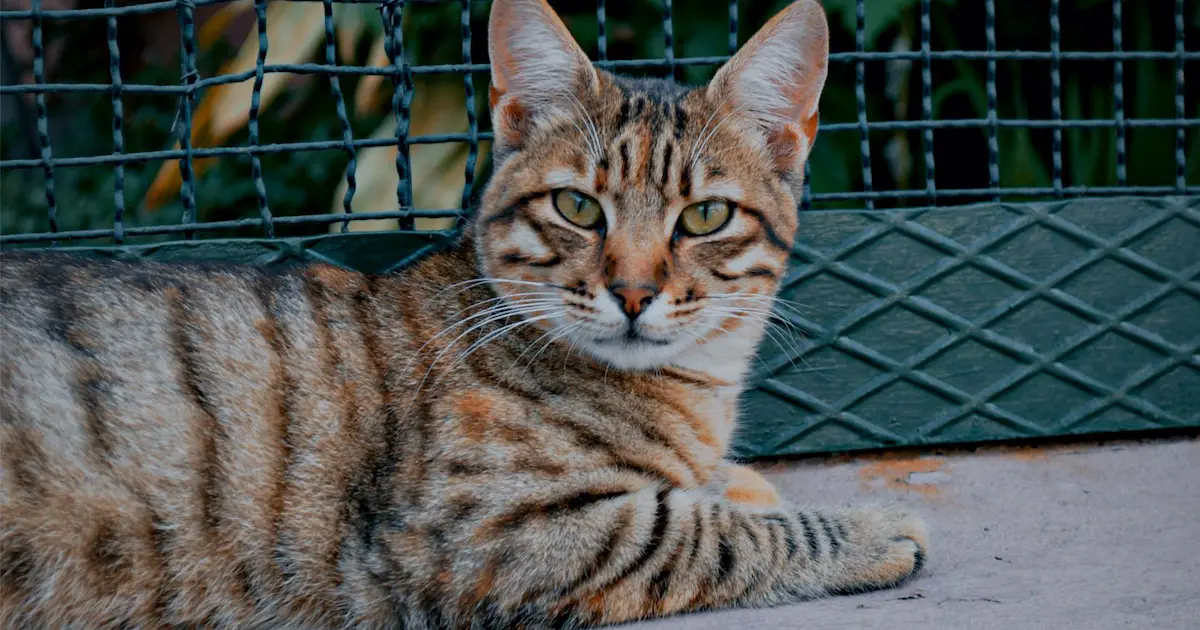
Picture this. A friend walks into your living room, spots your cat stretched out in a sunbeam, and freezes. “Is that… a baby tiger?” It isn’t. It’s a Toyger, and that reaction is exactly the point.
The Toyger was built to look like a tiny tiger. Bold vertical stripes, a coat that glints like it was dusted with gold, and a face ringed with markings no ordinary tabby has. People fall hard for that look. Then they find out the price, the waitlist, and a few other things, and the dream gets complicated.
So let’s do this honestly. Here’s what living with a Toyger is actually like, what they cost, the one health issue worth watching, and how to make sure the “Toyger” you’re paying thousands for is the real thing.
| Origin | United States, 1980s |
| Weight (Male) | 10 to 15 lbs |
| Weight (Female) | 7 to 10 lbs |
| Lifespan | 12 to 15 years |
| Coat | Short, thick, plush |
| Colors | Brown mackerel tabby with bold stripes; silver is rare |
| Energy Level | High |
| Grooming Needs | Low |
| Good With Kids | Yes |
| Good With Other Pets | Yes, with proper intros |
| Average Price | $1,500 to $5,000 from breeders |
The Toyger’s Surprising Origin Story
Here’s a fun bit of cat trivia. The woman who created the Toyger, Judy Sugden, is the daughter of Jean Mill, the breeder behind the Bengal. So this is a family business of making house cats look gloriously wild.
It started in the 1980s. Sugden was studying the markings on a Bengal she owned and noticed something odd: spots on the temples, in a spot where tabbies are usually blank. That little detail told her a true tiger-style face could be possible in a domestic cat. Most tabbies wear an “M” on the forehead, not circular tiger markings, so this was a real clue.
She got to work. The early Toyger lineup included a striped domestic shorthair named Scrapmetal and a Bengal named Millwood Rumpled Spotskin. In 1993, she added a street cat brought over from Kashmir, India, which carried unusual markings. Breeders Anthony Hutcherson and Alice McKee joined the project, and the breed slowly took shape.
Now the part most guides skip. Sugden didn’t just want a cute pet. She wanted a cat that would make people care about real tigers in the wild. The whole idea was conservation: a living, purring reminder that wild tigers are vanishing. Some Toyger breeders still donate a slice of their proceeds to tiger conservation today.
The Toyger earned registration with The International Cat Association in 1993 and full championship status in May 2007. The Cat Fanciers’ Association recognizes it for registration only, and registries in the UK and Europe acknowledge it too. It remains one of the newest breeds you can find.
What a Toyger Actually Looks Like
The whole breed is an exercise in looking like a tiger without being one. And honestly, they pull it off.
The coat is short, thick, and plush, with a deep orange to reddish-brown background. Over that, you get bold, dark stripes that branch out in a random, vertical pattern, the way a real tiger’s do, not the neat parallel lines of a regular mackerel tabby. Many Toygers also have “glitter,” a sparkle on the fur tips that catches the light. Silver Toygers exist, but they’re rare.
The face is the giveaway. Instead of the tabby “M,” a Toyger has circular markings framing the face, almost like war paint. Breeders describe the head shape as a “half hexagon.” The ears are small and rounded, the eyes are gold to deep hazel, and the body is long, muscular, and carried low to the ground. That low stance gives them a slinky, prowling walk that genuinely looks tiger-ish.
Toygers are medium-sized. Females usually land between 7 and 10 lbs, males between 10 and 15 lbs. Like Bengals, they often look bigger than they weigh because of all that muscle. Kittens start out fuzzy and a little awkward, and the markings sharpen and the coat color deepens as they mature.
Toyger vs Bengal vs Plain Tabby: How to Tell Them Apart
This matters more than you’d think, because plenty of people get sold a “Toyger” that’s really a striped tabby or a Bengal mix. Here’s how to actually tell.
Toyger: Vertical, branching stripes on an orange ground. Circular markings on the face. Small rounded ears. Long body held low. Mellow, cuddly, people-focused.
Bengal: Spots and rosettes, not stripes, because Bengals were bred to look like leopards. They carry actual Asian leopard cat ancestry, so they tend to be wilder, busier, and more intense. Longer back legs give them a powerful stride.
Tabby: Not a breed at all, just a coat pattern. Tabbies wear the classic forehead “M” and come in swirled or striped patterns. A striped tabby can look Toyger-ish from across a room, but the face markings and the stripe structure won’t match a real Toyger up close.
Quick tip: stripes that travel vertically and branch, plus circular face markings, point to Toyger. Spots and rosettes point to Bengal. A forehead “M” points to ordinary tabby. We’ll come back to verification in the sourcing section, because this is where money gets lost.
Living With a Toyger: The Real Personality
Good news first. Toygers are some of the friendliest cats in the designer-cat world. They were bred for temperament as much as looks, and it shows.
They’re social, confident, and a little dog-like. Expect a cat that follows you room to room, greets you at the door, and wants in on whatever you’re doing. They bond hard with their people and tend to dislike being left alone for long stretches.
They’re clever, too. Most Toygers take to clicker training, learn tricks, walk on a harness, and play fetch with the right reward. Many also have a thing for water, batting at a dripping faucet or staring into the water bowl like they’re fishing. It’s odd and charming.
They’re moderately vocal. Not a constant talker like a Siamese, but they’ll chirp and chat to get your attention. And here’s the honest part: they’re high energy. A bored Toyger gets into mischief, opens cabinets, knocks things off shelves, and generally invents its own entertainment if you don’t provide some.
Is a Toyger Right for You?
Let’s be real with each other for a minute, because this is where a lot of buyers should pump the brakes.
A Toyger is a great fit if you:
- Want a deeply affectionate, interactive cat and you’re home enough to give it attention
- Enjoy play sessions, training, and enrichment, and won’t resent a cat that needs them
- Have the budget for the kitten price and ongoing care
- Can sit on a waitlist, sometimes for a year or more, without caving to a sketchy seller
Think twice if you:
- Are away from home most of the day and want a low-needs, independent cat
- Want a calm lap cat that mostly sleeps (the Toyger has energy to burn)
- Mainly want the look of stripes (a striped shelter tabby gives you 90% of the aesthetic for a fraction of the price and a clear conscience)
- Can’t comfortably absorb a surprise vet bill
That last point deserves a moment of honesty. If you love the tiger look but the budget makes you wince, a rescue tabby with bold stripes is a genuinely wonderful cat. You won’t get the pedigree or the perfect circular face markings, but you’ll get the personality, the stripes, and a cat that needed a home. No shame in choosing that.
Health Issues to Know About
The good news is that Toygers are generally a healthy, sturdy breed with a solid lifespan. The honest news is there’s one issue worth understanding properly, plus a screening gap most guides don’t mention.
Hypertrophic cardiomyopathy (HCM) and heart murmurs. HCM is the most common heart disease in cats, and it thickens the heart’s muscular walls so it pumps less efficiently. Because Toygers carry Bengal genetics, and Bengals appear on the list of breeds with some HCM predisposition, it’s the condition cardiologists keep an eye on. Vets sometimes catch a heart murmur during a checkup, but here’s the tricky part: plenty of healthy cats have harmless murmurs, and plenty of cats with HCM have none at all. A murmur is a flag, not a diagnosis.
Now the bit that genuinely sets this guide apart. For Maine Coons and Ragdolls, there’s a DNA test for the known HCM mutation. For Toygers, there is no breed-specific genetic test. So if a breeder tells you their cats are “HCM gene tested,” ask exactly what that means, because there’s no Toyger-specific cheek swab for it. The real screening tool is an echocardiogram (a heart ultrasound) done by a vet, ideally repeated over time. Ask whether the breeding parents have had recent echocardiograms. That’s the question that actually protects you.
Other things to watch. Toygers are prone to the same issues as any cat: obesity if they’re overfed and under-exercised, and dental disease over time. Keep them lean and keep up with annual vet visits. Because the breed is so new and the gene pool is small (a few hundred registered cats), long-term health data is still thin. That’s not a scare, just a reason to buy from someone who screens carefully.
Grooming and Care
If you’re nervous about grooming, relax. This is one of the easiest coats going.
That short, plush fur needs a quick weekly brush, mostly to remove loose hair and keep the shine. Toygers shed, but far less than long-haired breeds, and you won’t be fighting mats. A soft slicker or a rubber grooming mitt is plenty.
Round out the basics: trim nails every couple of weeks, check ears, and brush those teeth regularly to stay ahead of dental disease. Honestly, the hardest part of Toyger grooming is convincing them to sit still, since they’d rather be playing.
Feeding Your Toyger
Despite the wild look, a Toyger eats like any other domestic cat. There’s no special tiger diet here.
Go for a high-quality, meat-forward food appropriate for their life stage, whether that’s kitten, adult, or senior. Protein should lead the ingredient list. Toygers are active enough that they usually manage their weight well, but they can still tip into overweight if you free-feed, so measure meals and keep treats to a small share of daily calories.
Fresh water always, and if your Toyger is one of the water-obsessed ones, a pet fountain can keep them happily hydrated and entertained at the same time.
Exercise and Enrichment
This is non-negotiable with a Toyger. High energy plus high intelligence means a cat that needs a job, or it’ll make one up at your expense.
Plan on daily interactive play: wand toys, chase games, puzzle feeders, and a tall cat tree for climbing. Many Toygers love learning tricks, so training sessions double as mental exercise. Harness walks suit the adventurous ones, since they tend to be bolder than the average house cat.
Keep them indoors. Their striking looks make them a target for theft, and outdoor life carries the usual risks. A well-enriched indoor Toyger is a happy one. A bored, under-stimulated one is a tiny tiger-shaped tornado.
Toygers With Kids, Dogs, and Other Cats
This is where the Toyger’s mellow streak really pays off. Compared to the more intense Bengal, Toygers tend to be more tolerant and easygoing, which makes them a strong family pick.
With kids, they’re generally patient and playful, especially when raised around them. As always, teach children to handle cats gently and give the cat an escape route. With dogs and other cats, Toygers usually do well, provided you do slow, proper introductions rather than tossing everyone in the same room on day one.
The bigger compatibility issue isn’t temperament, it’s time. A Toyger that’s part of family life thrives. One that’s ignored gets lonely and restless. They want to be in the mix.
Lifespan and Aging
Toygers typically live 12 to 15 years, and many sail past that with good care. To get the most years and the best ones, keep them lean, keep up with vet visits, and stay alert to that heart-health piece as they age.
As your Toyger moves into the senior years, watch for subtle changes: less jumping, lower appetite, faster or harder breathing. Those can be early signs of heart trouble and are worth a vet call. Older Toygers slow down but usually keep their affectionate, people-loving streak right to the end.
How Much Does a Toyger Cost?
Brace yourself. Toygers are one of the pricier cats out there, and the rarity is the reason.
Kitten prices generally run from $1,500 to $5,000. Where you land depends on the breeder’s reputation, the quality of the markings, your location, and whether the kitten is pet-quality or show-quality. Exceptional examples and breeding rights push the top of that range higher.
Then there’s the rest of the iceberg. Budget for ongoing costs: quality food, litter, annual vet care, and the occasional emergency. Pet insurance is worth a serious look with this breed, partly because of the heart-screening angle. Over a 14-year life, the lifetime cost dwarfs the purchase price, so plan for the whole journey, not just the kitten.
Where to Find a Toyger Ethically
Here’s the section breeder sites won’t write, and the reason you’re reading this guide instead of theirs.
Toygers are genuinely rare. There are only around 30 active breeders worldwide, and just a few hundred cats registered in major databases. Waitlists of a year or more are normal with good breeders. That scarcity creates two big problems for buyers.
Problem one: scams and fakes. Because demand wildly outstrips supply, some sellers list striped tabbies or Bengal mixes as “Toygers” and charge Toyger prices. Owners on forums describe spending years trying to find a legitimate one. So verify before you pay. Ask for TICA registration paperwork, the cat’s pedigree, and photos of the parents. Check the circular face markings and vertical branching stripes against what a real Toyger looks like. If the face has a tabby “M,” it’s not a Toyger.
Problem two: pressure to skip the safeguards. A long waitlist tempts people to jump at the first available kitten, even a sketchy one. Don’t. A good breeder will happily show you the parents’ health screening (including those echocardiograms), let you visit or video-call, provide a written health guarantee, and ask you plenty of questions in return.
Red flags to walk away from:
- No registration papers, or vague answers about pedigree
- Kittens available immediately with no waitlist (real Toygers rarely work that way)
- No mention of any heart screening for the parents
- Prices that seem too good for such a rare breed
- Pressure to pay a deposit fast, especially by untraceable methods
And don’t rule out rescue. Purebred Toygers in shelters are uncommon, but breed-specific and exotic-cat rescues do exist, and tiger-striped tabbies needing homes are everywhere. If the look is what you love, a rescue can be the kindest path.
Common Myths and Misconceptions
Myth: Toygers are part tiger. Nope. There’s zero wild tiger in them. They’re fully domestic cats selectively bred to resemble a tiger. They’re as safe and tame as any house cat.
Myth: Toygers and Bengals are the same. They share some ancestry, but Bengals are bred to look like leopards (spots and rosettes) and tend to be wilder, while Toygers are bred to look like tigers (stripes) and tend to be calmer.
Myth: They’re high-maintenance to groom. The opposite. That short coat is about as easy as cat grooming gets.
Myth: A striped tabby is basically a cheap Toyger. The look overlaps, but a real Toyger is a registered breed with specific markings and a documented pedigree. A tabby is a fantastic cat, just not the same thing.
Frequently Asked Questions
Q: Are Toyger cats good pets for families?
Yes. Toygers are friendly, social, and more easygoing than many exotic-looking breeds, which makes them a good fit for families with kids and other pets. They do best in homes where someone is around to give them attention and play.
Q: Why are Toyger cats so expensive?
Rarity is the main reason. There are only around 30 active Toyger breeders worldwide and a small registered population, so demand far exceeds supply. Kittens typically cost between $1,500 and $5,000.
Q: Are Toygers hypoallergenic?
No. No cat breed is truly hypoallergenic. Toygers produce the same Fel d 1 protein that triggers allergies. Their short coat means less visible shedding, but it does not make them allergy-safe.
Q: Do Toyger cats get along with dogs?
Generally yes, with proper introductions. Toygers are confident and sociable, so they often coexist happily with dogs and other cats, especially when raised together from a young age.
Q: How long do Toyger cats live?
Toygers typically live 12 to 15 years, and many live longer with good care. Keeping them at a healthy weight and staying on top of vet checkups, including heart health, helps them reach the upper end.
Q: What health problems do Toygers have?
The main concern is heart-related, specifically heart murmurs and hypertrophic cardiomyopathy (HCM). There is no Toyger-specific DNA test for HCM, so screening relies on echocardiograms. Obesity and dental disease are the other things to watch.
Q: How can I tell a real Toyger from a fake?
Look for vertical, branching stripes on an orange background and circular markings on the face rather than a tabby “M.” Ask for TICA registration papers, a pedigree, and photos of the parents. A real Toyger comes with documentation.
Q: Are Toygers indoor or outdoor cats?
Indoor. Their striking appearance makes them a theft risk, and outdoor life carries the usual dangers. A Toyger kept indoors with plenty of play and enrichment stays happy and active.
Final Verdict: Should You Get a Toyger?
The Toyger is a genuine showstopper, a friendly, clever, people-loving cat wrapped in a tiger’s coat. If you want an affectionate companion that plays, learns tricks, and turns heads, and you have the budget and the patience for a waitlist, you’ll adore one.
But buy with your eyes open. Know the price, expect the wait, demand the paperwork, and ask specifically about the parents’ heart screening. And if the cost or the rarity gives you pause, remember that a striped tabby from a shelter offers nearly the same look, the same affection, and a clear conscience.
Either way, you’re choosing a cat that brings a little bit of the wild into your home. Just make sure, if you go for the real Toyger, that the one you bring home is exactly that.

Hello and welcome to The Ideal Cat!
We are some passionate cat owners from different professions. We love our cats and have a lot of experience in how to care for our pets. We are incredibly excited to share our knowledge, experience, and research with you. So you can take good care of your loving cat. We will answer most of the common questions about owning cats, taking care of them, etc. If you have any question contact with us. Thanks for visiting! Enjoy the content.
)