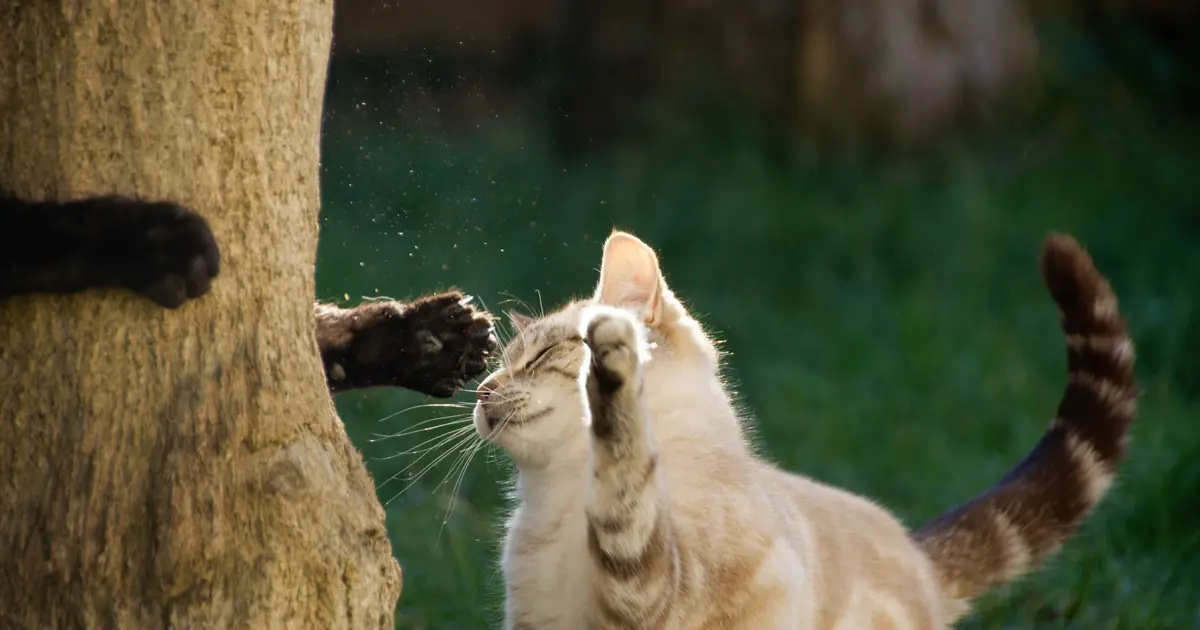
Picture this: you’re walking through the living room, minding your own business, and out of nowhere a paw shoots out from under the couch. Your cat gets you right on the ankle, then bolts like nothing happened. You jump, you yelp, and your cat looks positively delighted with themselves.
If this sounds familiar, you’re not raising a tiny monster. You’re living with a hunter who never quite clocked out of work. Cats are built to chase movement, and your feet walking by look a lot like prey scurrying past. The good news is that once you understand what’s driving the swipe, it’s usually easy to redirect into something that doesn’t leave you flinching every time you cross the hallway.
- Ankle swiping is almost always predatory play triggered by the motion of your feet, not real aggression.
- Kittens and young cats swipe more often because they’re practicing hunting skills through play.
- Cats need two 10 to 15 minute interactive play sessions a day to burn off predatory energy safely.
- Claws staying retracted, a loose body, and quick retreats point to play; claws out, hissing, and flattened ears point to real aggression, fear, or pain.
- A sudden change in swiping behavior, especially with limping or reluctance to be touched, can signal pain and is worth a vet visit.
Why does my cat swipe at me when I walk by?
Your cat swipes at you when you walk by because your moving feet look and act like prey. Cats are ambush predators by design, and feet passing at just the right speed flip a switch that says “chase this.” The crouch, the swipe, and the quick retreat afterward are all part of a hunting sequence your cat is running on you, whether they mean to or not.
This shows up most in cats without another outlet for that hunting drive: indoor-only cats, kittens, and cats left alone a lot during the day. It’s not personal. If anything, it means your cat trusts you enough to practice hunting on you.
Is this predatory play or the ambush instinct kicking in?

Yes, in most cases this is straight-up predatory play, the same instinct that makes a cat stalk a feather toy or freeze before pouncing on a bug. Feet moving rhythmically past a doorway are basically a highlight reel of prey behavior to a cat’s brain.
Kittens are the worst (best?) offenders here because play is literally how they learn to hunt. Without a littermate to wrestle, a passing ankle becomes the substitute. Bored indoor adults keep the habit going well past kittenhood because nothing has replaced it. According to International Cat Care, this kind of foot pouncing is a normal part of a cat’s predatory sequence and rarely a behavior problem on its own. It’s also worth knowing that cats staying silent during rough play is a good sign; a hiss usually means the game has tipped into something less friendly.
Is my cat swiping at me for attention?
Sometimes, yes. If swiping at your ankles reliably gets you to stop, look down, or yelp and jump, your cat has learned that swiping works. Cats are quick studies, and a big, dramatic reaction is its own kind of reward, even an annoyed one.
This is especially common in cats who don’t get much one-on-one time during the day. The fix isn’t to ignore your cat forever, it’s to make sure they’re getting attention on your terms too, so they’re not stuck fishing for it in the hallway.
Could pent-up energy or boredom be the real cause?
Very possibly. A cat with too much energy and not enough to do will find something to do with it, and your feet are an easy, always-available target. Single indoor cats without a feline playmate are especially prone to this, since they’re missing the rough-and-tumble outlet a housemate would normally provide.
Cats are naturally most active at dawn and dusk, exactly when a lot of households are up and walking around. If your cat’s swiping spikes in the early morning or right after you get home, understimulation is a strong suspect, and it’s often the same energy behind the zoomies your cat gets at night. The ASPCA notes that predatory play toward feet often improves once cats get more structured outlets for hunting behavior.
Why does my cat swipe at me after I’ve been petting them?
This is usually overstimulation, a different thing from an ambush swipe by your feet, but worth naming since the two get lumped together. A cat being petted can go from purring to swatting in seconds once they’ve had enough, and tail flicking, skin twitching, or ears turning back are your warning signs before the paw comes out.
Unlike the playful ankle pounce, these swipes happen during contact, and they’re your cat’s way of saying “that’s enough now.” Watching for the early cues and stopping before your cat has to escalate is the easiest fix.
How can I tell a playful swipe from real aggression, fear, or pain?
You can usually tell by the claws, the body language, and what happens right after. Playful swipes come from a loose body, claws stay tucked in or only lightly extended, and your cat often runs off afterward looking pleased with itself. Real aggression or fear looks different: flattened ears, a puffed tail, hissing or growling, dilated pupils, and claws or teeth used with real force.
Pain is the one people miss most often. A cat with arthritis or an injury may swipe defensively when a foot gets too close too fast to a tender spot. Older cats and cats who suddenly start swiping out of nowhere are worth watching closely. Redirected aggression is another possibility: a cat spooked by something else (another animal outside, a loud noise) can lash out at whoever walks by next, even though you had nothing to do with it. VCA Hospitals describes redirected aggression as one of the most common and most misunderstood forms of feline aggression, since the trigger and the target are two different things. Learning the broader signs of stress in cats can help you catch a fearful cat before a swipe happens at all.
| Sign | Playful swiping | Aggressive or pain-driven swiping |
|---|---|---|
| Body posture | Loose, low crouch, tail flicking gently | Tense, puffed up, or flattened low to the ground |
| Ears | Forward or neutral | Flattened back or sideways |
| Claws | Retracted or barely out | Fully extended, used with force |
| Sound | Silent, maybe a chirp or trill | Hissing, growling, yowling |
| What happens after | Cat runs off to play more or watches for round two | Cat freezes, flees and hides, or keeps escalating |
| What to do | Redirect to a wand toy, keep playing | Back away calmly, don’t punish, consider a vet check |
How do I stop my cat from swiping at me when I walk by?
You stop the ankle attacks by giving your cat a better outlet for that hunting energy and by never letting your hands or feet be part of the game in the first place. These steps work for most playful swipers within a couple of weeks:
- Schedule two interactive play sessions a day, 10 to 15 minutes each, using one of the best interactive cat toys for your cat’s energy level so your hands stay well out of pouncing range.
- Play right before your cat’s normal witching hours, usually early morning or early evening, to burn off energy before it turns into an ambush.
- Never use your hands, fingers, or feet as toys, even for young kittens. It feels harmless now and teaches the exact habit you’re trying to break later.
- If you get swiped at, stop moving and go still instead of jerking away. Sudden movement is exactly what triggers the pounce, and a boring, still target loses its appeal fast.
- Add enrichment for the times you can’t play directly: a cat tree near a window, a puzzle feeder, or rotating toys so nothing gets stale.
- Never punish a playful swipe with yelling or swatting back. It won’t stop the behavior and it can damage your cat’s trust in you.
- Book a vet visit if the swiping is new, sudden, or paired with limping, hiding, or reluctance to be touched, since pain can look a lot like a behavior problem.
If your cat’s play has gotten rough enough to leave marks, it’s worth reading up on why cats bite during play and how to reset the rules, since biting and swiping usually come from the same overexcited place.
When should I worry that swiping means something more serious?
Take it seriously when it comes on suddenly, happens with clear signs of fear or pain, or escalates instead of settling down with more play. A cat who was never an ankle-attacker and suddenly starts, especially an older cat, deserves a closer look rather than a shrug.
This article is meant to help you understand normal feline behavior, not replace a vet’s judgment. A sudden onset of swiping, or swiping paired with limping, hiding, or flinching when touched, is worth a vet visit to rule out illness, injury, or arthritis before assuming it’s purely behavioral. If the aggression seems to be escalating rather than improving with more play, it’s also worth reading about sudden aggression in cats to understand the fuller list of possible causes.
Frequently Asked Questions
Q: Is it normal for cats to swipe at your feet when you walk by?
Yes, it’s very normal and usually just predatory play. Your moving feet trigger a cat’s natural ambush instinct, and most cats grow out of the more intense version of this once they get regular play and enough stimulation during the day.
Q: Why does my kitten swipe at my feet more than my adult cat does?
Kittens swipe more because play is how they practice hunting skills and burn energy. This behavior usually settles down as they mature, especially once they’re getting structured play sessions instead of relying on your feet as the only outlet.
Q: Should I punish my cat for swiping at me?
No, punishing a cat for swiping doesn’t work and can damage your relationship with them. Redirecting the behavior toward a wand toy and staying still instead of jerking away is far more effective than yelling or swatting back.
Q: How much play does my cat need to stop swiping at my ankles?
Most cats do well with two interactive play sessions a day, around 10 to 15 minutes each, using a wand toy. Timing one session before your cat’s usual high-energy period, often early morning or early evening, tends to work best.
Q: Can swiping at me mean my cat is in pain?
Yes, though it’s less common than playful swiping. A cat with arthritis or an injury may swat defensively if a foot comes too close to a sore area, and this is more likely if the swiping is new, sudden, or paired with limping or flinching when touched.
Q: What’s the difference between play aggression and redirected aggression in cats?
Play aggression is directed hunting practice toward moving targets like feet or toys, while redirected aggression happens when a cat gets worked up by one trigger, like another animal outside, and then lashes out at whoever is nearby afterward. Both can look intense, but redirected aggression usually comes with more obvious signs of arousal like a puffed tail or dilated pupils.
Q: Will my cat ever grow out of swiping at my feet?
Many cats do calm down as they mature past the kitten stage, especially with consistent interactive play. Adult cats who still swipe often just need more enrichment or a change in when and how they get exercise during the day.
Q: Does having another cat stop the ankle swiping?
It can help, since a second cat gives your cat a playmate to wrestle and stalk instead of your feet. It’s not a guaranteed fix on its own though, and a new cat still needs a proper introduction and its own outlets for play.

Hello and welcome to The Ideal Cat!
We are some passionate cat owners from different professions. We love our cats and have a lot of experience in how to care for our pets. We are incredibly excited to share our knowledge, experience, and research with you. So you can take good care of your loving cat. We will answer most of the common questions about owning cats, taking care of them, etc. If you have any question contact with us. Thanks for visiting! Enjoy the content.
