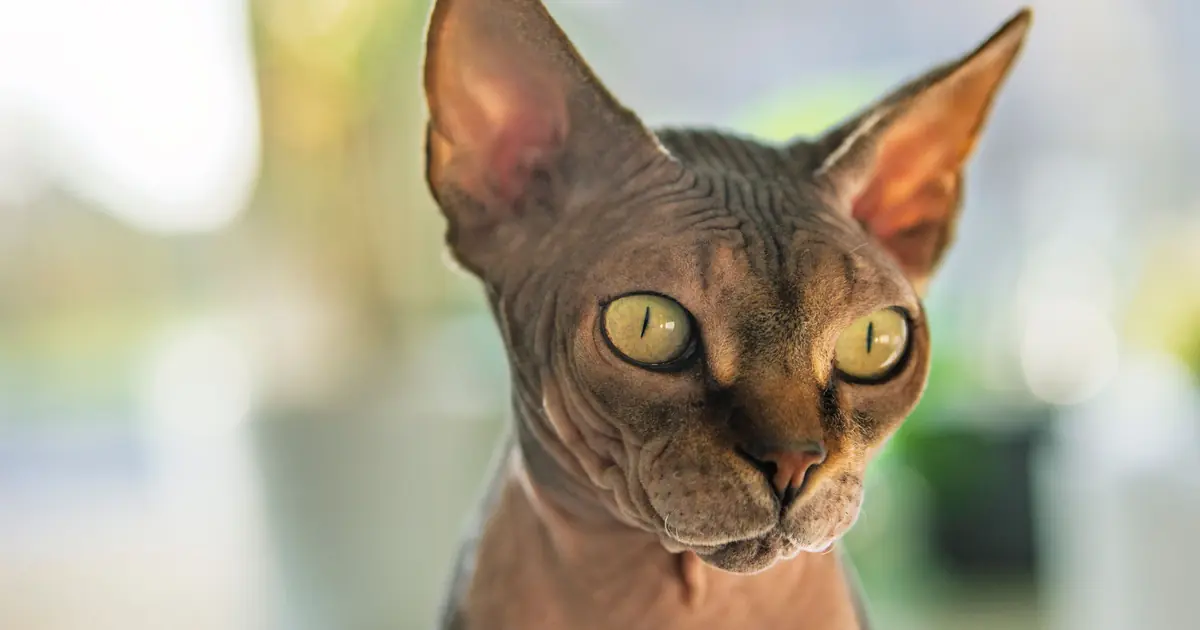
You reach out to pet a cat and your hand lands on warm, soft suede. No fluff, no fur, just a little body heat and a face full of wrinkles staring back at you. If you’ve ever met a hairless cat, you know the feeling. They’re strange, gorgeous, and weirdly hard to stop cuddling.
Hairless cats fascinate people. They also come with a few myths and some real care needs most cat parents never hear about. Here’s the honest, friendly rundown on no-fur cats: what makes them bald, the main breeds, what they’re like to live with, and how to keep that bare skin healthy.
This article is educational and isn’t a substitute for veterinary care. For breed-specific health questions, talk to your vet.
- Hairless cats are the result of a natural genetic mutation that weakens or reshapes the hair shaft, not a shaved coat.
- Most “no fur” cats aren’t 100% bald, they have a fine, soft down that feels like warm suede or peach fuzz.
- The main hairless breeds are the Sphynx, Peterbald, Donskoy, Bambino, Dwelf, Elf, Ukrainian Levkoy, and Minskin.
- With no coat to soak up skin oils, hairless cats need regular bathing plus ear and nail-fold cleaning.
- Hairless cats are NOT truly hypoallergenic, because the Fel d 1 allergen lives in saliva and skin, not fur.
What makes a cat hairless?
A hairless cat is hairless because of a natural genetic mutation that affects the hair shaft, not because anyone shaved it. In the Sphynx, the most famous no-fur cat, the change sits in a gene called KRT71 that normally helps build a strong, healthy hair. With that gene altered, the hairs grow in weak, brittle, and rootless, so most simply never make it to a full coat.
Here’s the part that surprises people: most hairless cats aren’t actually bald. Run your hand over a Sphynx and you’ll feel a fine, downy fuzz, often compared to warm peach skin, suede, or a chamois cloth. Many keep a little more hair on the nose, ears, tail, and toes. So “hairless” really means “almost hairless with very fine down.”
The look isn’t man-made either. The modern Sphynx traces back to a single hairless kitten named Prune, born to an ordinary house cat in Toronto, Canada, in 1966. Breeders liked the trait and worked to develop it safely. Other hairless breeds popped up the same way, from spontaneous mutations in Russia, Ukraine, and the United States, and were then carefully bred to keep the cats healthy.
What are the main hairless cat breeds?
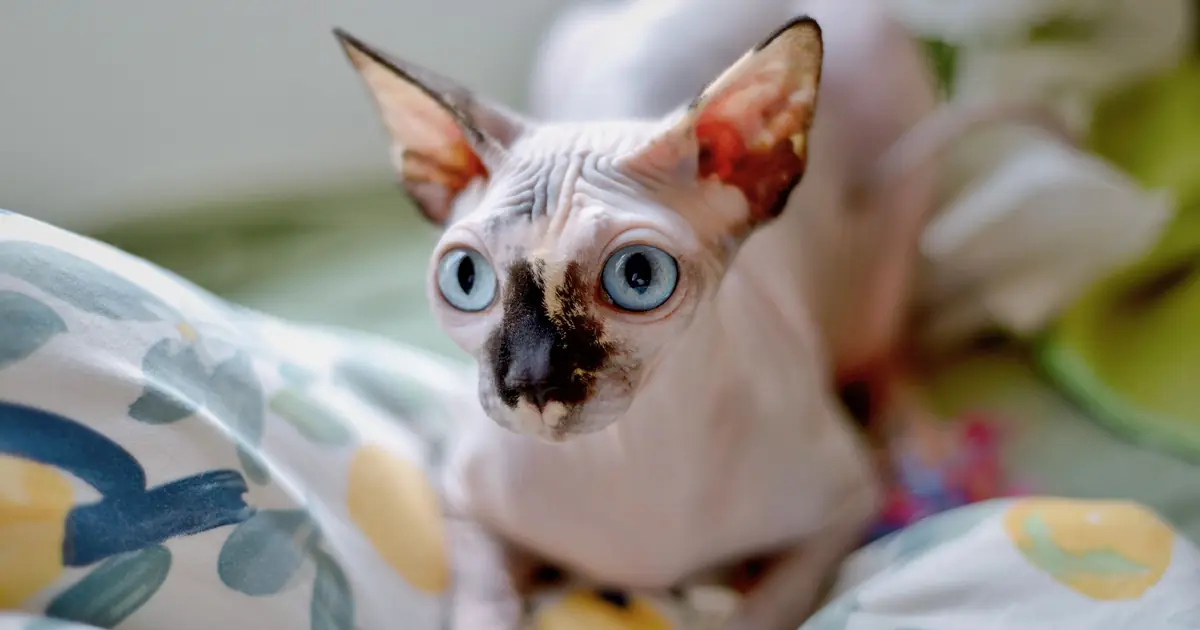
There are around eight recognized or developing hairless cat breeds, and they differ in origin, ear shape, leg length, and how bald they really are. The Sphynx is the classic, but several newer breeds mix the hairless gene with short legs (from the Munchkin) or curled and folded ears. Here’s how the main no-fur cats compare.
| Breed | Origin | Standout trait | Coat |
|---|---|---|---|
| Sphynx | Canada, 1966 | The original hairless cat, big ears, pot belly, super social | Fine peach-fuzz down |
| Peterbald | Russia, 1994 | Slim, elegant, big pointed ears; loves to follow you around | Ranges from fully bald to a soft brush |
| Donskoy (Don Sphynx) | Russia, 1987 | Sturdy, wrinkled, webbed toes; a dominant-gene hairless breed | Bald to a light fuzz that can shift with seasons |
| Bambino | USA, mid-2000s | Sphynx crossed with a short-legged Munchkin, name means “baby” | Mostly hairless with fine down |
| Dwelf | USA, 2000s | Short legs plus curled ears; small and impish (dwarf + elf) | Hairless with light fuzz |
| Elf | USA, 2000s | Sphynx crossed with American Curl for backward-curling ears | Hairless with fine down |
| Ukrainian Levkoy | Ukraine, 2000s | Hairless with inward-folding ears, from a Donskoy and Scottish Fold cross | Bald to soft fuzz |
| Minskin | USA, 2000 | Short-legged and small, with fur “points” on the face, ears, legs, and tail | Sparse velvety fur on the extremities |
The Sphynx is still the one most people picture, and it’s a great starting point if you’re new to bald cats. If you want the full story on the classic, our Sphynx cat guide digs into personality and care. Curious about the Russian branches of the family? We break down the elegant Peterbald and the sturdy Donskoy too, plus the pint-sized Bambino.
Are all these breeds actually different?
Yes, they’re genuinely different breeds, even though they look similar at a glance. The biggest split is genetic: the Sphynx carries a recessive hairless gene, while the Donskoy and Peterbald carry a dominant one, which is why their coats behave differently. After that, breeds are set apart by body shape. Bambinos, Dwelfs, and Minskins have short Munchkin legs, Elf and Dwelf cats have curled ears, and the Ukrainian Levkoy has folded ears. Same “naked” theme, lots of variations.
What are hairless cats like as pets?
Hairless cats are famously affectionate, warm, and busy. Sphynx cats especially have earned a “velcro cat” reputation, following their people from room to room, greeting guests at the door, and burrowing under blankets for warmth and company. Many hairless breeds act almost dog-like: playful, curious, and happiest when they’re part of whatever you’re doing.
They also run warm to the touch. Their core body temperature is normal for a cat, around 100.5 to 102.5°F, but without a coat to insulate them, all that heat radiates straight into your hand. That’s why they feel like a living hot water bottle, and why they seek out laps, sunbeams, and heated cat beds.
One heads-up: these are not low-effort cats. The affection is a gift, but so is the maintenance. A no-fur cat is a companion that genuinely wants to be with you, and needs you to keep its skin healthy in return.
How do you care for a hairless cat’s skin?
A hairless cat needs regular bathing because its skin has no fur to absorb the natural oils it produces. On a furry cat, the coat wicks away that oily sebum. On a bald cat, it builds up on the skin and can leave a greasy film, clog pores, and stain your sheets or furniture a rusty brown. So the coat’s job becomes your job.
A simple skin-care routine keeps things comfortable:
- Bathe on a schedule. Most hairless cats do well with a bath every 1 to 3 weeks using a gentle, cat-safe shampoo and lukewarm water. Don’t overdo it, too-frequent baths can make the skin produce even more oil.
- Dry thoroughly and keep them warm. A wet naked cat gets cold fast. Towel-dry gently and keep them out of drafts until they’re fully dry.
- Wipe between baths. A quick wipe-down with a damp, unscented cloth or a fragrance-free pet wipe handles oil buildup in the skin folds mid-week.
- Clean the ears. With no ear-canal fur to trap debris, hairless cats build up wax quickly. Check and gently clean the ears weekly with a vet-approved cleaner.
- Care for the nails and nail folds. Oil and grime collect around the claws. Trim nails regularly and gently clean the nail beds.
Skip heavily scented products and human lotions, which can irritate bare skin. If you spot redness, spots, scabs, or a yeasty smell, that’s a vet visit, not a DIY fix.
Do hairless cats need sun and cold protection?
Yes. Hairless cats are exposed on both ends of the thermostat, so they need protection from sun and cold. With no fur shield, their skin burns easily, and repeated sun damage raises the long-term risk of skin problems. Limit direct, intense sun through windows, and ask your vet before using any sunscreen, since many human formulas aren’t safe for cats.
Cold is the flip side. These cats lose body heat fast, which is why so many happily wear soft sweaters in winter and curl up on heated beds. Because they burn extra energy just staying warm, some hairless cats eat a bit more than a furry cat of the same size. For all these reasons, hairless cats should live strictly indoors.
Are hairless cats hypoallergenic?
No, hairless cats are not truly hypoallergenic, and this is the single biggest myth about them. Cat allergies aren’t caused by fur. They’re triggered by a tiny protein called Fel d 1, which a cat makes in its saliva, skin oils, and glands, then spreads over its body by grooming. A hairless cat still produces Fel d 1 in full.
In fact, going bald can backfire for allergy sufferers. With no coat to hold the allergen, more of that oily, Fel d 1-rich residue ends up directly on the cat’s skin, and then on your hands when you pet it. Some sensitive people react to a Sphynx just as much as to a fluffy cat. If allergies are your reason for wanting a no-fur cat, spend real time around one before committing, and read our honest breakdown of which cat breeds are considered hypoallergenic first. According to the Cornell Feline Health Center, no cat breed is fully allergen-free.
What health issues do hairless cats have?
Hairless cats are generally healthy but do carry a few breed-linked risks worth knowing. The most important is a heart condition called hypertrophic cardiomyopathy (HCM), a thickening of the heart muscle. The Sphynx has one of the higher rates of HCM among cat breeds, and it can show up in young adults, so many breeders and vets recommend regular heart screening with echocardiograms.
Other things to keep an eye on:
- Skin conditions. Oily buildup, clogged pores, yeast, and fungal issues are more common without a protective coat.
- Temperature sensitivity. They chill and overheat more easily than furry cats, so climate control matters.
- Dental disease. Some hairless breeds are prone to gum and tooth trouble, so regular dental care helps.
- Joint concerns in short-legged types. Bambinos, Minskins, and Dwelfs carry the Munchkin dwarfism gene, which can come with mobility and joint questions.
None of this should scare you off. It just means yearly vet checkups, breed-appropriate screening, and choosing a responsible breeder who tests their cats. For a trustworthy overview of hairless-cat needs, the vet-reviewed guide at PetMD is a solid read, and International Cat Care is a great resource on feline welfare in general.
Frequently asked questions about no-fur cats
Q: Are hairless cats completely bald?
Most hairless cats aren’t completely bald. They usually have a fine, soft down that feels like peach fuzz or warm suede, with slightly more hair on the nose, ears, tail, and toes. A truly 100% hairless cat is rare.
Q: What is the most popular hairless cat breed?
The Sphynx is by far the most popular and well-known hairless cat breed. It originated from a natural mutation in Canada in 1966 and is loved for its warm, wrinkled skin and outgoing, affectionate personality.
Q: Do hairless cats need baths?
Yes. Because hairless cats have no coat to absorb skin oils, they need regular baths, usually every 1 to 3 weeks, plus ear and nail-fold cleaning. Skipping baths leads to greasy skin and can stain furniture and bedding.
Q: Are hairless cats good for people with allergies?
Not necessarily. Hairless cats are not truly hypoallergenic because the Fel d 1 allergen comes from saliva and skin, not fur. Many allergy sufferers still react to them, so spend time with one before adopting.
Q: Do hairless cats get cold?
Yes. Without fur to insulate them, hairless cats lose body heat quickly and get cold easily. They seek out warm spots, enjoy soft sweaters and heated beds in cold weather, and should always live indoors.
Q: Why do hairless cats feel so warm?
Hairless cats feel warm because there’s no coat to insulate their body heat. Their core temperature is normal for a cat, about 100.5 to 102.5°F, but that heat radiates straight to your hand, so they feel like a little hot water bottle.
Q: How much does a hairless cat cost?
Hairless cats are pricey, since the breeds are rare and hard to breed. A Sphynx or similar hairless cat from a reputable breeder often runs from around $1,500 to $3,500 or more, depending on breed, pedigree, and location.
Q: Are hairless cats high maintenance?
Fairly high maintenance, yes. They need regular bathing, ear and nail care, warmth in winter, sun protection, indoor living, and yearly vet checks. In return you get an unusually affectionate, people-focused companion.
Bottom line: a no-fur cat is a warm, wrinkly, deeply affectionate companion that trades a coat for a bit more upkeep. Keep the skin clean, keep them warm and out of harsh sun, screen for heart health, and don’t count on them solving allergies. Do that, and a hairless cat will reward you with more cuddles than just about any cat on earth.

Hello and welcome to The Ideal Cat!
We are some passionate cat owners from different professions. We love our cats and have a lot of experience in how to care for our pets. We are incredibly excited to share our knowledge, experience, and research with you. So you can take good care of your loving cat. We will answer most of the common questions about owning cats, taking care of them, etc. If you have any question contact with us. Thanks for visiting! Enjoy the content.
