You go to pick up your cat and feel like you’re lifting a small dog. Or maybe people keep stopping you on walks (well, vet visits) to ask what breed that “gorgeous unit” is. Either way, you’re wondering the same thing: is my cat just built big, or is my cat carrying extra weight?
Here’s the thing: a big cat isn’t automatically an unhealthy cat. Some breeds are simply meant to be large. But a chunky cat isn’t automatically a happy, thriving cat either. The trick is learning to tell the two apart, and knowing what to do if the answer turns out to be weight instead of genetics.
- Over half of pet cats in the United States are overweight or obese, according to the Association for Pet Obesity Prevention.
- Large-breed cats like the Maine Coon can naturally weigh 13 to 18 pounds or more without carrying any excess fat.
- The most reliable at-home test for excess weight is feeling your cat’s ribs: you should feel them easily under a thin layer of fat, without pressing hard.
- A saggy belly flap (called a primordial pouch) is normal in almost every cat and is not the same thing as fat from being overweight.
- Neutered and spayed cats burn roughly 20 to 30 percent fewer calories than intact cats, which makes weight gain more likely if food intake isn’t adjusted.
Why Is My Cat So Big?
Your cat is big for one of two reasons: genetics or extra weight, and sometimes a bit of both. Some cats are simply born into large-framed breeds with bigger bones, longer bodies, and more muscle mass. Other cats are a normal size underneath, but they’re carrying more fat than their frame was built for.
Neither situation is rare. Certain breeds are specifically known for their size, and separately, cats as a whole population are getting heavier as pets. Figuring out which category your cat falls into starts with looking at the whole cat, not just the number on the scale.
Which Cat Breeds Are Naturally Big?
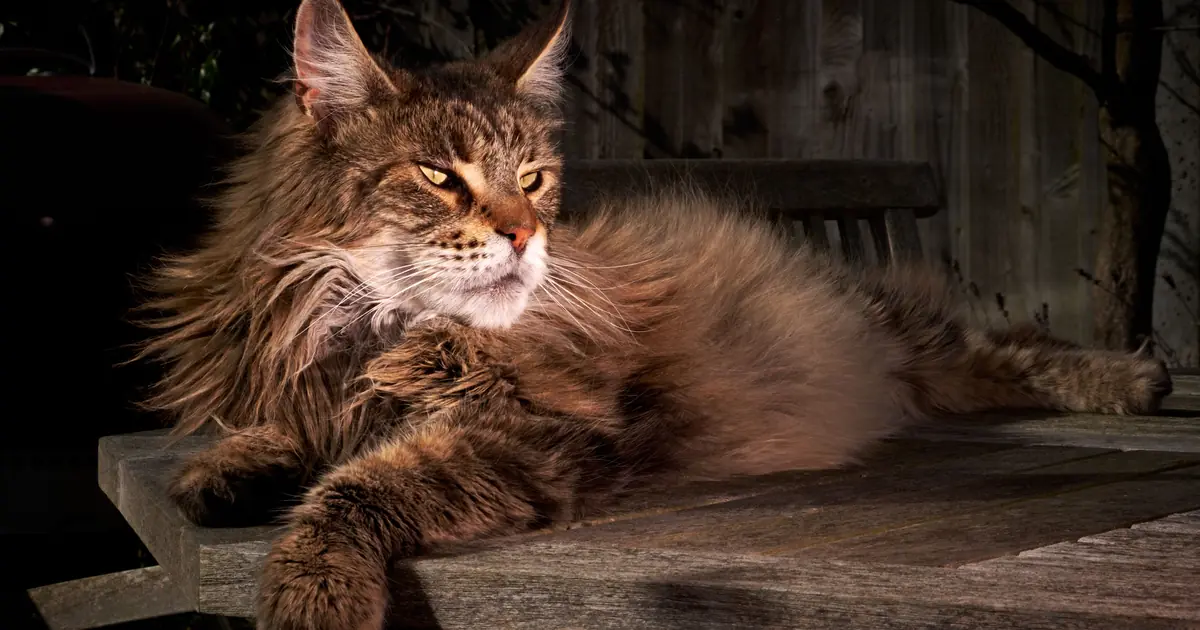
Several cat breeds are simply built bigger than the average house cat, and a large frame in these breeds is completely normal. Don’t panic if the scale reads high for one of these.
- Maine Coon: One of the largest domestic breeds, males typically 13 to 18 pounds, some over 20. Body-plus-tail length can stretch past 3 feet.
- Ragdoll: Big and muscular, usually 10 to 20 pounds, males on the heavier end.
- Norwegian Forest Cat: Typically 9 to 18 pounds, with a dense double coat that adds visual bulk.
- Savannah: An athletic, wild-cat-crossed breed ranging from about 12 to 25 pounds depending on generation.
- Siberian: Usually 8 to 17 pounds, with a thick triple coat and sturdy build.
These are ranges, not fixed numbers. A healthy Maine Coon and a healthy domestic shorthair are simply built differently. Breed sets the frame. What’s layered on top of it is the next question.
Is My Cat Big-Boned or Overweight?
You tell the difference by feeling your cat’s ribs and checking their waist, not by reading a scale. Vets use a body condition score (BCS), usually on a 1 to 9 scale, where 4 or 5 is ideal, and you can do a simplified version at home.
Run your hands along your cat’s ribcage. On a healthy-weight cat, you should feel the ribs easily under a thin layer of fat, similar to running your fingers over the back of your hand. If you have to press firmly, or can’t find them at all, that’s extra weight. Then look at your cat from above. A healthy cat usually has a visible waist tucking in behind the ribs. An overweight cat looks more like a straight line, or bulges outward.
| Big Because of Breed | Big Because of Weight |
|---|---|
| Ribs are easy to feel under a thin fat layer | Ribs are hard to feel, or can’t be felt at all |
| A waist is visible from above, even if the cat is long-bodied | No visible waist; the body looks oval or straight from above |
| Weight matches known breed ranges (e.g. Maine Coon males, 13 to 18 lbs) | Weight is well above what’s typical for the cat’s breed and frame |
| Generally healthy, no diet change needed | Raises health risks; a vet-guided weight plan is worth starting |
| What to do: nothing, just keep up regular vet checkups | What to do: ask your vet for a body condition score and a gradual weight-loss plan |
What Causes a Cat to Become Overweight?
Cats gain excess weight mostly from taking in more calories than they burn, and a handful of everyday habits usually drive it, according to the ASPCA. None are dramatic alone, which is why the weight creeps up slowly.
- Overfeeding: Bag feeding guides are often set for active, unfixed cats, so following them exactly can mean feeding more than your cat needs.
- Free-feeding: Leaving dry food out all day makes it hard to track intake, and bored cats often graze more than they’d naturally choose to.
- Too many treats: A few extra treats a day can equal a meaningful chunk of a cat’s daily calories.
- Low activity: Indoor cats, especially in smaller homes, often don’t get enough play to burn off what they eat.
- Neutering or spaying: Fixed cats typically need around 20 to 30 percent fewer calories than intact cats, but portions don’t always get adjusted afterward.
- Age: Middle-aged and senior cats naturally slow down, so a feeding routine that worked at age 2 can be too much by age 8.
Is That a Big Belly or Just a Primordial Pouch?
That saggy pouch swinging under your cat’s belly is almost always a primordial pouch, and it’s completely normal, not a sign of being overweight. Nearly every cat has one, even lean, athletic cats. It’s a flap of loose skin and a little fat running from the belly toward the back legs, and nobody knows the exact reason it exists. The leading theories: it gives the belly room to stretch during a full sprint, or offers a bit of protection during fights with other cats.
A primordial pouch swings and jiggles as your cat walks. If you can still feel ribs easily and there’s a waist behind it, the pouch alone doesn’t mean your cat is overweight.
What Health Risks Come With Cat Obesity?
Cat obesity raises the risk of several serious health problems and can shorten a cat’s life. “Big and cuddly” can quietly become “big and struggling,” so it’s worth taking seriously.
- Type 2 diabetes: Overweight cats are significantly more likely to develop diabetes than cats at a healthy weight, according to VCA Hospitals.
- Arthritis and joint pain: Extra weight strains joints, which speeds up arthritis and makes it more painful.
- Urinary tract problems: Overweight cats have a higher rate of feline lower urinary tract disease (FLUTD) and painful urination.
- Shorter lifespan: Studies link obesity in cats to a shorter life expectancy compared to lean cats.
- Reduced quality of life: Heavier cats groom less effectively, jump less, and generally move around less.
This is educational information, not a diagnosis. If you’re worried your cat may be overweight, a licensed veterinarian can check their body condition score and rule out other causes.
How Do I Know If My Big Cat Is Actually Healthy, and What Should I Do About Excess Weight?
Your big cat is likely healthy if they pass the rib test, have visible energy, and move comfortably, regardless of what the scale says. Watch how easily your cat jumps onto furniture and whether grooming looks normal. A cat who’s slowing down, avoiding jumps, or skipping self-grooming around the lower back may be carrying weight that’s affecting their comfort.
If your vet confirms your cat is overweight, the fix is a gradual, vet-guided plan, not a fast one. Here’s what that usually looks like:
- Get an accurate weight and body condition score from your vet before changing anything.
- Ask your vet for a specific daily calorie target instead of guessing from the bag.
- Measure food with a kitchen scale or measuring cup rather than eyeballing it.
- Cut back on treats, or swap some for a few extra minutes of play instead.
- Add short daily play sessions with a wand toy to get your cat moving.
- Weigh your cat monthly and adjust the plan with your vet as needed.
Never put a cat on a crash diet or withhold food to speed up weight loss. Cats who lose weight too fast risk a serious and sometimes fatal liver condition called hepatic lipidosis, according to the Cornell Feline Health Center. Slow and steady, under a vet’s guidance, is the only safe way to do it.
If your cat’s actually underweight instead, the approach looks completely different. Check our guide on how to know if your cat is underweight to compare, and if appetite seems to be part of the picture, see why some cats always act hungry. For thin cats needing to gain weight safely, our how to fatten up a cat guide walks through that. And if you’re a Maine Coon or Ragdoll owner wondering what’s normal for your bigger breed, our Maine Coon cat guide and Ragdoll cat guide cover breed-specific size and health details.
Frequently Asked Questions
Q: What is the biggest domestic cat breed?
The Maine Coon is widely considered the largest common domestic breed, with males typically 13 to 18 pounds and body-plus-tail length exceeding 3 feet. Savannah cats can weigh more, but they’re a hybrid breed rather than a purely domestic one.
Q: How much should an average house cat weigh?
Most average domestic cats weigh 8 to 10 pounds at a healthy weight, though this varies by breed and frame. A body condition score from your vet matters more than the number alone, since a 12-pound Maine Coon and a 12-pound domestic shorthair aren’t equally healthy.
Q: Can I tell if my cat is overweight just by looking at them?
Looking helps, but feeling is more reliable. Check whether you can feel your cat’s ribs under a thin layer of fat without pressing hard, and look for a visible waist from above. If both are missing, your cat is likely carrying excess weight.
Q: Why does my cat have a saggy belly that swings when they walk?
That’s almost always a primordial pouch, a normal flap of loose skin nearly all cats have, regardless of weight. It’s not the same thing as fat from being overweight, though an overweight cat’s pouch can look bigger too.
Q: Do neutered or spayed cats gain weight more easily?
Yes. Neutered and spayed cats typically need around 20 to 30 percent fewer calories than intact cats. Many owners don’t adjust portions after the surgery, which is a common reason cats put on weight in the following year or two.
Q: How can I safely help my overweight cat lose weight?
Work with your vet to set a calorie target and measure food precisely instead of guessing. Add daily play to boost activity and aim for slow, steady loss. Never withhold food or crash-diet a cat, since rapid weight loss can trigger a dangerous liver condition called hepatic lipidosis.
Q: Is a big cat automatically an unhealthy cat?
No. Large breeds like Maine Coons, Ragdolls, and Norwegian Forest Cats are naturally big, and a large frame with a visible waist and easily-felt ribs is a sign of good health. Size only becomes a concern when it comes from excess fat rather than genetics.
Q: What percentage of cats are actually overweight?
Over half of pet cats in the United States are classified as overweight or obese, according to survey data from the Association for Pet Obesity Prevention. That makes it one of the most common health issues facing pet cats today.

Hello and welcome to The Ideal Cat!
We are some passionate cat owners from different professions. We love our cats and have a lot of experience in how to care for our pets. We are incredibly excited to share our knowledge, experience, and research with you. So you can take good care of your loving cat. We will answer most of the common questions about owning cats, taking care of them, etc. If you have any question contact with us. Thanks for visiting! Enjoy the content.
