A 40-pound box of cat litter is a genuinely annoying object to get from the car to the bathroom.
Cat’s Pride is made by Oil-Dri, a company that has worked with clay minerals since the 1940s and which says it invented lightweight litter in the first place.
Knowing how they made it lighter tells you almost everything about which bag to buy.
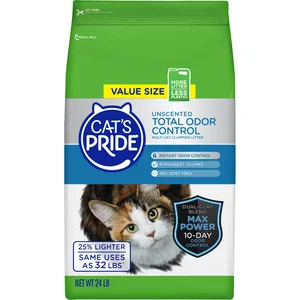
Read the bag rather than the product line. Chewy’s listing for Max Power Total Odor Control, which you might expect to be the heavy standard clay, describes it as a lightweight, 99 percent dust-free formula. The flushable jug goes further and claims 50 percent more litter per pound than traditional heavy clumping litter.
So most of this range is lightweight in some form. If firm clumps matter more to you than carrying weight, check the bag for the word lightweight before you buy.
Which Cat’s Pride for which problem
| Litter | Size | Price | Pick it if |
|---|---|---|---|
| Max Power Total Odor Control, Unscented | 24-lb bag | $18.98 | You want strong odour control in an unscented bag. |
| Max Power UltraClean Low-Tracking, Scented | 15-lb jug | $16.79 | Tracking is the problem and your cat accepts a scented litter. |
| Complete Care Lightweight Multi-Cat, Unscented | 18-lb bag | $17.89 | Several cats share boxes. Baking soda added, no fragrance. |
| Baking Soda Lightweight, Unscented | 10-lb jug | $10.79 | You want the cheapest way to try the brand. |
| Antibacterial Lightweight | 18-lb bag | $17.89 | Smell builds fast between scoops. It is odour control, not a health product. |
| Flushable Lightweight, Scented | 10-lb jug | $13.49 | You like the jug format. Bin the waste anyway. |
What lightweight litter actually is
Lightweight litter is not clay with air whipped into it, and it is not a smaller quantity in a bigger bag. It is a genuinely different mineral.
Standard clumping litter is sodium bentonite, a dense clay that swells and locks together when wet. It is heavy because the mineral itself is heavy.
Lightweight litter uses naturally less dense absorbent minerals that hold liquid without the weight. Oil-Dri puts the result at up to 50 percent lighter for the same volume, which is why the jug you carry home is a manageable object rather than a workout.
| Standard clay | Lightweight clay | |
|---|---|---|
| Weight for the same volume | Heavier | Up to 50 percent lighter, per Oil-Dri |
| Clump hardness | Generally firmer | Generally softer |
| Tracking | Depends on grain size | Slightly more, being less dense |
| Dust | Both produce dust when poured | Both produce dust when poured |
| Cost per box fill | Similar | Similar |
| Best for | Hard clumps, heavy users | Carrying, stairs, ordering online |
The trade-off in one line: lightweight is easier to carry and slightly softer to scoop. If clump integrity is what you care about, look for a dense, standard-weight bentonite, and read the bag: Chewy’s listing describes even Max Power Total Odor Control as lightweight. If lugging bags is what you care about, buy lightweight and use a slotted metal scoop.
One thing lightweight does not fix is dust. All clay litter shatters into fine airborne particles when poured and when a cat digs, and some of that is crystalline silica. Pour slowly from a low height, and if dust is your real complaint, a tofu pellet litter solves it properly. OSHA covers crystalline silica exposure generally.
Odor control: baking soda, carbon, or antibacterial?
Cat’s Pride sells three different odour approaches, and they work in genuinely different ways. Knowing which is which stops you paying for the wrong one.
- Baking soda neutralises. Sodium bicarbonate reacts with acidic odour compounds and converts them into something that does not smell. It is chemistry, not perfume, and it is cheap.
- Antibacterial formulas target the source. Urine itself barely smells at first. Bacteria break urea down into ammonia, and that is the smell you notice on day two. Slowing the bacteria slows the smell.
- Fragrance covers. It adds a smell on top rather than removing one, and it is added for humans. A cat’s nose is far more sensitive than yours, and scented litter is a common reason a cat quietly starts avoiding the box.
- Clump strength beats all three. A hard clump removes the source of the smell entirely when you scoop it. Nothing else in a litter matters as much.
- Scooping daily beats everything. No formulation compensates for a box left three days.
On the antibacterial claim specifically: treat it as odour management, not hygiene. A litter that slows bacterial growth in the box is not protecting your cat from infection, and it is not a substitute for washing the box out with soap and water when you change the litter.
If odour is suddenly worse and nothing about the litter changed, that is worth noticing. Strong-smelling urine, much larger clumps than usual, or a cat urinating more often can signal diabetes, kidney disease or a urinary infection, and those are vet questions rather than litter questions.
Is Cat’s Pride flushable litter safe to flush?
One jug in the range is sold as flushable. It does break down in water. You still should not flush it.
The problem is the waste, not the litter. Cat faeces can carry Toxoplasma gondii, a parasite that survives standard wastewater treatment. Flushed cat waste has been linked to toxoplasmosis reaching coastal waters and infecting marine wildlife.
The rules reflect that. California requires cat litter packaging to carry a warning against flushing, and Rhode Island has its own restriction. A flushable label describes what the product physically does, not what is advisable.
The plumbing point is real too. Clay swells as it absorbs. Older pipes, septic systems and low-flow toilets deal with that badly, and a flushable label is not a promise about your drains.
What to do instead: bag it and bin it. This matters most if anyone in the household is pregnant or immunocompromised, and the AVMA covers safe litter handling.
Which Cat’s Pride should you buy?
Buy Max Power unscented if odour control is the priority. Chewy lists it as lightweight too, so it is no longer the heavy option. Buy one of the lightweight jugs if carrying litter is the part you dread, or if you order it online and would rather not wrestle a 40-pound box off the doorstep.
Skip it if dust is your main complaint, because no clay litter fixes that. Compare in our best cat litter guide and against Arm & Hammer.
A solid, sensibly priced clay litter range from the company that invented the lightweight category, with a genuine choice between weight and clump strength.
Buy unscented, scoop daily, keep the depth near three inches, and bin the waste rather than flushing it whatever the jug says. Cat’s Pride Max Power Total Odor Control Unscented Clumping Cat Litter, 24-lb bag is the one to start with. This article is educational rather than veterinary advice.
Cat’s Pride questions
Q: What makes lightweight cat litter lighter?
It uses naturally less dense absorbent minerals rather than the heavy sodium bentonite in standard clumping clay. Oil-Dri puts the result at up to 50 percent lighter for the same volume, without reducing how much liquid it holds.
Q: Is lightweight litter as good as regular litter?
Almost. The main trade-off is clump hardness: lightweight clay generally forms slightly softer clumps than standard-weight clay. If clump integrity matters most to you, choose the standard-weight formula; if carrying bags matters most, choose lightweight.
Q: Can you flush Cat’s Pride flushable litter?
It breaks down in water, but flushing cat waste is not recommended. Cat faeces can carry Toxoplasma gondii, which survives wastewater treatment, and California requires litter packaging to carry a warning against flushing. Swelling clay can also block older pipes and septic systems.
Hello and welcome to The Ideal Cat!
We are some passionate cat owners from different professions. We love our cats and have a lot of experience in how to care for our pets. We are incredibly excited to share our knowledge, experience, and research with you. So you can take good care of your loving cat. We will answer most of the common questions about owning cats, taking care of them, etc. If you have any question contact with us. Thanks for visiting! Enjoy the content.