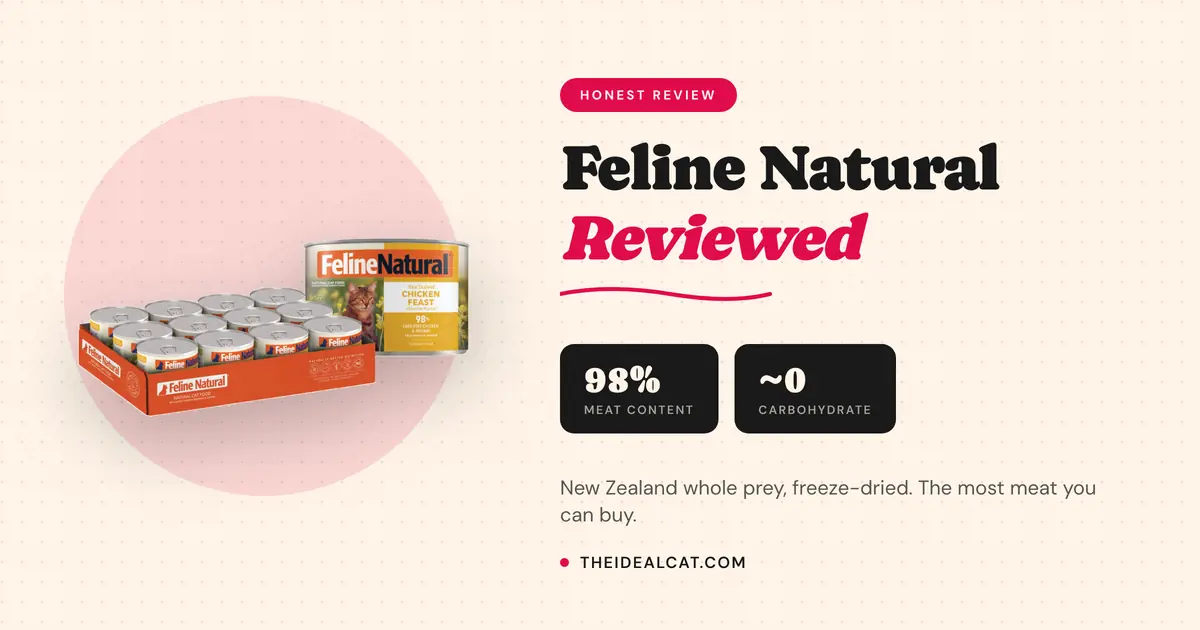
Ninety-eight percent meat. Virtually zero carbohydrate. Muscle, organ, bone and blood in the proportions a cat would get from actual prey.
On paper Feline Natural is about as close to a wild feline diet as anything you can buy in a bag or a can.
It is also among the most expensive cat food in existence, which makes this a question about budget rather than about quality.
- Feline Natural freeze-dried recipes contain 98 percent New Zealand meat, fish and organs.
- The whole prey formulation includes muscle meat, organs, bones and blood in ratios resembling wild prey.
- Feline Natural products contain virtually no carbohydrate, which suits cats as obligate carnivores.
- Feline Natural is the cat arm of K9 Natural, both owned by Christchurch-based Fresh Pet Food Holdings, founded in 2006.
- It is among the most expensive cat foods sold, so cost per serving matters more than the price on the case.
Our Top Picks
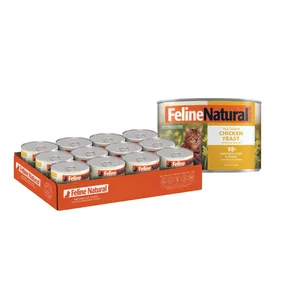
Feline Natural Chicken Feast Grain-Free Canned Cat Food, 6-oz, case of 12
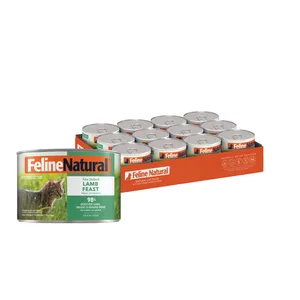
Feline Natural Lamb Feast Grain-Free Canned Cat Food, 6-oz, case of 12
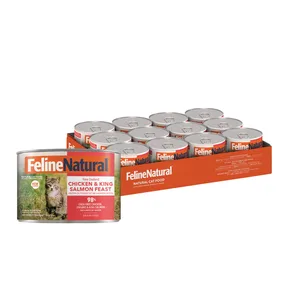
Feline Natural New Zealand Chicken & King Salmon Feast Grain-Free Pate Canned Wet Cat Food, 6-oz can, case of 12
Feline Natural range compared
| Product | Best for | Size | Price | Recipe |
|---|---|---|---|---|
| Feline Natural Chicken Feast Grain-Free Canned Cat Food, 6-oz, case of 12 | Best overall | Case | $64.99 | Chicken feast |
| Feline Natural Lamb Feast Grain-Free Canned Cat Food, 6-oz, case of 12 | Best novel protein | Case | $64.99 | Lamb feast |
| Feline Natural Beef & Hoki Feast Grain-Free Canned Cat Food, 6-oz, case of 12 | Best fish pairing | Case | $64.99 | Beef & hoki |
| Feline Natural Lamb & King Salmon Feast Grain-Free Canned Cat Food, 6-oz, case of 12 | Best premium blend | Case | $64.99 | Lamb & salmon |
| Feline Natural New Zealand Lamb & Venison Feast Grain-Free Pate Canned Wet Cat Food, 6-oz can, case of 12 | Best for variety | Case | $64.99 | Lamb & venison |
| Feline Natural New Zealand Chicken & King Salmon Feast Grain-Free Pate Canned Wet Cat Food, 6-oz can, case of 12 | Best everyday option | Case | $64.99 | Chicken & salmon |
Why almost zero carbohydrate matters
This is the genuine nutritional argument for the brand, and it is stronger than most premium marketing claims.
Cats are obligate carnivores. Unlike dogs or people they have no dietary requirement for carbohydrate at all, and they metabolise protein and fat far more efficiently. Typical dry cat food runs 30 to 45 percent carbohydrate because grain, potato and legumes are cheap bulk and because extrusion needs starch to hold a kibble together.
Feline Natural’s freeze-dried range contains virtually none. That is only possible because freeze-drying removes water rather than cooking and shaping, so no binding starch is needed.
Where this genuinely helps: overweight cats, and cats with diabetes, where carbohydrate load directly affects blood glucose. Feline diabetes is strongly associated with obesity and high-carbohydrate diets, and low-carb feeding is a recognised part of management. That is a conversation for your vet rather than a decision to make from a bag, and the Cornell Feline Health Center covers feline diabetes in detail.
Whole prey, and what organs actually contribute
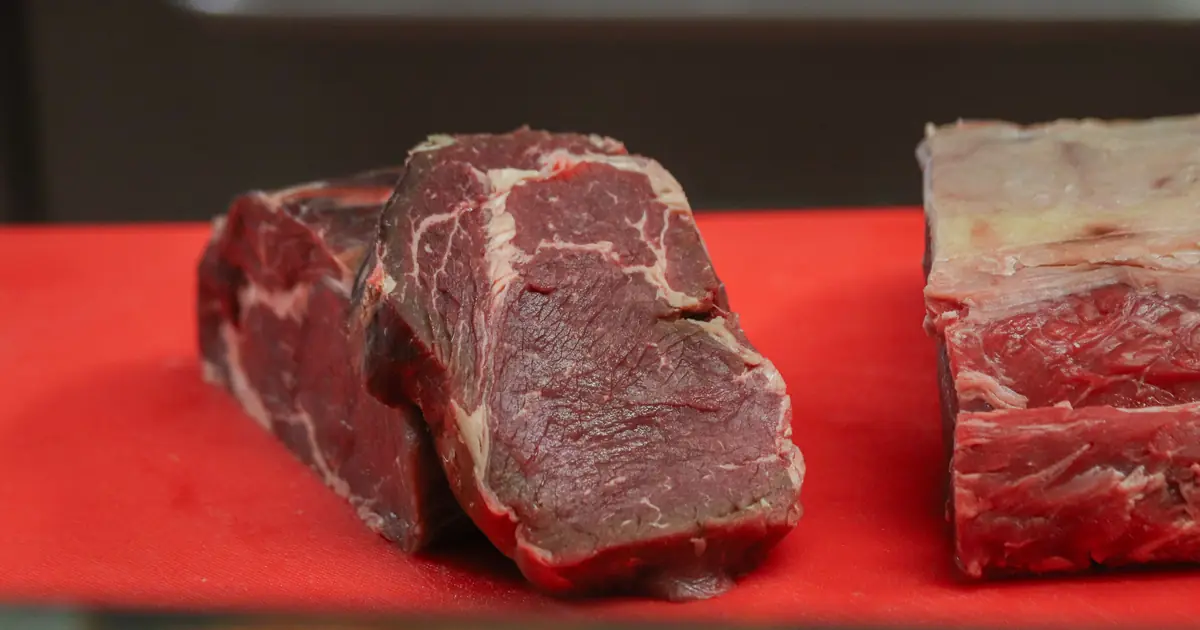
Feline Natural includes organs, bone and blood alongside muscle meat, and this is where the nutritional work happens rather than in the headline percentage.
A cat eating a mouse does not get a fillet. Taurine concentrates in heart tissue, and taurine is an essential amino acid for cats, with deficiency causing dilated cardiomyopathy and retinal degeneration. Liver supplies vitamin A, which cats cannot convert from beta-carotene the way many animals can. Bone provides calcium and phosphorus in roughly the right ratio.
A food built this way needs fewer synthetic vitamins added back, because the nutrients arrive in the ingredients. That is the same logic behind Orijen and Acana, both of which do it at a lower price per serving.
The 6 Feline Natural products, reviewed
Feline Natural Chicken Feast Grain-Free Canned Cat Food, 6-oz, case of 12: best overall
The chicken feast is the simplest entry into the range and the sensible first case. Grain free, very high meat content, and built on the whole prey idea of muscle, organ and bone in the proportions a cat would eat catching an animal. Expensive per can, and the food is dense so portions are small.
Feline Natural Lamb Feast Grain-Free Canned Cat Food, 6-oz, case of 12: best novel protein
Lamb feast, a protein most cats have never encountered. Genuinely useful for an elimination diet run with your vet, because a trial needs a protein the immune system has not met rather than simply a change of brand.
Feline Natural Beef & Hoki Feast Grain-Free Canned Cat Food, 6-oz, case of 12: best fish pairing
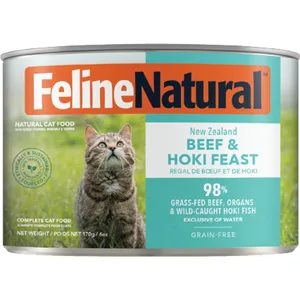
Beef with hoki, a New Zealand whitefish. Two proteins neither of which is chicken, which broadens the amino acid profile and gives you somewhere to go if poultry and common fish are already ruled out.
Feline Natural Lamb & King Salmon Feast Grain-Free Canned Cat Food, 6-oz, case of 12: best premium blend
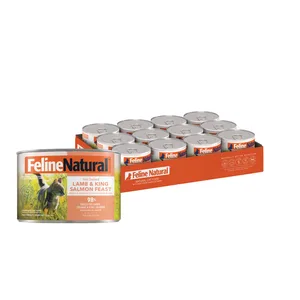
Lamb with king salmon. Pairing a red meat with an oily fish delivers a wider fatty acid profile than either alone. Worth including in a rotation rather than feeding as the only recipe.
Feline Natural New Zealand Lamb & Venison Feast Grain-Free Pate Canned Wet Cat Food, 6-oz can, case of 12: best for variety
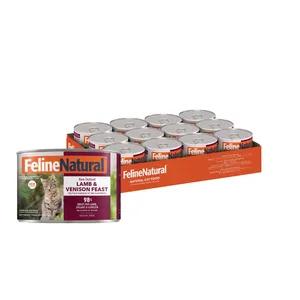
Lamb and venison, and venison is about as novel as commercial cat protein gets. If your cat has reacted to multiple common proteins, this combination gives an elimination diet somewhere genuinely new to go.
Feline Natural New Zealand Chicken & King Salmon Feast Grain-Free Pate Canned Wet Cat Food, 6-oz can, case of 12: best everyday option
Chicken with king salmon, the most conventional flavour pairing in the range and the easiest sell to a fussy cat. If you want to know whether your cat will accept the brand at all, this is the least adventurous place to find out.
The price problem, honestly
There is no way around this, so here it is plainly.
- Freeze-dried is the most expensive format there is. Removing water at low temperature costs far more than extruding kibble.
- Compare per serving, not per case. The food is dense and portions are small, which narrows the gap somewhat but does not close it.
- It works well as a topper. Using it to boost a cheaper complete food captures much of the benefit at a fraction of the cost, and this is how many owners actually use it.
- Not a therapeutic diet. Cats with kidney disease need controlled protein and phosphorus set by a vet, and a 98 percent meat food is not that.
Who should buy Feline Natural
Buy it if you have one cat, budget genuinely allows, and you want the closest thing to a prey diet without handling raw meat. It also suits cats with multiple protein sensitivities, since venison and lamb give an elimination diet somewhere new to go.
Skip it if you feed several cats, or if your cat has a condition requiring a controlled diet. Consider using it as a topper instead, which is the sensible compromise. Compare with our best wet cat food picks and the main cat food guide.
The bottom line on Feline Natural
On formulation this is about as good as cat food gets. Ninety-eight percent meat, whole prey composition including organs and bone, virtually no carbohydrate, and New Zealand sourcing throughout.
The price is the entire argument against it, and for most households it is decisive. If you want to try it, Feline Natural Chicken Feast Grain-Free Canned Cat Food, 6-oz, case of 12 is the least adventurous starting point, and using it as a topper over a good complete food is the pragmatic way in. This article is educational rather than veterinary advice.
Frequently asked questions
Q: Is Feline Natural a good cat food?
Feline Natural is among the highest quality cat foods available. It contains 98 percent New Zealand meat, fish and organs, uses whole prey formulation including bone and blood, and has virtually no carbohydrate. Its main drawback is a very high price.
Q: What does 98% meat mean in Feline Natural?
It means 98 percent of the recipe comes from animal sources including muscle meat, organs, bones and blood, with only 2 percent from other ingredients. Typical dry cat food contains far more plant material and carbohydrate.
Q: Who makes Feline Natural cat food?
Feline Natural is the cat arm of K9 Natural, both owned by Fresh Pet Food Holdings, based in Christchurch, New Zealand. The company was founded in 2006 and pioneered freeze-dried raw pet food there.
Q: Why is low carbohydrate good for cats?
Cats are obligate carnivores with no dietary requirement for carbohydrate, and they metabolise protein and fat more efficiently. Low-carbohydrate feeding is particularly relevant for overweight cats and for diabetic cats, though diet for a diabetic cat should be set by a vet.
Q: Is Feline Natural worth the price?
It is among the most expensive cat foods sold. Compare cost per serving rather than per case, since the food is dense and portions are small. Many owners use it as a topper over a cheaper complete food, which captures much of the benefit for far less.
Q: Is Feline Natural good for cats with allergies?
Its lamb and venison recipes are genuinely novel proteins that most cats have never eaten, which makes them useful in an elimination diet. Any food trial should be run under veterinary supervision to produce a usable answer.
Q: Is Feline Natural safe for cats with kidney disease?
Not without veterinary approval. Cats with chronic kidney disease usually need controlled protein and phosphorus, and a 98 percent meat food is unlikely to meet that requirement.

Hello and welcome to The Ideal Cat!
We are some passionate cat owners from different professions. We love our cats and have a lot of experience in how to care for our pets. We are incredibly excited to share our knowledge, experience, and research with you. So you can take good care of your loving cat. We will answer most of the common questions about owning cats, taking care of them, etc. If you have any question contact with us. Thanks for visiting! Enjoy the content.
