Dental disease is the most common health problem in adult cats, and most owners never see it coming. It hides at the back of a mouth almost nobody looks into.
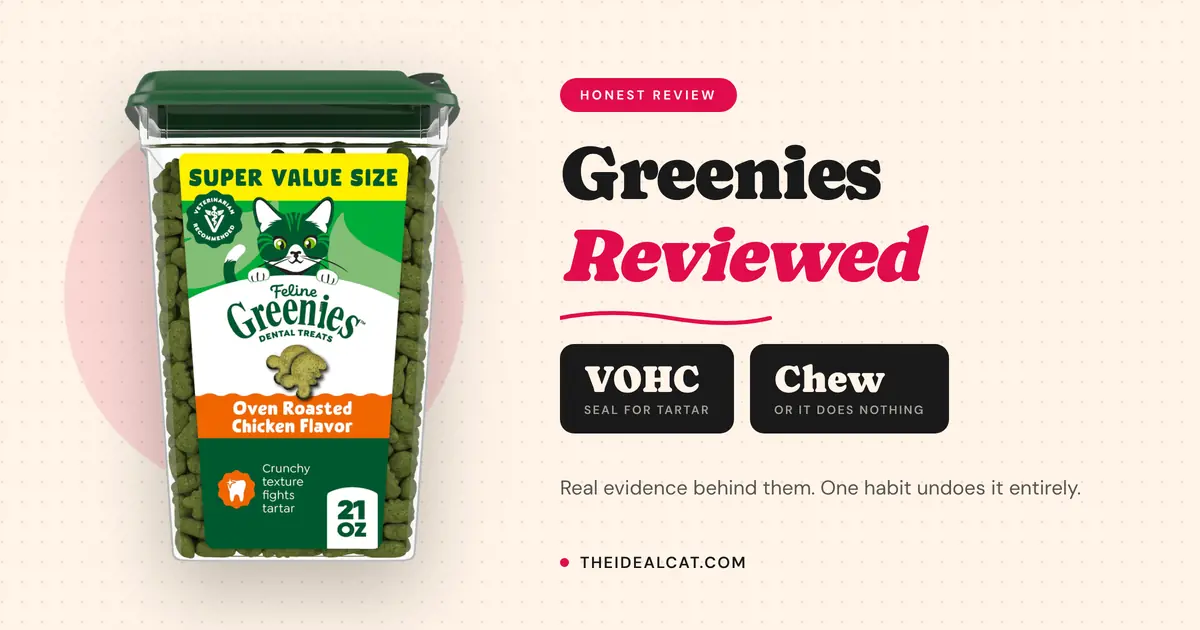
Greenies are one of very few cat treats with actual evidence behind the dental claim, carrying the Veterinary Oral Health Council seal.
There is a catch, though, and it is entirely about how your cat eats them.
Two details worth knowing before you buy. The Veterinary Oral Health Council acceptance on Feline Greenies is for tartar control, according to the product listings, even though the tub’s own copy talks about plaque, tartar, gums and breath. Tartar is the claim that went through the council’s trials.
And the big tub is barely a bulk deal. The 42-ounce tuna bundle costs $45.50, while two 21-ounce tubs cost $45.96. That is a 46-cent saving, so buy whichever size you will actually finish while it is fresh.
Which Greenies tub to buy
Only these four are dental treats. The soft SmartBites and the lickable Smart Purees do nothing for teeth.
| Dental treat | Size | Price | Per oz | Pick it if |
|---|---|---|---|---|
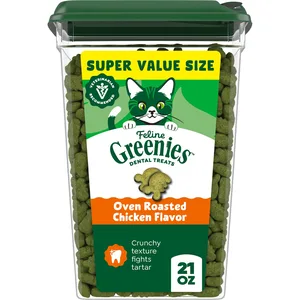
| Oven Roasted Chicken | 21 oz | $22.98 | $1.09 | You are starting out. Chicken is the flavour most cats accept. |
| Tempting Tuna | 21 oz | $22.98 | $1.09 | Your cat sniffs and walks away. Tuna has the strongest smell. |
| Tempting Tuna bundle | 42 oz | $45.50 | $1.08 | Your cat already eats the tuna daily and you want fewer reorders. |
| Catnip | 21 oz | $22.98 | $1.09 | Your cat rejects the usual flavours and responds to catnip. |
What the VOHC seal actually proves
The Veterinary Oral Health Council seal is the strongest evidence available in this category, and it is worth understanding precisely, because it is both better and narrower than the marketing implies.
What it means. The VOHC sets standards for products that retard plaque and tartar, and awards its seal to products meeting those standards in trials. Very few cat treats carry it. That is a genuine, testable claim rather than a vague promise of dental support.
What it does not mean. The VOHC is not a regulatory agency and does not certify products in a legal sense. Greenies’ acceptance is for tartar control specifically. It does not mean the treats prevent dental disease, treat existing disease, or substitute for a cleaning under anaesthetic.
The mechanism is mechanical. The treat is engineered so the tooth sinks into it rather than shattering it, and the scraping action removes soft plaque before it mineralises into tartar. Once plaque hardens into tartar, nothing a cat chews will remove it and only a veterinary cleaning will.
So the honest framing is: a daily dental treat slows the accumulation between cleanings. That is worth doing. It is not a reason to skip a vet check, and the AVMA is clear that home care supplements professional care rather than replacing it.
The habit that cancels the benefit
Here is the failure mode nobody mentions on the tub, and it is common enough to matter.
A cat that swallows a dental treat whole gets no dental benefit. None. The entire mechanism is abrasion during chewing, and a treat that goes down intact has simply added calories. Some cats, particularly fast eaters and cats with existing mouth pain, do exactly this.
How to check: watch them. If your cat crunches audibly a few times, the treat is working. If it disappears in one gulp, it is not.
- Hand them over one at a time rather than tipping a pile into the bowl, which encourages gulping.
- If your cat still swallows them whole, the treat is not doing a dental job and brushing becomes the priority instead.
- Watch for pain. A cat that avoids chewing on one side, drops food, drools, or has suddenly stopped crunching may have painful teeth. That is a vet visit, and a dental treat is not the answer.
- Mind the calories. Treats should stay under about 10 percent of daily intake. An average 10-lb cat needs roughly 200 calories a day, so the treat budget is small.
The single most effective home dental measure remains brushing with a cat-safe toothpaste, and never human toothpaste, which contains fluoride and sometimes xylitol. Treats are the thing you do when brushing is not happening, which for most households is honestly most of the time.
Not everything in this range is dental
Greenies sells three quite different products under one brand and only one of them is a dental treat, which the packaging does not make obvious.
- Feline Dental Treats are the crunchy ones with the VOHC seal. These are the dental product.
- SmartBites are soft treats aimed at hairballs, skin and coat, or indoor cats. Soft treats cannot scrape plaque, so these do nothing for teeth.
- Smart Purees are lickable tubes, useful for medication and appetite, with no dental function at all.
- Buying the wrong one is easy, and it means paying for dental care you are not getting. Check for the word Dental on the tub.
Are Greenies worth it for your cat?
Buy the crunchy dental treats if you want to slow tartar build-up between veterinary cleanings and you will give them daily. The evidence behind them is real, which cannot be said of most treats making dental claims.
Skip them if your cat swallows treats whole, where they add calories and nothing else. Compare alternatives in our best cat treats guide, and see Inaba Churu for a lower-calorie treat and our feeding guide for the calorie maths.
The verdict on Greenies
One of very few cat treats with a genuine veterinary seal behind the dental claim, at a fair price, in flavours most cats accept.
They only work if your cat chews, they slow tartar rather than preventing dental disease, and half the range is not dental at all. Buy the crunchy ones, watch your cat eat one, and keep the vet checks. Start with Greenies Feline Oven Roasted Chicken Flavor Adult Natural Dental Cat Treats, 21-oz tub. This article is educational rather than veterinary advice.
Dental treat questions
Q: Do Greenies dental treats actually work for cats?
Greenies Feline dental treats carry the Veterinary Oral Health Council seal for tartar control, which few cat treats do. They work through mechanical abrasion as the cat chews, so they reduce build-up between cleanings rather than preventing dental disease.
Q: What is the VOHC seal?
The Veterinary Oral Health Council sets standards for products that reduce plaque and tartar and awards a seal to those meeting them in trials. It is not a regulatory agency and does not certify products in a legal sense, but the seal is the strongest evidence available in this category.
Q: Do Greenies work if my cat swallows them whole?
No. The entire mechanism is abrasion during chewing, so a treat swallowed whole delivers no dental benefit and only adds calories. Hand treats over one at a time and watch whether your cat actually crunches them.
Q: Are Greenies a replacement for brushing my cat’s teeth?
No. Brushing with a cat-safe toothpaste remains the most effective home dental measure, and professional cleaning under anaesthetic is the only way to remove hardened tartar. Dental treats supplement both rather than replacing either.
Q: Are Greenies SmartBites dental treats?
No. SmartBites are soft treats aimed at hairballs, skin and coat or indoor cats, and soft treats cannot scrape plaque. Only the crunchy Feline Dental Treats carry the dental claim and the VOHC seal.
Q: How many Greenies can I give my cat a day?
Treats should stay under about 10 percent of daily calories. An average 10-lb cat needs roughly 200 calories a day, so the treat allowance is small. Follow the feeding guide on the tub and adjust for your cat’s actual weight.

Hello and welcome to The Ideal Cat!
We are some passionate cat owners from different professions. We love our cats and have a lot of experience in how to care for our pets. We are incredibly excited to share our knowledge, experience, and research with you. So you can take good care of your loving cat. We will answer most of the common questions about owning cats, taking care of them, etc. If you have any question contact with us. Thanks for visiting! Enjoy the content.