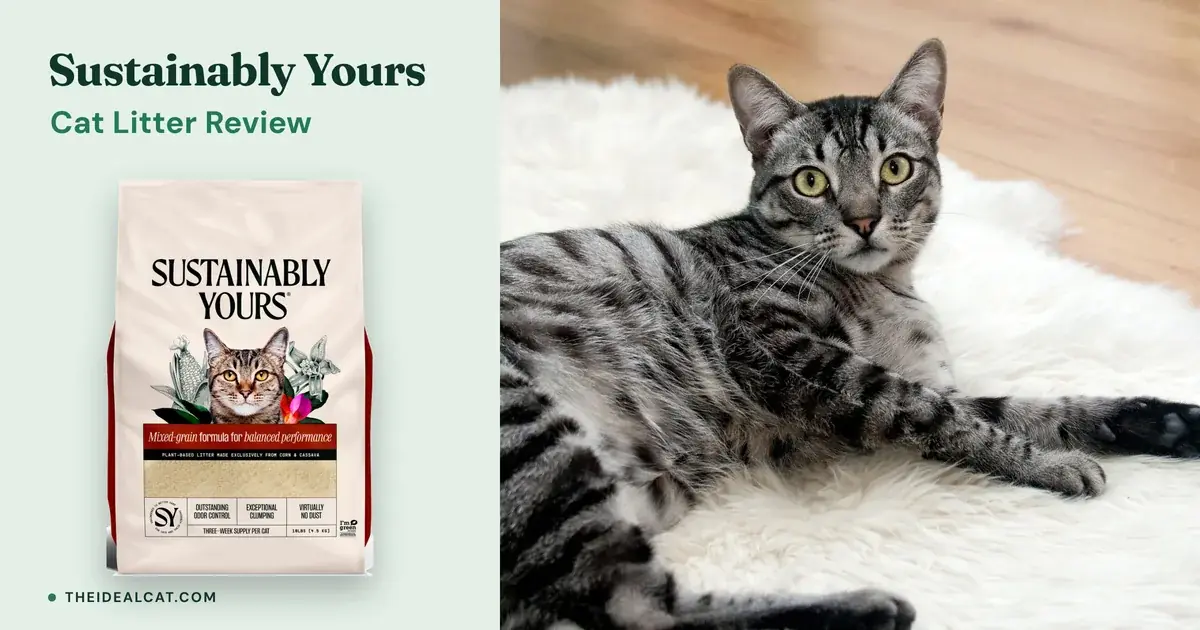
Here is the thing almost every review of this brand buries: all three Sustainably Yours formulas contain exactly the same ingredients.
Corn and cassava. That is it. Small grain, large grain and mixed grain are not different recipes.
The only variable is how big the granules are, and that single difference decides whether you get better clumps or less litter tracked across your floor. You cannot have both.
The bigger bag saves less than you might hope. A 10-pound bag is $20.89 to $21.99, and every 20-pound bag is $39.99, about $2 a pound. That is 5 to 9 percent off for twice the weight to carry.
The listings are not quite identical, even though the ingredients are. Chewy’s large- and mixed-grain descriptions promise virtually no dust and low tracking. The small-grain description only talks about faster clumping, which fits the trade-off below.
Which Sustainably Yours grain size should you buy?
Same corn and cassava in all three. Here is how they differ, with Chewy prices.
| Formula | What the grain size does | 10-lb bag | 20-lb bag | Pick it if |
|---|---|---|---|---|
| Mixed Grain | Balances clumping and tracking | $20.89 | $39.99 | You are not sure yet. Our pick, and the cheapest small bag. |
| Small Grain | Fastest, firmest clumps | $21.99 | $39.99 | Crumbly clumps annoy you more than a few stray grains. |
| Large Grain | Least tracking, softer clumps | $21.99 | $39.99 | Litter on the floor is your main complaint. |
Grain size is the whole decision
Sustainably Yours sells three formulas made of the same corn and cassava. Choosing between them means choosing which problem you would rather have.
Small grain clumps better. Fine particles pack tightly around urine, so clumps set fast and hold together on the scoop. Fine particles also lodge between toe pads and ride out of the box on your cat’s feet.
Large grain tracks less. Bigger granules are too heavy and too bulky to wedge into paws, so they stay in the box. Those same bigger granules leave more air gaps around urine, so clumps are softer and need a gentler scoop.
Mixed grain splits the difference, and it is the right default. Buy this one unless you already know which of the two problems annoys you more.
Dust is low across the range, though only the large- and mixed-grain listings actually promise virtually no dust. Plant granules do not shatter into airborne particles the way clay does, which matters if anyone in the house, cat or human, has asthma. Dust is the reason plenty of people leave clay litter behind in the first place.
About flushing it, honestly
Sustainably Yours is marketed as flushable, and the clumps do break down after soaking. Whether you should flush them is a different question, and the honest answer is usually no.
Cat faeces can carry Toxoplasma gondii, a parasite that survives standard wastewater treatment. Flushed cat waste has been linked to toxoplasmosis reaching coastal waters and infecting marine wildlife, including sea otters. This is why some US jurisdictions restrict it: California requires cat litter packaging to carry a warning against flushing, and Rhode Island has its own restriction.
There is also a plumbing argument. Older pipes, septic systems and low-flow toilets do not handle litter clumps well, and a blockage costs more than a year of bin bags.
The practical position: bag it and bin it. The environmental case for this litter is that it is biodegradable and made from renewable crops rather than strip-mined clay, and that case stands on its own without flushing. The CDC covers toxoplasmosis and safe litter handling, which matters especially if anyone in the house is pregnant or immunocompromised.
How to switch litter without a protest
Cats form strong preferences about what they stand on, and an abrupt switch is one of the most common causes of a cat going outside the box. Corn and cassava feel nothing like clay underfoot, so this is a switch worth doing slowly.
- Start at roughly 25 percent new litter mixed into the old, for about a week.
- Move to half and half for another week if there are no protests.
- Go to 75 percent new for a week, then complete the switch.
- Keep one box on the old litter throughout if you have the space, so your cat always has a familiar option and never has to choose the carpet.
If your cat starts going outside the box at any stage, go back a step. And if the avoidance continues once you have returned to the old litter, that is a vet visit rather than a litter problem.
Should you buy Sustainably Yours?
Buy it if you want to move off clay for environmental or dust reasons and you want clumping that actually competes with clay. Among plant litters, the clumping here is genuinely at the top end, which is where most natural litters fall down.
Skip it if you want the cheapest cost per pound, where clay wins comfortably. Compare across types in our best cat litter guide and best clumping cat litter, or see World’s Best for the other major corn-based option.
Two plant ingredients, biodegradable, very low dust, and clumping strong enough to stand next to clay. For a natural litter that is a genuinely good combination, and the clumping is where most competitors disappoint.
Ignore the flushable claim and bag it instead. Pick mixed grain unless you already know whether clumping or tracking annoys you more, and start with Sustainably Yours Mixed-Grain Formula Unscented Clumping Cat Litter, 10-lb bag. This article is educational rather than veterinary advice.
Sustainably Yours questions
Q: What is the difference between small, large and mixed grain?
Nothing except granule size. All three formulas contain the same corn and cassava. Small grain clumps hardest, large grain tracks least, and mixed grain balances the two. Mixed grain is the sensible default.
Q: Can you flush Sustainably Yours cat litter?
It is marketed as flushable, but flushing cat waste is not recommended. Cat faeces can carry Toxoplasma gondii, a parasite that survives wastewater treatment and has been linked to infections in marine wildlife. California requires a warning against flushing on cat litter packaging.
Q: Does Sustainably Yours track a lot?
The large-grain formula tracks the least, because bigger granules are too heavy to wedge between toe pads. Small grain tracks most. Pairing large grain with a litter mat is the most effective combination if tracking is your main complaint.

Hello and welcome to The Ideal Cat!
We are some passionate cat owners from different professions. We love our cats and have a lot of experience in how to care for our pets. We are incredibly excited to share our knowledge, experience, and research with you. So you can take good care of your loving cat. We will answer most of the common questions about owning cats, taking care of them, etc. If you have any question contact with us. Thanks for visiting! Enjoy the content.
