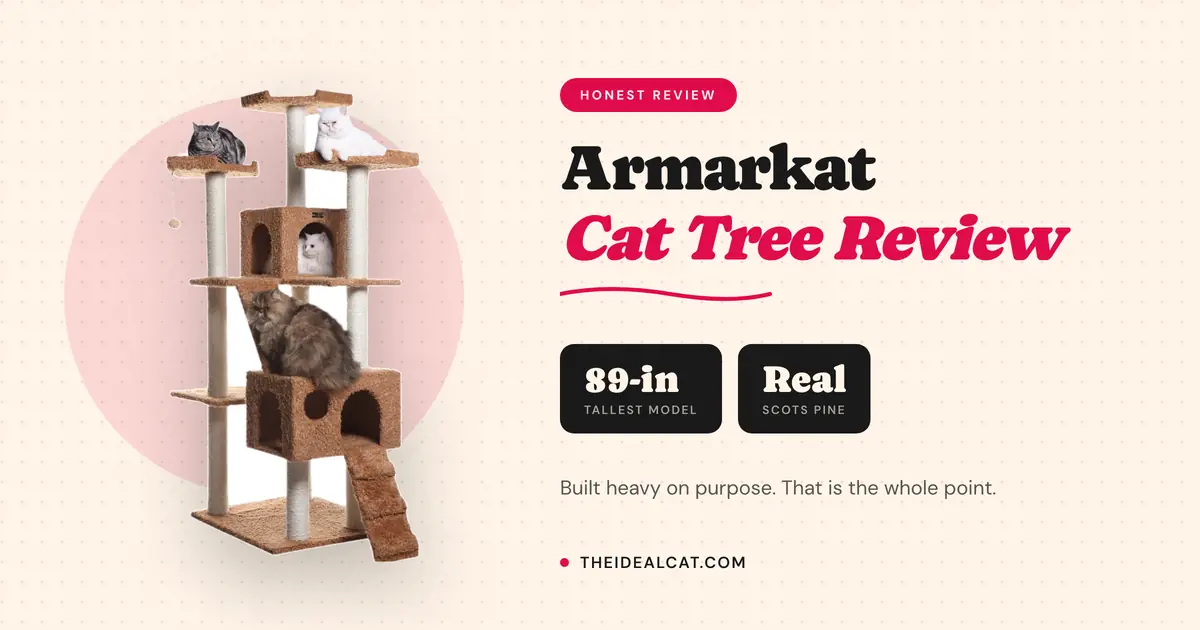
There is a moment when a big cat lands on the top platform of a cheap tower and the whole thing shifts an inch.
The cat notices. And a cat that has felt a perch move once will often never trust it again.
Armarkat’s answer is weight: real wood, wide bases, and towers up to 89 inches that are built to absorb that landing rather than flinch at it.
Two listing details worth having before you choose. Only one of these six towers publishes a weight capacity: the Royal Perch Mansion, rated to support up to 80 pounds. The rest leave you to judge sturdiness from the materials, which is exactly why the real wood matters.
And the real wood is not range-wide. The 89-inch tower is Scots pine and the 80-inch Giant is real wood with fully sisal-wrapped posts, but the 58-inch Classic sits on a pressed wood base. If weight is what you are paying for, buy one of the real wood models.
Why weight is the feature you are buying
Cat trees are sold on height and photographed on style. The specification that actually determines whether one works is mass.
The physics is simple. A 15-lb cat landing on a top platform delivers roughly 30 to 45 pounds of momentary force, and it arrives off-centre and sideways. Only the weight and footprint of the base resist that. A tall, light tower has neither.
- Base at least 24 inches wide, and wider again for anything over 70 inches.
- Total weight 30 lb or more for a full-height tower. This is where real wood earns its price over particle board.
- Anchor anything over 60 inches to the wall, whatever the weight. Straps cost a few dollars.
- Corner placement gives you two walls of free stabilisation and suits cats, who prefer a perch with its back protected.
- Re-tighten the bolts after two weeks. Every tree loosens once it is in real use, and a loose joint is where a wobble starts.
Real wood versus particle board is the whole reason Armarkat costs more than a budget tower of the same height. Particle board is lighter, cheaper, and swells if it ever gets damp. Solid wood holds screws better over years of being climbed, which matters because the failure point on old cat trees is almost always the joints rather than the surfaces.
Vertical space is worth the investment. It expands a cat’s usable territory without using floor area, which measurably reduces tension in multi-cat homes, as International Cat Care sets out.
Sizing a tree to your actual cat
Most cat tree disappointment comes from buying for the room rather than for the animal.
Platform size is the number nobody checks. A cat should be able to lie down fully on a platform, not perch on it like a bird. A Maine Coon can measure over three feet nose to tail, and a platform sized for an average cat leaves them balancing. That is why big cats ignore trees that look perfectly good.
Condo openings matter too. An enclosed box a large cat cannot turn around inside will be used once and never again. Check the opening dimensions rather than the overall height.
- Large breeds such as Maine Coons, Ragdolls, Norwegian Forest Cats and Savannahs need the 80-in-plus models with wide platforms, not just tall ones.
- Senior or arthritic cats need shorter hops between levels. A tall tower with big gaps is unusable to a cat with sore joints, and they will simply stop climbing.
- Kittens should start low. A fall from six feet is a real injury risk while coordination is still developing.
- Multi-cat homes want several perches at different heights rather than one impressive tower, so cats can space themselves out.
If your cat used to climb and has stopped, do not assume they have gone off the tree. Reluctance to jump is one of the most common signs of feline arthritis, which is far more prevalent than most owners realise and is easy to miss because cats compensate quietly. That is a vet conversation. Our guides to cat trees for large cats and multi-cat homes cover sizing in more detail.
Armarkat versus the budget towers
- Against Frisco: Armarkat is heavier, uses more real wood and costs meaningfully more. Frisco wins on price per inch; Armarkat wins on stability and lifespan.
- Assembly is more involved here, because the parts are heavier. Budget an hour and a second pair of hands for the tall models.
- Sisal posts are included across the range, which is the surface cats actually want to scratch.
- Faux fur models look plush but wear faster than carpet under sustained clawing. The Scots pine and real wood models are the durable half of the range.
- Shipping weight is a real consideration. These are heavy boxes, which is the point, but plan for getting one upstairs.
Here is the range with the construction detail each listing actually gives.
| Tree | Height | Price | Construction | Pick it if |
|---|---|---|---|---|
| 74-in Multi-Level | 74 in | $164.99 | Two condos, many platforms | Most households. Tall and heavy without the top price. |
| 89-in Premium Scots Pine | 89 in | $229.99 | Scots pine, sisal rope posts | You have a Maine Coon or Ragdoll. Anchor it anyway. |
| Real Wood Giant, Dark Gray | 80 in | $209.99 | Real wood, fully sisal-wrapped posts | You want real wood and seven platforms in a dark finish. |
| Royal Perch Mansion | 84 in | $261.65 | Faux fur, eight levels, rated to 80 lb | Several cats share one tree. |
| 58-in Classic, Tartan | 58 in | $152.38 | Fleece over a pressed wood base | You rent and cannot drill. Not a real wood model. |
| AMNI 47-in Real Branch | 47 in | $150.26 | Plush, real branch elements, baskets and condo | Your space is small, or your cat wants a hideout. |
Is an Armarkat worth the extra money?
Buy one if you have a large cat, several cats, or an enthusiastic jumper who has already made a cheaper tower wobble. The weight is the product, and it is the thing budget towers cannot match at any height.
Buy cheaper if you have one small cat and limited space, where Frisco covers the basics for less. Compare the whole category in our best cat trees guide.
Heavy, well-built cat furniture that stays where you put it, in heights up to 89 inches, with real wood on the models that matter. You pay for the mass, and the mass is the entire reason it works.
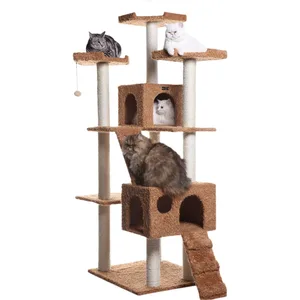
Measure your cat before you buy, match platform size to their body length, and anchor anything over sixty inches anyway. Armarkat 74-in Multi-Level Cat Tree, Ochre Brown is the model most households should choose. This article is educational rather than veterinary advice, and a cat who has stopped jumping should see a vet.
Cat tree questions owners ask
Q: Are Armarkat cat trees good?
Armarkat cat trees are well built and notably heavy, using real wood including Scots pine on the premium models. That weight is what keeps tall towers stable under large cats. They cost more than budget towers, typically $150 to $260.
Q: What size cat tree does a Maine Coon need?
A large breed needs wide platforms as much as height, since a cat should be able to lie down fully rather than perch. Armarkat’s 80-inch-plus models suit large breeds. Check condo opening dimensions too, since a box a big cat cannot turn around in goes unused.
Q: Do heavy cat trees still need anchoring?
Yes. Anything over about 60 inches should be anchored to the wall regardless of weight, especially with large or energetic cats. Corner placement adds further stability by using two walls.
Q: Is real wood better than particle board for a cat tree?
Real wood is heavier, which resists tipping, and holds screws better over years of climbing. Particle board is lighter and cheaper and swells if it gets damp. The failure point on old cat trees is almost always the joints.
Q: My cat stopped using the cat tree. Why?
If a cat who used to climb has stopped, reluctance to jump is a common sign of feline arthritis, which is more prevalent than most owners realise and easy to miss. It can also mean the tree wobbled once. Speak to your vet.
Q: How many cat trees do I need for multiple cats?
Several perches at different heights work better than one tall tower, because cats partly negotiate status through vertical position and need to be able to space themselves out. Multiple levels on one tree helps but does not fully replace separate perches.

Hello and welcome to The Ideal Cat!
We are some passionate cat owners from different professions. We love our cats and have a lot of experience in how to care for our pets. We are incredibly excited to share our knowledge, experience, and research with you. So you can take good care of your loving cat. We will answer most of the common questions about owning cats, taking care of them, etc. If you have any question contact with us. Thanks for visiting! Enjoy the content.
