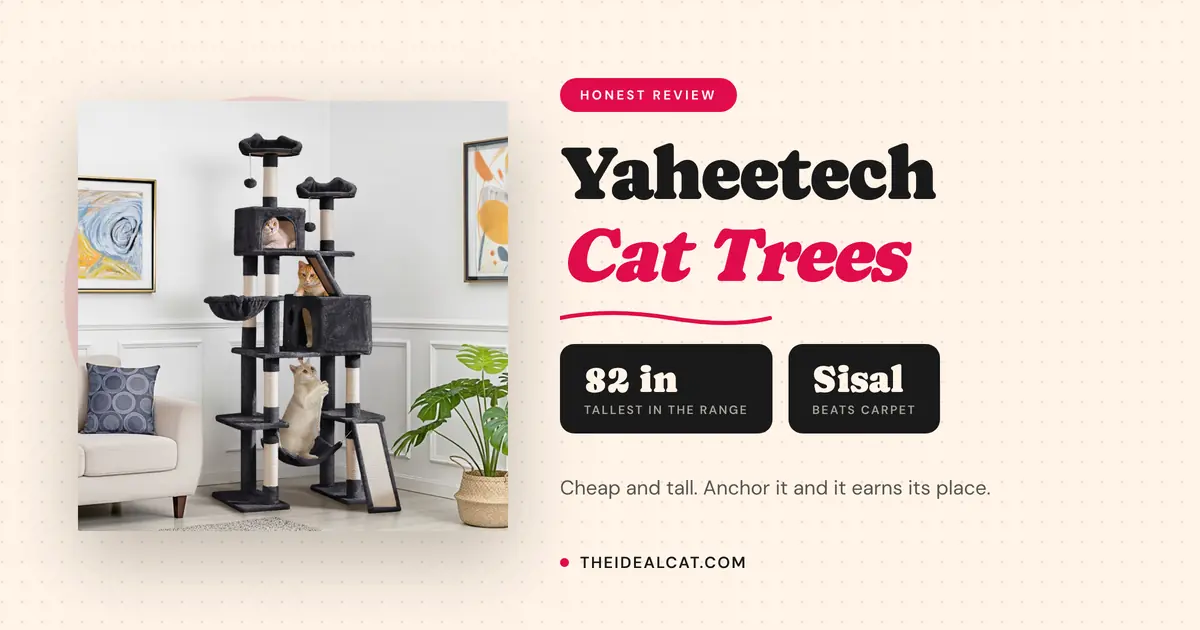
Yaheetech sells one of its cat trees as 61.5 inches tall. The product description on the same listing calls it 54.5 inches. Both numbers come from the manufacturer.
That is a seven-inch gap on the single specification that decides whether a cat tree is worth owning. It is also a fair summary of what buying in this price bracket is like: the products are genuinely decent, and the information around them is sloppy.
So rather than walk you through six near-identical towers, this covers the four things that actually vary between them, and the two the listings get wrong.
The listed height is not always the height
Cross-checking each product title against its own description turned up two disagreements, one of them large.
| Sold as | Its own description says | Gap |
|---|---|---|
| Cat Scratching Tree, 61.5-in | 54.5 in | 7 in |
| 69-in Multi-Level Cat Tree | 68.5 in | 0.5 in |
| 82.5-in, 76-in, 66-in, 54-in | consistent | none |
Half an inch is rounding. Seven inches is not. If you are buying to clear the top of a wardrobe or a kitchen counter, measure the gap you need and treat the lower figure as the one to trust until the box is open.
Height is worth being fussy about because it is the reason cats use a tree at all. A raised perch is defensible, gives a view of the room, and lets a cat opt out of a dog or a stressed housemate without a confrontation, which is why the Ohio State Indoor Pet Initiative lists vertical space as a basic indoor need rather than an enrichment extra. A tower that lands six inches short of the furniture it was meant to beat has failed at its one job.
Wobble is geometry, not quality
Wobble is the complaint that dominates owner reviews of these trees, and it is not spread evenly across the range. It clusters on the tall models with narrow bases, and it is largely absent from the shorter ones.
That pattern makes sense. The height comes from long posts; the low price comes from a small, light base. Those two things pull against each other, and the taller you go the more a given base has to resist. It is physics rather than a defect, which is also why it has a cheap fix.
Every one of these trees ships with a wall anchor strap, and owner reports converge on the same conclusion: fitted, the wobble stops being an issue. Reviewers running the tallest models with several cats report them steady once strapped. Reviewers who skipped the strap are the ones describing movement that bothered them.
This matters more than it sounds. A cat jumping to a top perch is committing to a landing, and a tower that shifts under the impact teaches the cat in a single attempt that the perch is not safe. Cats do not retest that judgement often. An unanchored tall tree does not wobble its way to mild annoyance, it gets abandoned.
Three things take ten minutes and remove the problem entirely: tighten every bolt fully during assembly, re-tighten after a fortnight once the flat-pack settles, and fit the supplied strap. On a hard floor, add a rug underneath so the base cannot slide on impact.
What CARB P2 on the label actually tells you
Every Yaheetech tree in this range lists CARB Phase 2 compliant particle board. It is on the spec sheet, almost nobody explains it, and it is worth thirty seconds of your attention given your cat will sleep on this thing daily for years.
Particle board is wood fibre bonded with resin, and some of those resins release formaldehyde. CARB Phase 2 is the California standard capping how much, and the federal EPA rule under TSCA Title VI sets identical limits, with particleboard capped at 0.09 parts per million. Panels have to be certified by a third party rather than self-declared.
Two honest caveats. Since March 2019, products made or imported in the US have had to be certified as TSCA Title VI compliant anyway, so the CARB P2 wording is a legacy label rather than a premium feature. And the rule covers formaldehyde only, not the other volatile compounds that can come off fabrics and finishes.
So this is a floor, not a selling point. What it does mean is that the cheap price is not coming from uncertified board, which is the thing worth knowing. New trees often smell for the first few days regardless; unbox it and let it air in a ventilated room before your cat moves in.
Nobody publishes a weight limit, including Yaheetech
If you have a Maine Coon, a Ragdoll or simply a heavy cat, the question you want answered is what these platforms hold. There is no published answer. Yaheetech does not state a load rating on any model in this range.
Worth flagging because this gap gets filled with invention. At least one review site presents a specific stability figure for these trees that is actually the shipping weight of the tree itself, alongside a quoted veterinarian who does not appear to exist. If you find a confident number for a spec the manufacturer never published, that is where it came from.
Without a rating, judge it by proxy. Owner reports on the mid-height models are consistently positive including from multi-cat homes, while the specific durability complaints cluster on the smaller scratching tree. Two patterns recur for heavier cats: platforms spaced further apart than a less athletic cat wants to jump, and perches that bow before anything breaks. Neither is catastrophic, and both argue for a mid-height model with a wider base over the tallest one in the range.
Picking between them
The six models differ on three axes that matter: height, how much sisal they carry, and whether the covering survives claws. Everything else is colour.
| Model | Height | Price | Pick it if |
|---|---|---|---|
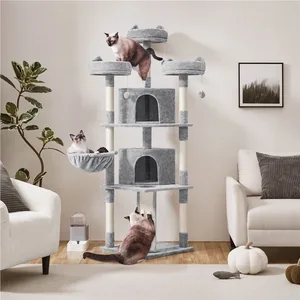
| 76-in Multi-Level | 76 in | $89.99 | You want maximum usable height per dollar. The sweet spot of the range. |
| 82.5-in Multi-Level Condo | 82.5 in | $99.99 | You want the tallest and will definitely fit the strap. |
| 69-in Multi-Level | 68.5 in | $85.99 | A full tower would dominate the room. Less height, less wobble. |
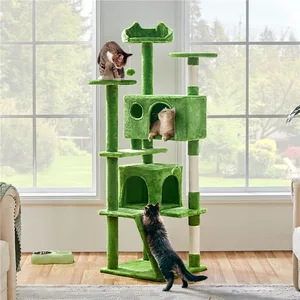
| Cat Scratching Tree | 54.5 in (listed 61.5) | $83.99 | Scratching matters more than climbing. Most sisal of the six. |
| 66-in Cactus | 66 in | $81.21 | You have to look at it every day and that matters. |
| 54-in Plush Rattan | 54 in | $109.99 | It needs to read as furniture. Buy a separate post, rattan is not for claws. |
One material note that applies across the range. Cats prefer sisal for scratching because the resistance is consistent, whereas carpet loops snag individual claws and shred unevenly, which cats find frustrating rather than satisfying. Plush and rattan are resting surfaces and nothing more. If the tree you like is mostly soft covering, pair it with a dedicated post, which is also the Humane Society approach to steering claws away from the sofa. Our scratching post guide covers the standalone options.
Placement decides whether any of this gets used. A tree beside a window in a room the household actually occupies will be in constant use; the identical tree in a spare bedroom will not. Cats want to be near you and near something to watch. Compare the sturdier end of the market in our best cat trees guide.
So, worth buying?
Yes, with the strap fitted and your expectations set by the lower of the two heights on the listing.
These are honest budget trees. You are buying particle board, certified to the same formaldehyde standard as furniture, wrapped in plush with sisal where it counts, at a third of what a solid-wood tower costs. What you give up is the self-supporting stability that extra mass buys, and you buy most of it back with a ten-minute anchoring job. The 76-inch model is where I would start.
What you should not do is buy the tallest one, skip the strap, and conclude that cheap cat trees do not work.
Questions owners actually ask
Q: How much weight can a Yaheetech cat tree hold?
Yaheetech does not publish a load rating for any model in this range, and any specific figure you find online is not from the manufacturer. Owner reports on the mid-height models are positive including from multi-cat households, while platforms tend to bow rather than fail. For a large or heavy cat, a mid-height model with a wider base is the safer choice than the tallest in the range.
Q: Do Yaheetech cat trees wobble?
The taller models can, because height comes from long posts while the low price comes from a small base. Every tree includes a wall anchor strap, and owner reports converge on the strap resolving it. Tighten all bolts during assembly, re-tighten after about two weeks, and fit the strap.
Q: Is the listed height accurate?
Usually, with one big exception. The Cat Scratching Tree is sold as 61.5 inches but its own product description states 54.5 inches, a seven-inch difference. The 69-inch model describes itself as 68.5 inches, which is rounding. Measure the space you need before ordering.
Q: What does CARB P2 particle board mean for my cat?
It means the board is certified to a formaldehyde emissions limit of 0.09 parts per million, the same level the federal EPA rule requires. It is a compliance baseline rather than a premium feature, and it covers formaldehyde only, not other compounds from fabrics and finishes. Air a new tree in a ventilated room for a few days before your cat uses it.
Q: How long does assembly take?
Typically 20 to 60 minutes for one person depending on the model and your experience with flat-pack furniture. No specialist tools are needed. Do not fully tighten anything until every part is in place, or the last panels will not line up.

Hello and welcome to The Ideal Cat!
We are some passionate cat owners from different professions. We love our cats and have a lot of experience in how to care for our pets. We are incredibly excited to share our knowledge, experience, and research with you. So you can take good care of your loving cat. We will answer most of the common questions about owning cats, taking care of them, etc. If you have any question contact with us. Thanks for visiting! Enjoy the content.
