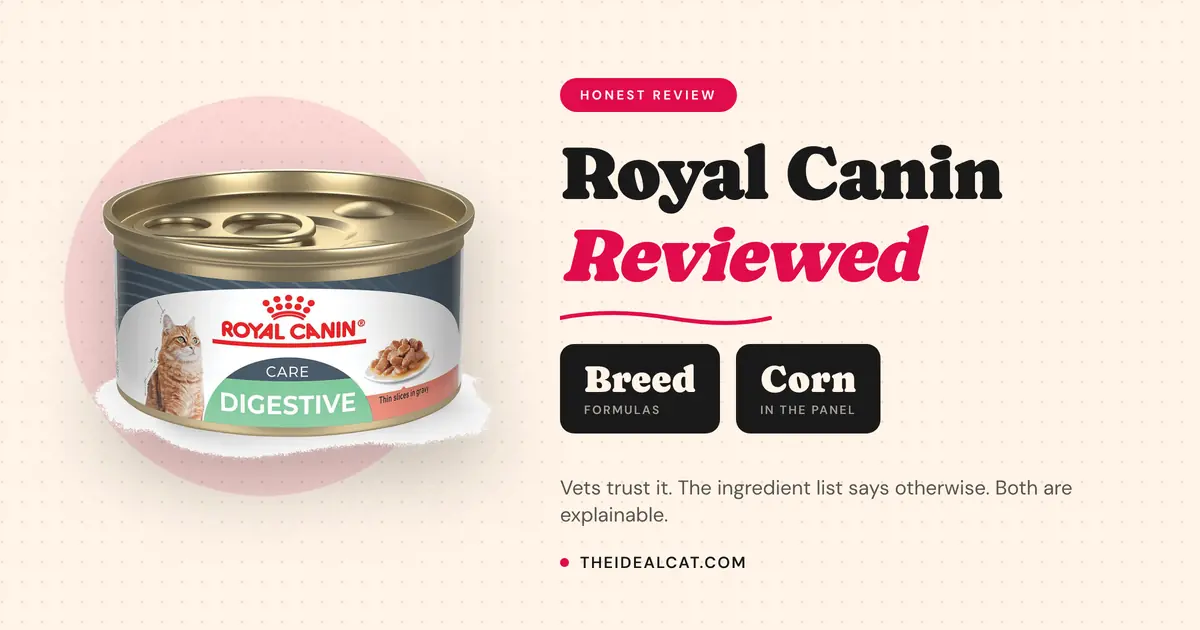
Royal Canin is the food your vet hands you and the food the internet tells you is overpriced corn.
Look at the panel and the critics have a case: chicken by-product meal, wheat gluten, corn gluten meal, at a price that would buy you something with far more named meat in it.
And yet clinics keep stocking it, and not only for the money. Here is what is actually going on.
- Royal Canin is widely used in veterinary practice because its formulas are heavily tested and reliably palatable to unwell cats.
- The top ingredients in many Royal Canin recipes are chicken by-product meal, wheat gluten, wheat, chicken fat, and corn gluten meal.
- Royal Canin breed-specific formulas are largely a marketing construct, with brachycephalic breeds such as Persians the clearest exception.
- Royal Canin is expensive relative to its ingredient quality compared with high-meat premium brands at similar prices.
- Kibble and can shape is genuinely engineered around jaw structure, which matters for flat-faced breeds that struggle with standard shapes.
Our Top Picks
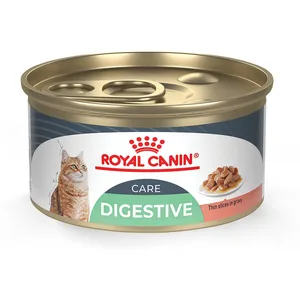
Royal Canin Digest Sensitive Thin Slices Canned Cat Food, 3-oz, 24 ct
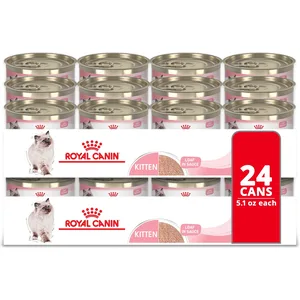
Royal Canin Feline Health Nutrition Kitten Loaf in Sauce Canned Cat Food, 5.1-oz, case of 24
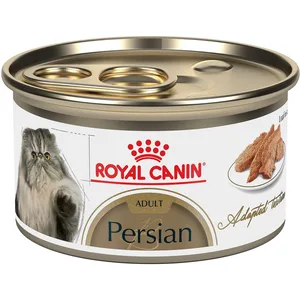
Royal Canin Feline Breed Nutrition Persian Loaf Pate Adult Wet Cat Food, 3-oz can, case of 24
Royal Canin range compared
| Product | Best for | Size | Price | Line |
|---|---|---|---|---|
| Royal Canin Digest Sensitive Thin Slices Canned Cat Food, 3-oz, 24 ct | Best overall | Case | $57.36 | Digest Sensitive |
| Royal Canin Feline Care Nutrition Digestive Care Adult Gravy Wet Cat Food, 5.1-oz can, case of 24 | Best for digestion | Case | $74.16 | Digestive Care |
| Royal Canin Feline Health Nutrition Kitten Loaf in Sauce Canned Cat Food, 5.1-oz, case of 24 | Best for kittens | Case | $74.16 | Kitten loaf |
| Royal Canin Feline Care Nutrition Weight Care Loaf Pate Wet Cat Food, 5.1-oz can, case of 24 | Best for weight control | Case | $74.16 | Weight Care |
| Royal Canin Maine Coon Adult Thin Slices in Gravy Wet Cat Food, 3-oz can, case of 24 | Best breed formula | Case | $66.96 | Maine Coon |
| Royal Canin Feline Breed Nutrition Persian Loaf Pate Adult Wet Cat Food, 3-oz can, case of 24 | Best for flat-faced breeds | Case | $66.96 | Persian |
Are breed-specific formulas real or marketing?
Mostly marketing, with one genuine exception. Here is the split.
The marketing part: despite the breed names on the bags, the top five ingredients across breed formulas are largely the same combination of by-product meal, wheat gluten, wheat, chicken fat, and corn gluten meal. A Maine Coon and a Ragdoll do not have meaningfully different nutritional requirements, and no published evidence suggests they do.
The genuine part: kibble and can shape really is engineered per formula, and that matters for brachycephalic breeds. Persians and Exotic Shorthairs have flattened faces and a jaw structure that makes picking up standard round kibble physically awkward. A shape designed for that jaw is solving an actual mechanical problem, not an imaginary nutritional one.
So if you have a Persian, the Persian formula is defensible. If you have a Maine Coon, you are mostly paying for the name. Our Persian breed guide and Maine Coon guide cover the wider care differences that do matter.

Why vets use it despite the ingredient panel
Two reasons, and neither is a kickback.
First, testing. Royal Canin runs feeding trials and clinical studies rather than formulating to a spreadsheet, which means the nutrient claims have been measured in live cats. Many boutique brands with far prettier labels have never done this.
Second, and more practically, sick cats eat it. A cat recovering from surgery, or nauseous from kidney disease, that refuses food is in real danger, because cats that stop eating develop hepatic lipidosis quickly, a condition the Cornell Feline Health Center explains in detail. Royal Canin’s textures, particularly the thin slices in gravy, get food into cats that have refused everything else. In a clinic that is worth more than an ingredient list.
The criticism still stands on its own terms: by-product meal and wheat gluten at this price is a poor value proposition for a healthy cat with a normal appetite. The AAFCO nutrient profiles set the floor all complete foods meet, and Royal Canin comfortably clears it. Whether you should pay premium prices to do so is your call.
The 6 Royal Canin products, reviewed
Royal Canin Digest Sensitive Thin Slices Canned Cat Food, 3-oz, 24 ct: best overall
Digest Sensitive thin slices in gravy is one of the most reached-for products in general practice for cats with unsettled digestion. The texture is a large part of why: thin slices in gravy tempt cats who have stopped eating, and getting food into a sick cat is the whole battle. Priced high for what the panel shows.
Royal Canin Feline Care Nutrition Digestive Care Adult Gravy Wet Cat Food, 5.1-oz can, case of 24: best for digestion
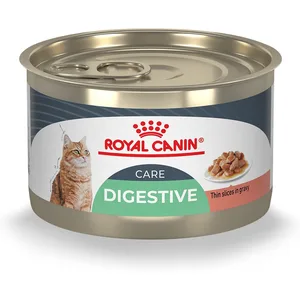
Digestive Care loaf, formulated around stool quality and nutrient absorption. Worth being direct: a cat with chronic diarrhea needs a diagnosis, not a food swap. This helps genuinely mild cases and is often what a vet suggests trying first before investigating further.
Royal Canin Feline Health Nutrition Kitten Loaf in Sauce Canned Cat Food, 5.1-oz, case of 24: best for kittens
Kitten loaf in sauce, with the higher protein and calorie density growth demands. Royal Canin’s kitten range is widely used in shelters and breeder settings, largely because it is reliably eaten. Expensive per can, but kittens eat small volumes so a case lasts longer than you would expect.
Royal Canin Feline Care Nutrition Weight Care Loaf Pate Wet Cat Food, 5.1-oz can, case of 24: best for weight control
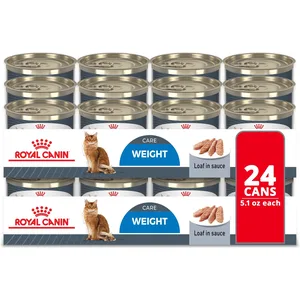
Weight Care loaf, cutting calories while keeping protein up. Weight loss in cats has to be gradual: rapid loss risks hepatic lipidosis, a serious liver condition. Set the target with your vet and weigh monthly rather than eyeballing progress.
Royal Canin Maine Coon Adult Thin Slices in Gravy Wet Cat Food, 3-oz can, case of 24: best breed formula
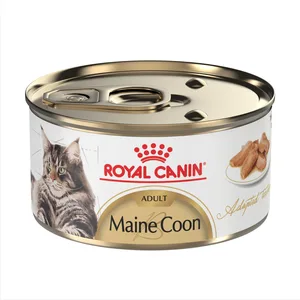
Maine Coon thin slices in gravy. Breed-specific formulas are mostly a marketing construct, and the honest version is below. Even so, the kibble and can shapes are genuinely designed around jaw shape, which matters more for brachycephalic breeds than for a Maine Coon.
Royal Canin Feline Breed Nutrition Persian Loaf Pate Adult Wet Cat Food, 3-oz can, case of 24: best for flat-faced breeds
Persian loaf pate. This is the breed formula with the most defensible reasoning behind it: Persians are brachycephalic, meaning flat-faced, and genuinely struggle to pick up standard kibble shapes. The pate texture and the matching dry kibble shape solve a real mechanical problem.
Where the money actually goes
- Research and trials. Genuinely expensive and genuinely done, unlike much of the premium market.
- Texture engineering. Sounds trivial until you have a cat that will not eat, at which point it is everything.
- Consistency. Batch-to-batch reliability matters for cats on long-term managed diets.
- Not ingredients. By-product meal, wheat gluten, and corn gluten meal are inexpensive. This is the fair criticism and there is no getting around it.
Who should buy Royal Canin
Buy it if your vet recommended a specific formula, if your cat is recovering and refusing other food, or if you have a flat-faced breed that struggles with standard kibble shapes. Those are the cases where it earns its price.
Skip it if you have a healthy cat with a good appetite and simply want the best nutrition per dollar, because Acana and similar brands deliver far more animal protein at comparable money. Compare across the range in our best wet cat food guide.
The bottom line on Royal Canin
Royal Canin is better than the forums say and worse value than the price implies. The testing is real, the palatability engineering is real, and for a sick or fussy cat those two things can matter more than everything on the ingredient panel combined.
For an ordinary healthy cat eating happily, you are paying premium money for a mid-tier recipe, and there are better nutritional buys. If you want a starting point, Royal Canin Digest Sensitive Thin Slices Canned Cat Food, 3-oz, 24 ct is the most useful product in the range. This article is educational rather than veterinary advice, and a cat that has stopped eating for more than a day needs a vet.
Frequently asked questions
Q: Is Royal Canin good cat food?
Royal Canin is well tested and highly palatable, which is why veterinary practices use it, particularly for cats that have stopped eating. Its ingredient panel is ordinary for the price, commonly featuring by-product meal, wheat gluten, and corn gluten meal.
Q: Are Royal Canin breed-specific formulas worth it?
Mostly not. The top ingredients are largely the same across breed formulas and there is no evidence different breeds need different nutrients. The exception is flat-faced breeds like Persians, where the engineered kibble and can shape solves a genuine mechanical feeding problem.
Q: Why do vets recommend Royal Canin?
Royal Canin runs feeding trials and clinical studies rather than formulating on paper, and its textures are engineered to be eaten by unwell cats. Getting a sick cat to eat prevents hepatic lipidosis, which makes palatability clinically valuable.
Q: Does Royal Canin contain corn?
Yes, many Royal Canin recipes contain corn and corn gluten meal, along with wheat and wheat gluten. Cats digest these without difficulty, but they are inexpensive plant ingredients rather than meat, which is the basis of the value criticism.
Q: Is Royal Canin worth the price?
For a sick, recovering, or very fussy cat, or a flat-faced breed, yes. For a healthy cat with a normal appetite, brands like Acana offer considerably more animal protein for similar money.
Q: What is the difference between Royal Canin and Royal Canin Veterinary Diet?
The retail range is available to anyone, while Veterinary Diet formulas are therapeutic products for diagnosed conditions and require veterinary authorisation. They are not interchangeable, and a prescribed diet should not be swapped for a retail one.
Q: Is Royal Canin good for kittens?
Royal Canin’s kitten range is widely used in shelters and by breeders, largely because kittens reliably eat it. It provides the higher protein and calorie density kittens need during their first year.

Hello and welcome to The Ideal Cat!
We are some passionate cat owners from different professions. We love our cats and have a lot of experience in how to care for our pets. We are incredibly excited to share our knowledge, experience, and research with you. So you can take good care of your loving cat. We will answer most of the common questions about owning cats, taking care of them, etc. If you have any question contact with us. Thanks for visiting! Enjoy the content.
