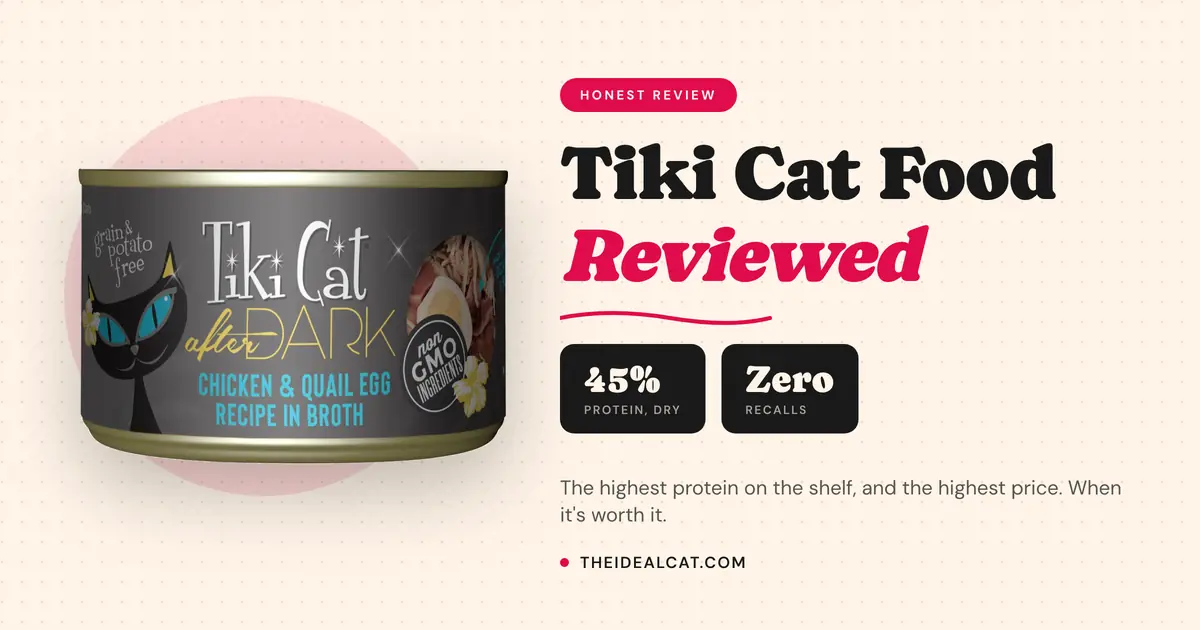
You pick up a single can of Tiki Cat, look at the price, and put it back down. Then you read the ingredient panel and pick it up again.
This is the food that people either swear by or refuse to buy on principle, and the principle is usually cost. A month of After Dark for one cat runs well past what most people budget for pet food.
So the only question worth answering is whether the food is actually better, or just better marketed. Here is the honest read.
Two details from Tiki Cat’s own listings change how you should shop the range. The Indoor Health bag is the cheapest way into Born Carnivore dry food: $29.99 for 6 pounds, about $5.00 a pound, against $6.78 a pound for the standard High Protein bag and $7.12 for the kitten bag. The High Protein recipe is also described as gently baked rather than ordinary kibble.
And the budget wet line is less of a budget buy than it looks. Aloha Friends comes in smaller 3-ounce cans, so each can costs less, but per ounce it is $0.53 against $0.64 for After Dark. That is about 17 percent less, not half price.
What makes Tiki Cat different?
Tiki Cat is built around a simple idea: cats are obligate carnivores, so the food should be mostly meat and mostly water. Both halves of that are unusual in practice.
The wet recipes are shredded meat in broth rather than ground pate, with very little added carbohydrate. The Born Carnivore dry range pushes protein to about 45 percent on a dry matter basis, which is far above the 30 to 34 percent typical of budget kibble.
In practice that means a smaller portion goes further, and a cat eating Tiki Cat is getting most of its calories from animal protein rather than from grain or potato. Whether that is worth triple the price depends on your cat and your budget, and it is a legitimate thing to decide either way.
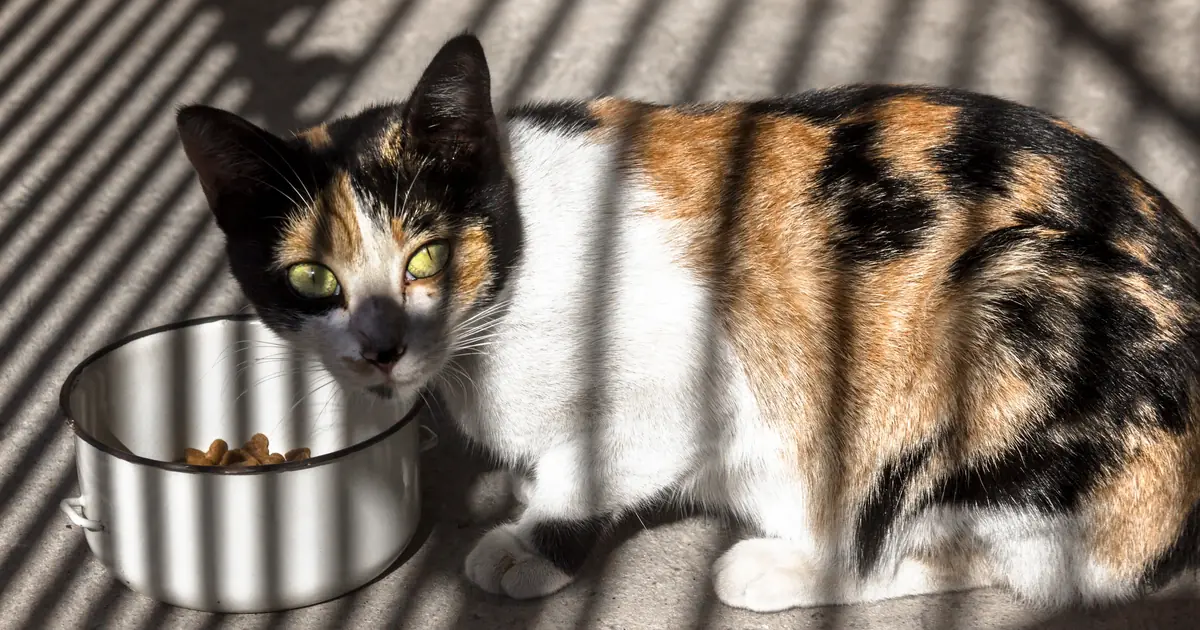
Tiki Cat’s range, by what it costs
| Product | Format | Price | Unit cost | Pick it if |
|---|---|---|---|---|
| After Dark Chicken & Quail Egg, 8 cans | Wet, shreds in broth | $28.08 | $0.64/oz | You want to try the recipe the brand is known for. |
| Aloha Friends Tuna, Calamari & Pumpkin, 12 cans | Wet, with pumpkin | $19.08 | $0.53/oz | You want the Tiki style for a little less per ounce. |
| Born Carnivore Indoor Health, 6 lb | Dry | $29.99 | $5.00/lb | You feed some dry food and want the cheapest Born Carnivore bag. |
| Born Carnivore Chicken, Herring & Salmon, 5.6 lb | Dry, baked | $37.99 | $6.78/lb | Your active adult cat does well on dry and you want the most protein. |
| Born Carnivore Baby, 5.6 lb | Dry, kitten | $39.89 | $7.12/lb | You have a kitten, where the protein genuinely earns its price. |
Has Tiki Cat ever been recalled?
No. Tiki Cat has never had a product recall. For a brand that has been selling in the United States since the mid 2000s, that is a genuinely strong record and one of the few objective quality signals available to an owner.
Recall history is worth checking for any brand you feed. The FDA maintains a public recall database you can search yourself rather than relying on a brand’s own claims.
When high protein is the wrong choice
This is the part most Tiki Cat reviews skip, and it matters.
High protein is excellent for healthy adult cats, growing kittens, and cats who need to lose fat while keeping muscle. It is not automatically better for every cat.
- Chronic kidney disease. Cats with diagnosed CKD are often placed on controlled protein and phosphorus diets. Do not switch a CKD cat to a high protein food without your vet’s approval.
- Certain liver conditions. Protein requirements change, and the decision belongs to your veterinarian rather than to a food label. The Cornell Feline Health Center covers feline kidney and liver conditions in more detail.
- Sudden switches. Moving a cat abruptly from budget kibble to a rich, high protein food frequently causes diarrhea. Transition over seven to ten days.
If your cat is older, drinking more than usual, or losing weight, that warrants blood work before a diet change rather than after one. This article is educational and is not a substitute for veterinary advice.
Is Tiki Cat worth the money?
Buy it if you have a healthy cat, the budget stretches, and you want the closest mainstream approximation of a prey based diet. Buy it especially for kittens, where the protein genuinely earns its place.
Skip it if you are feeding several cats, if the monthly cost would be a strain, or if your cat has a condition requiring a controlled diet. A cheaper complete food fed consistently beats a premium food you resent buying. Compare against our best dry cat food picks and the best wet options before committing.
Tiki Cat is the real thing. High protein, low carbohydrate, high moisture, never recalled, and formulated around how cats actually digest food rather than around what is cheap to mill. On quality alone it sits near the top of the shelf.
The price is the whole argument against it, and it is a fair one. If you want to try it without committing, start with Tiki Cat After Dark Chicken & Quail Egg Recipe in Broth Grain-Free Wet Cat Food, 5.5-oz can, case of 8 and see whether your cat cares as much as the ingredient panel suggests she should. Some cats, maddeningly, prefer the cheap stuff.
Tiki Cat questions, answered
Q: Is Tiki Cat a good cat food?
Tiki Cat is a high quality cat food. Its wet recipes are high in moisture and very low in carbohydrate, the Born Carnivore dry range runs about 45 percent protein on a dry matter basis, and the brand has never been recalled. Its main drawback is a high price.
Q: Has Tiki Cat ever been recalled?
No. Tiki Cat has never had a product recall, which is unusual for a brand of its size and time on the market. You can verify current recall status for any brand through the FDA’s recall database.
Q: How much protein is in Tiki Cat food?
Tiki Cat Born Carnivore dry food contains roughly 45 percent protein on a dry matter basis. That is considerably higher than typical supermarket kibble, which usually falls between 30 and 34 percent.
Q: Is Tiki Cat good for kittens?
Yes. Tiki Cat makes a Born Carnivore Baby recipe formulated for growth. Kittens need high protein and fat during their first year, so this is the life stage where a high protein food is most clearly justified.
Q: Is Tiki Cat safe for cats with kidney disease?
Not without veterinary approval. Cats with chronic kidney disease are often prescribed controlled protein and phosphorus diets, and a high protein food may not be appropriate. Talk to your veterinarian before switching.

Hello and welcome to The Ideal Cat!
We are some passionate cat owners from different professions. We love our cats and have a lot of experience in how to care for our pets. We are incredibly excited to share our knowledge, experience, and research with you. So you can take good care of your loving cat. We will answer most of the common questions about owning cats, taking care of them, etc. If you have any question contact with us. Thanks for visiting! Enjoy the content.
