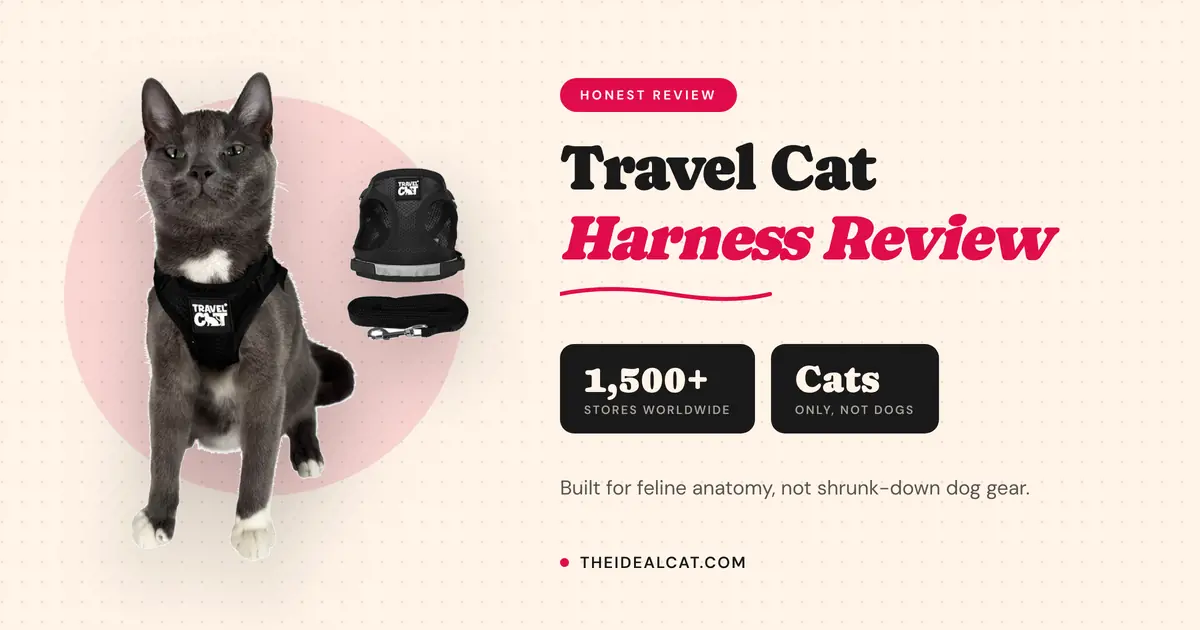
You put the harness on. Your cat immediately falls over sideways and refuses to move, like their legs have stopped working.
Every cat parent who has tried leash walking knows this exact scene. It is normal, it passes, and the harness is usually not the problem.
Travel Cat was founded in New York in 2017 by a couple who rescued a kitten and discovered almost nobody was designing gear for cats specifically. Here is whether their harnesses live up to that.
Check what is in the box before you compare prices. The True Adventurer ($29.99) and the Jackson Galaxy set ($37.95) come with a matching leash. The Pathfinder ($49.99) and the Catagonia puffer ($53.00) are harness only, so add a leash to those prices.
The Pathfinder’s pocket is built for a GPS tracker such as the Tractive Cat Mini, which is sold separately and runs on a paid subscription. That is a smart setup for an escape artist, but it is not a $50 purchase.
Four Travel Cat harnesses, and what each one leaves out
Chewy prices. Each listing is for one size, so measure your cat’s chest before you click.
| Harness | Style | Leash included? | Price | Pick it if |
|---|---|---|---|---|
| The True Adventurer | Reflective vest | Yes | $29.99 | It is your first harness. Our pick. |
| Jackson Galaxy Set | Reflective, adjustable neck and chest | Yes | $37.95 | You like the limited-edition design. |
| The Pathfinder | Reflective vest with tracker pocket | No | $49.99 | Your cat has bolted before and you will buy a tracker. |
| The Catagonia | Water-resistant puffer jacket | No | $53.00 | You walk a thin-coated or senior cat in cold weather. |
Travel Cat also sells The Captain, a retractable leash that extends to 10 feet. Keep it for open, quiet spaces, since a long line gives a startled cat a lot of room to run.
Is any cat harness really escape-proof?
No cat harness is genuinely escape-proof, and any brand claiming otherwise is overselling. Cats have no collarbone and a spine built to compress, which means a cat can squeeze through a gap far narrower than their body looks.
What a good harness does is make escape hard enough that a startled cat stays put long enough for you to react. Travel Cat harnesses do that well, because vest designs spread contact over a wide area and there is no single loose loop to reverse out of.
The fit test that actually matters. With the harness on and adjusted, you should be able to slide exactly two fingers flat between the strap and your cat’s body. Three fingers means it is too loose and your cat will back out of it. One finger means it is too tight and will chafe.
Check the fit every single time before you go out. Harnesses loosen with wear, cats gain and lose weight, and the fit that was right in spring is not automatically right in autumn.
And get your cat microchipped regardless. A tracker pocket tells you where your cat was; a microchip is what gets them home. The AVMA covers how microchipping works and why registration details have to stay current.
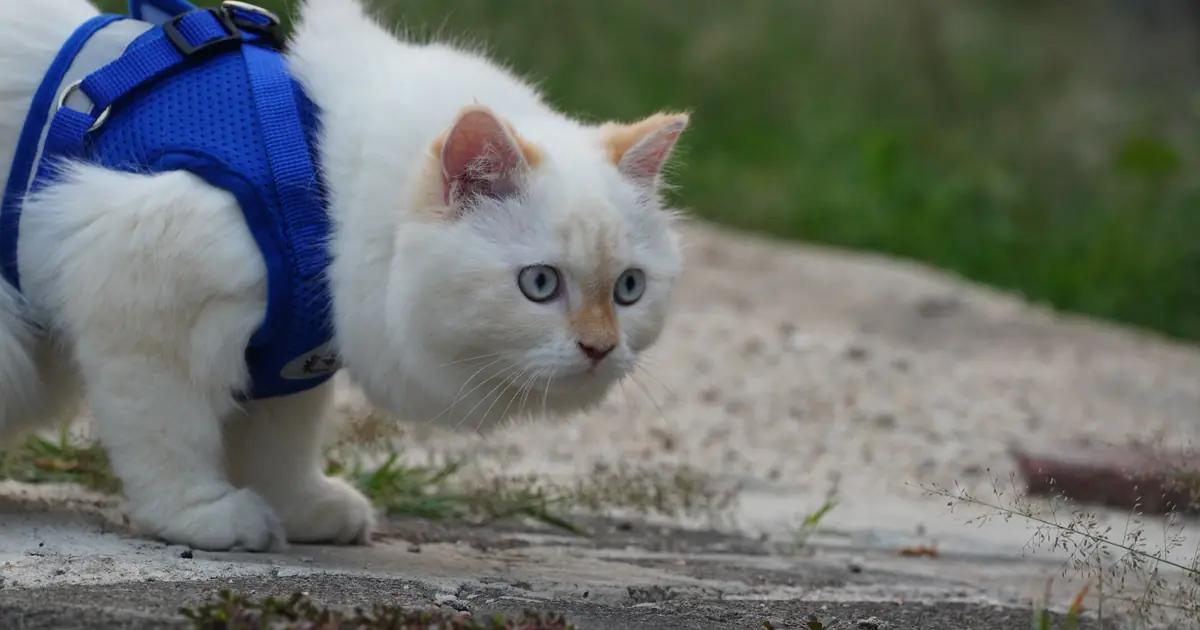
How to get your cat used to a harness
Most harness failures are training failures, not product failures. The flop-over-sideways response is normal and it goes away with a slow introduction, usually over one to three weeks.
- Leave the harness out near the food bowl for a few days so it stops being a strange object.
- Drape it on without fastening anything, for thirty seconds, then treat and remove it.
- Fasten it loosely indoors for a few minutes at a time. Expect the flop. Do not comfort it too much, just wait it out and treat when they move.
- Build up indoor wearing time to fifteen or twenty minutes across several days, with the harness properly adjusted.
- Add the leash indoors and let it drag while you supervise, so the weight becomes normal before it ever means direction.
- Go outside only once your cat walks around comfortably indoors wearing both. Start with a quiet, enclosed space, not the pavement.
Never leave a harness on an unsupervised cat, indoors or out, and follow International Cat Care’s guidance on harness walking before your first trip out. A harness can catch on furniture, fencing or branches, and a trapped cat panics fast.
If your cat still hates it after a few weeks of patient work, some cats simply do not take to leash walking. A cat backpack or a secure carrier gives them outdoor stimulation without the harness fight.
Vest or H-style: which suits your cat?
- Vest harnesses (True Adventurer, Pathfinder, Jackson Galaxy) spread pressure over the widest area and are hardest to escape. Best first harness, and best for nervous cats.
- H-style harnesses (Day Tripper) use straps rather than panels. Lighter and cooler, better for summer and for cats who dislike fabric across the back.
- Jacket harnesses (Catagonia) add warmth. Useful for thin-coated breeds and senior cats in cold weather, unnecessary otherwise.
- Whatever you pick, measure first. Sizing by your cat’s weight is unreliable, because chest girth varies enormously between a lean Oriental and a stocky British Shorthair of the same weight.
Should you buy a Travel Cat harness?
Buy one if you want to give an indoor cat safe outdoor time and you are willing to spend a few weeks on acclimation. The build quality is a clear step above generic pet-aisle harnesses, and the cat-specific design shows in how the pressure sits.
Skip it if you expect to clip it on and walk out the door this afternoon, because that is not how this works with cats. Compare the wider market in our best cat harness guide.
Travel Cat makes genuinely good cat-specific gear, and the pressure distribution on the vest models is the real difference from cheap dog-harness knockoffs. Nine years of building for cats only shows in the details.
Just do not believe any escape-proof claim, from this brand or any other. Two fingers of slack, a microchip, weeks of patient indoor practice, and never a harness left on unsupervised. Start with Travel Cat The True Adventurer Reflective Cat & Kitten Harness & Leash, Black, Medium. This article is educational rather than veterinary advice.
Travel Cat questions
Q: Are Travel Cat harnesses escape proof?
No cat harness is truly escape proof, including Travel Cat’s. Cats have no collarbone and a compressible spine, so a determined cat can reverse out of a loose harness. Correct fit, allowing exactly two fingers of slack, is what prevents escapes.
Q: Which Travel Cat harness should I buy first?
The True Adventurer vest harness is the best first harness for most cats. It spreads pressure across the chest and shoulders rather than the throat, and it offers more coverage than an H-style, which makes it harder to escape.
Q: Why does my cat flop over when I put a harness on?
Falling over sideways and refusing to move is a normal first response to the unfamiliar pressure of a harness. It nearly always passes with short, repeated indoor sessions and treats, and it is a training stage rather than a sign the harness is wrong.

Hello and welcome to The Ideal Cat!
We are some passionate cat owners from different professions. We love our cats and have a lot of experience in how to care for our pets. We are incredibly excited to share our knowledge, experience, and research with you. So you can take good care of your loving cat. We will answer most of the common questions about owning cats, taking care of them, etc. If you have any question contact with us. Thanks for visiting! Enjoy the content.
