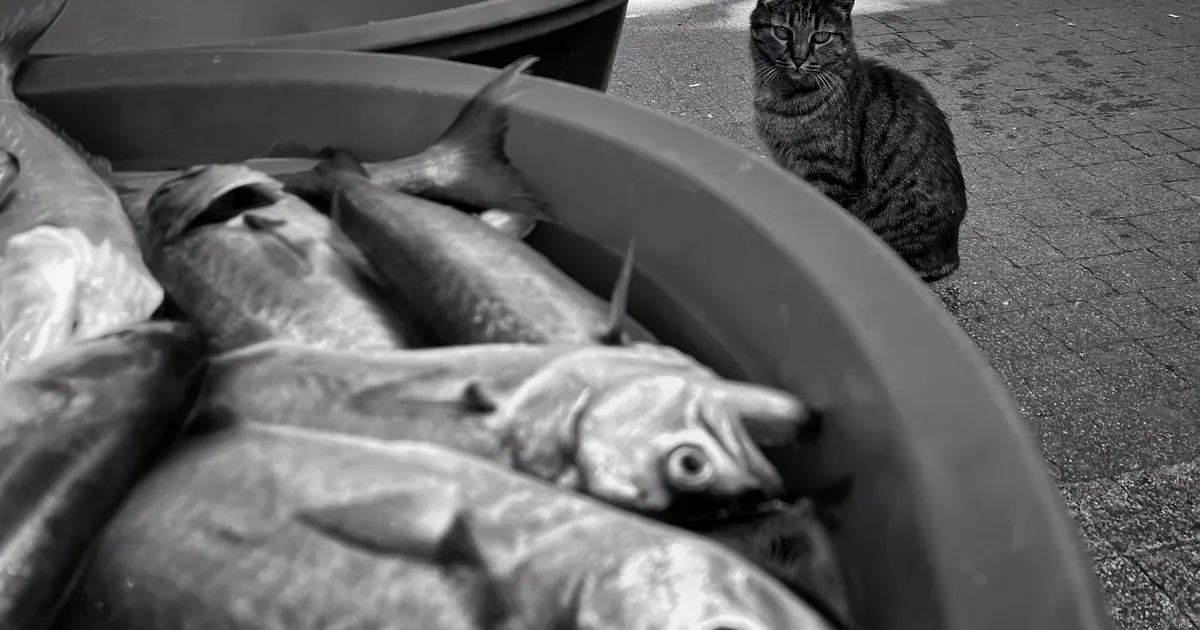
You crack open a can, any can, and your cat materializes out of nowhere. Doesn’t matter if it’s tuna, salmon, or something that vaguely smells like the ocean. That sound alone is enough to summon a cat from three rooms away, tail up, meowing like you’ve been starving them for a week.
It’s a funny scene, but it also raises a real question. Cats aren’t fishing in the wild. So where does this obsession actually come from, and is it something you should be feeding into (literally)? Let’s get into it.
- Cats are drawn to fish mainly because of its intense smell, and cats rely on scent even more than taste when deciding what to eat.
- Wild and feral cats rarely eat fish naturally; domestic cats descended from desert-dwelling African wildcats that hunted rodents, birds, and insects, not seafood.
- Commercial cat food made fish popular starting in the mid-1900s, and generations of cats have now grown up associating fish with mealtime.
- Raw fish contains an enzyme called thiaminase that destroys thiamine (vitamin B1), which can cause serious neurological problems in cats over time.
- A few bites of cooked, boneless fish once in a while is fine for most cats, but a fish-heavy diet can lead to mercury buildup, thiamine deficiency, and mineral imbalances.
Why do cats like fish so much?
Cats like fish because of its powerful smell and its high protein and fat content, both of which trigger a cat’s natural predator instincts. Cats are obligate carnivores, meaning their bodies are built to run on animal protein, and fish delivers that in a concentrated, easy-to-digest form. It’s also loaded with fish oils that carry a strong scent, and scent is the single biggest factor in whether a cat decides food is worth eating.
According to International Cat Care, a cat’s sense of smell is far more developed than ours, and it plays the lead role in guiding what they’ll eat. Fish, especially oily fish like salmon, sardines, and tuna, hits that smell receptor hard. To a cat’s nose, it practically screams “this is food.”
Is fish actually natural for cats to eat?
No, fish isn’t a natural part of a wild cat’s diet. Domestic cats descend from the African wildcat, a desert-dwelling hunter that fed on rodents, birds, lizards, and insects, not seafood. Wild and feral cats today still hunt these same small land prey animals far more often than they wade into water after a fish.
Cats also aren’t natural swimmers, and most actively avoid getting wet. So the idea of a cat instinctively craving fish from some ancestral memory of hunting rivers doesn’t really hold up. The craving you see today is something else entirely: a learned taste, not a hardwired one.
How did cats end up craving fish if it isn’t natural to them?
Cats developed a taste for fish mainly through commercial cat food, not evolution. When canned cat food became widely available in the mid-20th century, fish was a cheap, abundant, protein-rich ingredient, and companies leaned into it. Over generations, cats raised on fish-flavored food learned to associate that smell with mealtime, and that association got passed down through habit and exposure rather than instinct.
It’s kind of like how a lot of us develop a craving for a specific comfort food we grew up eating. Nothing biological about it demands that food. It’s just familiar, and familiar tastes good. The same logic applies here: your cat likes fish because fish has meant “dinner” for most of their life, not because their ancestors were out there catching trout.
Is fish good or bad for cats?

Fish can be a fine occasional treat for most healthy cats, but it comes with real catches if it becomes a regular part of the diet. In small, appropriate amounts, cooked fish offers lean protein and omega-3 fatty acids that support skin and coat health. The trouble starts when fish becomes a daily habit instead of a now-and-then extra.
- Mercury exposure: Larger, longer-lived fish like tuna can carry higher mercury levels, and repeated exposure adds up in a small body over time.
- Thiamine deficiency: Raw fish, particularly certain species, contains an enzyme called thiaminase that breaks down thiamine (vitamin B1). Long-term feeding of raw fish can lead to a serious thiamine deficiency, which affects the nervous system.
- Food allergies: Fish is actually one of the more common food allergens in cats, alongside beef and dairy, and can trigger itchy skin or digestive upset.
- Mineral imbalance: A diet too heavy in fish, especially fish not formulated as a complete cat food, can throw off the balance of minerals cats need, which has been linked to urinary tract issues.
The VCA Animal Hospitals notes that treats, fish included, should make up no more than about 10 percent of a cat’s daily calories, with the rest coming from a complete and balanced cat food.
Can cats eat tuna specifically?
Yes, cats can eat small amounts of plain, cooked tuna as an occasional treat, but it shouldn’t be a regular meal. Tuna is exactly the fish where the mercury and thiamine concerns show up most, since it’s a larger predatory fish and it’s the one most commonly fed to cats straight from the pantry. If you want the full breakdown of safe amounts and what to watch for, our guide on whether cats can eat tuna covers it in detail, and if you’ve got a kitten drawn to that briny tuna juice, we’ve also covered whether kittens can have tuna juice.
Skip tuna packed in oil or brine meant for human consumption. The added salt and oil aren’t doing your cat any favors, and the sodium content can add up fast for such a small animal.
How much fish is safe for a cat to eat?
A safe amount of fish for most healthy adult cats is a small serving, cooked and boneless, once or twice a week at most, not as a daily staple. Think of it as a topper or a treat, not a meal replacement. Always cook fish thoroughly first (no raw or smoked fish) and pull out every bone you can find, since bones pose a choking and internal injury risk.
If your cat has a history of urinary issues, kidney disease, or food allergies, talk to your vet before adding fish to their routine at all. Every cat’s tolerance is different, and a vet who knows your cat’s health history can tell you what fits and what doesn’t.
Fish feeding scenarios at a glance
| Scenario | Is it OK? | Notes |
|---|---|---|
| Cooked, plain fish (no bones, no seasoning) | Yes, in moderation | Best as an occasional treat, once or twice a week max. |
| Canned tuna (packed in water) | Yes, sparingly | Small amounts only; watch mercury and sodium levels over time. |
| Raw fish | No | Contains thiaminase, which destroys vitamin B1 and can cause neurological harm. |
| Fish-based complete cat food | Yes | Formulated to be nutritionally balanced; fine as a regular meal option. |
| Smoked or seasoned fish | No | Too much salt and often garlic or onion seasoning, both harmful to cats. |
Should fish be a regular part of your cat’s diet?
No, fish shouldn’t be the main or a frequent part of your cat’s daily diet, even though many cats would happily eat it every day if you let them. A diet too heavy in fish raises the risk of thiamine deficiency, mercury buildup, and mineral imbalances that can affect the urinary tract. Fish-flavored complete cat foods are formulated to avoid these problems, since they’re balanced with the vitamins and minerals your cat actually needs, but feeding straight fish as a regular meal is a different story.
The safest approach is to treat fish, especially the fresh or canned kind, as an occasional bonus rather than a foundation. If you’re building out your cat’s regular meals, it helps to know what a genuinely balanced option looks like, and our guide to the best wet cat food is a good place to start. Curious why cats seem just as obsessed with dairy? We’ve broken down why cats like milk too, and spoiler, it’s a similarly complicated story.
This article is for general education and isn’t a substitute for veterinary advice. If your cat has a known health condition or you’re planning to make fish a regular part of their diet, check with your vet first.
Frequently Asked Questions
Q: Why does my cat go crazy when I open a can of tuna?
Your cat reacts to the strong, oily smell of tuna, which is exactly the kind of scent that signals “high-value food” to a cat’s nose. It’s also likely a learned response built from past experience of tuna smell leading to a tasty snack.
Q: Do cats need fish in their diet?
No, cats don’t need fish specifically. They need animal-based protein, taurine, and specific vitamins and minerals, all of which can come from chicken, turkey, or other meats just as well. Fish is one option among many, not a requirement.
Q: Can kittens eat fish?
Kittens can have small amounts of cooked fish occasionally, but it’s even more important to keep portions tiny given their smaller size and developing systems. Raw fish should be avoided entirely at any age due to the thiamine-destroying enzyme it contains.
Q: Why do wild cats not eat fish very often?
Wild and feral cats mostly hunt rodents, birds, and insects because those are what’s available and catchable on land. Domestic cats descend from desert-dwelling African wildcats, and fishing was never part of that ancestral hunting pattern.
Q: Is tuna bad for cats?
Tuna isn’t bad for cats in small, occasional amounts, but regular feeding can lead to mercury buildup and thiamine deficiency over time. Plain tuna packed in water, given sparingly, is the safest way to offer it.
Q: What happens if a cat eats too much fish?
Eating too much fish over time can lead to thiamine (vitamin B1) deficiency, mercury exposure, and mineral imbalances that may contribute to urinary tract problems. Symptoms of thiamine deficiency can include loss of appetite and neurological signs, so it’s worth taking seriously if fish has become a daily habit.
Q: Can cats eat raw fish, like sushi-grade salmon?
No, raw fish should be avoided. It contains an enzyme called thiaminase that destroys thiamine in a cat’s body, and raw fish also carries a higher risk of harmful bacteria and parasites.
Q: Is fish-flavored cat food actually made mostly of fish?
Not always. Many fish-flavored cat foods use a mix of fish and other animal proteins, along with added flavoring, to create that strong fishy scent cats respond to. Check the ingredient list if you want to know exactly how much real fish is in a specific product.

Hello and welcome to The Ideal Cat!
We are some passionate cat owners from different professions. We love our cats and have a lot of experience in how to care for our pets. We are incredibly excited to share our knowledge, experience, and research with you. So you can take good care of your loving cat. We will answer most of the common questions about owning cats, taking care of them, etc. If you have any question contact with us. Thanks for visiting! Enjoy the content.
