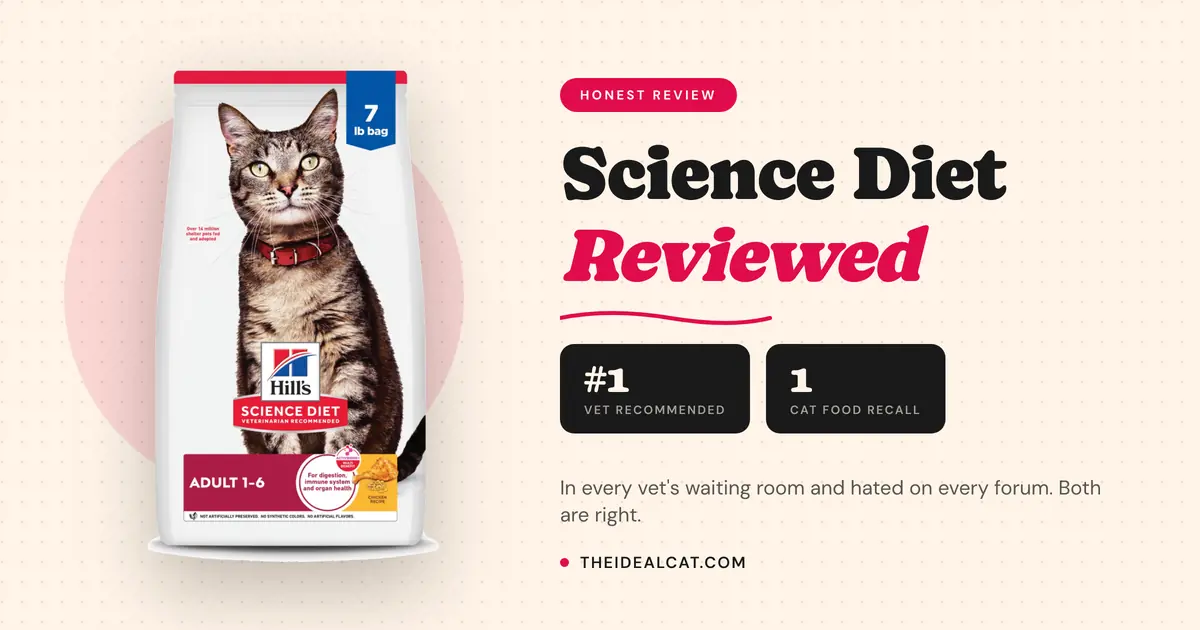
Hill’s Science Diet sits in almost every veterinary waiting room in the country, and gets dismissed on almost every pet forum.
The forum argument is about the ingredient panel: corn, by-product meal, and a price that looks unjustified next to it. That criticism is fair on its own terms.
The veterinary argument is about something the panel does not show. Both sides are right, and understanding why is the most useful thing this review can give you.
The everyday Adult Chicken bag is the priciest per pound in this lineup. It costs $69.98 for 14 pounds, about $5.00 a pound. The Senior 7+ bag is $64.99 for 16 pounds, about $4.06, and Sensitive Stomach & Skin is about $4.39.
One listing also undersells itself. The can Chewy sells as plain “Science Diet Chicken Cat Food” is the Adult Hairball Control Savory Chicken Entree, so it carries extra fiber you might not expect from the name.
Why vets recommend it when the label looks ordinary
This is the crux of the whole argument, and it is worth explaining properly rather than treating as either corruption or gospel.
Most premium brands formulate on paper: they design a recipe to meet published nutrient targets and have it manufactured, often by a third party. That is legal, common, and usually fine.
Hill’s does something different. It employs board-certified veterinary nutritionists, runs AAFCO feeding trials rather than formulating to a spreadsheet, publishes research, and manufactures in plants it owns. Feeding trials mean cats actually ate the food under observation and their bloodwork was measured, rather than the nutrients being calculated and assumed.
So a vet choosing between a food with a beautiful ingredient list and no trial data, and a food with an ordinary ingredient list and decades of measured outcomes, often picks the second. That is a defensible professional judgement rather than a kickback, and the AAFCO nutrient profiles explain what the trial standard actually requires.
The counterargument stands too: none of that makes corn better than chicken, and you are paying premium prices for a mid-tier panel. Both things are true at once.
Here is what each formula is for, with Chewy prices.
| Formula | Built for | Bag and price | Unit cost | Pick it if |
|---|---|---|---|---|
| Adult Chicken Recipe | Healthy adults | 14 lb, $69.98 | $5.00/lb | Your adult cat has no particular issues. |
| Sensitive Stomach & Skin | Occasional digestive upsets, skin | 15.5 lb, $67.99 | $4.39/lb | Your cat throws up now and then. Vet first if it is often. |
| Urinary Hairball Control | Urine mineral balance, hairballs | 15.5 lb, $70.99 | $4.58/lb | Your vet wants urinary support but not a prescription diet. |
| Senior 7+ Chicken | Cats 7 and older | 16 lb, $64.99 | $4.06/lb | Your cat is 7 or older. The lowest cost per pound here. |
| Chicken Cans (Hairball Control) | Wet, hairball fiber | 24 x 5.5 oz, $66.96 | $0.51/oz | You want to add moisture. Note the hairball fiber. |
Recall history
Hill’s has had recalls across its brands, and this needs separating carefully because most coverage conflates dog and cat products.
The widely reported 2019 vitamin D recall affected canned dog food, not cat food. On the cat side, the last Science Diet recall was in March 2007, when Savory Cuts canned cat foods made by Menu Foods were caught up in the melamine crisis. In November 2015 Hill’s did withdraw one canned cat food, but it came from its separate Ideal Balance line, it was pulled alongside seven dog foods, and the cause was never clearly published.
For a manufacturer of this size producing at this volume, that is a strong record on the cat range specifically. Check current status yourself in the FDA recall database.
Science Diet vs Prescription Diet
People confuse these constantly and the distinction matters.
- Science Diet is the everyday retail range you can buy without authorisation. That is what this review covers.
- Prescription Diet is the therapeutic range for diagnosed conditions such as kidney disease, urinary stones, and diabetes, and requires veterinary authorisation.
Do not substitute one for the other. A cat prescribed a therapeutic renal diet is on it because the phosphorus and protein levels are clinically controlled, and a Science Diet bag with a similar-sounding name will not do the same job.
Should you buy Hill’s Science Diet?
Buy it if you value demonstrated testing over ingredient aesthetics, if your vet has recommended a specific formula, or if your cat has a mild ongoing issue such as hairballs or a sensitive stomach that a targeted formula genuinely helps with.
Skip it if you want maximum meat content for your money, because brands like Orijen and Acana deliver far more animal protein at comparable prices. Our best dry cat food guide compares across that spectrum.
Hill’s is not the best food on ingredients and it never claims to be. What it offers is the most thoroughly tested, most consistently manufactured, most clinically studied food available at retail, from a company with a near-spotless record on its cat range.
Whether that is worth the price over a high-meat premium brand is a genuine judgement call rather than an obvious answer. If your vet recommended a formula, follow that. Otherwise Hill’s Science Diet Adult Chicken Recipe Dry Cat Food, 14-lb bundle is the sensible everyday choice. This article is educational rather than veterinary advice.
Hill’s Science Diet questions
Q: Has Hill’s Science Diet cat food been recalled?
Not since 2007, when Savory Cuts canned cat foods were caught up in the melamine recall. A 2015 withdrawal of one Hill’s canned cat food involved the separate Ideal Balance line, not Science Diet. The widely reported 2019 vitamin D recall affected canned dog food, not cat food.
Q: What is the difference between Science Diet and Prescription Diet?
Science Diet is the everyday retail range anyone can buy. Prescription Diet is the therapeutic range for diagnosed conditions such as kidney disease or urinary stones and requires veterinary authorisation. They are not interchangeable.
Q: Does Hill’s Science Diet contain corn?
Many Hill’s Science Diet recipes contain corn or corn gluten meal. Cats digest cooked corn without difficulty and it is not a common allergen, but it is a plant ingredient rather than meat, which is why the panel looks ordinary for the price.
Q: Is Hill’s Science Diet good for sensitive stomachs?
Hill’s Sensitive Stomach and Skin is one of the most commonly recommended foods in general veterinary practice for cats that vomit or have loose stools. Persistent vomiting should be investigated by a vet rather than managed by changing food repeatedly.

Hello and welcome to The Ideal Cat!
We are some passionate cat owners from different professions. We love our cats and have a lot of experience in how to care for our pets. We are incredibly excited to share our knowledge, experience, and research with you. So you can take good care of your loving cat. We will answer most of the common questions about owning cats, taking care of them, etc. If you have any question contact with us. Thanks for visiting! Enjoy the content.
