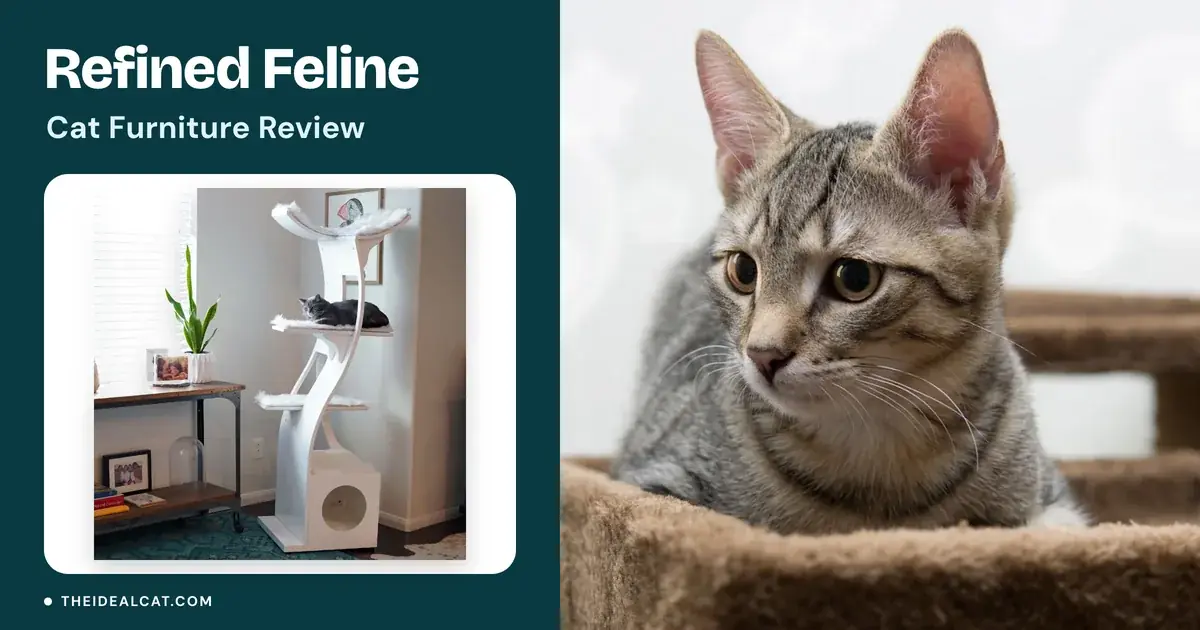
Nobody wants a litter box in the living room. The Refined Feline’s answer is to build furniture around it.
The cabinets genuinely look like furniture, and at close to three hundred dollars each they ought to.
The question worth asking is not whether it fools your guests. It is whether your cat still wants to go in.
One listing deserves a slow read before you order. The Self Cleaning Cat Litter Box Cabinet ($285) is built to hide an automatic litter box, and it does not come with one. Add The Refined Feline’s own Automatic Self-Cleaning Litter Box at $399.99 and the setup comes to $684.99, before litter.
The smaller extras add up too. Carbon filters for the Deluxe cabinets are sold separately, and the automatic box needs standard two-gallon waste bags, also sold separately. None of that is unusual. It just is not on the price tag.
What each piece costs, all in
The third column is the one the product pages bury.
| Piece | Price | Also budget for | Pick it if |
|---|---|---|---|
| Lotus 69-in Cat Tree | $414.99 | Nothing extra listed | You want the flagship tower: solid wood, stable without a wall strap. |
| Metropolitan 62-in Tree & Condo | $349.99 | Nothing extra listed | Your cat is nervous and wants enclosed spaces to retreat into. |
| Farmhouse Deluxe Cabinet, X-Large | $284.99 | Carbon filter, sold separately | You want a manual box hidden in a farmhouse look. |
| Cottage Deluxe Cabinet, X-Large | $284.99 | Carbon filter, sold separately | Same job as the Farmhouse. Pick the style you can live with. |
| Self Cleaning Cabinet, Cane Door | $285.00 | An automatic box ($399.99 for theirs) | You already own an automatic box. Measure it twice first. |
| Automatic Self-Cleaning Litter Box | $399.99 | Two-gallon waste bags | Your cat meets the weight sensor minimum, and you will still look at what it scoops. |

Does hiding the litter box bother the cat?
It can, and whether it does comes down to four things that have nothing to do with how the cabinet looks.
- Size inside. The cabinet is not the box. What matters is the box that fits inside it, and that still needs to be at least one and a half times your cat’s length. A handsome cabinet holding a too-small tray is a worse setup than a bare tray of the right size.
- Ventilation. An enclosure concentrates ammonia in the air around your cat’s head. Cats have far more sensitive noses than we do, and a stuffy box is a common reason for quiet avoidance.
- Exits. A single doorway can feel like a trap to a nervous cat, or to one that gets ambushed on the way out by another cat in the house. Two openings, or a cabinet placed so the cat can see out, solves most of this.
- Entry height. A raised threshold is a real obstacle for an arthritic cat, and arthritis is common and under-diagnosed in cats over about ten, which the AVMA covers under senior pet care.
- Your scooping discipline. Out of sight genuinely does mean out of mind, and an enclosed box left two days is far worse than an open one left two days.
The test is simple. Put the cabinet in place with the door off for a week, then fit the door. If box use drops after the door goes on, the cabinet is the problem rather than the location.
And keep a second box elsewhere. The standard guidance is one box per cat plus one, in different locations, and a concealed box should be one option rather than the only one. The ASPCA covers litter box problems in more depth, and our guide to cats not using the litter box works through the causes.
What the money actually buys
A Refined Feline tree costs three to four times a budget flat-pack tower. Here is where the difference goes, and where it does not.
| Budget flat-pack | The Refined Feline | |
|---|---|---|
| Stability | Needs wall anchoring | Solid wood, stable unaided |
| Height | Often taller for the money | Moderate, prioritises build |
| Looks | Recognisably pet equipment | Reads as furniture |
| Scratching surface | Usually sisal rope | Sisal and faux fur |
| Lifespan | Years, if anchored | Considerably longer |
| What the cat cares about | Height and stability | Height and stability |
The honest summary: your cat cares about height, stability and placement. It does not care about the veneer. What you are buying is a piece you are happy to have in the living room, which is a real benefit because furniture you like stays in the good room, and a cat tree in the good room gets used far more than one exiled to a spare bedroom.
Where the premium is genuinely functional is stability. A solid-wood tree does not wobble, and wobble is the single most common reason a cat abandons a tower. If you have a large or heavy cat, that stops being an aesthetic argument and becomes a practical one. Compare against budget flat-pack towers before deciding.
Measuring before you buy
Most disappointment with litter box furniture is a measuring failure, and it happens after the money is spent. Five minutes now avoids it.
- Measure your cat from nose to the base of the tail, then multiply by 1.5. That is the minimum internal box length you need.
- Check the cabinet’s internal dimensions, not its external ones. The listing usually gives both, and the difference can be several inches.
- Measure the litter box you plan to put inside, or buy one to fit rather than assuming your current tray works.
- Check the doorway height and width, especially for a large cat or a stiff older one.
- For an automatic box, measure the unit in all three dimensions including the lid at its highest point during a cycle.
- Leave clearance for airflow and for getting your hand and scoop in comfortably, since a cabinet you resent cleaning gets cleaned less.
If the numbers do not work, buy the smaller cabinet and a bigger open box for elsewhere in the house. A cat with one properly sized box and one attractive-but-tight cabinet is better served than a cat with only the cabinet.
Is The Refined Feline worth it for you?
Buy it if you want cat furniture you are happy to keep in the main room, if you have a large or heavy cat that needs solid construction, or if concealing the litter box is what stands between you and putting a box where the cat actually wants one.
Skip it if budget is the binding constraint, since a wall-anchored flat-pack tower delivers the height for far less. Compare in our best cat trees guide.

The verdict
Genuinely well-built cat furniture that looks like furniture, at prices to match, with solid-wood stability as the functional justification rather than just the finish.
Measure the internal dimensions before ordering, keep the box inside at one and a half times your cat’s length, ventilate it, scoop it daily, and keep a second box elsewhere. The Refined Feline Lotus 69-in Cat Tree, White is the flagship. This article is educational rather than veterinary advice.
Litter cabinet and cat tree questions
Q: Is litter box furniture bad for cats?
Not inherently, but a concealed box has to clear the same bar as any other. It needs to be at least 1.5 times the cat’s length, well ventilated, easy to enter, and scooped daily. An enclosure concentrates ammonia around the cat’s head, so a stuffy hidden box is a common reason for quiet avoidance.
Q: What size litter box fits in a cabinet?
Check the cabinet’s internal dimensions rather than its external ones, and size the box to at least 1.5 times your cat’s length from nose to tail base. The difference between internal and external measurements can be several inches.
Q: Do cats prefer covered or open litter boxes?
It varies, but a covered box suits owners more reliably than cats. A single exit can feel like a dead end to a nervous cat or one ambushed by a housemate, and the enclosure traps odour where the cat’s head goes. Offer both and see which gets used.
Q: How many litter boxes should I have if one is hidden in furniture?
One per cat plus one, in different locations. A concealed box should be one of the options rather than the only one, both so the cat has a choice and so you retain somewhere easy to check.
Q: Can you put an automatic litter box in a cabinet?
Some cabinets are sized for it, but measure the unit in all three dimensions including the lid at its highest point during a cleaning cycle. Automatic units vary considerably, and a cabinet that nearly fits does not fit.
Q: What is the downside of hiding the litter box?
You stop seeing the waste. Urine clump size, stool consistency and any blood are daily health signals most owners read without realising, and concealment removes that check. Open the cabinet and look rather than only scooping by feel.

Hello and welcome to The Ideal Cat!
We are some passionate cat owners from different professions. We love our cats and have a lot of experience in how to care for our pets. We are incredibly excited to share our knowledge, experience, and research with you. So you can take good care of your loving cat. We will answer most of the common questions about owning cats, taking care of them, etc. If you have any question contact with us. Thanks for visiting! Enjoy the content.
