
You wake up at 2am needing to shift position, and there it is: a warm, purring lump wedged right between your knees. You freeze and start doing the math on how long you can hold still before your leg goes numb. Sound familiar?
If your cat has claimed the space between your legs as a personal sleeping spot, you’re not imagining the pattern. It happens almost every night, and it’s not random. That spot checks every box on a cat’s wish list: warmth, cover, and you.
- Cats sleep between your legs mainly for warmth, security, and closeness to your scent and heartbeat.
- A cat’s normal body temperature runs between 100.5°F and 102.5°F, several degrees warmer than a human’s, so cats seek out extra heat sources even indoors.
- Cats sleep 12 to 16 hours a day on average, and they instinctively pick enclosed, defensible spots for the deepest part of that sleep.
- Sleeping between your legs is generally a good sign of trust and attachment, not a behavior problem.
- You can gently redirect your cat to a nearby bed using consistent placement and positive reinforcement, without damaging the bond.
Why does my cat sleep between my legs?
Cats sleep between your legs because it’s the closest thing to a den they can find on your bed. The space is warm, partly enclosed on three sides, and it puts your cat right up against your scent and the rhythm of your breathing. Wild and feral cats sleep in burrows and brush piles for the same reasons: cover and warmth. Your legs, tucked under a blanket, are the domestic version of that shelter. Your cat isn’t overthinking it. The spot just feels right.
Is it about warmth?
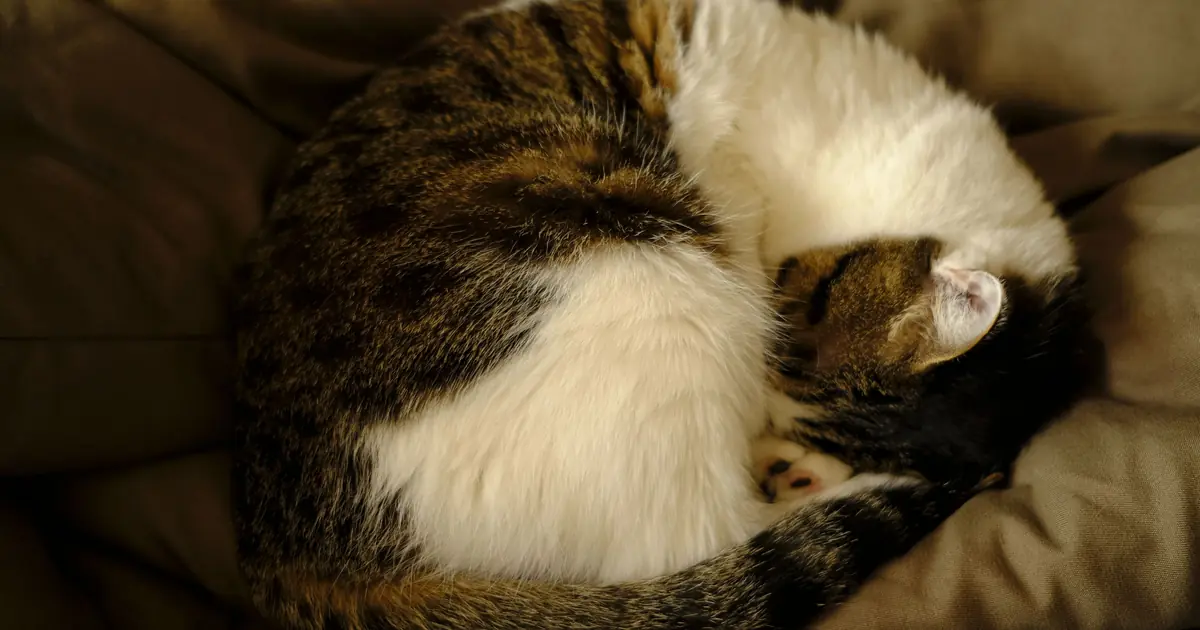
Yes, warmth is one of the biggest reasons. A healthy cat’s body temperature sits between 100.5°F and 102.5°F, according to ASPCA cat care guidance, noticeably warmer than the average human’s 98.6°F. Cats run hot and they know it, so they gravitate toward anything that helps them hold onto that heat: sunbeams, laptops, heating vents, and the pocket of warm air trapped between your legs under the covers.
Cats also lose body heat faster than a lot of mammals their size, because they’re small and lean. Curling into a tight ball between your legs cuts down on exposed surface area. If your home runs cool at night, don’t be surprised if your cat’s sleep spot options are basically “warmest place available.”
Is it about feeling safe?
Mostly, yes. A cat sleeping between your legs is choosing an enclosed, low-visibility spot, exactly what instinct tells it to look for at rest. Deep sleep is when a cat is most vulnerable, so cats gravitate toward defensible spaces: boxes, closets, and the pocket your legs create under the blanket. According to International Cat Care, cats prefer sleeping spots that are enclosed because it lets them rest without feeling exposed, and between your legs checks that box perfectly.
Is it about bonding and scent?
Yes, sleeping close to you is one of the clearest signs of trust a cat can give. Cats have scent glands on their cheeks, chin, and paws, and sleeping pressed against your body mixes your scent with theirs, almost like a security blanket made of “us.” It also puts your cat near your heartbeat and breathing, steady sounds a cat’s brain reads as safe. If you want to know more about what different sleep positions signal, this guide to whether your cat actually loves you breaks down more of these trust behaviors.
Why the legs specifically, and not somewhere else on the bed?
Cats sleep between your legs specifically because that spot combines warmth, enclosure, and contact with you, something no other spot on the bed offers as completely. Your chest is warm but moves with every breath. Your feet are warm but usually exposed. The pocket between your legs, especially if you sleep on your side with knees bent, is snug, still, and insulated. A cat curled on your chest instead is often after connection and your heartbeat rather than warmth alone, a spot our post on why your cat lays on your chest covers in more detail.
What different sleeping spots mean
Where a cat chooses to sleep on you or near you isn’t random. Here’s a quick breakdown of what the most common spots tend to signal, and if you want the full picture of every bed position, this guide to where your cat sleeps on your bed covers it all.
| Sleeping spot | What it likely means |
|---|---|
| Between your legs | Wants warmth and an enclosed, secure spot close to your scent |
| On your chest | Craves close bonding and comfort from your heartbeat and breathing |
| By your head or on your pillow | Feels safest near your face and voice, often a very attached cat |
| At your feet | Wants closeness without full contact, common in more independent cats |
Is it a good thing or a bad thing that my cat sleeps between my legs?
It’s a good thing in almost every case. A cat that sleeps pressed against you, including between your legs, is telling you it feels safe enough to be at its most vulnerable right next to you. Cats don’t extend that kind of trust to just anyone.
The only time it’s worth a second look is if the behavior shows up suddenly alongside other changes, like sleeping far more than the usual 12 to 16 hours a day, hiding more, or acting withdrawn. According to VCA Hospitals, cats sometimes seek out extra warmth and quiet when they’re not feeling well, since illness can lower their ability to regulate body temperature. If sleep habits change fast alongside appetite, energy, or litter box use, it’s worth a vet visit rather than assuming it’s just cuddling. Our guide on when a sleepy cat is sleeping too much lays out the red flags.
Should I let my cat keep sleeping between my legs?
Whether you let it continue is a personal call, not a behavior problem to fix. There’s no medical or training reason you have to stop it, so it comes down to how it affects your own sleep and comfort. Here’s the honest tradeoff:
- Pros: it’s a bonding ritual, it’s often genuinely soothing for both of you, and cats that sleep near their owners tend to show fewer signs of stress overall.
- Cons: you may wake up stiff, your cat’s nighttime wandering can interrupt your sleep cycle, and shared bedding means more cat hair close to your face.
If your cat sleeps well and you sleep well, there’s no reason to change a thing. If your own sleep is suffering, that’s reason enough to make a change, no guilt required.
How do I get my cat to stop sleeping between my legs?
You can redirect the habit by giving your cat an equally warm, equally close alternative and rewarding them for using it. Cats form habits fast, but they’re motivated by comfort, so a new spot with the same warmth and security usually wins them over.
- Set up a cat bed at the foot of your bed or right beside your pillow, still close to you.
- Add a worn t-shirt or blanket with your scent on it to make the spot feel familiar.
- Place a warm (not hot) pet-safe heating pad under the bedding on cold nights.
- Reward your cat with a treat or calm praise for choosing the new spot on their own.
- Move your cat to the new spot at bedtime, before they settle between your legs.
- Stay consistent for two to three weeks. It rarely happens overnight.
Don’t punish or startle your cat out of the spot. That teaches your cat that bedtime is unpredictable, which creates more anxiety, not less.
Frequently Asked Questions
Q: Why does my cat sleep between my legs every single night?
Your cat has learned this exact spot reliably delivers warmth, cover, and closeness to you, so it becomes a nightly habit. Once a sleeping spot proves safe and comfortable, cats tend to return to it night after night.
Q: Does a cat sleeping between my legs mean they love me?
It’s a strong sign of trust and attachment. Sleep is when cats are most vulnerable, so choosing to do it pressed against you means your cat feels safe with you specifically.
Q: Is it unhealthy to let my cat sleep in my bed with me?
For most healthy adults, sharing a bed with a cat isn’t a health risk, though people with allergies or asthma may want to skip it. Keeping your cat current on parasite prevention and vaccines lowers any minor exposure risk from close contact.
Q: Why does my cat only sleep between my legs and not my partner’s?
Cats often bond more closely with whoever handles feeding and daily care, and they can simply prefer one person’s scent or sleeping position. It’s not rejection of your partner, just a stronger association built over time.
Q: My cat used to sleep between my legs but stopped. Should I worry?
A single change in sleep spot usually isn’t a red flag, especially after a change in routine, temperature, or bedding. If it comes with reduced appetite, hiding, or less activity, it’s worth a vet check to rule out pain or illness.
Q: Do kittens sleep between your legs for the same reasons as adult cats?
Yes, and often even more so, since kittens have less body fat and lose heat faster than adults. A kitten seeking the warmest, most enclosed spot on the bed is following the same instinct that once had it piled against littermates.
Q: Can I train my cat to sleep somewhere else without hurting our bond?
Yes, redirecting where a cat sleeps doesn’t damage your relationship as long as you offer a warm alternative and use positive reinforcement instead of punishment. Most cats adjust within a few weeks.
Q: Why does my cat knead or circle before settling between my legs?
Kneading and circling are leftover instincts from kittenhood and from wild cats flattening grass to make a sleeping spot more comfortable. It’s a normal pre-sleep ritual, and our post on why cats twitch in their sleep covers what’s normal once they’ve settled in.

Hello and welcome to The Ideal Cat!
We are some passionate cat owners from different professions. We love our cats and have a lot of experience in how to care for our pets. We are incredibly excited to share our knowledge, experience, and research with you. So you can take good care of your loving cat. We will answer most of the common questions about owning cats, taking care of them, etc. If you have any question contact with us. Thanks for visiting! Enjoy the content.
