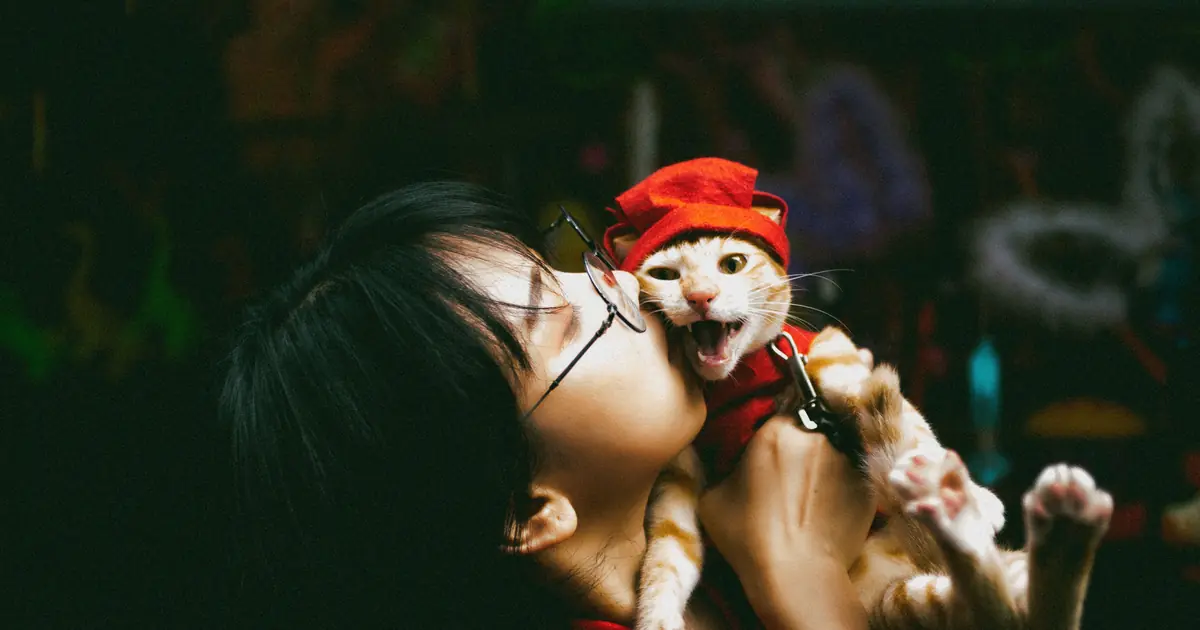
Picture this: you lean in, plant one on your cat’s head, and she blinks slowly, leans into you, and starts purring. Your heart melts. Does she know you just kissed her? Not exactly, and that’s okay.
Cats read the world through scent, body position, and tone of voice, not lip contact. So when you kiss your cat, she’s not thinking “aw, a kiss.” She’s reading your closeness, your warm breath, your soft voice, and deciding whether all of it feels safe. For a lot of cats, it does. For some, it really doesn’t. Let’s get into why.
- Cats don’t have an instinctive concept of kissing; it’s a human gesture with no equivalent in feline body language.
- Cats can learn to associate kisses with good things through repeated pairing with treats, petting, and calm tone of voice.
- Cats show affection to each other through slow blinks, head bunting, allogrooming (mutual grooming), and sitting in close contact.
- A 2020 Scientific Reports study found slow blinking increases positive interaction between cats and unfamiliar humans, making it the closest thing cats have to a “kiss.”
- A cat pulling away from a kiss is usually about restraint or an overstimulated face, not rejection of you.
Do Cats Understand What a Kiss Means?
No, cats don’t understand kissing the way people do. A kiss is a human-only greeting, and cats have no built-in instinct that tells them lips-to-fur contact means love. What your cat does understand is everything wrapped around the kiss: your soft voice, the way you slow down, the fact that you’re close but not grabbing her.
Over time, a cat can build an association between “human leans in and makes a kissy sound” and “good stuff happens next,” the same way she learns that the sound of a treat bag means food. That’s learned meaning, not built-in understanding, and it’s the honest answer to why some cats seem to love kisses and others couldn’t care less.
Why Do Cats Sometimes Pull Away From Kisses?
Cats pull away from kisses because a face right up close to theirs can feel like a threat, not affection. In the wild, having something loom directly over the face and head is exactly what a predator does. Even the friendliest house cat can carry a flicker of that instinct.
A few other reasons your cat might duck a kiss:
- She’s not in the mood to be held still, and a kiss usually comes with restraint.
- Her whisker pads and cheeks are packed with nerve endings, and a lot of pressure right there is more sensation than she wants.
- She’s mid-nap, mid-hunt-mode, or just focused on something else entirely.
- Your breath, perfume, or a new soap smells strange to her, and cats are picky about smells near the face.
None of this means your cat doesn’t love you. It usually just means the timing or the delivery wasn’t her favorite. Reading your cat’s body language before you go in for a kiss (relaxed tail, soft eyes, no flattened ears) will save you both a lot of head-turning.
How Do Cats Actually Show Affection to Each Other?
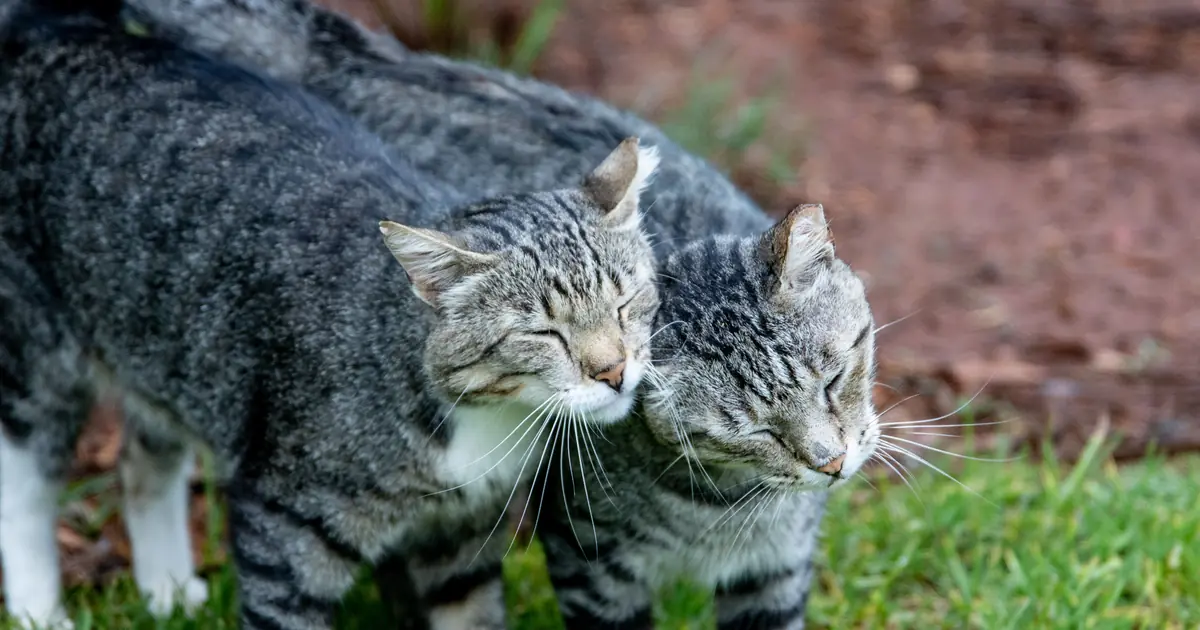
Cats show affection to each other through slow blinks, head bunting, mutual grooming, and simply choosing to sit close together. None of it involves anything like a kiss, which is exactly why kisses don’t register as an obvious love signal to a cat brain.
- Head bunting or bumping: cats rub their faces on each other (and on you) to mix scents from glands near the cheeks, marking each other as part of the same social group.
- Allogrooming: bonded cats groom each other’s heads and necks, the spots they can’t easily reach themselves.
- Slow blinking: a soft, half-closed-eye look shared between cats who trust each other.
- Body contact: sleeping curled up together or resting tail-to-tail.
If you’ve ever wondered why your cat headbutts you or licks your hand or face, both are versions of this same feline affection toolkit, just aimed at you instead of another cat. According to the International Cat Care body language guide, these contact behaviors are some of the clearest signs a cat feels safe and bonded with someone.
Can Cats Learn to Like Being Kissed?
Yes, cats can learn to like being kissed, but it’s the association they’re learning, not the gesture itself. Pair a kiss with something your cat already enjoys, chin scratches, a soft “I love you” voice, a treat right after, and her brain starts filing “kiss” under “good things happen.”
This is basic classical conditioning, the same mechanism that makes cats come running at the sound of a can opener. A kitten kissed gently and often from a young age, alongside plenty of positive handling, is far more likely to grow into a cat who leans into kisses as an adult. A cat who was never touched much as a kitten, or who had a rough start, may need months of slow, low-pressure affection before a kiss reads as safe rather than startling.
What Is a Cat’s Slow Blink, and Is It a “Cat Kiss”?
A cat’s slow blink is a cat’s closest equivalent to a kiss: a slow, deliberate half-closing of the eyes aimed at someone she trusts. Cat behaviorists sometimes call it a “cat kiss” because it’s a voluntary, affectionate signal, even though it looks nothing like a human kiss.
A 2020 study published in Scientific Reports by researchers at the University of Sussex and University of Portsmouth found that cats slow-blink more at their owners when the owners slow-blink first, and that cats were also more likely to approach a stranger who slow-blinked at them compared to one with a neutral expression. If you want your cat to understand a “kiss” in her own language, try a slow blink instead of leaning in with your lips. You can read more about how this works in our guide to what it means when a cat slow-blinks at you.
What You Mean vs What Your Cat Understands
| Human Gesture | What You Intend | What Your Cat Likely Picks Up On |
|---|---|---|
| Kiss on the head | “I love you” | Close warm face, soft voice, maybe a nice smell (learned over time) |
| Slow blink | “I love you” | A trust signal she recognizes instinctively, cat to cat and cat to human |
| Tight hug | “I love you” | Restraint, which can feel unsafe unless she’s used to it |
| Head bump back at her | “I love you too” | Scent-sharing, a genuine cat greeting she understands natively |
| Kissy noises | “Come here, I adore you” | An odd new sound; curiosity or mild alertness, not affection by default |
Is It Safe to Kiss Your Cat?
Kissing your cat on the fur is generally safe in moderation, but kissing near her mouth or letting her lick your lips carries some real hygiene risk. Cats can carry bacteria like Pasteurella and, in rare cases, parasites, in their mouths and on their claws, picked up from grooming, hunting, or the litter box.
The Cornell Feline Health Center and the ASPCA both note that good hygiene habits, like washing your hands after handling your cat and avoiding mouth-to-mouth contact, keep affection safe for the whole household. If you’re pregnant, immunocompromised, or have young kids in the house, it’s worth being a bit more careful and sticking to kisses on the fur, not the face.
How Can You Show Affection in a Way Your Cat Understands?
The fastest way to show affection your cat actually understands is to speak her language back to her: slow blinks, gentle head bumps, and quiet time near her, on her terms. These are the signals wired into feline communication, not borrowed from ours.
- Slow blink at her from across the room and see if she blinks back.
- Let her initiate head bumps instead of forcing a kiss when she’s not in the mood.
- Scratch the spots she can’t groom herself, like under the chin and behind the ears.
- Sit near her without picking her up. Presence counts more than most people think.
- Save actual kisses for calm, sleepy moments when she’s already leaning into you.
Wondering if your cat loves you at all if she’s not big on cuddling? Some cats are simply less physical by nature. Our guide on how to tell if your cat loves you covers the subtler signs worth watching for, and if you’re drawn to a breed that’s naturally more of a lap cat, the most affectionate cat breeds are worth a look before your next adoption.
Frequently Asked Questions
Q: Do cats know what kisses mean?
Not instinctively. Cats don’t have a natural concept of kissing, but they can learn through repetition that a kiss usually comes with attention, treats, or a calm voice, and start to enjoy the whole package.
Q: Why does my cat lick me back when I kiss her?
Licking is allogrooming, a bonding behavior cats use on other cats they trust. When she licks you back after a kiss, she’s treating you like part of her social group, which is one of the clearer signs of affection in cat language.
Q: Why does my cat move away when I try to kiss her?
Most cats pull away because a face looming close and being held still can feel restrictive, not because they dislike you. Sensitive whisker pads and cheeks also make some cats less tolerant of close contact than others.
Q: Is a slow blink the same thing as a cat kiss?
People often call it a “cat kiss” because it’s the closest thing to an affectionate kiss in feline body language. A 2020 study in Scientific Reports found cats slow-blink more at people who slow-blink at them first, and approach strangers who do it too.
Q: Is it bad to kiss your cat on the mouth?
Kissing a cat directly on the mouth carries more hygiene risk than kissing the fur, since cat mouths can carry bacteria like Pasteurella from grooming and hunting. It’s safer to kiss the top of the head and wash your hands after handling your cat.
Q: Can kittens learn to like being kissed?
Yes, kittens who are gently handled and kissed alongside positive experiences, like treats and soft petting, are more likely to grow into adult cats who accept kisses comfortably. Early, low-pressure handling matters a lot for how a cat responds to affection later.
Q: What does it mean if my cat purrs when I kiss her?
Purring during a kiss usually means she’s relaxed and content in that moment, though cats can also purr when nervous or in pain. If the purring comes with a soft body, half-closed eyes, and no flattened ears, it’s a good sign she’s genuinely enjoying the closeness.
Q: How do I know if my cat actually likes affection or just tolerates it?
Watch her body: an unbothered tail, soft or half-closed eyes, and leaning into you signal real enjoyment, while a twitching tail, flattened ears, or stiff body mean she’s tolerating it at best. Checking her body language before and during affection tells you far more than guessing.

Hello and welcome to The Ideal Cat!
We are some passionate cat owners from different professions. We love our cats and have a lot of experience in how to care for our pets. We are incredibly excited to share our knowledge, experience, and research with you. So you can take good care of your loving cat. We will answer most of the common questions about owning cats, taking care of them, etc. If you have any question contact with us. Thanks for visiting! Enjoy the content.
