
Your cat and dog get along a little too well, and now you’re side-eyeing them wondering… could that ever lead to puppies-slash-kittens? Rest easy. It can’t.
Here’s the clear biology behind why cats and dogs can’t crossbreed, and what mounting behavior really means.
Can cats mate with dogs?
No, cats cannot mate with dogs to create offspring. Cats and dogs are separate species that split on the evolutionary tree tens of millions of years ago, and their reproductive systems are completely incompatible. Even if a cat and dog attempt mounting behavior, no fertilization can occur. There is no such thing as a cat-dog hybrid, it belongs to myth, not biology. The two simply cannot reproduce together.
Why can’t cats and dogs crossbreed?
Cats and dogs can’t crossbreed because their genetics and biology don’t match on any level. For two animals to produce offspring, they generally need to be the same or very closely related species with compatible chromosomes. Cats and dogs fail this on every count. Their DNA is too different to combine, their reproductive tracts and cells are incompatible, and their mating signals don’t align. Nature has no pathway for a cat and dog to make a viable embryo.
What about chromosomes and genetics?
The chromosome mismatch alone makes a cat-dog hybrid impossible. Domestic cats have 38 chromosomes, while dogs have 78, and successful reproduction requires compatible chromosome sets that pair up correctly. With such different numbers and structures, cat and dog genetic material can’t combine to form a functional embryo. This is the same reason very different species across the animal kingdom can’t hybridize, the genetic blueprints simply don’t fit together.
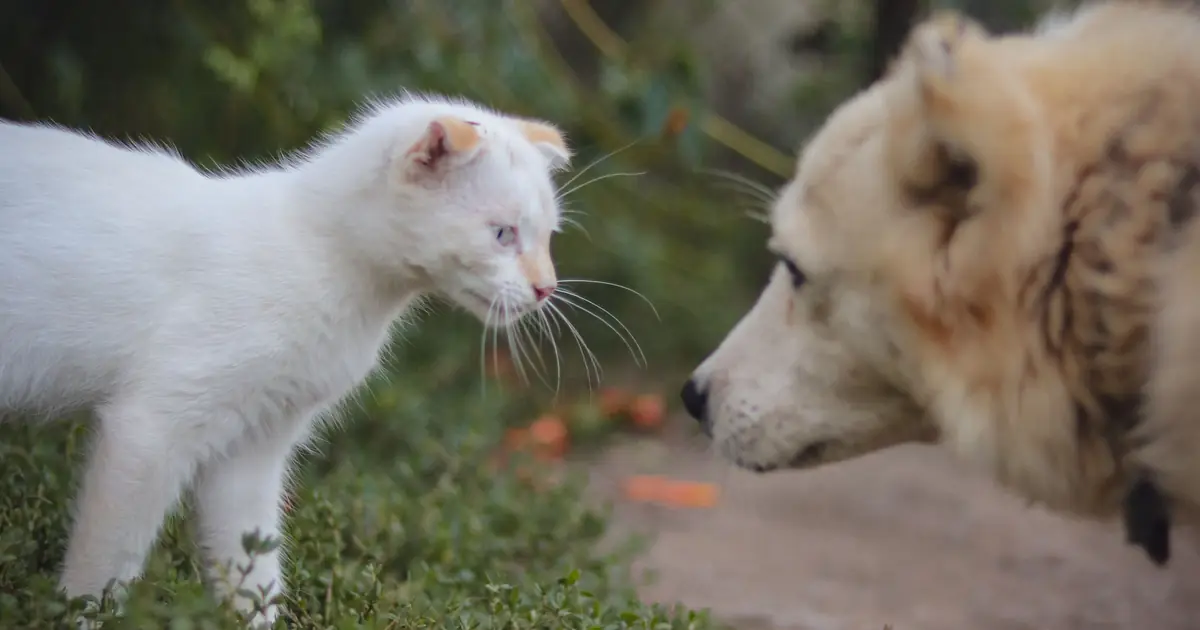
Why do dogs and cats sometimes mount each other?
Mounting between cats and dogs is a behavior, not an attempt to reproduce. Several harmless (if awkward) reasons explain it:
- Play or excitement, especially in young or energetic pets.
- Hormones in unneutered animals driving mounting urges.
- Dominance or social behavior between housemates.
- Stress or overstimulation released through the behavior.
None of this can lead to offspring. Spaying and neutering usually reduces mounting, and it’s often just part of how pets that live together interact, related to how cats and dogs bond and groom each other.
How does cat and dog reproduction compare?
Here’s why the two just don’t line up.
| Feature | Cats | Dogs |
|---|---|---|
| Chromosomes | 38 | 78 |
| Species/family | Felidae (felines) | Canidae (canines) |
| Ovulation | Usually induced by mating | Spontaneous cycles |
| Can produce offspring together | No | No |
Do any hybrids like this exist?
No true cat-dog hybrid exists anywhere, despite viral hoaxes and photoshopped images online. Hybrids only occur between closely related species, for example a lion and tiger (both big cats) can produce a liger, and a horse and donkey can produce a mule. Cats and dogs are far too distant for that. Any “cat-dog” you see online is a costume, a fluffy mixed-look pet, or a fake. This article is educational; for real feline reproduction, see do cats mate for life and why cats scream when they mate. For reliable background, the Merck Veterinary Manual covers cat reproduction, and the dog genome paper covers canine genetics.
More questions about cats and dogs mating
Q: Why is my dog trying to mate with my cat?
It’s behavioral, not reproductive. Mounting can stem from play, excitement, hormones in unneutered pets, dominance, or overstimulation. It can’t produce offspring. Spaying or neutering and redirecting the behavior usually reduces it.
Q: Will neutering stop my pets from mounting?
Often, yes. Spaying and neutering reduce hormone-driven mounting in both cats and dogs. If mounting continues, it’s usually play or stress-related; redirecting with toys and activity, and consulting your vet, can help manage it.

Hello and welcome to The Ideal Cat!
We are some passionate cat owners from different professions. We love our cats and have a lot of experience in how to care for our pets. We are incredibly excited to share our knowledge, experience, and research with you. So you can take good care of your loving cat. We will answer most of the common questions about owning cats, taking care of them, etc. If you have any question contact with us. Thanks for visiting! Enjoy the content.