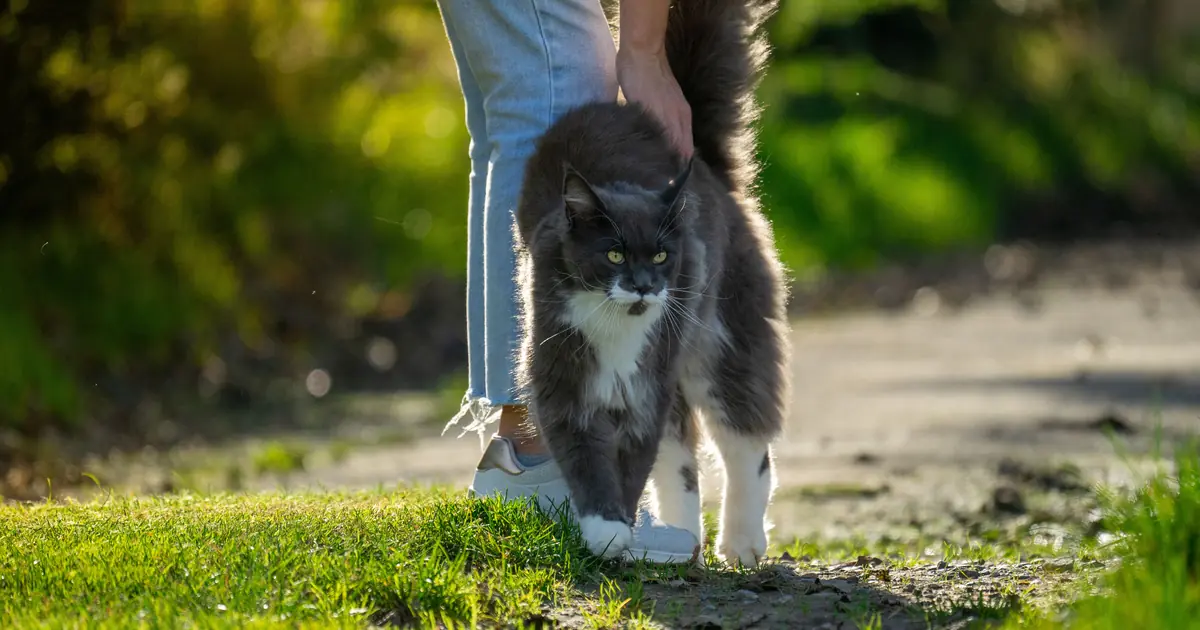
One second you’re sitting on the couch, minding your own business. The next, twelve pounds of cat has landed on your chest like it fell from the sky. You didn’t call. You definitely didn’t invite the claws. And yet, here they are, purring, kneading, staring at you like you’re the whole point of their day.
Good news: your cat isn’t being weird, and it isn’t an accident. Jumping on you is one of the clearest ways a cat says “I like you” without saying a word. It usually means you’re doing something right as a cat parent, even when it happens at the worst possible moment (looking at you, freshly poured coffee).
- Cats jump on people mainly for affection, warmth, attention, food requests, and a sense of security.
- Cats are drawn to warmth because their preferred body temperature runs higher than ours, often between 100.5 and 102.5 degrees Fahrenheit, so a warm lap feels great.
- Jumping up and rubbing against you also mixes your cat’s scent with yours, a behavior called scent marking that tells other cats “this human is mine.”
- Cats are naturally drawn to height because elevated spots feel safer and give a better view, which is why laps, shoulders, and cat trees are all popular perches.
- A sudden increase in jumping and clinginess, especially in an older cat, is occasionally linked to stress or an underlying health issue and is worth mentioning to your vet.
Why do cats jump on you in the first place?
Cats jump on you because it’s an easy, direct way to be close to someone they trust. Unlike dogs, cats don’t wag their way over asking for a cuddle. Jumping up is their version of walking across the room and sitting down next to you, except with better vertical range. It’s a package deal of affection, attention-seeking, warmth, and habit, all rolled into one four-legged leap.
Most of the time, it’s a compliment. Cats are choosy about who they get physically close to, and if yours picks your lap over the empty couch cushion right next to you, that’s not nothing.
Is jumping on you a sign of affection and bonding?
Yes, jumping on you is one of the clearest signs of affection a cat shows. Cats form real attachments to their people, and physical closeness is a big part of how they express it, alongside slow blinks and head bumps. A cat who jumps up, settles in, and starts kneading or purring is telling you, in cat, that you’re part of its trusted circle.
This is also why the behavior tends to grow over time. Kittens and newly adopted cats often stay more independent at first, then start jumping up more as the relationship builds. If your cat has recently started doing this more, take it as a sign the bond is deepening, not a phase to worry about. If you’ve ever wondered whether your cat actually loves you, this habit is one of the better clues.
Why does my cat use me as a warm spot to nap?
Your cat jumps on you partly because you’re a walking heater. A healthy cat’s normal body temperature runs around 100.5 to 102.5 degrees Fahrenheit, noticeably warmer than ours, and cats are drawn to any surface that’s warm and soft. Your lap, chest, or the back of your neck all qualify.
That’s also why cats gravitate toward laptops, sunny windowsills, and freshly run dryers. You’re just a more interactive version of a heating pad, one that occasionally scratches behind the ears. It’s not personal, exactly, but it’s also not nothing. Comfort-seeking and affection tend to travel together in cats.
Are cats jumping on you to get attention or food?
Sometimes, yes, jumping is a plain, simple request: pet me, feed me, or play with me right now. Cats are quick learners, and if jumping into your lap has ever gotten you to open a treat bag or stop scrolling your phone, your cat has filed that away as a strategy that works.
This is especially common around usual mealtimes or right when you sit down after being gone all day. The jump is the opening move, followed by meowing, pawing at your arm, or parking directly on your keyboard. It’s less about warmth here and more about getting your undivided attention, fast.
Does jumping on you have anything to do with scent and territory?
Partly, yes. When a cat rubs against you, kneads you, or curls up on your chest, it’s also depositing its scent on you from glands on its face, paws, and body. This is a normal cat behavior called scent marking, and it’s how cats build a shared scent that says “this person belongs to my group.”
Jumping on you and settling in is an efficient way to get that scent transfer done while also getting warmth and closeness. In multi-cat households, you might notice each cat jumping on you at different times, almost like they’re each renewing their claim. Cornell Feline Health Center notes that scent communication is one of the primary ways cats manage their social relationships, both with other cats and with people.
Why do cats seem to love a high vantage point like your lap or shoulder?

Cats jump up because height feels safe. In the wild, elevated spots let cats watch for danger, scope out prey, and rest without being caught off guard. Your lap, shoulder, or the back of the couch behind your head gives your cat that same lookout advantage, minus the actual danger.
This is also why cat trees, shelves, and window perches are such a hit. Your body is just a warmer, more mobile version of that furniture. A cat perched on your shoulder or chest gets height, a good view of the room, and your undivided company, all in one spot. The ASPCA points out that vertical space is a genuine environmental need for indoor cats, not just a preference.
| What your cat might want | What it looks like |
|---|---|
| Affection or bonding | Slow approach, settling in, kneading, purring, staying put for a while |
| Warmth | Curling into your lap, chest, or neck, especially in a cool room |
| Attention | Jumping up right after you sit down, pawing at you, meowing |
| Food | Jumping up near mealtime, heading toward the kitchen after landing |
| Security or vantage point | Perching on your shoulder or the back of the couch, watching the room |
Do certain cats jump on people more than others?
Yes, personality and life stage both play a big role. Bold, social breeds like the Siamese, Abyssinian, and Ragdoll are known for being more people-focused and physically affectionate, so they tend to jump up more often. Kittens also jump on people constantly, partly out of curiosity and partly because they haven’t learned other ways to ask for attention yet.
Cats that were well socialized with people early on, generally between two and seven weeks old, also tend to be more comfortable initiating contact like this. A shy or under-socialized cat might show affection in quieter ways instead, like sitting nearby rather than jumping straight into your lap. Neither style means a cat loves you less. If your cat prefers sitting close by rather than climbing on, you might enjoy reading about why cats like to sit on your feet instead.
When does a cat jumping on you become a problem?
Jumping on you becomes a problem when it happens somewhere unsafe, startles you badly, or turns into an unwanted habit like jumping on guests or kitchen counters. A cat leaping onto your lap while you’re cooking, holding a hot drink, or walking down stairs can genuinely hurt someone, even if the intention is friendly.
It’s also worth paying attention if a normally independent cat suddenly can’t stop jumping on you and won’t settle, or if the jumping comes with hiding, appetite changes, or excess vocalizing. That combination points to something more than a request for cuddles.
How do you redirect unwanted jumping without punishing your cat?
The most reliable fix is to reward the behavior you want and quietly ignore the behavior you don’t. Here’s how to do it in practice:
- Don’t pet, feed, or talk to your cat the moment it jumps on the counter or lands somewhere off-limits. Gently place it back on the floor and walk away for a moment.
- Give your cat an appealing alternative, like a cat tree, window perch, or shelf near where it usually jumps, so the urge for height still gets met.
- Build in scheduled attention, a few short play or petting sessions a day, so your cat isn’t relying on surprise jumps to get noticed.
- Reward calm behavior. When your cat sits or lies down near you instead of jumping up uninvited, offer a treat or gentle praise.
- Keep countertops and stovetops clear of food smells, since that’s a common reason cats keep testing the same off-limits surface.
Never yell at or physically punish a cat for jumping. It doesn’t teach the behavior you want, and it can damage the trust that made your cat want to be near you in the first place. VCA Hospitals recommends redirection and positive reinforcement over punishment for exactly this reason, since punishment tends to increase anxiety rather than fix the habit.
Is a cat suddenly jumping on you more ever a sign of a health issue?
Usually, no. Most jumping is simply affection, warmth-seeking, or a bid for attention. But a sudden, noticeable increase in clinginess and jumping, especially paired with other changes like hiding, a drop in appetite, or new vocalizing, can occasionally point to stress, pain, or an underlying illness. This shows up more often in senior cats.
This article is educational and isn’t a substitute for veterinary care. If the change in behavior is sudden, sticks around for more than a few days, or comes with any other red flags, it’s worth a check-up with your vet just to rule things out. If your cat has generally become more attached than usual lately, our guide on why cats get extra clingy walks through the common causes in more detail.
Frequently Asked Questions
Q: Why does my cat jump on me every time I sit down?
Your cat has likely learned that you sitting down means you’re finally available for petting, play, or a nap partner. Cats are quick to associate a routine, like you settling on the couch, with a chance to get attention, so the jump becomes an automatic response.
Q: Why does my cat jump on my chest specifically?
Your chest offers warmth, a strong heartbeat and breathing rhythm your cat finds soothing, and easy access to your face and scent. Many cats also like the height it gives them over the rest of the room while they nap.
Q: Is it bad to let my cat sleep on me every night?
No, letting a healthy cat sleep on you is not harmful and is a normal bonding behavior. The only real downsides are practical ones, like disrupted sleep or allergies, so it comes down to personal preference rather than a safety concern.
Q: Why does my cat jump on me and then bite gently?
A gentle bite after jumping up is often an affectionate gesture called a love bite, sometimes paired with kneading. It usually means your cat is comfortable and a little overstimulated by the attention, not that it’s upset with you.
Q: Why does my cat only jump on certain family members?
Cats often gravitate toward whoever feeds them, handles them gently, or gives them calm, predictable attention. A cat may also prefer someone who doesn’t chase or grab it, since cats generally like to initiate contact on their own terms.
Q: Should I stop my cat from jumping on the kitchen counter?
Yes, kitchen counters are worth keeping off-limits since they can expose your cat to hot surfaces, sharp knives, or unsafe foods. Redirecting with a consistent “off” cue and a nearby perch works better than yelling, which can just make your cat wary of you.
Q: Why does my cat jump on me right before mealtime?
This is almost always a food request. Cats quickly learn your feeding schedule and will use jumping, meowing, or pawing as a reminder that it’s time to eat, especially if that behavior has worked before.
Q: Why did my older cat suddenly start jumping on me a lot more?
A sudden jump in clingy behavior in a senior cat can be a normal response to a household change, like a new pet or schedule shift, but it can also signal discomfort or an underlying health issue such as hyperthyroidism or arthritis pain. If it’s new and persistent, a veterinary check-up is a good idea.

Hello and welcome to The Ideal Cat!
We are some passionate cat owners from different professions. We love our cats and have a lot of experience in how to care for our pets. We are incredibly excited to share our knowledge, experience, and research with you. So you can take good care of your loving cat. We will answer most of the common questions about owning cats, taking care of them, etc. If you have any question contact with us. Thanks for visiting! Enjoy the content.
