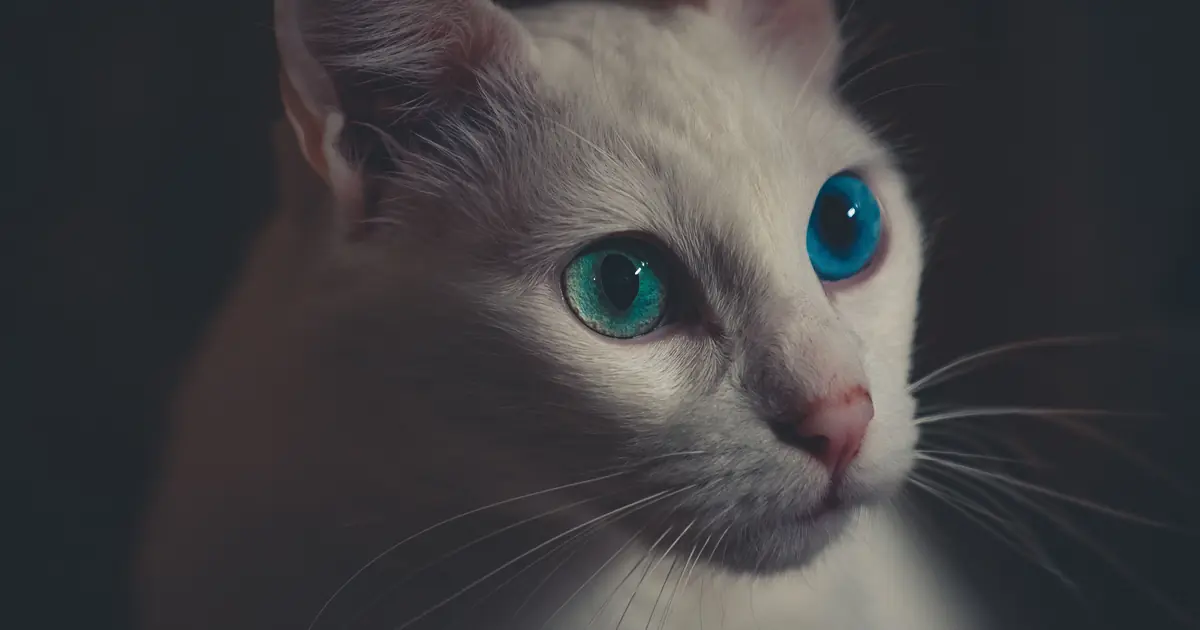
You’re scrolling through cat photos and there it is: a stunning white cat with eyes that look almost violet. Your heart does a little flip. Can cats have purple eyes for real? It’s a fair question, and honestly, the internet is full of dreamy images that make it look totally possible.
Here’s the honest answer, and it’s the one your inner scientist already suspects. True purple or violet cat eyes don’t exist in nature. It’s a charming myth, and I love a good cat myth, but the biology just doesn’t allow it. Let me walk you through why, and what those “purple” eyes really are.
- Cats cannot naturally have true purple, violet, red, or pink eyes; those shades are not part of the feline palette.
- Real cat eye colors are set by melanin and range through blue, green, yellow, gold, amber, orange, copper, and hazel.
- A “purple” cat eye is almost always a very pale blue or gray-blue iris scattering light, a camera flash reflection, or a filtered photo.
- Cats with albinism can look faintly reddish or pale lilac because blood vessels show through, but that is not true purple.
- A sudden change in your cat’s eye color or appearance can signal illness and should be checked by a vet.
Can cats have purple eyes, yes or no?
No, cats cannot have true purple eyes. The feline iris simply doesn’t produce or reflect violet wavelengths, so a genuine purple or lilac eye isn’t biologically possible. Every real cat eye color you’ll ever see traces back to one pigment: melanin. And melanin gives you blues, greens, yellows, ambers, and coppers, never purple.
So when you spot a “purple-eyed cat” online, one of a few things is going on. It’s a pale blue eye photographed in soft light. It’s a flash bouncing off the retina. Or it’s a photo that’s been filtered, tweaked, or generated by AI. The look is real in the picture. The purple pigment is not.
I get why the myth sticks around. A pale, icy blue eye can genuinely read as lavender for a split second. But charming as that is, no cat is walking around with amethyst eyes.
Why can’t cats have purple eyes?
Cats can’t have purple eyes because feline eye color depends entirely on melanin, the same pigment that colors fur and skin. The cells that make it, called melanocytes, sit in the iris and decide how light and dark the eye turns out. More melanocytes mean deeper golds and coppers. Fewer mean greens. None at all means blue.
Purple would need a pigment that reflects violet light, and cats just don’t have one. Human eyes don’t make true purple either, for the same reason. The few people described as having “violet” eyes usually have very pale blue eyes reacting to lighting or, in rare cases, a medical condition.
According to the Cornell Feline Health Center, iris color in cats comes down to one thing, melanin concentration. It’s beautiful in its range, but that range has firm edges. Purple sits outside them.
What makes a cat’s eye look purple then?
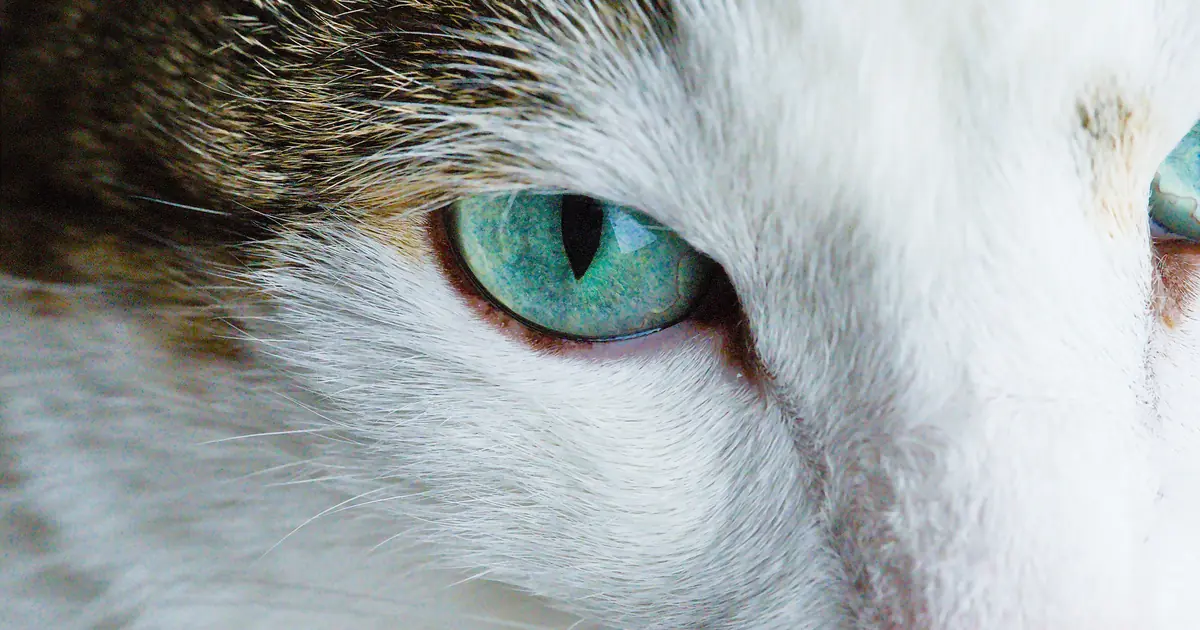
A cat’s eye looks purple mainly because of light, lenses, and editing, not pigment. Once you know what to look for, the “purple” melts away every time. Here are the usual culprits behind a violet-looking cat eye:
- Pale blue eyes in soft light. A very light blue or gray-blue iris can pick up warm tones from a lamp or sunset and read as faint lilac.
- Flash reflection (eyeshine). A camera flash can bounce off the back of the eye and throw a reddish or pinkish glow, which blends with a blue iris to look purplish.
- Albinism. True albino cats have so little pigment that tiny blood vessels show through, giving a pale pink or faint reddish tint. That’s not purple, but people often mislabel it.
- Edited and AI photos. Filters, saturation boosts, and AI-generated images invented a lot of “purple-eyed” cats that never existed.
Blue eyes are the sneakiest of the bunch, and there’s a neat bit of physics behind them. A blue-eyed cat has no blue pigment at all. The iris has no melanin, so it scatters light and looks blue, the same reason the sky and the ocean look blue. Nudge that scattering with warm light and a pale blue eye can flirt with lavender. It’s a trick of light, not a new color.
What eye colors can cats actually have?
Cats can actually have blue, green, yellow, gold, amber, orange, copper, and hazel eyes, plus the striking two-color look called heterochromia. That’s the real palette, and it’s gorgeous enough that you won’t miss purple. Yellow and gold tones are by far the most common, while blue eyes and odd eyes are much rarer. If you’re curious about the full range of real cat eye colors, there’s a lot of beautiful variety to explore.
Here’s how the real colors stack up against the myths:
| Eye color | Real or myth? | What’s going on |
|---|---|---|
| Blue | Real | No melanin; the iris scatters light and looks blue |
| Green | Real | Low melanin in the iris |
| Yellow / gold / amber | Real | Moderate to high melanin; the most common shades |
| Orange / copper | Real | High melanin concentration |
| Hazel | Real | A blend of green and gold tones |
| Odd-eyed (heterochromia) | Real, but rare | Each eye has a different amount of pigment |
| Purple / violet | Myth | Pale blue in light, flash glare, or an edited photo |
| Red / pink | Myth (mostly) | Only a faint reddish look in albino cats, from blood vessels |
Two different colored eyes, usually one blue and one gold or green, show up in less than 1% of cats. It’s most common in white cats and cats with a lot of white fur. That’s a real showstopper, and it’s the closest thing to “unusual eyes” you’ll ever legitimately find.
Do any cat breeds come close to purple eyes?
No cat breed has true purple eyes, but a few breeds show off pale blue eyes that can flirt with lilac in the right light. Siamese, Ragdoll, Balinese, and Himalayan cats are famous for deep or icy blue eyes tied to their coat pattern. White cats and cats with the dominant white gene can also carry vivid blue eyes.
In cool or warm lighting, those pale blues are exactly the eyes that get photographed and captioned “purple.” The iCatCare team notes that coat and eye color in cats are closely linked to genetics, which is why certain breeds reliably land in the blue-eyed zone. Reliable blue, yes. Actual purple, no. It just looks that way for the camera.
If the way cats see the world fascinates you as much as how their eyes look, it’s worth reading up on how cats see color and what feline vision actually looks like. Their eyes are built for low light and motion, which shapes the whole way they experience your living room.
When does a change in eye color need a vet?
A sudden or new change in your cat’s eye color or appearance needs a vet, because it can signal a health problem rather than a lighting trick. Kittens are the exception. Most kittens start with blue eyes that shift to their adult color by around 6 to 12 weeks, and that’s completely normal.
In an adult cat, though, keep an eye out for these red flags and book a vet visit:
- One eye changing color or developing new spots or brown flecks (this can be linked to iris melanoma)
- Cloudiness, a bluish haze, or a filmy look over the eye
- Redness, swelling, squinting, or discharge
- A pupil that stays large or looks different from the other eye
- Any sign your cat is pawing at the eye or bumping into things
Eye changes can point to inflammation, infection, high blood pressure, or other conditions, and the ASPCA stresses that anything unusual is worth a quick professional check. This article is educational, not a diagnosis, so when in doubt, call your vet. Eyes are one thing you never want to wait and see on.
The eyes also tell you a lot when they’re healthy. A slow blink, a wide pupil, a hard stare: all of it is communication. If you want to read your cat better, cat body language starts with the eyes.
Cats can’t have purple eyes, and now you know exactly why. Melanin sets the real palette, and it runs from blue and green through gold, amber, copper, and hazel, with odd-eyed cats stealing the show. Every “purple-eyed cat” is a pale blue eye caught in flattering light, a flash reflection, or a photo that’s been touched up. Enjoy the myth, admire the real colors, and keep an eye out for any sudden changes worth a vet visit.
Frequently asked questions about cats and purple eyes
Q: Can any cat have naturally purple eyes?
No, no cat has naturally purple eyes. Feline eye color comes from melanin, which only produces blue, green, yellow, gold, amber, orange, copper, and hazel shades. True purple or violet would need a pigment cats simply don’t have.
Q: Why do some cats look like they have purple eyes in photos?
Cats look purple-eyed in photos because a pale blue iris can catch warm light and read as lilac. A camera flash can also add a reddish glow, and many “purple-eyed” images are filtered or AI-generated. The purple is an effect, not real pigment.
Q: What is the rarest real eye color in cats?
Odd-eyed cats, with two different colored eyes, are among the rarest, appearing in less than 1% of cats. Solid blue eyes are also uncommon, showing up in roughly 3 to 5% of cats. Yellow and gold eyes are by far the most common.
Q: Can albino cats have purple or pink eyes?
Albino cats can look faintly pink or pale reddish because they have almost no pigment, so tiny blood vessels show through the iris. This can be mistaken for lilac or purple, but it is not true purple pigment. It’s the near-total lack of melanin.
Q: Do purple-eyed cat breeds exist?
No purple-eyed cat breeds exist. Breeds like Siamese, Ragdoll, Balinese, and Himalayan have striking blue eyes that can appear lilac in certain light, which fuels the myth. Their eyes are genuinely blue, never purple.
Q: Why are my kitten’s blue eyes changing color?
Kitten eyes change color because nearly all kittens are born with blue eyes before melanin develops. Their adult color usually settles in between 6 and 12 weeks of age. This early color change is completely normal and not a health concern.
Q: When should I worry about my cat’s eye color changing?
Worry about eye color change in an adult cat if one eye develops new spots, brown flecks, cloudiness, redness, or swelling. These can signal conditions like iris melanoma, inflammation, or high blood pressure. Have any sudden change checked by a vet promptly.
Q: Can cats have red eyes?
Cats cannot have true red eyes as a natural color. A reddish look comes either from flash eyeshine in photos or, in albino cats, from blood vessels showing through unpigmented irises. Persistent redness in a normal photo can mean irritation and warrants a vet check.

Hello and welcome to The Ideal Cat!
We are some passionate cat owners from different professions. We love our cats and have a lot of experience in how to care for our pets. We are incredibly excited to share our knowledge, experience, and research with you. So you can take good care of your loving cat. We will answer most of the common questions about owning cats, taking care of them, etc. If you have any question contact with us. Thanks for visiting! Enjoy the content.
