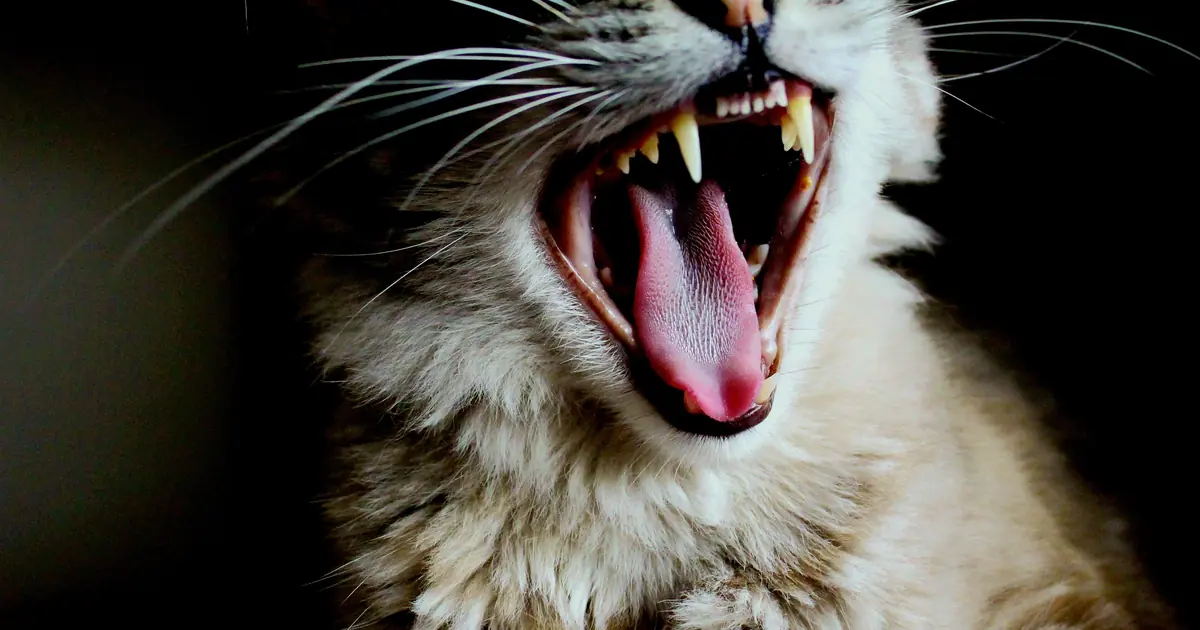
Get close enough to your cat’s face (they’ll let you know if you’re too close) and you’ll notice something odd. That little mouth doesn’t really move the way yours does. No smirk, no pursed kiss, no exaggerated yawn-smile. Just a small, tidy line framed in what looks like dark eyeliner.
So do cats even have lips, or is that just the edge of their mouth? It’s a fair question, and the answer is more interesting than a simple yes. Cats do have lips, they’re just built for a totally different job than ours, and they run into their own problems, like a swollen lip.
- Cats have lips, but they’re thin, fused to the muzzle, and covered in fur, so they can’t purse, smile, or curl the way human lips do.
- Most cat lips are edged in black or dark pigment, even on cats with pale fur, because melanin often concentrates around the mouth, nose, and eyes.
- Cat lips help with eating, lapping water, grooming fur, gripping prey, and the flehmen response, a lip-curl cats use to “taste” scents.
- The vertical line under a cat’s nose is called the philtrum, and it’s a normal part of feline anatomy shared by nearly all cats.
- Swelling, sores, or color changes on a cat’s lips can signal a real problem, like a rodent ulcer or stomatitis, and are worth a vet visit.
Do Cats Actually Have Lips?
Yes, cats do have lips. They’re just small, thin, and mostly hidden under fur, which is why it’s easy to miss them. A cat’s lips run along the edge of the mouth from the corners up toward the nose, and they’re made of the same basic tissue as ours: skin, muscle, and a mucous membrane lining on the inside.
What throws people off is how little cat lips move. Unlike a dog, who can pull back a wide, floppy lip into a grin, a cat’s lips stay mostly still. That’s not a design flaw. Cats just never needed lips for expression the way social, food-sharing primates like us did.
How Are Cat Lips Different From Human Lips?
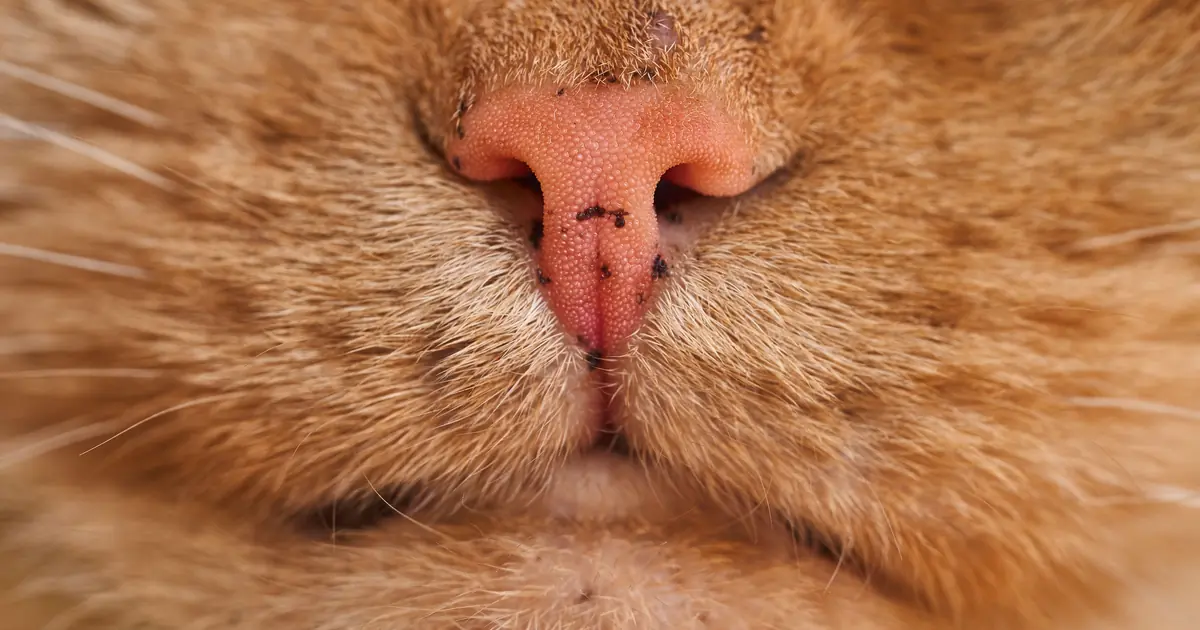
Cat lips differ from human lips in structure, movement, and job. They’re thinner, fused closer to the muzzle, usually dark-pigmented, and covered in short fur, and they lack the thick, mobile muscles that let humans purse, pout, or form words.
Human lips are packed with a ring of muscle called the orbicularis oris, which is what lets us whistle, kiss, and shape speech sounds. Cats have a much smaller, weaker version of that muscle. It’s enough to open and close the mouth and make small adjustments, but nowhere near enough for the fine motor control humans have.
| Feature | Cat Lips | Human Lips |
|---|---|---|
| Structure | Thin, fused close to the muzzle, covered in short fur | Thick, exposed, hairless, richly vascular (which is why they look pink or red) |
| Movement | Limited; mostly open and close, slight curling | Highly mobile; can purse, pout, curl, and stretch |
| Function | Eating, lapping water, grooming, gripping prey, flehmen response | Eating, speech, expression, kissing |
| Color | Usually black or dark-pigmented, even on light-furred cats | Pink to reddish, varies with skin tone |
What Do Cats Use Their Lips For?
Cats use their lips mainly for practical jobs: sealing the mouth around water and food, holding prey steady, helping direct fur during grooming, and curling back slightly during the flehmen response. None of it is about expression.
Watch your cat drink from a bowl and you’ll see it in action. Cats lap water by flicking the tip of the tongue against the surface, drawing a thin column of liquid upward, then closing the lips fast to seal it in before gravity wins. It happens about four times a second, which is a wild party trick when you slow it down on video.
Lips also help cats grip. A hunting cat uses its lips along with its rough, barbed tongue to hold and reposition prey without dropping it, and during grooming, the lips help guide fur through the mouth, which is part of why some cats groom more than others.
Then there’s the flehmen response, that slightly goofy face where a cat’s mouth hangs open with the upper lip curled back. It’s not a grimace. Cats do this to push scent molecules toward the vomeronasal organ on the roof of the mouth, a specialized structure that lets them “taste” pheromones, most often another cat’s scent marks.
Why Are Most Cat Lips Black or Dark-Colored?
Most cat lips are black or dark-colored because melanin, the same pigment that colors fur and skin, tends to concentrate around the mouth, nose, and eyelids in cats. This happens even in cats with white or cream coats, which is why you’ll often see a dark outline framing an otherwise pale face.
This isn’t universal though. Some cats have pink or lightly pigmented lips, especially cats with very little melanin overall, like some white or dilute-colored cats. A pink lip on its own isn’t a health problem. What matters is whether the color is normal for that individual cat and stays consistent over time.
Do Cats Have a Philtrum? (That Line Under Their Nose)
Yes, cats have a philtrum, the small vertical groove that runs from the bottom of the nose down to the upper lip. It’s completely normal feline anatomy, present in humans too, and it’s part of what gives cats that classic “boop-able” little nose-to-lip look.
In cats, the philtrum also plays a small functional role. It helps channel liquid toward the mouth when a cat drinks or licks, sort of like a tiny built-in gutter. You’ll notice it most clearly on cats with short, smooth fur around the muzzle.
What Lip and Mouth Problems Should You Watch For?
The most common lip and mouth problems in cats are rodent ulcers, swelling, sores, drooling, and changes in lip color, and any of these are worth paying attention to. Cats hide pain well, so a change around the mouth is often one of the few visible clues something’s off.
- Rodent ulcers (eosinophilic granuloma complex): These show up as raised, reddish-brown or yellowish sores, usually on the upper lip. Despite the old nickname, they have nothing to do with rodents. They’re linked to allergies and an overactive immune response, and they need veterinary treatment to heal.
- Swelling: A puffy or lopsided lip can point to an abscess, an insect bite, trauma, or a dental problem with a root nearby.
- Sores or scabs: Ulcers inside the mouth or along the lip line can be a sign of stomatitis, a painful inflammatory condition, or a viral infection like calicivirus.
- Color changes: Lips turning pale, white, or bluish can signal poor circulation, shock, or a breathing problem, and this is an urgent sign, not a wait-and-see one.
- Excess drooling: Occasional drool while being petted is often just contentment (here’s more on why cats drool when they’re relaxed), but sudden, heavy drooling paired with pawing at the mouth usually means pain, nausea, or something stuck.
According to the Cornell Feline Health Center, feline stomatitis causes severe mouth and gum inflammation and often needs long-term management. And VCA Animal Hospitals notes that rodent ulcers, while usually not painful themselves, can grow large enough to interfere with eating if left untreated.
When Should You Take Your Cat to the Vet?
Take your cat to the vet if you notice lip swelling, a sore that doesn’t heal within a few days, sudden pale or bluish lips, heavy drooling, bad breath that seems new (learn more about what causes stinky cat breath), or your cat pawing at its face and refusing food. None of these are things to just watch and wait on for long.
This article is meant to help you spot what’s normal and what’s not. It’s not a substitute for an actual exam. If something around your cat’s mouth looks new, painful, or is getting worse, a licensed veterinarian is the right call, not a guess based on a photo search. For general background on healthy feline mouth anatomy, International Cat Care and PetMD are both solid, vet-reviewed places to start.
Frequently Asked Questions About Cat Lips
Q: Do cats have lips like humans?
Cats have lips, but they’re far thinner and less mobile than human lips. Cats lack the strong ring muscle around the mouth that lets humans purse, kiss, or shape speech, so cat lips mostly just open and close.
Q: Can cats smile with their lips?
No, cats can’t smile the way humans do. Their lip muscles aren’t built for that kind of expression. What looks like a cat “smiling” is usually a relaxed face, slow blink, or the flehmen response, not a true smile.
Q: Why are my cat’s lips black?
Black or dark-edged lips are normal in most cats and come from melanin, the pigment that also colors skin and fur. It often shows up around the mouth, nose, and eyelids even on cats with pale coats.
Q: What is that black bump on my cat’s lip?
A dark, flat freckle-like spot on a cat’s lip is often lentigo, a harmless buildup of pigment that’s common in orange and calico cats. But a raised, reddish, or growing bump could be a rodent ulcer or another lesion, so it’s worth a vet check to be sure.
Q: Do cats have a philtrum?
Yes, cats have a philtrum, the small vertical groove running from the nose down to the upper lip. It’s normal anatomy shared by nearly all cats and helps channel liquid toward the mouth while drinking.
Q: Why does my cat’s lip look swollen?
Lip swelling in cats can come from an insect bite, an abscess, trauma, or a rodent ulcer linked to allergies. Swelling that lasts more than a day or two, or comes with drooling and pain, needs a veterinary exam.
Q: What is a rodent ulcer on a cat’s lip?
A rodent ulcer, also called eosinophilic granuloma, is a raised sore that usually appears on a cat’s upper lip. It’s caused by an overactive immune response, often linked to allergies, and typically needs veterinary treatment such as medication to heal.
Q: Do cats use their lips to drink water?
Yes, cats use their lips to seal in water after lapping it with the tip of their tongue. Cats flick their tongue against water’s surface about four times per second, drawing a column of liquid upward before closing the lips to swallow it.

Hello and welcome to The Ideal Cat!
We are some passionate cat owners from different professions. We love our cats and have a lot of experience in how to care for our pets. We are incredibly excited to share our knowledge, experience, and research with you. So you can take good care of your loving cat. We will answer most of the common questions about owning cats, taking care of them, etc. If you have any question contact with us. Thanks for visiting! Enjoy the content.
