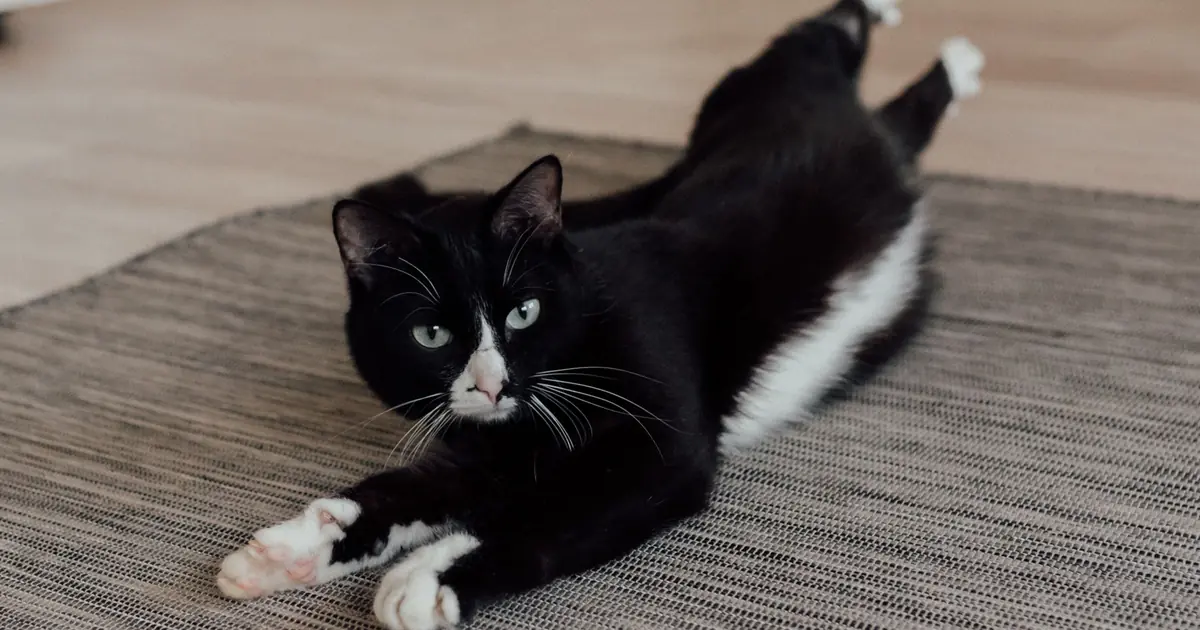
You walk into the room and your cat throws itself onto the floor at your feet, rolling over with a little thud. It’s dramatic, adorable, and clearly aimed at you. So what’s the cat trying to say?
Mostly: “I trust you, hi, pay attention to me.” Here’s the full meaning behind the flop.
Why do cats flop down in front of you?
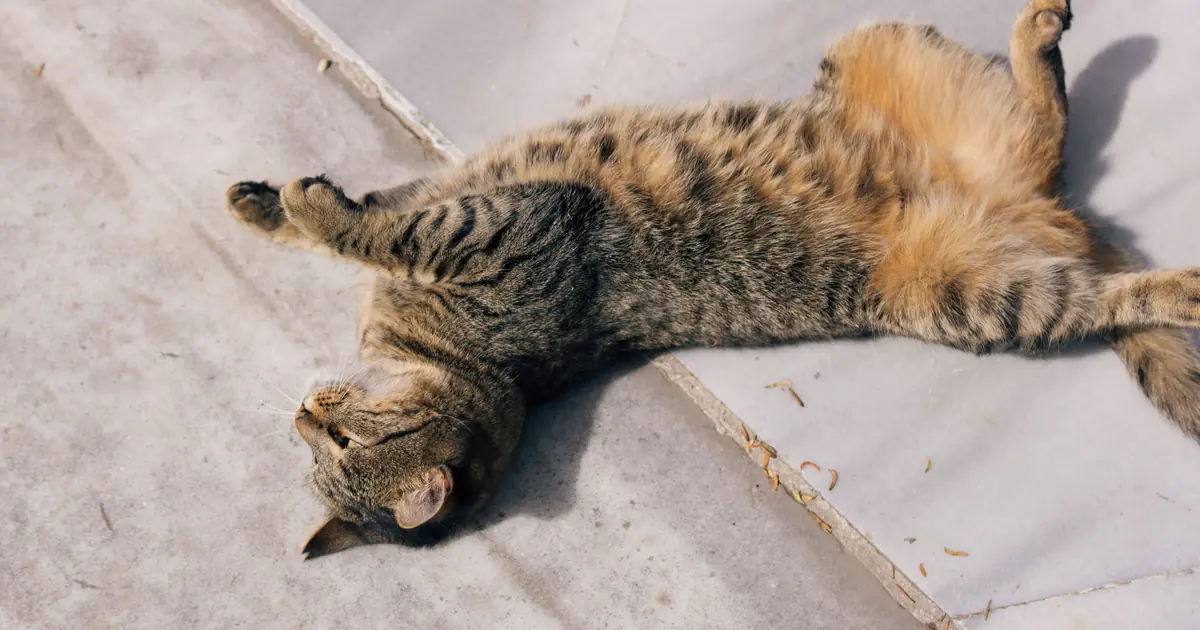
Cats flop down in front of you mainly as a trusting, friendly greeting. Rolling over and exposing the belly, a cat’s most vulnerable area, signals that your cat feels completely safe in your presence. A frightened cat can roll onto its side defensively too, but that looks tense, not loose. So when your cat drops at your feet, it’s essentially saying, “I’m relaxed, I trust you, and I’m glad you’re here.”
Is flopping a sign of trust?
Yes, it’s one of the clearest trust signals a cat gives. The belly holds vital organs, so exposing it means your cat isn’t on guard. A cat that flops and shows its tummy near you is telling you it feels secure, the same message behind a slow blink or a head-butt. We break down the belly-up posture further in why cats lay on their backs.
Does my cat want attention or play?
Often, yes. The flop is frequently a bid for your attention or an invitation to interact. Your cat has learned that dropping and rolling in front of you gets a reaction, talking, petting, or a play session. Some cats flop as a playful “let’s do something” cue, especially energetic cats greeting you after time apart.
Is the flop a request for a belly rub?
Usually not, and this trips a lot of people up. Exposing the belly is about trust, not an invitation to touch it. Many cats will grab, kick, or bite if you rub the exposed tummy, because the belly is a sensitive, instinctively protected area. Some cats do enjoy belly rubs, but they’re the exception, our guide on whether cats like belly rubs explains how to tell.
Are there other reasons cats flop down?
International Cat Care calls this rolling behavior a social roll, and notes that intact females also do it during courtship, so an unspayed cat rolling and yowling may be in heat. A few practical motives round out the picture. Here’s a quick guide to what a flop can mean.
| Flop behavior | Likely meaning |
|---|---|
| Flops and shows belly when you arrive | Trusting greeting, happy to see you |
| Flops and looks at you expectantly | Wants attention or play |
| Rolls back and forth on the floor | Scent-marking the spot as its own |
| Flops on a cool floor and stretches | Cooling off and relaxing |
| Rolls near catnip | Enjoying the catnip response |
How should you respond when your cat flops?
Meet the greeting without assuming it’s a belly-rub invite. Talk to your cat, offer gentle pets on the head or cheeks, or start a quick play session, that’s usually what the flop is really after. Skip the tummy unless you know your cat enjoys it. This article is educational; the flop is normal, healthy cat behavior and a lovely sign of your bond. For more on reading feline body language, International Cat Care’s guide to cat communication and the ASPCA are excellent references.
More questions about cats flopping
Q: Why does my cat flop down and roll when it sees me?
That’s a happy, trusting greeting, often mixed with a request for attention or play. Rolling also spreads your cat’s scent, marking the spot. It’s a strong sign your cat is glad you’re there.
Q: Why does my cat flop on the floor and stretch out?
Often to cool down and relax on a cool surface, or to scent-mark by rubbing against the floor. Combined with a look your way, it doubles as a friendly, attention-seeking greeting.
Q: Should I pet my cat when it flops over?
Yes, but aim for the head, cheeks, or chin rather than the belly. Respond to the greeting with attention or play, and only try the tummy if your cat has shown it enjoys belly rubs.

Hello and welcome to The Ideal Cat!
We are some passionate cat owners from different professions. We love our cats and have a lot of experience in how to care for our pets. We are incredibly excited to share our knowledge, experience, and research with you. So you can take good care of your loving cat. We will answer most of the common questions about owning cats, taking care of them, etc. If you have any question contact with us. Thanks for visiting! Enjoy the content.