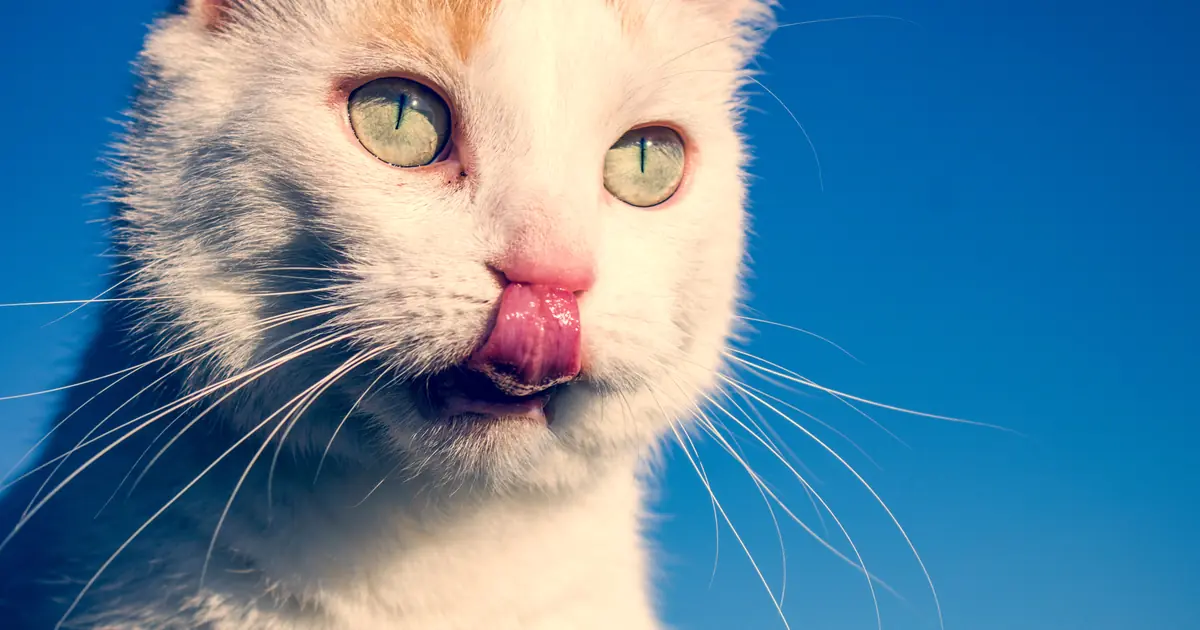
You’re half asleep, cat curled up next to your pillow, when a sandpaper tongue drags across your cheek. Maybe you laugh. Maybe you flinch and wonder if something’s wrong. Either way, you’re left asking why your cat keeps licking your face like you’re a kitten who needs a bath. Licking your hands and arms is a slightly different habit, covered in why your cat licks you.
Here’s the short version: your cat licking your face is one of the clearest signs of feline affection there is. Cats don’t hand out this kind of attention to just anyone. If your cat is grooming you, you’ve made it into their inner circle, the same small group of bodies they trust enough to touch with their tongue. That’s a real compliment, even if it comes with a bit of drool. Some cats take it a step further and chew on your hair.
- Cats lick people through allogrooming, the same mutual grooming behavior they use with trusted cats and littermates.
- Licking mixes scents, which helps a cat mark you as part of their social group.
- Mother cats groom kittens constantly, so licking you can be an instinctive caretaking behavior turned toward a human.
- Cat mouths carry bacteria, including Bartonella henselae in roughly 40 percent of cats, so licks should stay off open wounds and away from your mouth and eyes.
- Sudden or excessive licking that’s new for your cat is worth mentioning to your vet, since pain or nausea can sometimes look like grooming.
Is it affection when a cat licks your face?
Yes, in most cases a cat licking your face is a clear sign of affection. Behaviorists call this allogrooming, grooming that’s directed at another individual instead of yourself. Cats allogroom other cats they’re bonded to, usually family members or close housemates, and they extend that same behavior to the humans they consider part of their group. According to International Cat Care, allogrooming is one of the clearest social bonding behaviors cats display, and it’s reserved for individuals they feel safe around.
Think about who your cat licks. It’s probably not the mail carrier. It’s you, the person who feeds them, sleeps near them, and lets them sit on your lap while you scroll your phone. That selectiveness matters. A cat who licks your face is telling you, in cat language, that you’ve earned a level of trust most people in their life never will. It fits right alongside other affection signals in cat body language, like slow blinks and a raised, quivering tail.
Why does licking mix scents between you and your cat?
Cats use scent to build a shared identity, and licking is one way they spread it. Every cat in a bonded group ends up smelling a little like everyone else, thanks to rubbing, headbutting, and mutual grooming. When your cat licks your face, they’re adding their scent to yours (and picking up a bit of yours in return), which reinforces the idea that you belong to the same group.
This is the same instinct behind headbutting, which cats also use to swap scent from the glands on their face. If you’ve ever wondered why your cat headbutts you, it’s the same underlying goal as licking: mark you as theirs, and confirm you smell like family. Cats are surprisingly deliberate about this. Scent isn’t a side effect for them, it’s information, and licking is one of the more direct ways they write it onto you.
Is licking a leftover mothering instinct?
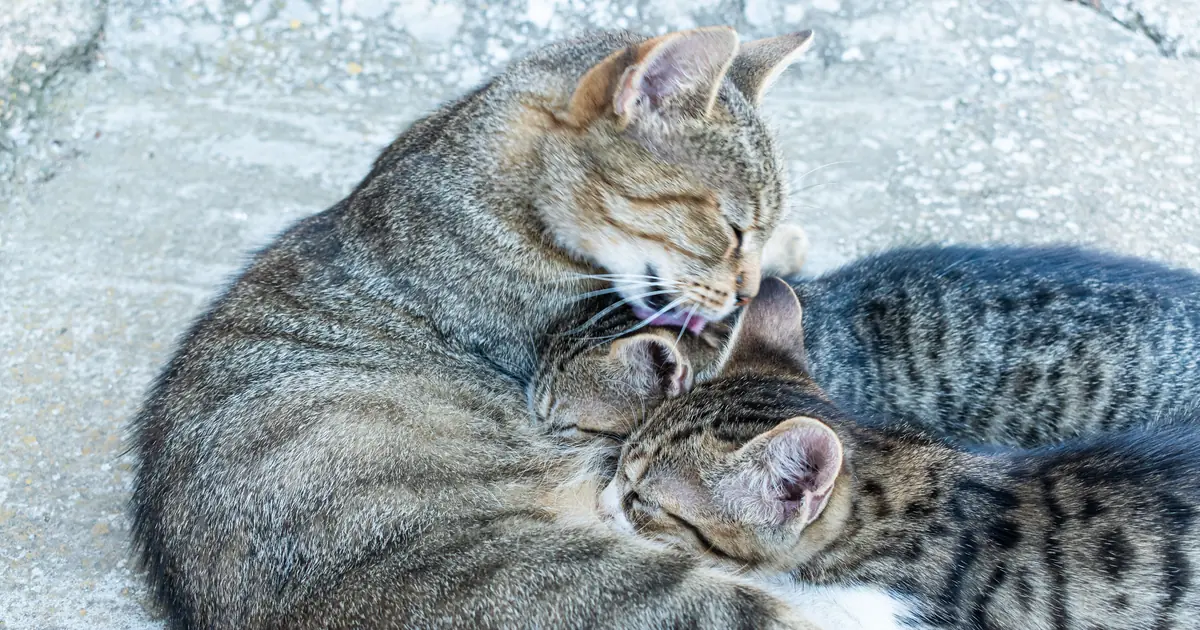
Often, yes. Mother cats groom their kittens for hours a day, cleaning them, stimulating them to eliminate, and calming them down. That grooming instinct doesn’t disappear once a cat grows up. Many adult cats, especially ones that were weaned early or bottle-raised, redirect that caretaking urge toward the people and animals they’re closest to.
If your cat licks you slowly and rhythmically, almost like they’re working through a checklist, that’s a strong sign of the mothering instinct at play. It’s not that your cat thinks you’re literally a kitten. It’s that grooming is wired into them as a way to soothe and care for someone they love, and you’re the nearest recipient. Cats that do this often show other contentment behaviors at the same time, like kneading or a low, steady purr.
Could your cat just be seeking attention?
Sometimes, yes, and there’s nothing wrong with that. Cats are quick learners. If a lick from your cat gets you to laugh, talk to them, or reach over for a pet, they’ll file that away as a behavior that works. A cat who wants engagement and knows licking gets a reaction will use it, the same way they might meow at you or touch your face with a paw.
This isn’t manipulation in a sneaky sense. It’s closeness. Cats that lick for attention are usually the same cats who lay on your chest or follow you room to room. They want to be near you, and licking is one more tool in their kit for making that happen.
Why does your cat taste your skin specifically?
Cats have an excellent sense of smell and taste, and human skin carries plenty for them to investigate. Salt from sweat, lotion, sunscreen, leftover food, even the residue of hand cream can all draw a curious tongue. If your cat suddenly starts licking your face right after you’ve applied moisturizer or come back from a workout, that’s probably the reason. It’s less about you and more about what’s on you at that moment.
This is worth knowing because it changes what you might do about it. A cat licking you out of curiosity over a new lotion smell isn’t the same as a cat grooming you out of affection, even though the behavior looks identical from the outside. Either way, the fix is simple: wipe off strong-smelling products before snuggle time if the licking bothers you.
Can licking be a self-soothing behavior?
Yes, grooming (including grooming directed at you) can calm a cat down. Cats groom themselves when they’re stressed, and some extend that self-soothing habit to licking a trusted person instead. If your cat tends to lick you more during thunderstorms, after a vet visit, or when a new pet joins the house, that’s likely stress relief rather than a simple hello.
A cat using you to self-soothe is still showing trust. They wouldn’t settle into a grooming session on someone who made them anxious. Still, if licking ramps up alongside other stress signs like hiding, appetite changes, or over-grooming their own fur, it’s worth a closer look at what’s changed in their environment.
Reasons your cat licks your face, at a glance
| Reason | What it looks like | What it means |
|---|---|---|
| Allogrooming | Slow, repeated licks, often on the face or hair | Bonding and trust, same as grooming another cat |
| Scent marking | Licking mixed with rubbing or headbutting | Mixing scent so you smell like part of the group |
| Mothering instinct | Rhythmic, almost obsessive licking | Redirected caretaking behavior from kittenhood |
| Attention-seeking | A quick lick, then watching for your reaction | Learned behavior that reliably gets a response |
| Taste curiosity | Licking right after lotion, sweat, or food contact | Investigating salt or scent on your skin |
| Self-soothing | Licking during or after a stressful event | Using a trusted person to calm down |
Is it safe to let your cat lick your face?
Mostly, yes, but a few limits matter. A cat’s mouth carries bacteria that don’t cause them any trouble but can cause infection in people, especially through broken skin or mucous membranes. The Cornell Feline Health Center notes that everyday contact with cats carries some zoonotic risk, and the CDC estimates that around 40 percent of cats carry Bartonella henselae, the bacteria behind cat scratch disease, without showing any symptoms themselves.
So enjoy the licks, just don’t let them land on open wounds, cuts, or scrapes. Keep your cat’s tongue away from your mouth and eyes too, and this matters more if you’re pregnant, immunocompromised, or caring for a young child who a cat likes to groom. Regular flea control also lowers the risk, since fleas are part of how Bartonella spreads between cats in the first place.
How do you gently redirect a cat that licks too much?
If the licking bothers you, you don’t have to just put up with it. Gently move your cat’s head away without scolding, then redirect with a toy or a scratch under the chin instead. Cats respond well to a consistent, calm response, and over time most will shift their affection into a form you’re both comfortable with. Never punish licking. It’s a bonding gesture, and yelling at your cat for showing affection just teaches them to trust you less, not to stop.
Safety and hygiene note
This article is meant to help you understand normal cat behavior, not to replace advice from your veterinarian. A cat’s saliva can carry bacteria that’s harmless to them but risky for people, so avoid letting your cat lick open wounds, your mouth, or your eyes, and always wash your hands after handling your cat. If licking suddenly becomes excessive, obsessive, or paired with other behavior changes, check in with your vet, since the ASPCA notes that sudden shifts in grooming habits can sometimes point to stress, pain, or an underlying medical issue.
Frequently Asked Questions
Q: Why does my cat lick my face and then bite me?
This is usually overstimulation, not aggression. Licking releases a bit of tension, and if petting or attention continues past your cat’s comfort level, a light nip can follow. Watch for tail flicking or ears turning back as your cue to give them space.
Q: Why does my cat only lick my face at night?
Nighttime licking often lines up with your cat’s natural activity cycle, since cats are most alert around dawn and dusk. It can also happen because you’re finally still long enough for your cat to settle in and groom you.
Q: Does a cat licking my face mean they see me as their kitten?
Not exactly. It’s closer to your cat treating you the way they’d treat a trusted member of their social group, drawing on the same grooming instinct mother cats use with kittens, rather than literally viewing you as one.
Q: Why does my cat lick my face but not my hands?
Your face carries more scent, salt, and product residue than your hands usually do, which can make it more interesting to lick. Some cats also target the face simply because it’s what’s closest when they’re curled up near your head.
Q: Should I let my cat lick my face if I have a cold sore or cut?
No. Keep your cat’s tongue away from any open skin, cold sores, or cuts, since cat saliva can introduce bacteria into broken skin. Wait until the area has fully healed before letting your cat groom you there again.
Q: Is it bad to let my cat lick my mouth?
It’s best avoided. Mucous membranes like your mouth and eyes are easier entry points for bacteria than intact skin, so gently redirect your cat’s licks to your cheek, chin, or hand instead.
Q: Why did my cat suddenly start licking my face more than usual?
A sudden increase often follows a change your cat noticed before you did, a new lotion, a stressful event, or simply more time spent close together. If it comes with hiding, appetite changes, or other new behaviors, mention it to your vet.
Q: Can kittens lick your face too?
Yes, kittens often start licking early, sometimes as young as a few weeks old, mimicking the grooming they receive from their mother. It’s a good sign of a kitten bonding with you, though the same hygiene rules still apply.

Hello and welcome to The Ideal Cat!
We are some passionate cat owners from different professions. We love our cats and have a lot of experience in how to care for our pets. We are incredibly excited to share our knowledge, experience, and research with you. So you can take good care of your loving cat. We will answer most of the common questions about owning cats, taking care of them, etc. If you have any question contact with us. Thanks for visiting! Enjoy the content.
